
Determine the necessary mass, volume, or concentration for preparing a solution.
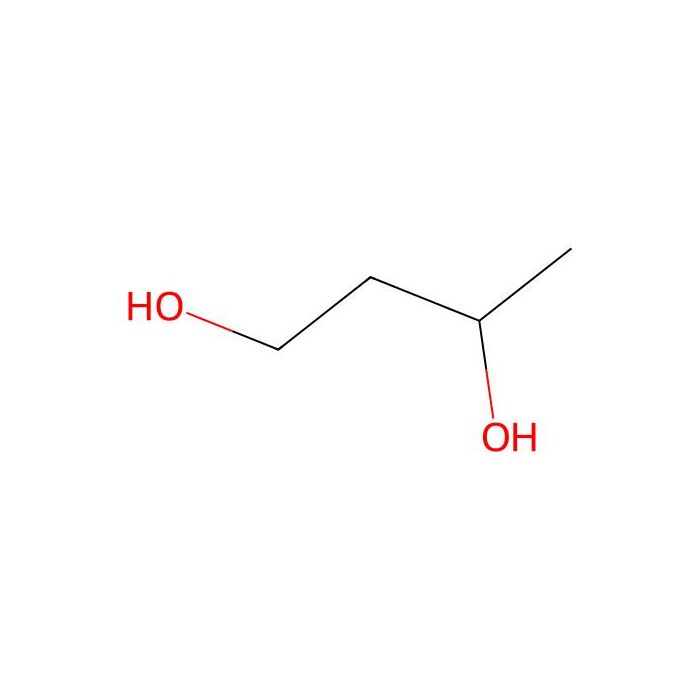
(±)-1,3-Butanediol - ≥99.5%,H2O≤0.5% , CAS No.107-88-0
AVAILABLE TO ORDER
Storage
Room temperature,Argon charged
Shipped In
Normal
≥99.5%,H2O≤0.5% for sensitive chromatographic and analytical workflows requiring minimal baseline interference.
Room temperature,Argon charged Ships Normal Check lot-specific COA for exact specifications.
SDS, COA, datasheet, and spec sheet available for download. Lot-specific COA accessible via lot number lookup.
Cited in 39 peer-reviewed publications across chromatography, organic synthesis, and cross-coupling reactions.
A building block for proteomics research
| Canonical Smiles | CC(CCO)O |
|---|---|
| IUPAC Name | butane-1,3-diol |
| InChIKey | PUPZLCDOIYMWBV-UHFFFAOYSA-N |
| INCHI | 1S/C4H10O2/c1-4(6)2-3-5/h4-6H,2-3H2,1H3 |
| Isomeric SMILES | CC(CCO)O |
| WGK Germany | 1 |
| RTECS | EK0440000 |
| Molecular Weight | 90.12 |
| Beilstein | 1731276 |
| Reaxy-Rn | 1718945 |
| Reaxys-RN_link_address | https://www.reaxys.com/reaxys/secured/hopinto.do?context=S&query=IDE.XRN=1718945&ln= |
Comprehensive hazard, handling, storage, and regulatory compliance document.
Download SDS →Lot-specific quality data. Enter your lot number to retrieve the exact COA.
Look up COA →Full quality attributes and acceptance criteria for this grade.
View spec sheet →Taxonomy Tree
| Kingdom | Organic compounds |
|---|---|
| Superclass | Organic oxygen compounds |
| Class | Organooxygen compounds |
| Subclass | Alcohols and polyols |
| Intermediate Tree Nodes | Not available |
| Direct Parent | Secondary alcohols |
| Alternative Parents | Primary alcohols Hydrocarbon derivatives |
| Molecular Framework | Aliphatic acyclic compounds |
| Substituents | Secondary alcohol - Hydrocarbon derivative - Primary alcohol - Aliphatic acyclic compound |
| Description | This compound belongs to the class of organic compounds known as secondary alcohols. These are compounds containing a secondary alcohol functional group, with the general structure HOC(R)(R') (R,R'=alkyl, aryl). |
| External Descriptors | a glycol |
Find and download the COA for your product by matching the lot number on the packaging.
| Lot Number | Certificate Type | Date | Item |
|---|---|---|---|
 C2606298 C2606298 | Certificate of Analysis | Mar 18, 2026 | B1506736 |
| C2606311 | Certificate of Analysis | Mar 18, 2026 | B1506736 |
| C2606312 | Certificate of Analysis | Mar 18, 2026 | B1506736 |
| G2629052 | Certificate of Analysis | Mar 18, 2026 | B1506736 |
| Solubility | Solubility in water: soluble Solubility in other solvents: soluble in acetone, methyl ethyl ketone, ethanol slightly soluble in ether practically insoluble in aliphatic hydrocarbons, benzene, toluene and CCl4. |
|---|---|
| Sensitivity | Hygroscopic |
| x_refractive_index | 1.44 |
| x_flash_point_drop_fahrenheit | 251.6℉ |
| x_flash_point_drop_centigrade | 122℃ |
| x_boil_point_char | 207°C |
| x_melt_point_char | -50℃ |
| Molecular Weight | 90.120 g/mol |
| XLogP3 | -0.400 |
| Hydrogen Bond Donor Count | 2 |
| Hydrogen Bond Acceptor Count | 2 |
| Rotatable Bond Count | 2 |
| Exact Mass | 90.0681 Da |
| Monoisotopic Mass | 90.0681 Da |
| Topological Polar Surface Area | 40.500 Ų |
| Heavy Atom Count | 6 |
| Formal Charge | 0 |
| Complexity | 28.700 |
| Isotope Atom Count | 0 |
| Defined Atom Stereocenter Count | 0 |
| Undefined Atom Stereocenter Count | 1 |
| Defined Bond Stereocenter Count | 0 |
| Undefined Bond Stereocenter Count | 0 |
| The total count of all stereochemical bonds | 0 |
| Covalently-Bonded Unit Count | 1 |