Determine the necessary mass, volume, or concentration for preparing a solution.
Dilution Calculator
Determine the dilution needed to prepare a stock solution.
Reconstitution Calculator
Reviews
Customer Reviews
Application Protocols
Not applicable. No immunoassay or bioanalytical application protocols (e.g., WB, IHC, IF, FC) are defined for this small-molecule reagent. For synthetic uses, see Reaction Conditions and Synthetic Utility for general guidance.
Biological Roles
This product is a synthetic building block. It has no intrinsic biological role in cells or organisms under normal physiological conditions.
Literature context (no clinical claims):
The adamantyl group is a rigid, lipophilic motif used widely in medicinal chemistry to modulate membrane affinity, metabolic stability, and binding in hydrophobic pockets.
1-Iodoadamantane serves as a convenient precursor to diverse adamantyl derivatives (ethers, amines, thioethers, aryl adamantanes) that are explored as probes or as components of structure–activity relationship (SAR) libraries.
The adamantane cage itself is metabolically robust; introduction onto small molecules often increases lipophilicity and may reduce conformational flexibility (literature observation).
Biochemical handling (general):
No known natural metabolic pathways utilize 1-iodoadamantane; in vitro, nucleophiles (thiols, amines) can react under forcing conditions, but such transformations are not biologically relevant without catalysis.
Use implications:
When designing assays, consider the hydrophobicity of adamantylated products and their potential for nonspecific binding/aggregation at high concentrations—use appropriate cosolvents (DMSO/MeCN) and include counterscreens for assay interference.
Note: All uses are for research only; not for diagnostic, therapeutic, or in vivo applications.
Buffer Applications
Not typically applicable. 1-Iodoadamantane is a hydrophobic organic intermediate and does not function as a buffering agent. For experimental use in aqueous systems, prepare stock solutions in compatible organic cosolvents (e.g., DMSO, acetonitrile) and dilute into assay media as solubility permits. See Solvent Selection for guidance.
Green Alternatives
Greenness considerations focus on reagent choice (iodide vs alternative handles) and solvent/activation strategies.
Why consider alternatives:
Iodinated substrates are effective electrophiles but iodine sourcing and waste (AgI, HI) raise environmental load. Replacing halide leaving groups or using catalytic activation can reduce waste.
Potential greener strategies (literature):
Use 1-adamantanol as precursor with catalytic acid or solid acids to form Ad–E bonds in situ, avoiding iodide waste.
Decarboxylative couplings from 1-adamantanecarboxylic acid under photoredox/Ni catalysis to forge Ad–C bonds (no stoichiometric halide).
Employ green solvents: 2-MeTHF, CPME, ethyl acetate, or MeCN in place of chlorinated solvents when compatible.
Photochemical activation under visible light at ambient temperature often reduces energy input compared to thermal radical initiators.
Small comparison (general, literature):
| Approach | Waste profile | Typical conditions | Trade-offs |
|---|---|---|---|
| 1-Iodoadamantane (this item) | Stoichiometric iodide; AgI byproducts common | SN1/Ag+-mediated, Lewis acids, photoredox | High reactivity/selectivity; iodide waste |
| 1-Adamantanol | Water as coproduct under acid catalysis | Strong Brønsted/Lewis acids, sometimes higher temp | Less halide waste; may require harsher acids |
| Adamantanecarboxylic acid (decarboxylative) | CO2 byproduct | Ni/photoredox, blue LEDs | Modern methods; catalyst cost/optimization |
Bottom line: If iodide waste and silver salts are concerns at scale, evaluate alcohol or acid-based routes and greener solvents; otherwise, 1-iodoadamantane remains a reliable, high-reactivity adamantyl source.
Pharmaceutical Uses
Item-specific (Product Data): None specified; for research use only.
General formulation/manufacturing context (no therapeutic claims):
1-Iodoadamantane itself is not an established excipient. Its relevance in pharmaceutical R&D is as a synthetic intermediate for introducing the adamantyl group into discovery candidates, pro-moieties, or affinity tags.
The adamantyl substituent is valued for improving hydrophobic interactions and solid-state properties in APIs; thus, 1-iodoadamantane may be used to prepare screening libraries of adamantylated analogs.
For process chemistry, halide byproducts (iodide, AgI) and silver salts (if used) must be controlled via robust workups and impurity clearance strategies to meet GMP specifications during later development.
Pharmacopeial status: Not a pharmacopeial excipient. Any quality attributes (residual solvents, inorganic iodide, metals) would be defined internally on the CoA for research grade material. For regulated use, alternative routes (e.g., from alcohols or carboxylic acids) that avoid iodide may be preferred to simplify elemental impurity control.
Physical Properties
Item-specific (Product Data):
Appearance: Not specified for this item; refer to CoA/Spec Sheet.
Molecular Formula: Not specified for this item; refer to CoA/Spec Sheet.
Molecular Weight: Not specified for this item; refer to CoA/Spec Sheet.
Physical state: Typically a crystalline solid (literature)
Melting point: Reported in the ~120–130 °C range (literature; values vary by source and purity). Not specified for this item; refer to CoA/Spec Sheet.
Boiling point: High; thermal decomposition may precede boiling at ambient pressure (literature). Not specified for this item; refer to CoA/Spec Sheet.
Density: Not specified for this item; refer to CoA/Spec Sheet. (Literature expectation: higher than adamantane due to iodine atom)
Solubility: Low in water; soluble in common organic solvents such as dichloromethane, chloroform, toluene, acetonitrile, and ethers (literature qualitative).
LogP: Hydrophobic; positive logP expected (literature qualitative). Not specified for this item; refer to CoA/Spec Sheet.
Refractive index: Not applicable to a solid; not specified for this item.
UV/Vis: No significant chromophore; weak UV absorption above ~220–230 nm typical of saturated iodides (literature qualitative).
Chemical reactivity notes (general):
The tertiary C–I bond is relatively weak and polarizable, enabling SN1 solvolysis and facile radical generation under photochemical or peroxide/AIBN initiation.
Adamantane framework confers high thermal stability of the carbon skeleton but does not prevent halide displacement under ionizing conditions.
Quality and Grades
Item-specific (Product Data):
Grade/Purity: Not specified for this item; refer to CoA/Spec Sheet.
Guidance on interpreting grades (general):
If labeled as “research grade,” typical intent is for synthetic and analytical research; impurity limits are defined on the CoA rather than pharmacopeial monographs.
If “≥98%” or higher is reported on the CoA, this usually reflects GC/LC or 1H NMR assay of organic purity; inorganic halide or iodine content may not be directly reflected and should be evaluated if critical.
For chromatography-sensitive uses (e.g., kinetic studies), consider documentation of residual inorganic iodide (I−) or hydrocarbon/byproduct profile.
Stabilizers/impurities (general for organoiodides):
No stabilizer is typically required; store cold and protected from light/moisture to limit trace iodide release or self-decomposition.
What is specific to this item:
Storage at -80°C and cold shipment are specified by the catalog—plan logistics to maintain the cold chain if consistent performance is required for moisture/light-sensitive applications.
For exact assay, water content, metals, and UV cutoffs: Not specified for this item; refer to CoA/Spec Sheet.
Reaction and Applications
Adamantyl cation chemistry (literature):
The tertiary C–I bond ionizes readily to give the 1-adamantyl cation under strongly ionizing or Lewis acidic conditions. This enables SN1-type solvolysis and electrophilic alkylation.
Typical transformations: Formation of 1-adamantyl ethers (RO–Ad) from alcohols, esters from carboxylic acids (Ad–O2CR), thioethers (Ad–SR), and amines/amides (Ad–NR2) often promoted by Ag+ salts (AgNO3, Ag2CO3) or acids (H2SO4, HBF4, TfOH).
Electrophilic aromatic substitution (literature):
Friedel–Crafts adamantylation of activated arenes (anisole, mesitylene, indoles) using AlCl3, BF3·OEt2, or superacids to generate Ad+ in situ. Provides Ad–Ar products useful as lipophilic scaffolds.
Radical pathways (literature):
Homolysis of the C–I bond under AIBN/initiator or photoredox conditions generates adamantyl radicals, which engage in Giese additions to electron-poor alkenes or in Minisci-type alkylations of heteroarenes.
Modern photocatalysis: Ir(ppy)3 or Ru(bpy)3 2+ with blue LEDs; HAT or SET activation of C–I. Often proceeds at room temperature with high selectivity for tertiary radical formation.
Cross-coupling perspective (literature note):
Conventional Pd-catalyzed cross-couplings of tertiary alkyl iodides can be challenging due to β-hydride issues; however, nickel/photoredox dual catalysis or radical relay strategies enable C(sp3)–C coupling with aryl/alkenyl partners.
Practical tips:
Dry, oxygen-free conditions help in radical/photoredox manifolds.
Silver-mediated substitutions benefit from stoichiometric Ag+ and exclusion of halide buildup (precipitation of AgI drives reactions).
Control exotherm and polyalkylation in Friedel–Crafts by slow addition and temperature management.
Reaction Conditions
General, literature-informed guidance (not specifications for this item):
SN1 solvolysis to 1-adamantyl ethers/esters:
Typical: Alcohol (ROH) or carboxylic acid (RCO2H) as solvent or co-solvent; catalytic to stoichiometric acid (H2SO4, HClO4, TfOH) or Ag+ salts (AgNO3, Ag2CO3).
Temperature: 0–60 °C depending on nucleophile and acid strength.
Notes: Precipitation of AgI drives reactions; exclude chloride if Cl− substitution is not desired.
Friedel–Crafts adamantylation of arenes:
Solvent: DCM, nitromethane, or CS2 (legacy); modern alternatives include MeNO2 or HFIP for enhanced ionization.
Catalyst: AlCl3, BF3·OEt2, or superacids.
Temperature: −20 to 25 °C to control polyalkylation; slow addition of iodide reagent recommended.
Radical additions (Giese/Minisci):
Photoredox: Ir(ppy)3 (0.5–2 mol%) or Ru(bpy)3Cl2 (1–2 mol%), blue LEDs (450 nm), MeCN or DMSO, 20–30 °C, 2–12 h. Add base (e.g., 2,6-lutidine) for Minisci with protonated heteroarenes.
Thermal: AIBN (5–10 mol%) with a hydrogen donor or chain carrier (legacy Bu3SnH; modern silanes), toluene or dioxane, 80–110 °C.
Nucleophilic substitutions (Ad–SR, Ad–NR2):
Conditions: Nucleophile (1.5–3.0 equiv), Ag2CO3 or AgOTf (0.5–1.5 equiv), MeCN or DCM, 0–25 °C.
Workup/purification tips:
Remove silver salts by filtration over celite; wash with solvent until filtrate is colorless. Treat residual iodine/iodide with thiosulfate wash if necessary. Silica gel chromatography typically separates starting iodide from adamantylated products effectively.
Expected outcomes:
Tertiary center disfavors SN2; SN1 or radical pathways dominate. Yields are often good to excellent when ionization is promoted and nucleophile is not deactivated.
Safety and Handling
Item-specific (Product Data):
GHS Classification / Signal word / H-statements / Pictograms: Not specified for this item; refer to SDS.
Storage: Store at -80°C.
General safety guidance (literature/standard practice; defer to SDS for authoritative information):
Hazards typical of alkyl iodides: May cause skin/eye irritation and respiratory irritation; harmful if swallowed; may release hydrogen iodide on decomposition. Avoid inhalation of dust and contact with skin/eyes.
PPE: Use chemical-resistant gloves (e.g., nitrile), lab coat, safety glasses or face shield. Handle in a fume hood to avoid exposure and to limit odor/HI formation.
Incompatibilities: Strong nucleophiles/bases and Lewis acids can react; avoid strong oxidizers and strong reducing agents. Silver salts abstract iodide—use only intentionally in planned reactions.
Peroxide formation: Not a typical risk for this solid; however, avoid prolonged exposure to light/air that may promote slow degradation of organoiodides.
Thermal/photolysis: The C–I bond can undergo homolysis under UV or radical initiators; minimize unnecessary light exposure.
First aid (overview):
Skin/eye contact: Rinse with water for at least 15 minutes; remove contaminated clothing; seek medical evaluation.
Inhalation: Move to fresh air; support breathing; consult medical attention.
Ingestion: Rinse mouth; do not induce vomiting; obtain medical assistance.
Spill/cleanup: Avoid dust formation; collect solids with disposable tools; place in halogenated organic waste.
Fire-fighting: Use dry chemical, CO2, or foam. Combustion may produce hydrogen iodide and iodine vapors; firefighters should use self-contained breathing apparatus.
Solvent Selection
This product is a solid substrate, not a solvent. Solvent choice pertains to its use in synthesis and purification.
Polarity/miscibility considerations (literature):
Hydrophobic substrate; generally soluble in nonpolar to moderately polar organic solvents: dichloromethane (DCM), chloroform, toluene, THF, diethyl ether, acetonitrile (MeCN). Poorly soluble in water.
For SN1 solvolysis or ionic substitutions: Highly ionizing solvents (HFIP, TFE), polar protic (formic acid, acetic acid, alcohols) or polar aprotic (MeCN, nitromethane) often enhance rates.
For radical chemistry/photoredox: Acetonitrile, DMF, DMSO, acetone, or green ethers (2-MeTHF, CPME) are common; ensure oxygen removal if needed.
Practical selection by application:
Adamantylation of heteroatoms (ROH, RSH, RNH2): Use the corresponding nucleophile as solvent or co-solvent with Ag+ salts or strong acids to promote iodide departure; DCM or MeCN are good media.
Friedel–Crafts adamantylation of arenes: Non-coordinating solvents (DCM, nitromethane) with strong Lewis acids (e.g., AlCl3, BF3·OEt2); control temperature to limit polyalkylation.
Radical Giese/minisci-type additions: MeCN or DMSO under blue-light photocatalysis; add H-donors or carboxylate partners as needed.
Small comparison (general):
DCM vs MeCN: DCM dissolves hydrophobic substrates well and tolerates strong Lewis acids; MeCN is more polar/ionizing and often better for Ag+-mediated solvolysis or photocatalysis.
2-MeTHF/CPME: Greener, water-tolerant ethers that can replace DCM/THF in many substitution or radical protocols.
Storage and Reconstitution
Item-specific (Product Data):
Storage conditions: Store at -80°C.
Shipped in: Dry ice packs + Cold packs.
Practical storage guidance (general, aligned with above):
Container: Keep tightly closed in an amber, screw-cap vial with PTFE-lined septum to minimize moisture and light exposure.
Atmosphere: Store under inert gas (N2/Ar) if possible; desiccant in secondary containment helps maintain dryness.
Light sensitivity: Protect from light to limit halide homolysis and iodine formation over long storage.
Freeze–thaw: As a solid, freeze–thaw cycling is less critical than for solutions, but avoid repeated warm-ups; remove small portions quickly and return to cold storage.
Preparing solutions (general):
Solvents: DCM, MeCN, THF, toluene, or DMSO depending on application. Use dry, oxygen-free solvent for sensitive reactions (radical/photoredox or Lewis-acid-mediated).
Typical stock concentrations: 0.05–1.0 M for reaction setup; filter if particulates are present.
Aliquoting: For multi-use, prepare single-use solution aliquots in amber vials; store at −80 °C. Stability of solutions depends on solvent and headspace—verify by analytical check (NMR/GC) prior to critical experiments.
Disposal: Collect waste containing iodide/iodine and silver residues separately following institutional and regulatory guidelines for halogenated organic waste.
Structure and Identity
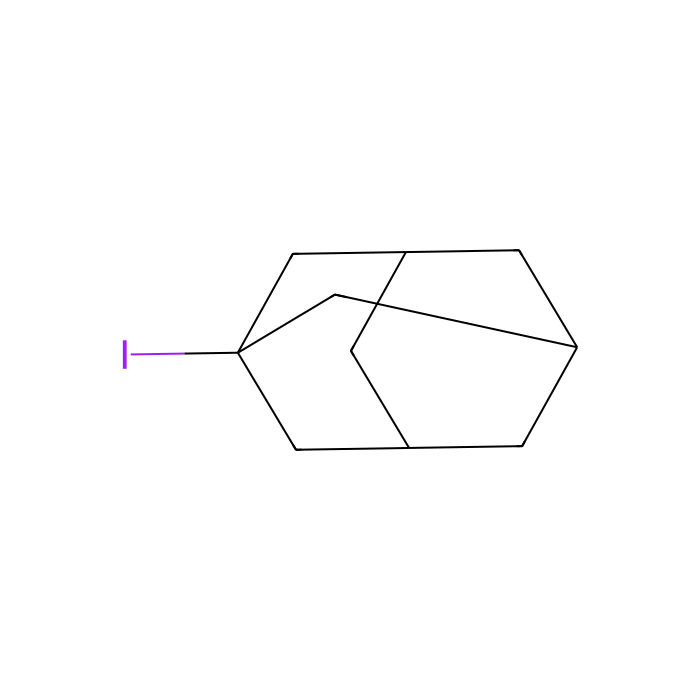
Brief overview: 1-Iodoadamantane is a tertiary alkyl iodide derived from the rigid tricyclic adamantane framework, useful as an adamantylating reagent via cationic or radical pathways.
Item-specific (Product Data):
SKU: I425889
CAS: 768-93-4
Storage note: Store at -80°C (see Storage & Reconstitution)
Shipped: Dry ice packs + Cold packs
Research use only
InChIKey: Not specified for this item; refer to CoA/Spec Sheet.
SMILES: Not specified for this item; refer to CoA/Spec Sheet.
Molecular formula and weight: Not specified for this item; refer to CoA/Spec Sheet.
Literature/General identity (for reference only):
Common name: 1-Iodoadamantane (adamantyl iodide; 1-adamantyl iodide)
Molecular formula (literature): C10H15I
Molecular weight (literature): ~262.13 g/mol
Typical SMILES (literature): I[C]12CC3CC(C1)CC(C3)C2 (one of several equivalent non-canonical forms representing the adamantyl iodide)
Structural features: Tertiary C–I at the bridgehead (1-position) on a diamondoid adamantane cage; no unsaturation; no heteroatoms besides I.
2D structural description (general): The carbon skeleton comprises three fused cyclohexane rings in chair conformations forming a rigid tricyclo[3.3.1.1]decane cage. An iodine substituent is attached at a bridgehead carbon (C1), yielding a tertiary alkyl iodide site that readily ionizes to the 1-adamantyl cation under strongly ionizing conditions.
Stereochemistry: The adamantane cage is achiral at C1; no stereocenters are generated by the iodine substituent.
Synthetic Utility
Key functional feature: a tertiary C(sp3)–I bond on a rigid adamantane cage.
Electrophilic substitutions (literature):
SN1 solvolysis with alcohols, acids, and amines gives 1-adamantyl ethers, esters, and amines. Ag+ salts accelerate by forming insoluble AgI, driving halide departure. Superacids (TfOH, HBF4) can generate the adamantyl cation directly.
Friedel–Crafts alkylation of electron-rich arenes to install adamantyl groups; useful to craft lipophilic aryl scaffolds.
Heteroatom installation (literature):
Formation of Ad–S–R and Ad–Se–R via reaction with thiols/selenols; Ad–N–R via amination (often requires strong acid or Ag+). Carbamate and urea formation proceeds via prior amination or via isocyanate capture of Ad–NHR intermediates.
Radical derivatization (literature):
Generation of adamantyl radicals from C–I homolysis under thermal (AIBN/initiator) or photoredox conditions; engages in additions to Michael acceptors, Minisci reactions on heteroarenes, and radical–radical couplings.
Retrosynthetic value:
1-Iodoadamantane provides a convergent “plug-and-play” handle to append the adamantyl moiety late-stage onto nucleophilic or radical-acceptor fragments, enabling rapid SAR exploration without reconstructing the cage each time.
Limitations and workarounds:
Conventional metal–halogen exchange/Grignard formation is disfavored for tertiary iodides; to access Ad–M species, alternative precursors (e.g., 1-bromoadamantane under specialized conditions) or carboxylate/boronate surrogates are used.
Competing elimination is minimal due to lack of β-H elimination pathways at the bridgehead; this often enhances substitution selectivity.
Target Specificity
Not applicable. This product is a small-molecule building block and is not an antibody, enzyme, or biological targeting agent. No antigen/epitope or species reactivity applies.
We use cookies to ensure the website functions properly and, where permitted, to improve your experience. You can manage your preferences at any time in Settings. Learn more in our Cookie Policy.
Shall we send you a message when we have discounts available?
Remind me later
Thank you! Please check your email inbox to confirm.
Products are supplied to verified businesses, institutions, and qualified professionals for research and development use only. Not for use in humans, animals, diagnosis, or therapy.

 G2417859