Determine the necessary mass, volume, or concentration for preparing a solution.
Taxonomy Tree
| Kingdom | Organic compounds |
|---|---|
| Superclass | Benzenoids |
| Class | Benzene and substituted derivatives |
| Subclass | Halobenzenes |
| Intermediate Tree Nodes | Not available |
| Direct Parent | Chlorobenzenes |
| Alternative Parents | Aryl chlorides Isothiocyanates Propargyl-type 1,3-dipolar organic compounds Organopnictogen compounds Organonitrogen compounds Organochlorides Hydrocarbon derivatives |
| Molecular Framework | Aromatic homomonocyclic compounds |
| Substituents | Chlorobenzene - Aryl halide - Aryl chloride - Isothiocyanate - Organic 1,3-dipolar compound - Propargyl-type 1,3-dipolar organic compound - Organic nitrogen compound - Organopnictogen compound - Hydrocarbon derivative - Organosulfur compound - Organonitrogen compound - Organochloride - Organohalogen compound - Aromatic homomonocyclic compound |
| Description | This compound belongs to the class of organic compounds known as chlorobenzenes. These are compounds containing one or more chlorine atoms attached to a benzene moiety. |
| External Descriptors | Not available |
| Sensitivity | Moisture sensitive |
|---|---|
| x_refractive_index | n20/D 1.6000 |
| x_flash_point_drop_fahrenheit | >230 °F |
| x_flash_point_drop_centigrade | >110 °C |
| Molecular Weight | 197.69 |
| XLogP3 | 4.100 |
| Hydrogen Bond Donor Count | 0 |
| Hydrogen Bond Acceptor Count | 2 |
| Rotatable Bond Count | 3 |
| Exact Mass | 197.007 Da |
| Monoisotopic Mass | 197.007 Da |
| Topological Polar Surface Area | 44.500 Ų |
| Heavy Atom Count | 12 |
| Formal Charge | 0 |
| Complexity | 169.000 |
| Isotope Atom Count | 0 |
| Defined Atom Stereocenter Count | 0 |
| Undefined Atom Stereocenter Count | 0 |
| Defined Bond Stereocenter Count | 0 |
| Undefined Bond Stereocenter Count | 0 |
| The total count of all stereochemical bonds | 0 |
| Covalently-Bonded Unit Count | 1 |
H302:Harmful if swallowed
H312:Harmful in contact with skin
H315:Causes skin irritation
H319:Causes serious eye irritation
H332:Harmful if inhaled
H334:May cause allergy or asthma symptoms or breathing difficulties if inhaled
H335:May cause respiratory irritation
P261:Avoid breathing dust/fume/gas/mist/vapors/spray.
P264:Wash hands [and …] thoroughly after handling.
P270:Do not eat, drink or smoke when using this product.
P271:Use only outdoors or in a well-ventilated area.
P280:Wear protective gloves/protective clothing/eye protection/face protection.
P284:[In case of inadequate ventilation] Wear respiratory protection.
P321:Specific treatment (see ... on this label).
P330:Rinse mouth.
P302+P352:IF ON SKIN: wash with plenty of water.
P304+P340:IF INHALED: Remove person to fresh air and keep comfortable for breathing.
P305+P351+P338:IF IN EYES: Rinse cautiously with water for several minutes. Remove contact lenses if present and easy to do - continue rinsing.
P362+P364:Take off contaminated clothing and wash it before reuse.
P405:Store locked up.
P403+P233:Store in a well-ventilated place. Keep container tightly closed.
P501:Dispose of contents/container to an approved waste disposal plant.
P264+P265:Wash hands [and …] thoroughly after handling. Do not touch eyes.
P301+P317:IF SWALLOWED: Get medical help.
P317:Get emergency medical help.
P337+P317:If eye irritation persists: Get medical help.
P332+P317:If skin irritation occurs: Get medical help.
P319:Get medical help if you feel unwell.
P342+P316:If experiencing respiratory symptoms: Get emergence medical help immediately.
No vendor-validated bioassay protocols (e.g., WB, IHC, IF, FC) are applicable to this small‑molecule reagent. For general laboratory use:
For any application requiring quantitative performance claims, develop and qualify an in‑house SOP using the specific lot’s CoA and SDS.
This substance is a synthetic arylalkyl isothiocyanate; it is not a known endogenous metabolite. The following describes general biochemical behavior of isothiocyanates (literature) and should not be construed as clinical or therapeutic claims.
All uses are for research purposes only (Product Data: Research Use Only).
This compound is not a buffering reagent and is not typically used to prepare defined pH buffer systems. In aqueous work, it is usually introduced from an organic stock (e.g., DMSO/DMF) into pre‑made buffers for bioconjugation or assay purposes. For information on practical media for reactions with this electrophile, see Solvent Selection and Reaction Conditions.
Greener considerations focus on solvent choice and waste minimization when employing this reactive electrophile; the molecule itself is a halogenated arylalkyl isothiocyanate and is not readily replaced in structure–activity studies without affecting outcome.
Comparison of common media (general, literature):
Operational greening:
No pharmacopeial excipient status or formulation role is specified for this item. This reagent is provided for research use only (Product Data).
General R&D context (literature):
Item-specific numerical specifications (bp, mp, density, refractive index, UV cutoff, residuals) are not provided in the Product Data.
Notes:
Guidance on interpreting quality for this reagent type:
This electrophilic arylalkyl isothiocyanate is a versatile building block for assembling sulfur-containing urea analogs and heterocycles.
Representative applications (literature/general):
Practical tips:
General conditions for common transformations (literature guidance; optimize per substrate):
Thiourea formation (amine additions):
O-/S-thiocarbamate formation (alcohols/thiols):
Cyclization to thiohydantoins/imidazolinethiones from thioureas:
Bioconjugation (amine labeling):
Always validate conditions on small scale; the argon-charged packaging underscores the need for dryness/inerting during setup.
Follow standard precautions for reactive electrophiles. Always consult the SDS for authoritative hazard and first‑aid information for this specific SKU.
Although this is not a solvent, effective reaction performance depends on choosing appropriate media for isothiocyanate chemistry.
Always refer to the SDS and the lot-specific CoA for authoritative guidance on stability, handling, and safe use.
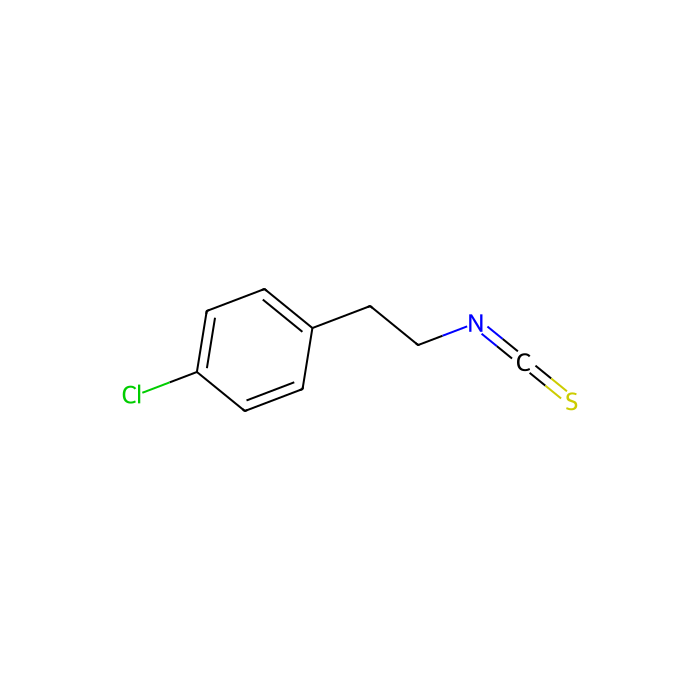
A para-chloro-substituted phenethyl isothiocyanate featuring an electrophilic –N=C=S group appended to a 4-chlorophenethyl scaffold.
Structural features (descriptive):
2D description in words: a 4-chloro phenyl ring bonded at the para position to a –CH2–CH2– chain, which terminates in an isothiocyanate group, N doubly bonded to C and singly bonded to the ethyl carbon; the isothiocyanate carbon is doubly bonded to sulfur.
Key functional group: isothiocyanate (–N=C=S), a soft electrophile that undergoes nucleophilic addition with amines, alcohols, and thiols to deliver sulfur‑containing urea analogs and downstream heterocycles.
Useful transformations (literature/general):
Retrosynthetic value:
Practical notes:
Not an antibody, oligonucleotide, or targeted biological. No target/epitope specificity, clone, isotype, or species reactivity applies to this small‑molecule reagent. For biochemical reactivity with nucleophilic residues (amines/thiols), see Biological Roles and Reaction & Applications.