This compound belongs to the class of organic compounds known as quinazolines. These are compounds containing a quinazoline moiety, which is made up of two fused six-member aromatic rings, a benzene ring and a pyrimidine ring.
External Descriptors
Not available
1. Djoumbou Feunang Y, Eisner R, Knox C, Chepelev L, Hastings J, Owen G, Fahy E, Steinbeck C, Subramanian S, Bolton E, Greiner R, and Wishart DS. ClassyFire: Automated Chemical Classification With A Comprehensive, Computable Taxonomy. Journal of Cheminformatics, 2016, 8:61.
Determine the necessary mass, volume, or concentration for preparing a solution.
Dilution Calculator
Determine the dilution needed to prepare a stock solution.
Reconstitution Calculator
Reviews
Customer Reviews
Application Protocols
No tested biological assay protocols are provided for this small-molecule building block. Typical laboratory uses are synthetic and analytical:
General synthetic handling (guidance)
Charge solid under inert atmosphere (argon) consistent with storage instructions.
Dissolve in dry DMSO/DMF (stock 0.1–0.5 M) or chosen reaction solvent; combine with catalyst/base under anhydrous conditions.
Monitor by TLC (UV active) and LC–MS; exploit Br isotopic pattern for rapid identification.
Library preparation (guidance)
Prepare DMSO stocks (e.g., 10–50 mM) for plate-based parallel reactions.
Quench reactions with water, extract with EtOAc or MTBE, and purify by flash chromatography or preparative HPLC.
For bioassays of derivatives, follow assay-specific SOPs. No validated WB/IHC/IF/FC conditions apply to this reagent.
Biological Roles
Item is for research use only. No biological function is assigned to the neat compound by the Product Data. The following points describe general, literature-based context for the quinazoline scaffold and do not constitute medical or clinical claims.
Quinazoline core (literature context)
The quinazoline ring is an isosteric, aromatic heterobicycle related to aza-analogues of naphthalene and purine-like motifs; its electron-deficient diazine ring can engage in π–π stacking and hydrogen-bond acceptor interactions.
Numerous bioactive molecules in chemical biology incorporate quinazoline motifs to interact with nucleotide-binding sites and aromatic pockets.
Reagent role (this item)
2,4-Dibromo substitution renders the scaffold a versatile platform for constructing diverse quinazoline derivatives for target-binding studies, probe development, and SAR exploration in enzymology or receptor biochemistry.
ADME-relevant features (scaffold-level, qualitative)
Aromaticity and two ring nitrogens confer potential for H-bond acceptance and modulate pKa of proximal substituents in derivatives.
Bromine atoms increase lipophilicity and polarizability in the parent compound; typically replaced during synthesis of derivatives with tuned properties.
Any specific biological properties of derivatives must be determined empirically. Handle this compound solely as a research chemical and not for any therapeutic or diagnostic use.
Buffer Applications
This compound is a heteroaromatic building block and is not used as a buffering agent. It lacks acid/base functionality suitable for establishing a defined buffer range in aqueous systems.
Practical guidance
If aqueous work is required (e.g., bioconjugation of derivatives), dissolve the compound first in a water-miscible organic co-solvent (DMSO/DMF) before dilution into buffered media.
Choose buffers appropriate to the biology/assay (e.g., phosphate, HEPES) independent of this compound; verify solubility and avoid precipitation upon dilution.
Green Alternatives
While the substrate itself (2,4-dibromoquinazoline) is fixed, greener choices can be made in solvents, bases, and catalytic systems to reduce environmental footprint.
Trade-offs include solubility, reaction rate, and workup. Validate greener conditions at small scale before scale-up.
Pharmaceutical Uses
No excipient or pharmacopeial status is provided for this item. It is supplied strictly for research use.
Item-specific note
Grade/Purity: Not specified for this item; refer to CoA/Spec Sheet.
General (non-clinical) context
2,4-Dibromoquinazoline serves as a synthetic intermediate for preparing quinazoline derivatives in medicinal chemistry workflows (lead discovery, SAR, linker installation). The parent compound itself is not an active ingredient.
In process development, dihalogenated heteroarenes like this are used to access diverse substitution patterns via selective mono- or di-functionalization.
Formulation/manufacturing relevance (general)
For compound libraries, prepare DMSO stock solutions (e.g., 10–50 mM) for plate-based screening logistics.
Control of residual metals and halogenated byproducts may be important for late-stage intermediates destined for further development; specify acceptable limits and request CoA where required.
No therapeutic or diagnostic claims are made for this product. All uses are confined to research and development settings.
Physical Properties
Item-specific physical constants are not provided in the Product Data. Refer to the CoA/Spec Sheet for definitive specifications.
Item-specific values
Appearance: Not specified for this item; refer to CoA/Spec Sheet.
Molecular Formula: Not specified for this item; refer to CoA/Spec Sheet.
Molecular Weight: Not specified for this item; refer to CoA/Spec Sheet.
Literature/computed (general reference; not product specifications)
Empirical formula (literature): C8H4Br2N2
Formula weight (calculated): ~287.94 g/mol
Physical state: Typically a solid, aromatic heterocycle (literature)
Solubility (typical):
Low in water (heteroaromatic dihalides are generally poorly aqueous-soluble)
Good solubility in polar aprotic organic solvents (DMSO, DMF, NMP); moderate in chlorinated (DCM, CHCl3) and aromatic solvents (toluene) (literature)
LogP/cLogP: Expected moderate to high due to two bromine atoms and aromaticity (literature, qualitative)
UV absorption: Quinazoline cores exhibit strong absorption in the UV region due to conjugation (literature, qualitative)
Practical handling notes (general)
For solution-phase work, prepare concentrated stocks in dry DMSO or DMF; dilute into reaction solvent as needed.
For analytical characterization, monitor by HPLC/UV or LC–MS using wavelengths in the 250–320 nm range typical for quinazoline chromophores (optimize empirically).
Always verify exact numeric properties for this SKU from the item’s CoA.
Quality and Grades
Item-specific quality information
Grade/Purity: Not specified for this item; refer to CoA/Spec Sheet.
Stabilizers/Inhibitors: Not specified for this item; refer to CoA/Spec Sheet.
Interpreting typical grades for heteroaromatic building blocks (general guidance)
Research grade materials commonly target high assay purity (e.g., ≥95% by HPLC/GC) suitable for discovery chemistry and library synthesis.
High-purity/synthetic grade offerings emphasize tight control of related impurities (e.g., monobrominated and tribrominated quinazoline isomers) and residual metals/solvents.
For cross-coupling applications, lower levels of moisture and halide scrambling byproducts can materially affect yields and selectivity; request metal and water content if critical to your use.
QC recommendations for end users
Verify identity by 1H/13C NMR (look for quinazoline aromatic region) and HRMS (M, M+2, M+4 isotopic cluster characteristic for dibromo).
Use HPLC/UPLC with UV detection around 254–310 nm to assess purity; diode-array helps deconvolute aromatic impurities.
For air- or moisture-sensitive campaigns, consider a brief vacuum-dry at ambient temperature, then store under argon at −20°C as this item specifies.
For definitive specifications for SKU D187409, consult the product’s CoA/Spec Sheet supplied with the lot.
Reaction and Applications
2,4-Dibromoquinazoline is a versatile, di-functional electrophile on an electron-deficient heteroaromatic core. The two aryl–Br positions enable sequential or orthogonal diversification of the quinazoline ring.
Cross-coupling (literature/general)
Suzuki–Miyaura: Install (hetero)aryl or vinyl fragments at C-2/C-4 using boronic acids/esters; Pd(0) catalysts (e.g., Pd(PPh3)4, Pd2(dba)3 + ligand), bases such as K3PO4, Cs2CO3, or K2CO3 in dioxane/H2O, toluene/H2O, or DMF.
Buchwald–Hartwig amination: Introduce anilines/alkyl amines via Pd catalysts (e.g., XPhos, BrettPhos, RuPhos ligands) with NaOtBu or Cs2CO3 in toluene/dioxane/DMAc.
Sonogashira: Couple terminal alkynes under Pd/Cu cocatalysis to access alkynyl quinazolines; inert atmosphere recommended.
Stille/Negishi/Kumada: Alternative organometallic partners where compatible.
Nucleophilic aromatic substitution (SNAr)
The diazine ring renders positions adjacent to ring nitrogens electrophilic; under strong nucleophiles and elevated T, amine/alkoxide displacement of bromide may proceed, often with regiochemical preferences dictated by N-activation.
Stepwise derivatization strategy
Leverage differential reactivity of the two C–Br bonds via ligand/base tuning to achieve selective mono-coupling, followed by diversification of the remaining site.
Applications
Synthesis of quinazoline-based libraries, common in kinase-inhibitor scaffold exploration (no medical claims; research only).
Preparation of advanced intermediates for materials and heteroaromatic dyes.
Careful choice of catalyst/ligand, base, and solvent is crucial to control site selectivity and minimize debromination.
Reaction Conditions
The following conditions are general literature guidance for aryl bromides on electron-deficient diazines and should be optimized per substrate and scale. They are not product specifications.
Solvent: 1,4-dioxane/H2O (3:1) or toluene/H2O; 0.05–0.2 M.
Temperature: 80–110°C; 2–16 h under inert atmosphere.
Note: Electron-deficient heteroaryl bromides typically undergo faster oxidative addition; monitor to avoid over-coupling or debromination.
Buchwald–Hartwig amination (C–Br → C–N)
Catalyst/Ligand: Pd2(dba)3 (1 mol% Pd) + BrettPhos or RuPhos; or Pd-precatalysts (e.g., XPhos Pd G3, 1–2 mol%).
Base: NaOtBu (2–3 equiv) or Cs2CO3.
Solvent: Toluene, dioxane, or DMAc; 0.05–0.15 M.
Temperature: 80–110°C, 4–18 h.
Tip: Ligand choice can bias C-2 vs C-4 selectivity; screen to control mono- vs di-amination.
Sonogashira coupling (C–Br → C≡C–R)
Catalyst: 1–2 mol% Pd(PPh3)2Cl2 + 5–10 mol% CuI.
Base/Solvent: Et3N or i-Pr2NH in THF, dioxane, or DMF.
Temperature: 25–80°C; 2–12 h.
SNAr (substrate/condition dependent)
Nucleophile: amines/alkoxides (2–5 equiv).
Solvent: DMSO/DMF.
Temperature: 80–140°C; longer times often required. Competing elimination/dehalogenation possible.
Use rigorously dry solvents, inert atmosphere (argon as per storage guidance), and verify completion by LC–MS/HPLC.
Safety and Handling
GHS/SDS status for this specific item
Signal Word: Not specified for this item; refer to SDS.
Hazard Statements (H-Statements): Not specified for this item; refer to SDS.
GHS Classification & Pictograms: Not specified for this item; refer to SDS.
General hazard profile (heteroaromatic dihalides; literature guidance)
May cause irritation to skin, eyes, and respiratory tract; handle in a fume hood.
Dust or particulates should be minimized; avoid inhalation and contact.
PPE and engineering controls
Use appropriate PPE: lab coat, nitrile gloves, splash goggles.
Handle under local exhaust ventilation; utilize closed transfer where feasible.
Storage and stability (item-specific)
Store at −20°C, Argon charged (as provided). Keep container tightly closed; protect from moisture and light.
Shipments are sent cold (ice chest + ice pads) to preserve integrity.
Incompatibilities and reactivity (general)
Avoid strong bases and nucleophiles during storage; undesired substitution can occur at activated positions.
Avoid prolonged exposure to heat; decomposition may generate nitrogen-containing and brominated byproducts.
First-aid overview (general)
Skin/eye contact: Rinse with water for ≥15 minutes; remove contaminated clothing.
Inhalation: Move to fresh air; seek medical attention if symptoms persist.
Ingestion: Rinse mouth; seek medical attention. Do not induce vomiting unless directed by medical personnel.
Always consult the product’s SDS for authoritative hazard, exposure limits, and emergency procedures.
Solvent Selection
2,4-Dibromoquinazoline is a moderately lipophilic, electron-deficient heteroaromatic. Solvent choice is typically driven by reaction mode (cross-coupling vs. SNAr) and desired temperature range.
Polarity/miscibility (literature/general)
Water: Poor solubility expected.
Polar aprotic: DMSO, DMF, NMP—excellent solvating power for substrates, bases, and catalysts; good for room temperature to 150°C.
Ethers: 1,4-dioxane, CPME, THF—useful for Pd-catalyzed couplings; may require co-solvent to fully dissolve bases.
Aromatics: Toluene, xylene—beneficial for high-temperature couplings with bulky ligands.
Chlorinated: DCM/CHCl3 often dissolve the substrate but are less compatible with strong bases at elevated T.
Practical selection tips
For Suzuki–Miyaura on aryl bromides: 1,4-dioxane/H2O or toluene/H2O with phase-transfer or alkaline aqueous base; DMF/DMAc when higher polarity is needed.
For Buchwald–Hartwig amination: Toluene, dioxane, or DMAc/NMP with strong base (NaOtBu, Cs2CO3).
For SNAr (when feasible on quinazoline): DMSO/DMF with alkoxide/amine nucleophiles under controlled temperatures.
Small comparison (general)
DMSO/DMF: maximum solubility and rate; harder workup.
Dioxane/toluene: cleaner workups; may need higher T and ligand optimization.
Select solvent systems consistent with your catalytic system, base, and thermal profile.
Storage and Reconstitution
Item-specific storage
Store at −20°C, Argon charged (as provided). Keep tightly sealed; minimize headspace oxygen and moisture.
Shipping: Ice chest + ice pads to maintain low temperature during transit.
In-use handling (general guidance)
Allow vial to equilibrate to room temperature under inert atmosphere before opening to prevent condensation.
For stock solutions, dissolve in dry DMSO or DMF (e.g., 10–100 mM). Filter (PTFE, 0.2 µm) if particulates are present.
Aliquot solutions into inerted, amber vials to limit air/light exposure; backfill with argon.
Stability considerations (general)
Avoid prolonged exposure to light, heat, and moisture; electron-deficient aryl bromides can undergo hydrolysis or debromination under harsh conditions.
For long-term storage of solutions, prefer −20°C to −80°C; verify stability by periodic LC–MS/HPLC.
Reconstitution notes
If crystallinity/aggregation impedes dissolution, brief sonication or gentle warming (≤40°C) in dry solvent can assist. Do not overheat.
For any unspecified, lot-specific guidance (appearance, assay, impurities), consult the product’s CoA/Spec Sheet and SDS prior to use.
Structure and Identity
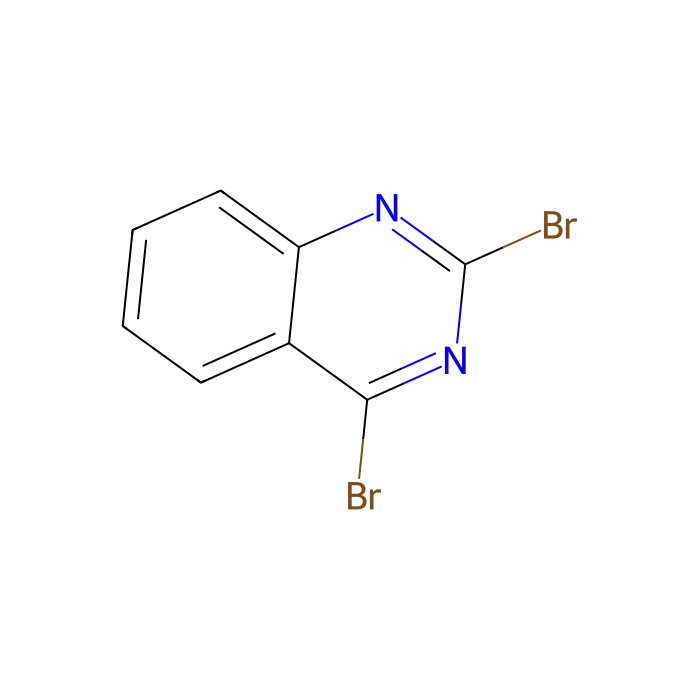
A dihalogenated quinazoline scaffold useful as a heteroaromatic coupling partner and electrophile in synthesis.
Item-specific identifiers (from Product Data)
Product Name: 2,4-Dibromoquinazoline
CAS: 872998-61-3
CID: 11652183
InChIKey: 40998 (as provided)
SMILES: Not specified for this item; refer to CoA/Spec Sheet.
Literature/derived identity details (for reference; not item specifications)
Molecular formula (literature): C8H4Br2N2 (dibrominated quinazoline core)
Molecular weight (literature): ~287.94 g/mol (calculated from C8H4Br2N2)
Core scaffold: Quinazoline (benzannulated 1,3-diazine) bearing bromine substituents at C-2 and C-4 on the diazine ring.
Functional groups/features:
Electron-deficient diazine ring (two ring nitrogens) fused to benzene
Aryl bromides (2×) as cross-coupling handles and electrophilic sites
Planar, polyaromatic heterocycle
Descriptive 2D structure (verbal)
A bicyclic system consisting of a benzene ring fused to a pyrimidine-like diazine ring. The ring nitrogens occupy positions 1 and 3 of the diazine. Bromine atoms are located at the 2- and 4-positions of the quinazoline ring, rendering those carbons activated toward oxidative addition and, in some cases, nucleophilic aromatic substitution due to the adjacent ring nitrogens.
Note: Where not explicitly provided in Product Data, values are cited as literature/typical information and should be confirmed against the CoA/SDS for this specific lot.
Synthetic Utility
The 2,4-dibromination pattern on an electron-deficient quinazoline enables modular, regioselective build-out of the diazine ring, a privileged heteroaromatic scaffold in discovery chemistry.
Electrophilic handles
Two aryl–Br sites support sequential cross-couplings (Suzuki, Buchwald–Hartwig, Sonogashira) allowing orthogonal installation of aryl, amine, and alkynyl substituents.
The ring nitrogens activate adjacent positions, enabling SNAr in some cases with strong nucleophiles.
Retrosynthetic advantages
A single starting point can deliver a matrix of C2- and C4-substituted quinazolines by tuning ligand/base/catalyst to control site selectivity.
The isotopic pattern (Br) simplifies LC–MS tracking during parallel synthesis.
Named-reaction compatibility (literature/general)
Suzuki–Miyaura for aryl/vinyl installation
Buchwald–Hartwig for primary/secondary amines and anilines
Sonogashira for alkyne appendages (followed by cycloadditions or reductions)
Carbonylation (Pd-catalyzed) to access amides/esters at aryl–Br positions
Downstream diversification
Post-coupling N-oxidation, N-alkylation, or annulation strategies can further modify electronic properties and binding motifs.
This building block thus accelerates rapid analogue generation for SAR, probe development, and materials-oriented heteroarene construction.
Target Specificity
Not applicable. This product is a small-molecule heteroaromatic building block, not a biological macromolecule or affinity reagent. No antigen/epitope, species reactivity, clone, or isotype information applies.
Frequently Asked Questions
What is the purity of this product?
This product is supplied at ≥95% purity (chemical assay). Lot-specific values are stated on the Certificate of Analysis.
How should this product be stored?
Store at ?20 °C under argon. It is supplied under an argon blanket; reseal under inert gas after each use.
How is this product shipped?
This product ships in an insulated container with ice pads. Unpack on arrival and transfer it to the storage condition stated above.
What are the CAS number, molecular formula and molecular weight?
The CAS Number is 872998-61-3, the molecular formula is C8H4Br2N2, and the molecular weight is 287.94 g/mol. InChIKey CDBAGRHVFMGOON-UHFFFAOYSA-N.
What documentation is provided?
Available product documentation, including Certificates of Analysis (COA), Safety Data Sheets (SDS), and specification sheets, is shown in the product document area. Document availability and access follow the current site policy.
We use cookies to ensure the website functions properly and, where permitted, to improve your experience. You can manage your preferences at any time in Settings. Learn more in our Cookie Policy.
Shall we send you a message when we have discounts available?
Remind me later
Thank you! Please check your email inbox to confirm.
Products are supplied to verified businesses, institutions, and qualified professionals for research and development use only. Not for use in humans, animals, diagnosis, or therapy.

 C2617295