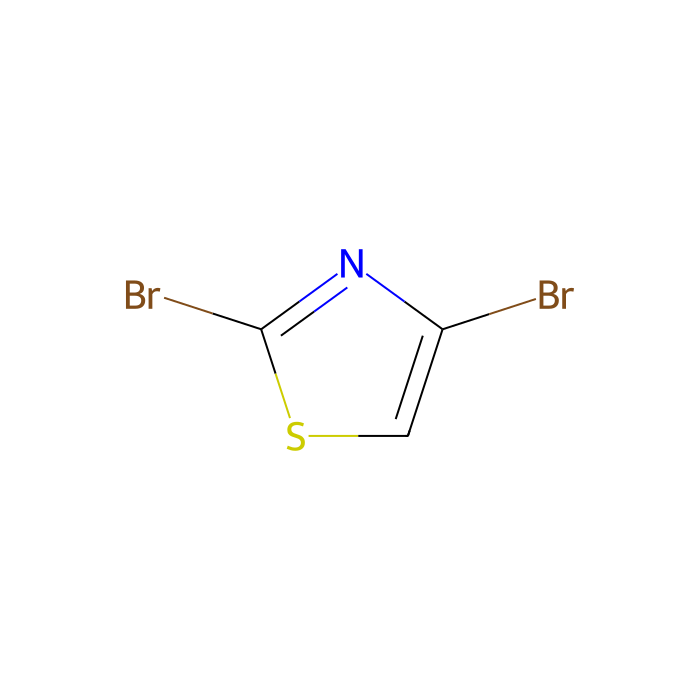
2,4-Dibromothiazole - ≥98% , CAS No.4175-77-3

CAS: 4175-77-3 Cat. No.: D122731 Formula: C3HBr2NS Molecular Weight: 242.92 EC Number: 629-026-6
AVAILABLE TO ORDER
GRADE & PURITY ≥98%
Synonyms
2.4-dibromothiazole|2,4-dibromo-1,3-thiazole|2,4-Dibromothiazole|2,4-Dibromo-thiazole|2 pound not4-dibromo-thiazole|2,4-dibromo thiazole
Storage
Room temperature,Argon charged
Shipped In
Normal
★
Size
Germany (EU)
USA*
Price
Qty
1g
D122731-1g
—
In stock ≥10
€8.59
5g
D122731-5g
—
In stock ≥10
€9.46
10g
D122731-10g
—
4 In stock
€10.33
25g
D122731-25g
—
3 In stock

€12.93

€19.87
Save €6.94 (34.93%)
100g
D122731-100g
—
6 In stock

€48.51

€72.80
Save €24.30 (33.37%)
500g
D122731-500g
1 In stock
2 In stock

€242.01

€363.50
Save €121.48 (33.42%)
Enter a quantity for the sizes you want to add.

Specifications

Synonyms
2.4-dibromothiazole | 2,4-dibromo-1,3-thiazole | 2,4-Dibromothiazole | 2,4-Dibromo-thiazole | 2 pound not4-dibromo-thiazole | 2,4-dibromo thiazole
Specifications & Purity
≥98%
Storage
Room temperature,Argon charged
Shipped In
Normal
Purity
≥98%
Names and Identifiers
Pubchem Sid
Pubchem Sid Url
https://pubchem.ncbi.nlm.nih.gov/substance/488193357
SMILES
C1=C(N=C(S1)Br)Br
IUPAC Name
2,4-dibromo-1,3-thiazole
InChIKey
MKEJZKKVVUZXIS-UHFFFAOYSA-N
InChI
1S/C3HBr2NS/c4-2-1-7-3(5)6-2/h1H
Isomeric SMILES
C1=C(N=C(S1)Br)Br
WGK Germany
3
Molecular Weight
242.92
Reaxys
507628
Reaxys-RN_link_address
https://www.reaxys.com/reaxys/secured/hopinto.do?context=S&query=IDE.XRN=507628&ln=

Advanced Data

Taxonomic Classification

Taxonomy Tree

KingdomOrganic compounds
SuperclassOrganoheterocyclic compounds
ClassAzoles
SubclassThiazoles
Intermediate Tree Nodes Not available
Direct Parent2,4-disubstituted thiazoles
Alternative Parents Aryl bromides  Heteroaromatic compounds  Azacyclic compounds  Organopnictogen compounds  Organonitrogen compounds  Organobromides  Hydrocarbon derivatives  
Molecular FrameworkAromatic heteromonocyclic compounds
Substituents 2,4-disubstituted 1,3-thiazole - Aryl halide - Aryl bromide - Heteroaromatic compound - Azacycle - Organic nitrogen compound - Organopnictogen compound - Hydrocarbon derivative - Organonitrogen compound - Organobromide - Organohalogen compound - Aromatic heteromonocyclic compound
DescriptionThis compound belongs to the class of organic compounds known as 2,4-disubstituted thiazoles. These are compounds containing a thiazole ring substituted at the positions 2 and 3.
External Descriptors Not available
3D Structure
Interactive Chemical Structure Model


Certificates (CoA,COO,BSE/TSE and Analysis Chart)
C of A & Other Certificates(BSE/TSE, COO):
Analytical Chart:

Find and download the COA for your product by matching the lot number on the packaging.

16 results found

Lot NumberCertificate TypeDateItem
D2303385D2303385Certificate of AnalysisSep 22, 2026 D122731
D2303386D2303386Certificate of AnalysisSep 21, 2026 D122731
G2426623G2426623Certificate of AnalysisMay 08, 2026 D122731
G2426624G2426624Certificate of AnalysisMay 08, 2026 D122731
G2426625G2426625Certificate of AnalysisMay 08, 2026 D122731
J2509035J2509035Certificate of AnalysisOct 13, 2025 D122731
H2529056H2529056Certificate of AnalysisSep 06, 2025 D122731
H1420043H1420043Certificate of AnalysisFeb 20, 2024 D122731
E2423129E2423129Certificate of AnalysisDec 11, 2023 D122731
F1404043F1404043Certificate of AnalysisNov 08, 2023 D122731
D1820041D1820041Certificate of AnalysisSep 13, 2023 D122731
D1820043D1820043Certificate of AnalysisSep 07, 2023 D122731
B2224420B2224420Certificate of AnalysisDec 07, 2021 D122731
B2224425B2224425Certificate of AnalysisDec 07, 2021 D122731
B2225097B2225097Certificate of AnalysisDec 07, 2021 D122731
B2303386B2303386Certificate of AnalysisDec 07, 2021 D122731
Chemical and Physical Properties
SolubilitySoluble in Methanol
x_melt_point_char82°C
Molecular Weight242.92
XLogP33.000
Hydrogen Bond Donor Count0
Hydrogen Bond Acceptor Count2
Rotatable Bond Count0
Exact Mass242.818 Da
Monoisotopic Mass240.82 Da
Topological Polar Surface Area41.100 Ų
Heavy Atom Count7
Formal Charge0
Complexity70.000
Isotope Atom Count0
Defined Atom Stereocenter Count0
Undefined Atom Stereocenter Count0
Defined Bond Stereocenter Count0
Undefined Bond Stereocenter Count0
The total count of all stereochemical bonds0
Covalently-Bonded Unit Count1
Safety and Hazards(GHS)
x_symbol
GHS05,   GHS07
x_signal_word
Danger
x_hazard_statements

H302:Harmful if swallowed

H315:Causes skin irritation

H318:Causes serious eye damage

H335:May cause respiratory irritation

x_precautionary_statements

P261:Avoid breathing dust/fume/gas/mist/vapors/spray.

P264:Wash hands [and …] thoroughly after handling.

P270:Do not eat, drink or smoke when using this product.

P271:Use only outdoors or in a well-ventilated area.

P280:Wear protective gloves/protective clothing/eye protection/face protection.

P321:Specific treatment (see ... on this label).

P330:Rinse mouth.

P302+P352:IF ON SKIN: wash with plenty of water.

P304+P340:IF INHALED: Remove person to fresh air and keep comfortable for breathing.

P362+P364:Take off contaminated clothing and wash it before reuse.

P405:Store locked up.

P403+P233:Store in a well-ventilated place. Keep container tightly closed.

P501:Dispose of contents/container to an approved waste disposal plant.

P264+P265:Wash hands [and …] thoroughly after handling. Do not touch eyes.

P301+P317:IF SWALLOWED: Get medical help.

P305+P354+P338:IF IN EYES: Immediately rinse with water for several minutes. Remove contact lenses if present and easy to do. Continue rinsing.

P317:Get emergency medical help.

P332+P317:If skin irritation occurs: Get medical help.

P319:Get medical help if you feel unwell.

x_wgk_germany
3
x_reaxy_rn
507628
x_reaxys_rn_link_address
https://www.reaxys.com/reaxys/secured/hopinto.do?context=S&query=IDE.XRN=507628&ln=
FAQs and Articles
Solution Calculators
Reviews

Customer Reviews

Application Protocols

No biological assay protocols (WB, IHC, IF, FC) are applicable to this small-molecule building block. For synthetic use, see Reaction Conditions for starting points on cross-coupling, amination, and metalation workflows.

Research Use Note: For research use only.

Biological Roles

This product is a small-molecule heteroaromatic building block and is not intended for biological use. No endogenous biological role is associated with 2,4-dibromothiazole.

  • General note (literature/general): Thiazole rings are found in natural products and cofactors (e.g., thiamine/vitamin B1), but 2,4-dibrominated thiazole is a synthetic intermediate without known physiological function.

  • Research Use Note: For research use only. Not for human or veterinary use.

Buffer Applications

Not typically applicable. 2,4-Dibromothiazole is a neutral, poorly water-soluble heteroaromatic and is not used to prepare laboratory buffer systems. For relevant guidance, see Solvent Selection and Reaction & Applications for synthetic uses in organic media.

Green Alternatives

Greener strategies when working with 2,4-dibromothiazole focus on solvent and catalyst choices, waste minimization, and energy efficiency (literature/general).

  • Solvent substitution:

    • Replace DMF/DMAc/NMP with 2-MeTHF, CPME, or TAME where feasible. These ethers offer better safety and renewable content (2-MeTHF) and often support cross-couplings.
    • Use aqueous micellar media (e.g., TPGS-750-M, Savie) with low Pd loadings for Suzuki couplings, enabling room-temperature or mild conditions and simplified workups.
  • Comparative snapshot (general):

    • 2-MeTHF vs THF: similar polarity, higher boiling point, partly bio-based, better phase separation; may slow some metalations relative to THF.
    • CPME vs dioxane: CPME has superior peroxide resistance and hydrophobicity; good for high-T couplings, but substrate solubility must be verified.
    • Ethanol/water mixtures: can support Suzuki couplings with robust palladium systems; significantly greener but may require base and ligand optimization.
  • Catalyst and loading:

    • Employ precatalysts with bulky biaryl phosphines (XPhos-type) or NHC systems to reduce Pd to 0.1–0.5 mol% on scale; consider nickel catalysis for certain couplings with aryl boronates or Grignards.
  • Process intensification:

    • Flow chemistry for exothermic metalations (Br/Li exchange) with precise temperature control and minimal solvent.
    • Telescoped sequences (metalation → electrophile quench → cross-coupling) to avoid isolating sensitive intermediates.
  • Trade-offs:

    • Greener solvents can alter selectivity/solubility; reoptimize base, ligand, and temperature. Some aqueous systems are incompatible with air/moisture-sensitive steps (metalation).
Pharmaceutical Uses

No direct excipient or formulation role is expected for 2,4-dibromothiazole. It may serve as a synthetic intermediate toward thiazole-containing APIs or advanced intermediates (literature/general), but this item is supplied strictly for research and development.

  • Pharmacopeial status: Not a compendial excipient (general).
  • Process chemistry context: Useful for assembling heteroaryl motifs via cross-coupling or metalation–electrophile sequences en route to API candidates.

Research Use Note: For research use only; not for human or veterinary applications.

Physical Properties

Item-specific specifications (this lot):

  • Appearance: Not specified for this item; refer to CoA/Spec Sheet.
  • Purity/grade: Not specified for this item; refer to CoA/Spec Sheet.

Literature/computed properties (for general reference; not guaranteed for this item):

  • Physical state at ambient conditions: typically a crystalline solid for dihalogenated thiazoles of this size; exact appearance varies by lot and handling (literature/general).
  • Estimated formula weight: ~242.92 g/mol (from literature formula C3HBr2NS).
  • Solubility profile (general):
    • Water: expected very low solubility (heteroaryl dihalides are generally poorly water-soluble).
    • Organic: typically soluble in polar aprotic solvents (DMF, DMSO, NMP), moderately soluble in chlorinated solvents (DCM, chloroform) and in ethers/esters (THF, EtOAc) depending on temperature (literature/general).
  • Volatility: low; aryl dibromides generally have negligible vapor pressure at room temperature (literature/general).
  • Acid/base: weakly basic ring nitrogen (pKaH of thiazole ≈ 2.5; the neutral ring is not appreciably basic in water), overall compound behaves as neutral aromatic under most conditions (literature).
  • LogP: halogenated thiazoles often show moderate lipophilicity; specific value for 2,4-dibromothiazole not readily reported (literature/general).

Notes:

  • Precise BP/MP/density/refractive index have not been located in authoritative sources for this exact substitution pattern. Consult primary literature or measure experimentally if critical to your process.
Quality and Grades

Item-specific quality information:

  • Grade/Purity: Not specified for this item; refer to CoA/Spec Sheet for assay, impurity profile, and any stabilizers.

Context and expectations for this compound class (general guidance):

  • Typical research grades:
    • Research grade: Assay usually ≥95% by NMR/GC/HPLC; suitable for most synthesis and screening work.
    • High-purity (≥98–99%): Preferred for catalytic cross-coupling, sequential orthogonal functionalizations, or when impurity halides/protodebrominated species can poison catalysts.
    • Anhydrous/low-water: Less critical for solids, but beneficial for air/moisture-sensitive metalation steps; material may be packaged under inert gas (this item is argon charged per Product Data).
  • UV/metal specifications: Not specified for this item; refer to CoA/Spec Sheet. For sensitive catalysis (e.g., ppm-level Pd), request trace-metal analysis if needed.
  • Stabilizers: None listed for this item; if present, they will be disclosed on the CoA/Spec Sheet. Most aryl bromides do not require stabilizers but benefit from dry, inert storage to preserve reactivity.
  • Acceptance criteria/use testing:
    • Verify identity by 1H/13C NMR (diagnostic C5–H in thiazole), HRMS, and quantitative assay (qNMR or HPLC).
    • Check for mono-brominated and dehalogenated byproducts; these can arise during manufacture or prolonged storage.
Reaction and Applications

As a dihalogenated thiazole, 2,4-dibromothiazole is a versatile heteroaryl electrophile enabling stepwise or differential functionalization of the 2- and 4-positions.

Key application families (literature/general):

  • Cross-coupling chemistry:
    • Suzuki–Miyaura, Stille, Negishi, Kumada: Enables C–C bond formation to install aryl, vinyl, or alkyl fragments. Catalyst/ligand choice can deliver chemoselectivity (e.g., preferential activation at C4–Br vs C2–Br in some systems).
    • Buchwald–Hartwig amination: Formation of C–N bonds; thiazole nitrogen is not the coupling site, but ring bromides participate under Pd catalysis.
  • Halogen–lithium exchange/metalation:
    • Rapid Br/Li exchange at low temperature (e.g., n-BuLi, t-BuLi) to generate 2- or 4-lithio intermediates for electrophile trapping (formylation, acylation, borylation, silylation). The thiazole ring directs and stabilizes adjacent metalation.
  • Sequential/orthogonal functionalization:
    • Exploit differential reactivity of C2–Br (typically more activated by the adjacent ring N) vs C4–Br to build unsymmetrically substituted thiazoles.
  • Heterocycle elaboration:
    • Construction of thiazole-containing ligands, materials, and bioactive cores; serves as a convergent node in SAR arrays where independent variation at positions 2 and 4 is desired.

Practical notes:

  • Dry, oxygen-free conditions improve catalytic performance and suppress protodebromination.
  • Use strong, non-nucleophilic bases (Cs2CO3, K3PO4) and modern ligands (XPhos, SPhos, RuPhos) to enhance couplings with heteroaryl bromides.
  • Monitor for dehalogenation and homocoupling; adjust catalyst/ligand, base, and temperature accordingly.
Reaction Conditions

General conditions reported for heteroaryl bromide transformations (apply with optimization to 2,4-dibromothiazole):

  • Suzuki–Miyaura coupling (literature guidance):

    • Catalyst: Pd(PPh3)4 (1–3 mol%) or Pd2(dba)3 (1 mol%) + XPhos/SPhos (2–4 mol%).
    • Base: K2CO3 or Cs2CO3 (2–3 equiv).
    • Solvent: 1,4-dioxane/H2O (4:1), THF/H2O, or toluene/H2O; alternatively DMF or DMAc (anhydrous) for difficult substrates.
    • Temperature/time: 60–100 °C, 2–16 h.
    • Notes: Site-selectivity (C4 vs C2) depends on ligand and conditions; screen ligands for chemoselectivity.
  • Buchwald–Hartwig amination:

    • Catalyst: Pd2(dba)3 or Pd(OAc)2 (1–2 mol%) + BrettPhos/RuPhos (2–4 mol%).
    • Base: NaOtBu or K3PO4 (2–3 equiv).
    • Solvent: Toluene, dioxane, or t-BuOH.
    • Temperature: 80–110 °C.
  • Negishi/Stille couplings:

    • Catalysts: Pd(PPh3)4 or PdCl2(PPh3)2 (1–3 mol%).
    • Solvents: THF/toluene (Negishi), toluene/dioxane (Stille).
    • Notes: Control for homocoupling/tin residues (Stille) in workup.
  • Halogen–lithium exchange / directed metalation:

    • Reagent: n-BuLi or t-BuLi (1.1–1.3 equiv) at −78 to −40 °C in dry THF.
    • Electrophiles: DMF (CHO), CO2 (CO2H), B(OR)3 (Bpin after workup), Me3SiCl, aldehydes/ketones.
    • Quench: −78 °C, then warm as appropriate; strict exclusion of moisture/air.
  • Carbonylative coupling:

    • Pd catalyst (1–3 mol%), CO (1–10 bar), base (Et3N, Cs2CO3), solvent (DMF/dioxane), 60–100 °C → amides/esters.

All conditions are literature/general guidance and require optimization for your substrate set and selectivity goals.

Safety and Handling

Authoritative safety data are provided in the product SDS; always review before use.

Item-specific hazard data from Product Data:

  • Signal word: Not specified for this item; refer to SDS.
  • H-statements: Not specified for this item; refer to SDS.
  • GHS classification/pictograms: Not specified for this item; refer to SDS.
  • Storage conditions: Room temperature, Argon charged. Store tightly sealed under inert gas.
  • Shipping: Shipped at ambient temperature (Normal).

General safety guidance for brominated heteroaromatics (literature/general):

  • Hazards: May cause skin/eye/respiratory irritation. Avoid dust formation. Combustible organic solid; keep away from ignition sources.
  • Incompatibilities: Strong bases can induce metal–halogen exchange; strong nucleophiles may react under forcing conditions. Avoid strong oxidizers and strong reducing agents. Moisture/air are not typically reactive, but inerting minimizes gradual hydrolysis/oxidation and preserves coupling reactivity.
  • PPE: Lab coat, nitrile gloves, splash goggles; handle powders in a fume hood. Consider double-gloving for extended handling with polar aprotic solvents.
  • First aid (overview; see SDS for details):
    • Inhalation: Move to fresh air; seek medical attention if symptoms persist.
    • Skin/eye contact: Rinse with plenty of water for at least 15 minutes; remove contaminated clothing; obtain medical advice as needed.
    • Ingestion: Rinse mouth; do not induce vomiting; seek medical attention.
  • Fire-fighting: Use dry chemical, CO2, or alcohol-resistant foam. Thermal decomposition may release HBr/NOx/SOx; firefighters should wear SCBA.
Solvent Selection

Use case-driven solvent choices for 2,4-dibromothiazole (general guidance):

  • Polarity/miscibility (literature/general):

    • Water: effectively insoluble; avoid aqueous-only media.
    • Organic solvents: soluble in polar aprotic media (DMF, DMAc, NMP, DMSO) and chlorinated solvents (DCM, CHCl3). Variable solubility in THF, dioxane, toluene, and EtOAc; warming or cosolvents often help.
  • Typical selections by application:

    • Pd-catalyzed cross-coupling: 1,4-dioxane, THF, toluene, or mixtures with water or alcohols; DMF/DMAc/NMP for higher-temperature couplings or poor-solubility partners.
    • Halogen–metal exchange/ortholithiation: dry THF or Et2O at −78 to −40 °C under inert atmosphere.
    • Nucleophilic substitution/elaboration after lithium–halogen exchange: THF, MTBE, or CPME depending on electrophile.
  • Practical tips:

    • Begin with 0.05–0.2 M substrate concentration for heterogeneous couplings; adjust based on mass transfer. Add a small amount of DMF to improve wetting if using toluene/dioxane.
    • For poorly soluble partners, switch to high-boiling polar aprotics (NMP/DMAc) or use micellar aqueous systems with surfactants (see Green Alternatives).
  • Brief comparison (general):

    • THF vs dioxane: THF offers faster kinetics but may promote base-sensitive side reactions; dioxane is less nucleophilic and often cleaner for thiazoles.
    • Toluene/xylene: good for high-T couplings with less polar partners; may require phase-transfer or higher catalyst loadings.
    • DMF/DMAc/NMP: maximize solubility and rate, but consider work-up and safety profiles.
Storage and Reconstitution

Item-specific storage from Product Data:

  • Storage conditions: Room temperature, Argon charged. Keep container tightly closed under inert gas.
  • Shipped in: Normal (ambient) conditions.

General handling guidance (literature/general):

  • Protect from prolonged exposure to air and moisture to preserve coupling reactivity and minimize hydrolysis/oxidation. Store in a dry desiccator or glovebox cabinet if possible.
  • After opening: Backfill headspace with argon or nitrogen; use septum-cap bottles for repeated needle transfers.
  • Light sensitivity: Halogenated heteroaromatics are generally not photolabile, but amber glass minimizes any risk.
  • Reconstitution/solution preparation: Dissolve in dry organic solvents (e.g., DCM, THF, 1,4-dioxane, toluene, DMF, DMSO) to prepare stock solutions. Filter if necessary to remove particulates. Use anhydrous solvents for metalation or sensitive catalytic sequences.
  • Freeze–thaw: Not applicable to solids; for prepared solutions, store in airtight vials under inert gas at 2–8 °C and avoid repeated freeze–thaw cycles.
  • Stability testing: For long-term projects, confirm purity by NMR/HPLC upon receipt and periodically thereafter.

Note: When specific shelf-life or assay limits are required, consult the product’s CoA/Spec Sheet and SDS.

Structure and Identity

Brief overview: 2,4-Dibromothiazole is a dihalogenated thiazole ring system useful as a heteroaryl coupling partner and electrophilic building block.

  • Item-specific identifiers (from Product Data):

    • CAS: 4175-77-3
    • SKU: D122731
    • InChIKey: Not specified for this item; refer to CoA/Spec Sheet.
    • SMILES: Not specified for this item; refer to CoA/Spec Sheet.
    • Molecular formula: Not specified for this item; refer to CoA/Spec Sheet.
    • Molecular weight: Not specified for this item; refer to CoA/Spec Sheet.
  • Literature/typical identity information (for reference only; not item-specific specs):

    • Core scaffold: thiazole (five-membered aromatic ring containing one nitrogen and one sulfur).
    • Substitution pattern: bromine atoms at the 2- and 4-positions of the thiazole ring (C2–Br and C4–Br). One remaining ring hydrogen at C5.
    • Expected empirical formula (literature): C3HBr2NS.
    • Calculated formula weight (literature): ~242.92 g/mol.
  • 2D structural description (general):

    • A planar five-membered aromatic ring with adjacent S and N heteroatoms; the carbon alpha to N (C2) and the carbon alpha to S (C4) each bear a bromine substituent; the remaining ring carbon (C5) carries hydrogen. No stereocenters; no tautomers of consequence under standard conditions.
  • Functional groups/features:

    • Heteroaromatic ring (thiazole), two aryl–Br bonds (activated toward cross-coupling/metal–halogen exchange), ring nitrogen (weakly basic, directing for metalation).
Synthetic Utility

Functional group set and reactivity (literature/general):

  • Two aryl–bromide sites (C2 and C4) provide orthogonal handles for C–C and C–N bond formation.
  • The thiazole ring nitrogen and sulfur modulate electronics, enhancing oxidative addition rates (vs benzene) and enabling directed metalation adjacent to N.

Retrosynthetic value:

  • Central linchpin for rapid diversification: install one substituent at C4 by selective coupling, then transform C2 (or vice versa) to access 2,4-disubstituted thiazole libraries.
  • Convergent assembly: couple with boronic acids/esters, organozincs, or stannanes to introduce aryl/vinyl fragments; follow with carbonylation (CO insertion) or borylation to generate further handles.

Named/typical transformations:

  • Suzuki–Miyaura and Stille couplings at C–Br.
  • Buchwald–Hartwig amination to introduce anilines/alkylamines.
  • Carbonylative couplings (Pd/Cu) to furnish thiazole carboxamides/esters.
  • Halogen–lithium exchange at low T → electrophile trapping (e.g., DMF for formylation; B(OMe)3 for boronation → subsequent Suzuki).

Practical synthesis tips:

  • Leverage ligand control for site-selectivity: bulky electron-rich phosphines (e.g., SPhos/XPhos) can favor C4 activation in some heteroaryl systems; NHCs may alter the preference.
  • Avoid strong nucleophiles that attack the ring; use non-nucleophilic bases (K3PO4, Cs2CO3, NaOtBu depending on solvent).
Target Specificity

Not applicable. This product is a small-molecule chemical reagent, not a biological targeting agent (e.g., antibody, probe, or inhibitor). No antigen/epitope or species reactivity data apply.

Frequently Asked Questions

What is the purity of this product?
This product is supplied at ≥98% purity (chemical assay). Lot-specific values are stated on the Certificate of Analysis.
How should this product be stored?
Store at room temperature under argon. It is supplied under an argon blanket; reseal under inert gas after each use.
How is this product shipped?
This product ships under standard ambient conditions. No temperature-controlled packaging is required.
What are the CAS number, molecular formula and molecular weight?
The CAS Number is 4175-77-3, the molecular formula is C3HBr2NS, and the molecular weight is 242.92 g/mol. InChIKey MKEJZKKVVUZXIS-UHFFFAOYSA-N.
What documentation is provided?
Available product documentation, including Certificates of Analysis (COA), Safety Data Sheets (SDS), and specification sheets, is shown in the product document area. Document availability and access follow the current site policy.

Shall we send you a message when we have discounts available?

Remind me later

Thank you! Please check your email inbox to confirm.

Oops! Notifications are disabled.