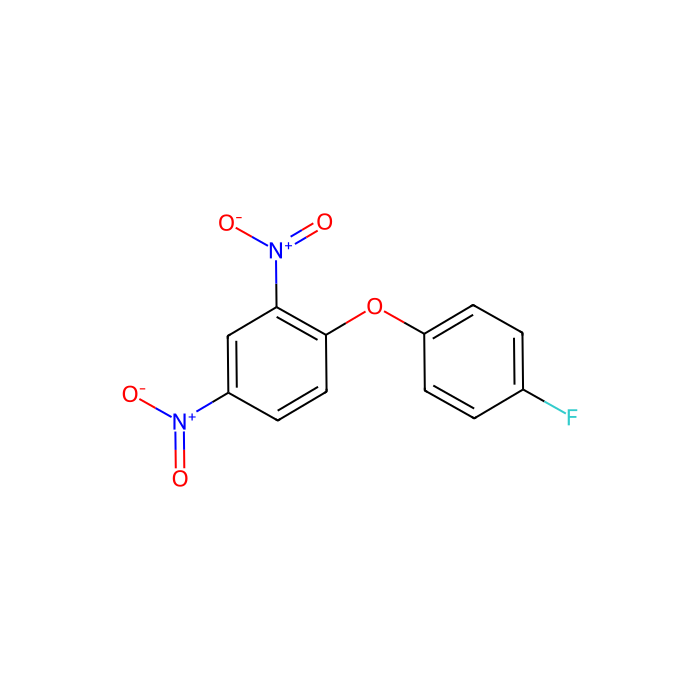
This compound belongs to the class of organic compounds known as diphenylethers. These are aromatic compounds containing two benzene rings linked to each other through an ether group.
External Descriptors
Not available
1. Djoumbou Feunang Y, Eisner R, Knox C, Chepelev L, Hastings J, Owen G, Fahy E, Steinbeck C, Subramanian S, Bolton E, Greiner R, and Wishart DS. ClassyFire: Automated Chemical Classification With A Comprehensive, Computable Taxonomy. Journal of Cheminformatics, 2016, 8:61.
Determine the necessary mass, volume, or concentration for preparing a solution.
Dilution Calculator
Determine the dilution needed to prepare a stock solution.
Reconstitution Calculator
Reviews
Customer Reviews
Application Protocols
No vendor-validated application protocols are provided for this SKU. For research use, consider the following general starting points (optimize as needed):
DNP tagging of amines (analytical derivatization, general):
Dissolve substrate (1.0 equiv) and base (1.5 equiv K2CO3) in dry DMF (0.1 M).
Add 2,4-dinitro-4'-fluorodiphenyl ether (1.1–1.5 equiv) at room temperature to 60 °C.
Stir 2–6 h; monitor by HPLC/UPLC.
Quench with water, extract with EtOAc, dry, and purify.
Thiolation (for DNP–thioether formation):
Generate thiolate (RS−) with NaH or K2CO3 in MeCN/DMF at 0–25 °C.
Add reagent (1.0–1.2 equiv); warm to 25–40 °C if needed until completion.
These are general literature-style guidelines and not product-specific validated methods. Adjust conditions for substrate solubility and reactivity.
Biological Roles
This is a synthetic nitroaromatic reagent intended for laboratory chemistry. It does not have a defined endogenous biological role.
General research context (non-clinical):
DNP tag utility: The 2,4-dinitrophenyl group is a classic hapten and a strong chromophore. DNP substitution on biomolecules (e.g., amino groups of peptides) is used in analytical derivatization and method development, providing robust UV detection and a recognizable mass increment.
Probe/assay development: DNP-labeled small molecules can serve as surrogates in binding or transport studies due to their UV signatures; however, this product is not supplied for any diagnostic or therapeutic use.
Note: No biological activity, ADME, or toxicology claims are made for this item. For cell-based or biochemical use, validate compatibility and quench unreacted electrophile thoroughly to avoid nonspecific modification.
Buffer Applications
Not typically applicable. 2,4-Dinitro-4'-fluorodiphenyl ether is not a buffering agent and does not constitute a conjugate acid/base pair for pH control.
Practical note: If used to derivatize nucleophiles in aqueous/bi-buffered systems, conduct reactions in biphasic or mixed organic media (e.g., MeCN/aqueous buffer) under basic conditions, and ensure that the buffer components (amine-containing buffers like Tris) do not compete as nucleophiles.
Green Alternatives
Greener choices relate both to the solvent system and to the electrophile scaffold used for derivatization.
Solvent considerations:
Prefer MeCN, 2-MeTHF, CPME, or EtOAc over chlorinated solvents when feasible. Polar aprotics like DMF/DMSO offer performance but pose EHS burdens; consider MeCN or propylene carbonate as alternatives if rates/yields remain acceptable.
Electrophile alternatives (contextual):
1-Fluoro-2,4-dinitrobenzene (FDNB) and 1-chloro-2,4-dinitrobenzene (CDNB) are classic DNP-transfer reagents; they may react faster but generate halide waste. The present aryl ether generates a phenoxide byproduct, which is generally less persistent than halides in some waste streams.
Cons: May be less reactive than FDNB; often requires stronger base or higher temperature.
FDNB/CDNB:
Pros: High reactivity; broad nucleophile scope.
Cons: Halogenated byproducts; potential for more stringent waste controls.
Green practice tips:
Use minimal solvent, telescoped workups, and non-chlorinated eluents (hexanes/EtOAc or heptane/EtOAc).
Evaluate catalytic phase-transfer bases to lower solvent volumes (literature strategy).
Pharmaceutical Uses
No pharmacopeial or excipient role is specified for this item. It is supplied for research use only.
General process-chemistry context (non-clinical):
Derivatization reagent: The DNP motif can be used in analytical method development (e.g., UV-active tagging of amines/thiols) for impurity profiling or stability-indicating assays.
Intermediate synthesis: As an activated aryl electrophile, it may be employed in the preparation of DNP-labeled reference materials and test articles. Any use in GMP settings requires independent qualification and method validation.
Physical Properties
Item-specific physical constants (BP, MP, density, refractive index, elemental limits) are not provided in the Product Data and should be confirmed on the CoA/Spec Sheet for this SKU.
General/literature expectations for compounds of this class (aryl dinitrophenyl ethers; guidance only):
Appearance: Typically yellow to orange crystalline solid or powder for DNP aryl ethers; actual appearance for this item: Not specified for this item; refer to CoA/Spec Sheet.
Melting point: Often in the 70–140 °C range for analogous DNP aryl ethers, contingent on substituents (literature, indicative only).
Boiling point: Decomposition may precede boiling for nitroaromatics; purification commonly by crystallization (literature/general).
Solubility: Poor in water; generally soluble in chlorinated solvents (CH2Cl2, CHCl3), moderately in EtOAc and acetone; higher solubility in polar aprotics (DMF, DMSO, NMP) (general guidance).
LogP: Nitroaryl ethers are typically moderately lipophilic (literature/general); exact logP Not specified for this item.
pKa: Not applicable (no ionizable Brønsted acid/base centers under neutral conditions); phenoxide leaving group forms under basic conditions during SNAr (general).
UV-Vis: Nitroaromatics show strong absorbance in near-UV; exact λmax Not specified for this item.
Notes:
Use these qualitative properties to guide solvent choice and workup; verify exact numeric values from the CoA/SDS for this SKU.
Quality and Grades
Grade/purity: Not specified for this item; refer to CoA/Spec Sheet for assay, impurity profile, and analytical criteria applicable to SKU D178900.
What grade typically implies (general guidance):
Research-grade aryl electrophiles are commonly specified by assay (HPLC/GC), residual solvents, and identity (1H/13C NMR, MS, IR). UV specifications may be given for chromatography users.
Absence/presence of stabilizers: Not specified for this item; refer to CoA/Spec Sheet. DNP aryl ethers are generally supplied neat without stabilizers.
Recommended QC on receipt (good practice):
Verify identity by NMR and MS; nitro symmetric stretches near ~1520/1345 cm−1 (IR) are characteristic (literature/general).
Check purity by HPLC with UV detection (strong absorbance near 260–360 nm typical for nitroaromatics; method development may be needed).
For reaction use, assess moisture content if base-sensitive transformations are planned (Karl Fischer as needed).
Reaction and Applications
As a 2,4-dinitrophenyl (DNP)-activated aryl ether bearing a para-fluorophenyl leaving group, this reagent functions as an electrophile in nucleophilic aromatic substitution (SNAr) and related derivatizations.
Key applications (literature/general):
DNP transfer to nucleophiles: Under basic conditions, nucleophiles such as amines, thiols, and alkoxides attack the DNP ring (activated by the two nitro groups), displacing 4-fluorophenoxide to afford DNP–Nu adducts. Useful for tagging, UV-active derivatization, or preparing DNP-protected intermediates.
Phenoxide release: The leaving group is para-fluorophenoxide, which can be trapped or further functionalized (e.g., fluorinated phenol derivatives).
Kinetic/ mechanistic studies: Suitable substrate for investigating Meisenheimer complex formation and substituent effects in SNAr.
Solid-phase or polymer conjugation (research): The DNP tag provides strong UV signals and recognizable spectroscopic handles for monitoring loading/cleavage events.
Practical tips:
Bases: Alkali carbonates (K2CO3, Cs2CO3) or organic bases (DBU, DIPEA) promote formation of the nucleophile; stronger bases accelerate reaction but may increase side reactions.
Solvents: DMF, DMSO, NMP, or MeCN; heat (40–80 °C) often beneficial.
Monitoring: TLC/UPLC with UV detection at 254–360 nm; appearance of 4-fluorophenol/phenoxide byproduct can be tracked.
Workup: Quench base, extract into organic solvent, and wash to remove inorganic salts. Purify by column chromatography or crystallization.
All uses are for research and laboratory synthesis only.
Reaction Conditions
General conditions for nucleophilic aromatic substitution on the DNP ring (literature guidance; optimize per substrate):
Nucleophiles: Primary/secondary amines, anilines (often need higher temperature), thiols, alkoxides. Order of reactivity typically: RS− > RO− ≈ aliphatic amines > anilines.
Base: K2CO3, Cs2CO3 (0.5–2.0 equiv) in polar aprotic solvents. Strong, non-nucleophilic bases (DBU, TMG) also effective, especially for weaker nucleophiles.
Solvents: DMF, DMSO, NMP, MeCN. For greener options, 2-MeTHF or propylene carbonate can be explored; solubility may limit rates.
Temperature/time: 25–80 °C, 1–16 h. Thiolations often proceed at lower temperatures; anilines may require heating.
Concentration: 0.05–0.5 M typical; higher concentration can increase rate but may complicate heat removal.
Atmosphere: Generally ambient; exclude moisture for base-sensitive nucleophiles.
Workup: Dilute with EtOAc or DCM, wash with water/brine, dry (Na2SO4), and concentrate. Purify by silica gel chromatography (hexanes/EtOAc) or recrystallization.
Monitoring: TLC with UV (254 nm) or HPLC/UPLC; observe disappearance of starting material and formation of DNP–Nu product and 4-fluorophenoxy byproduct.
Note: Exact stoichiometry, temperature, and time should be tailored to the nucleophile’s strength and sterics. Always perform small-scale trials to establish conditions.
Safety and Handling
GHS classification, pictograms, and H-statements: Not specified in the provided Product Data. Consult the SDS for authoritative hazard classification and first-aid measures for SKU D178900.
Anticipated hazards (general for nitroaromatic aryl ethers; guidance only):
May cause skin/eye irritation; harmful if swallowed or inhaled.
Nitroaromatics can present methemoglobinemia risk on significant exposure; prevent inhalation/dermal contact (general toxicology context).
PPE: Lab coat, safety goggles, and chemically resistant gloves (e.g., nitrile). Handle in a fume hood to avoid dust/vapor exposure.
Handling: Avoid generating dust. Keep away from strong bases and strong nucleophiles unless performing controlled reactions. Prevent contact with strong reducing agents. Do not heat to decomposition.
Incompatibilities (general): Strong bases, nucleophiles (can trigger SNAr); strong reducing agents; strong oxidizers (oxidation state considerations for nitro groups).
First aid (overview; defer to SDS):
Inhalation: Move to fresh air; seek medical attention if symptoms persist.
Skin/eye contact: Rinse thoroughly with water for at least 15 minutes; remove contaminated clothing.
Ingestion: Rinse mouth; seek medical attention. Do not induce vomiting unless directed by medical personnel.
Fire response: Nitroaromatics may burn; use CO2, dry chemical, or foam. Avoid high heat; thermal decomposition can release toxic fumes (NOx).
Storage: Room temperature (per Product Data); keep tightly closed, dry, and protected from light. Store segregated from incompatible reagents. Shipped at ambient conditions.
Solvent Selection
This compound is an apolar-to-moderately polar aromatic electrophile with limited aqueous solubility. Choose solvents based on reaction type and processing needs.
Polarity class: Low-to-moderate polarity aromatic. Favor aprotic media for SNAr.
Miscibility profile (general):
Water: Practically insoluble.
Polar aprotics (DMF, DMSO, NMP, DMAc): High solubility; good for SNAr and derivatizations.
Chlorinated (DCM, chloroform): Good solubility; useful for workup/extractions and chromatography.
Esters/ketones (EtOAc, acetone, MEK): Moderate solubility; greener than chlorinated in many cases.
Ethers (THF, 2-MeTHF, CPME): Moderate solubility; good for base-mediated reactions.
Selection tips:
For nucleophilic substitutions (DNP transfer), DMF/DMSO or acetonitrile often maximize rates and solubility of inorganic bases.
For crystallizations, use less polar solvents (EtOAc/hexanes, toluene) to exploit differential solubility.
For chromatography, start with hexanes/EtOAc gradients; strong UV helps detection at 254 nm.
Drying: If moisture-sensitive bases are used, dry solvents to minimize side hydrolysis; molecular sieves (3Å/4Å) are commonly sufficient (general practice).
Storage and Reconstitution
Storage conditions (from Product Data): Store at room temperature. Keep container tightly closed in a dry, well-ventilated place. Protect from moisture and prolonged light exposure.
Shipping: Normal (ambient) shipment per Product Data.
Reconstitution: Not applicable; supplied as a neat solid reagent. If preparing stock solutions:
Solvents: Dry DMF, DMSO, MeCN, or DCM recommended for concentrated stocks.
Concentrations: Prepare according to use-case (e.g., 10–100 mM for screening); filter if particulates are present.
Stability: Nitroaromatic ethers are generally stable in anhydrous organic solution at 2–8 °C for days to weeks; confirm by HPLC before use (literature/general). Avoid prolonged storage in basic media to prevent decomposition.
Freeze/thaw: Not typically applicable. If storing solutions, aliquot to minimize repeated warming.
Always refer to the CoA/SDS for item-specific stability and handling details for SKU D178900. Research use only.
Structure and Identity
A dinitro-activated aryl ether bearing a para-fluorophenyl leaving group; useful as an electrophilic 2,4-dinitrophenyl (DNP) transfer reagent.
Item-specific identifiers from Product Data:
CAS: 1033-02-9
CID: 265715
InChIKey: 459491 (as provided; consult CoA/SDS for a full canonical InChIKey)
SMILES: Not specified for this item; refer to CoA/Spec Sheet.
Core scaffold: diphenyl ether (two phenyl rings linked through an oxygen atom)
Substituents: two nitro groups at the 2- and 4-positions of one ring; a para-fluoro substituent on the other ring.
Functional groups: aryl fluoride, aryl ether (Ar–O–Ar), two strongly deactivating nitro groups (–NO2) that activate the ring toward SNAr at positions ortho/para to nitro.
2D description: Anisole-like DNP ring (bearing –NO2 at ortho and para relative to the Ar–O bond) connected via O to a para-fluorophenyl ring.
Molecular formula: Not specified for this item; refer to CoA/Spec Sheet. (Literature expectation for this structure: approximately C12H7FN2O5.)
Molecular weight: Not specified for this item; refer to CoA/Spec Sheet. (Literature estimate for the above formula: ~278.19 g/mol.)
Synthetic Utility
Functional groups and reactivity profile:
Electrophilic DNP ring: Two nitro groups strongly activate the ring toward nucleophilic aromatic substitution at positions ortho/para to nitro. The aryl–O bond functions as a leaving group site upon attack, expelling 4-fluorophenoxide.
Aryl fluoride: The para-fluorophenyl fragment is the leaving group in the SNAr on the DNP ring; it can also be leveraged synthetically after release (e.g., for further functionalization of 4-fluorophenol derivatives).
Ether linkage: Provides stability under neutral conditions yet is cleavable under strong nucleophilic/basic conditions on the DNP ring.
Use cases (literature/general):
Formation of DNP-carbamates/ureas/thioureas via reaction with amines and thiols (through aryl substitution, not acyl transfer).
Installation of a strongly UV-absorbing tag to facilitate chromatographic monitoring and quantitation.
Stepwise protection/activation: Transient DNP tagging to modulate nucleophilicity or to create handle-bearing intermediates for subsequent transformations.
Strategic notes:
Competes with nucleophile basicity; choose base and solvent to favor SNAr over side reactions (e.g., adventitious hydrolysis).
The byproduct 4-fluorophenoxide can assist as an internal base; manage via stoichiometry and buffering.
Target Specificity
Not applicable. This product is a small-molecule reagent, not a biological targeting agent. No antigen/epitope, clone, isotype, or species reactivity data apply.
Frequently Asked Questions
What is the purity of this product?
This product is supplied at ≥95% purity (chemical assay). Lot-specific values are stated on the Certificate of Analysis.
How should this product be stored?
Store at room temperature.
How is this product shipped?
This product ships under standard ambient conditions. No temperature-controlled packaging is required.
What are the CAS number, molecular formula and molecular weight?
The CAS Number is 1033-02-9, the molecular formula is C12H7FN2O5, and the molecular weight is 278.2 g/mol. InChIKey ZKMOMHWTRWMDBT-UHFFFAOYSA-N.
What documentation is provided?
Available product documentation, including Certificates of Analysis (COA), Safety Data Sheets (SDS), and specification sheets, is shown in the product document area. Document availability and access follow the current site policy.
We use cookies to ensure the website functions properly and, where permitted, to improve your experience. You can manage your preferences at any time in Settings. Learn more in our Cookie Policy.
Shall we send you a message when we have discounts available?
Remind me later
Thank you! Please check your email inbox to confirm.
Products are supplied to verified businesses, institutions, and qualified professionals for research and development use only. Not for use in humans, animals, diagnosis, or therapy.