2,5-Dimethoxyaniline is used as a laccase inducer which immobilizes the enzyme laccase from Trumetes versicolor. 2,5-Dimethoxyaniline is used for the electrochemical copolymerization of diphenylamine in 4M sulfuric acid.
This compound belongs to the class of organic compounds known as dimethoxybenzenes. These are organic aromatic compounds containing a monocyclic benzene moiety carrying exactly two methoxy groups.
External Descriptors
Not available
1. Djoumbou Feunang Y, Eisner R, Knox C, Chepelev L, Hastings J, Owen G, Fahy E, Steinbeck C, Subramanian S, Bolton E, Greiner R, and Wishart DS. ClassyFire: Automated Chemical Classification With A Comprehensive, Computable Taxonomy. Journal of Cheminformatics, 2016, 8:61.
Determine the necessary mass, volume, or concentration for preparing a solution.
Dilution Calculator
Determine the dilution needed to prepare a stock solution.
Reconstitution Calculator
Reviews
Customer Reviews
Application Protocols
No assay protocols (e.g., WB, IHC, IF, FC) apply, as this product is a small-molecule reagent. For synthetic applications, see the Reaction Conditions and Synthetic Utility sections for stepwise guidance on representative transformations (acylations, diazotizations, couplings).
Biological Roles
This compound is a synthetic aromatic amine and is not known as a native metabolite or biomolecule. No intrinsic biological role is assigned. The following are general observations for aniline derivatives (literature-based; not product-specific):
Reactivity in biological milieu:
Primary anilines can be protonated under physiological pH to form anilinium cations (pKaH typically ~5–5.5 for dimethoxy-substituted analogs), affecting membrane permeability and protein binding.
Electron-rich anilines may undergo oxidative metabolism (e.g., by peroxidases or cytochrome P450s) to form hydroxylated or quinone-imine type species.
Use context in biochemistry research:
Building block for small-molecule probes, azo dyes, and linker-bearing intermediates used in labeling studies.
Precursor to diazonium salts used in surface modification of carbon materials (graphene, CNTs) via aryl radical grafting.
Caveat: No claims are made regarding biological activity, safety in vivo, or therapeutic use. For all laboratory work involving biological systems, consult institutional safety guidelines and the SDS. Product is supplied strictly for research use only.
Buffer Applications
Not typically applicable. 2,5-Dimethoxyaniline is not a buffering agent and is not used to prepare biochemical buffers or electrophoresis systems. While the anilinium conjugate acid has a pKaH in the ~5–5.5 range (literature), aromatic amines exhibit poor buffering capacity and undesirable properties for biological buffering.
For practical use, focus on the Synthetic Utility, Reaction Conditions, and Solvent Selection sections for guidance on employing this compound in chemical synthesis.
Green Alternatives
This product is a solid building block, not a process solvent. Green considerations therefore center on solvent and reagent choices when employing 2,5-dimethoxyaniline in synthesis (literature-based guidance):
Prefer greener solvents where compatible:
Replace DCM/CHCl3 with ethyl acetate, 2-MeTHF, CPME, or toluene when reaction performance allows.
Use water/ethanol mixtures for diazotizations and azo couplings when feasible, minimizing mineral acid load and nitrite excess.
Catalysis and protection minimization:
Employ catalytic acylations (DMAP, Sc(OTf)3) or enzymatic acylations in greener media to reduce auxiliary waste.
Avoid unnecessary N-protection if regioselectivity and yields are acceptable; each protection/deprotection adds solvents and reagents.
Energy and workup:
Choose solvents enabling room-temperature operation and easy phase separations (2-MeTHF/EtOAc). Favor salts and crystallizations over chromatographic purifications.
Small comparison (general):
DCM vs 2-MeTHF:
EHS: Chlorinated waste vs bio-derived, lower toxicity.
Performance: DCM often faster in acylations; 2-MeTHF can match with slight temperature/base adjustments.
Practical: DMF maximizes solubility; greener options may require heating or higher dilution.
Note: Selection must be reaction-specific. Validate greener swaps at small scale to confirm rate, selectivity, and impurity profile.
Pharmaceutical Uses
Formulation/excipient role: None known. This compound is not used as a pharmaceutical excipient.
Relevance as an intermediate (literature/general):
Electron-rich anilines like 2,5-dimethoxyaniline are common synthons in the preparation of:
Azo dyes and color formers used in diagnostic reagents.
Advanced intermediates en route to heterocycles (benzoxazoles, benzimidazoles) found in medicinal chemistry programs.
Substituted diarylamines via Buchwald–Hartwig coupling as fragments for SAR exploration.
Regulatory status:
No pharmacopeial monograph is expected for this specialty intermediate.
Any use in GMP manufacturing would require full vendor qualification, CoA review, and in-house method validation for identity, purity, and residuals.
Important: No medical or clinical claims are made. This product is supplied for research and laboratory synthesis only.
Physical Properties
Item-specific measured specifications (this lot):
Not specified for this item; refer to CoA/Spec Sheet.
Typical physicochemical properties (literature/general; not item-specific):
Appearance: Off-white to pale solid or low-melting solid (literature; many dimethoxyanilines are low-melting solids).
Melting point: Often reported in the ~45–60 °C range (literature; values vary with purity and polymorph).
Boiling point: Reported in the ~250–265 °C range at ambient pressure (literature).
Density: Approximately 1.1–1.2 g/cm³ (literature estimate for substituted anilines; temperature-dependent).
Refractive index: Not commonly reported for solid samples; if liquid near mp, nD typically ~1.56–1.59 (literature for aryl amines/anisoles).
LogP (octanol/water): Expected moderate hydrophobicity due to aryl core and two methoxy groups; cLogP typically ~1.2–1.8 (literature/computed ranges).
pKa (conjugate acid, pKaH): ~5.1–5.5 (literature); methoxy substituents raise the basicity relative to aniline (pKaH ~4.6).
Solubility:
Water: Very limited at neutral pH; markedly increased in acidic media via formation of the anilinium salt (literature).
Organic solvents: Good solubility in alcohols, ethers (THF, CPME), esters (EtOAc), halogenated solvents (DCM, chloroform), and aromatics (toluene) (literature).
Notes:
Values above are for general reference in method development. For regulatory or specification-critical use, consult the product’s CoA/SDS for authoritative data.
Quality and Grades
Item-specific grade/purity details:
Grade/Purity: Not specified for this item; refer to CoA/Spec Sheet.
Appearance: Not specified for this item; refer to CoA/Spec Sheet.
General guidance on grades for aromatic building blocks (context):
Research/Analytical grade: Typically suitable for synthetic chemistry, screening, and method development. Impurity controls often include GC/HPLC area % purity, identity confirmation (NMR/IR/MS), and residual solvent limits. Low UV-absorbance is not generally a criterion unless product is marketed for chromatographic use.
Stabilizers/inhibitors: Not typically added to anilines. The Product Data indicates storage under argon and protected from light, which serves to minimize oxidative discoloration rather than relying on chemical stabilizers.
How to interpret CoA for this item:
Identity: Expect 1H/13C NMR consistent with a 1,2,5-trisubstituted arene, IR with N–H stretch (~3400–3200 cm⁻¹) and C–O stretch of aryl ethers (~1250–1020 cm⁻¹), MS [M+H]+ ~154 (literature expectations).
Purity: Reported as area % by GC/HPLC for low-melting solids; melting range may also be provided for solid lots (broadened ranges can indicate impurities or polymorph mixture).
Residual solvents/metals/peroxides/water: Not specified for this item; refer to CoA/Spec Sheet.
Fit-for-purpose selection:
For photoredox or oxidative couplings, prefer freshly opened material or material verified by peroxide/quinonoid color check (visual) and purity by HPLC/GC prior to use.
Reaction and Applications
As a strongly activated aniline bearing two methoxy groups, 2,5-dimethoxyaniline participates in a broad array of transformations (literature/general guidance):
Electrophilic aromatic substitution (EAS):
The –NH2 and –OMe substituents activate the aromatic ring and direct further substitution ortho/para. N-acyl protection (e.g., acetanilide formation) is often used to modulate reactivity and control regioselectivity in nitration, sulfonylation, or Friedel–Crafts reactions.
N-functionalization:
Acylation to amides (acyl chlorides/anhydrides; DMAP or base-catalyzed) to produce protecting groups or key intermediates.
Carbamate and urea formation (e.g., with chloroformates or isocyanates) for probe or linker synthesis.
Alkylation to anilinium salts, followed by base workup (care to prevent over-alkylation).
Diazotization and aryl diversification:
Conversion to diazonium salts (NaNO2/HCl at 0–5 °C), enabling Sandmeyer-type substitutions (Cl, Br, CN), Schiemann (BF4− to Ar–F), or azo coupling to phenols/anilines for dye synthesis.
Cross-coupling manifolds (after preactivation):
Formation of aryl triflates/mesylates (from phenolic derivatives) or use of diazonium salts for Pd-catalyzed Suzuki–Miyaura/Heck/Sonogashira couplings.
Oxidative transformations:
Oxidation to quinone-imine/quinonoid species (controlled conditions) for redox-active materials research; avoid adventitious oxidation during storage/handling as it discolors material.
Heterocycle construction:
As an aniline component in Buchwald–Hartwig amination (as nucleophile) with aryl halides; methoxy groups can tune electronics and directivity in downstream cyclizations (e.g., indole/benzoxazole formation from appropriately functionalized partners).
Reaction Conditions
General conditions guidance (literature; adjust to your system):
N-Acylation/Carbamoylation:
Solvent: DCM, THF, EtOAc, or AcCN. Base: TEA/DIPEA/pyridine. Temp: 0–25 °C. Time: 0.5–4 h. Typical isolated yields: 80–95% with acyl chlorides/anhydrides when water is excluded.
Buchwald–Hartwig N-arylation (as nucleophile):
Catalyst: Pd2(dba)3 or Pd(OAc)2 with BINAP/XantPhos/BrettPhos; base: NaOtBu, Cs2CO3. Solvent: toluene/dioxane/PhMe–tAmOH mixtures or tBuOH. Temp: 80–110 °C. Time: 4–18 h. Electron-rich aniline typically couples readily; monitor for overarylation.
Diazotization and Sandmeyer:
Conditions: NaNO2 (1.05–1.2 eq) in 2–6 M HCl at 0–5 °C; form diazonium, then add CuX (X = Cl, Br, CN) or HBF4 for tetrafluoroborate. Maintain cold to avoid premature decomposition. Quench excess nitrite with urea.
Electrophilic aromatic substitution (on ring):
Nitration: AcONO2/Ac2O (mild) or HNO3/H2SO4 at 0–10 °C if N-acyl protected. Overreaction risk; control stoichiometry.
Sulfonylation: RSO2Cl with base (pyridine/TEA) in DCM/THF, 0–25 °C.
Demethylation to phenols (if needed):
BBr3 in DCM at −78→0 °C; quench cautiously. Alternatively AlCl3/thiolates. Methoxy position affects ease.
Workup/purification tips:
Avoid silica with residual acidity for prolonged times (anilines may tail/decompose). Pre-treat silica with 1–2% TEA in eluent or use neutral alumina. Crystallization from EtOAc/hexanes or toluene/hexanes often effective for protected derivatives.
All conditions above are general literature guidance and should be optimized for the specific substrate set.
Safety and Handling
GHS/Classification (item-specific):
Signal Word: Not specified for this item; refer to SDS.
H-Statements: Not specified for this item; refer to SDS.
GHS Classification/Pictograms: Not specified for this item; refer to SDS.
General hazard profile for aromatic amines (literature/SDS of analogs):
May be harmful if swallowed, inhaled, or in contact with skin. Can cause skin/eye irritation. Aromatic amines can oxidize to colored species; avoid prolonged air/light exposure.
Sensitization: Some anilines may cause skin sensitization upon repeated exposure.
Engineering controls: Use in a fume hood to control vapors and dust. Ensure adequate ventilation.
Personal protective equipment: Lab coat, chemical-resistant gloves (e.g., nitrile), splash goggles. Consider double-gloving for extended operations.
Avoid: Strong oxidizers (risk of exothermic reaction/oxidation), nitrosating agents (formation of N-nitroso species), and prolonged exposure to air/light which can promote oxidative darkening.
Inerting: Product Data specifies storage under argon and protected from light; maintain headspace inert where practical during use and reseal promptly.
First aid (summary; defer to SDS):
Inhalation: Move to fresh air; seek medical attention if symptoms persist.
Skin: Wash with soap and water; remove contaminated clothing.
Eyes: Rinse cautiously with water for several minutes; remove contacts if present; seek medical attention if irritation persists.
Ingestion: Rinse mouth; do not induce vomiting; seek medical advice.
Spill/Fire response:
Spill: Absorb with inert material; avoid dust generation; dispose per local regulations.
Fire: Use CO2, dry chemical, or foam. Combustion may produce NOx/CO. Firefighters wear SCBA.
Solvent Selection
Applicability: 2,5-Dimethoxyaniline is a moderately polar aromatic amine and is used as a substrate/building block rather than as a solvent. This section guides solvent choices when using it in synthesis or processing.
Polarity/solubility profile (literature):
Good solubility in polar aprotic solvents (DMF, DMAc, DMSO), ethers (THF, 2-MeTHF, CPME), chlorinated solvents (DCM, CHCl3), esters (EtOAc), and aromatics (toluene). Limited solubility in aliphatic hydrocarbons. Increased aqueous solubility upon protonation in acidic media.
Dielectric constants for common media (literature):
DCM (~9), THF (~7.6), EtOAc (~6), toluene (~2.4), DMF (~37). Choose based on reaction mechanism and base/acid needs.
Selection tips by operation:
Electrophilic aromatic substitutions (EAS): Use acetic acid or nitrobenzene if strongly activating conditions are required; toluene/DCM for milder EAS with Lewis/Brønsted acids.
N-acylation/Carbamoylation: DCM, THF, or EtOAc with organic base (TEA/DIPEA). For higher solubility, DMF can be used.
Diazotization/coupling: Aqueous mineral acid (HCl) with water-miscible cosolvent (EtOH/MeOH/AcCN) at 0–5 °C.
Cross-coupling after prefunctionalization (e.g., from diazonium or via C–O activation): Toluene/dioxane/AcCN depending on catalyst system.
Practical comparison:
THF/2-MeTHF: Good substrate solubility; 2-MeTHF offers greener profile and easier phase separation.
DCM: Excellent handling for acylations but consider chlorinated waste.
DMF/DMSO: Maximize solubility for nucleophilic steps; plan for challenging removal at scale.
Storage and Reconstitution
Item-specific storage from Product Data:
Storage Conditions: Protected from light, Room temperature, Argon charged.
Shipped In: Normal.
Practical guidance (general):
Keep container tightly closed. Blanket headspace with inert gas (argon or nitrogen) after each use to minimize oxidative discoloration and formation of quinonoid impurities.
Store in an amber bottle or otherwise protect from light to slow photo-oxidation. Maintain at ambient temperature in a dry location; avoid high heat.
Moisture sensitivity: Not highly hygroscopic, but dry storage is recommended to preserve assay and crystallinity.
Reconstitution: Not applicable; supplied neat. For solution preparation, use anhydrous solvents (e.g., DCM, THF, toluene, DMF) as required by your application. If preparing stock solutions, filter through PTFE (0.2 µm) to remove particulates and store under inert atmosphere in amber vials at 2–8 °C when practical; assess stability prior to long-term storage.
Freeze–thaw: Not relevant for solids; if storing solutions, avoid repeated freeze–thaw cycles. Prepare aliquots to minimize exposure.
Always consult the product CoA and SDS for definitive handling, stability, and storage details.
Structure and Identity
Research-grade aromatic amine building block bearing two electron-donating methoxy substituents on the aniline ring.
Item-specific identifiers (from Product Data):
SKU: D111647
Product Name: 2,5-Dimethoxyaniline
CAS: 102-56-7
CID: 7613 (literature; provided in Product Data)
InChIKey: Not specified for this item; refer to CoA/Spec Sheet.
SMILES: Not specified for this item; refer to CoA/Spec Sheet.
Molecular formula and mass:
Molecular Formula: C8H11NO2 (literature)
Molecular Weight: ~153.18 g/mol (literature)
Structural features (general chemistry description):
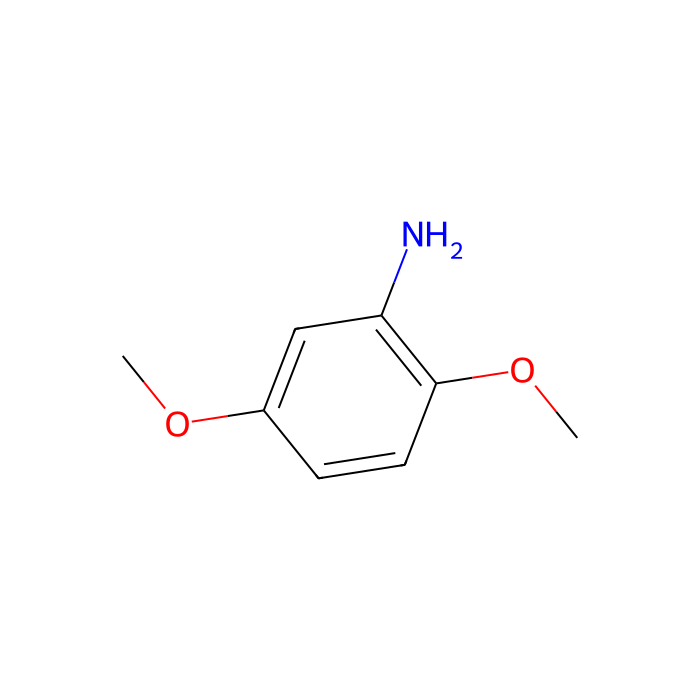
Core ring system: 1,4-disubstituted benzene bearing an anilino group (–NH2) and two methoxy groups (–OCH3).
Substitution pattern: Amino at position 1; methoxy groups at positions 2 and 5 (ortho and para relative to –NH2). Both –NH2 and –OMe are strong ortho/para directors and ring-activating substituents.
Protonation behavior: The aniline nitrogen forms an anilinium ion under acidic conditions (conjugate acid pKaH typically ~5–5.5 for dimethoxy-substituted anilines; literature).
2D structure in words:
A benzene ring with –NH2 at C1, –OCH3 at C2 (adjacent to –NH2), and –OCH3 at C5 (para to C2 and meta to –NH2). The two methoxy groups increase electron density on the ring and mildly increase basicity of the aniline nitrogen relative to aniline.
Synthetic Utility
Key functional elements and reactivity (literature):
Nucleophilic center: Primary aniline nitrogen readily acylates, carbamoylates, or participates in Buchwald–Hartwig couplings (as nucleophile) to give N-arylated products.
Activated aryl ring: Strongly electron-rich due to –NH2 and two –OMe groups; highly susceptible to EAS (nitration, sulfonation, halogenation). N-acyl protection is recommended to temper reactivity and steer regioselectivity.
Diversification via diazonium chemistry: Formation of the corresponding diazonium salt enables Sandmeyer and related transformations (Ar–X, Ar–CN, Ar–BF4→Ar–F) and azo couplings.
Oxidation handles: Controlled oxidation can access quinone-imine/benzoquinone derivatives, relevant to materials science.
Retrosynthetic value:
Serves as a versatile donor ring fragment for constructing push–pull architectures (e.g., diarylamines, triarylamines) with tailored electronic properties.
Methoxy groups act as latent handles for demethylation (e.g., BBr3, AlCl3/thiols) to phenols, enabling subsequent etherification or cross-coupling via triflation.
Protection/deprotection tactics:
Convert –NH2 to acetanilide or carbamate to suppress overreaction in EAS; deprotect under acidic/basic conditions as appropriate.
Scale-up notes:
Electron-rich anilines can tar on acidic catalysts—maintain low temperatures and controlled addition. Monitor for colored byproducts; employ antioxidants/exclusion of air/light as needed.
Target Specificity
Not applicable. This product is a small-molecule chemical building block, not a biological affinity reagent. No antigen/epitope, clone, isotype, or species reactivity information applies.
Frequently Asked Questions
What is the purity of this product?
This product is supplied at ≥97% purity (chemical assay). Lot-specific values are stated on the Certificate of Analysis.
How should this product be stored?
Store at room temperature, protected from light, under argon. It is supplied under an argon blanket; reseal under inert gas after each use.
How is this product shipped?
This product ships under standard ambient conditions. No temperature-controlled packaging is required.
What are the CAS number, molecular formula and molecular weight?
The CAS Number is 102-56-7, the molecular formula is C8H11NO2, and the molecular weight is 153.18 g/mol. InChIKey NAZDVUBIEPVUKE-UHFFFAOYSA-N.
What documentation is provided?
Available product documentation, including Certificates of Analysis (COA), Safety Data Sheets (SDS), and specification sheets, is shown in the product document area. Document availability and access follow the current site policy.
We use cookies to ensure the website functions properly and, where permitted, to improve your experience. You can manage your preferences at any time in Settings. Learn more in our Cookie Policy.
Shall we send you a message when we have discounts available?
Remind me later
Thank you! Please check your email inbox to confirm.
Products are supplied to verified businesses, institutions, and qualified professionals for research and development use only. Not for use in humans, animals, diagnosis, or therapy.

 J2213514