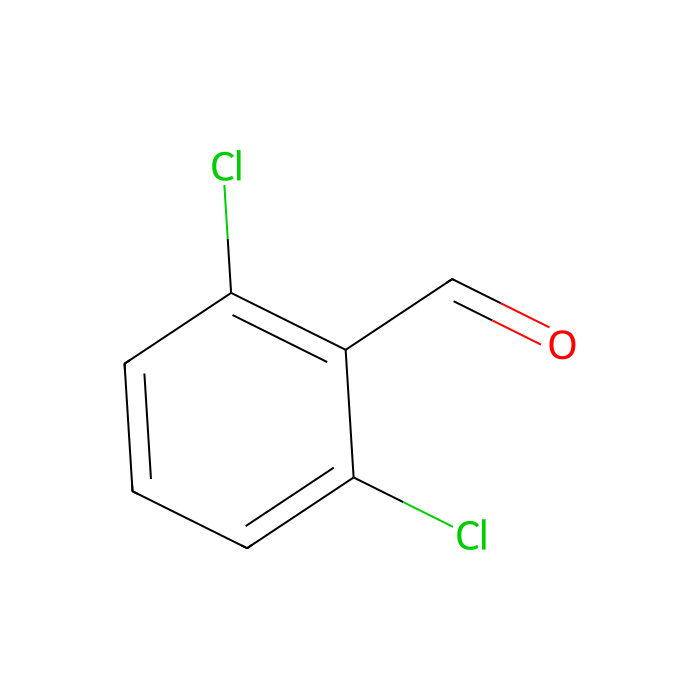
2,6-Dichlorobenzaldehyde - ≥98% , CAS No.83-38-5

CAS: 83-38-5 Cat. No.: D129145 Formula: C7H4Cl2O Molecular Weight: 175.01 Beilstein Registry Number: 386477 EC Number: 201-472-2
AVAILABLE TO ORDER
GRADE & PURITY ≥98%
Synonyms
2,6-dichloro benzaldehyde|2,6-dichloro -benzaldehyde|(2,6-dichlorophenyl)methanone|Benzaldehyde, 2,6-dichloro-|2,6-DICHLOROBENZALDEHYDE|2,6-dichloro-benzaldehyde|2,6dichloro-benzaldehyde|O,O'-DICHLOROBENZALDEHYDE|Benzaldehyde,6-dichloro-
Storage
Room temperature,Argon charged
Shipped In
Normal
★
Size
Germany (EU)
USA*
Price
Qty
10g
D129145-10g
—
3 In stock

€9.46

€14.66
Save €5.21 (35.50%)
100g
D129145-100g
—
3 In stock

€19.00

€28.55
Save €9.55 (33.43%)
500g
D129145-500g
1 In stock
2 In stock

€59.79

€90.16
Save €30.37 (33.69%)
Enter a quantity for the sizes you want to add.

Specifications

Synonyms
2,6-dichloro benzaldehyde | 2,6-dichloro -benzaldehyde | (2,6-dichlorophenyl)methanone | Benzaldehyde, 2,6-dichloro- | 2,6-DICHLOROBENZALDEHYDE | 2,6-dichloro-benzaldehyde | 2,6dichloro-benzaldehyde | O,O'-DICHLOROBENZALDEHYDE | Benzaldehyde,6-dichloro-
Specifications & Purity
≥98%
Storage
Room temperature,Argon charged
Shipped In
Normal
Purity
≥98%
Names and Identifiers
Pubchem Sid
Pubchem Sid Url
https://pubchem.ncbi.nlm.nih.gov/substance/504751161
SMILES
C1=CC(=C(C(=C1)Cl)C=O)Cl
IUPAC Name
2,6-dichlorobenzaldehyde
InChIKey
DMIYKWPEFRFTPY-UHFFFAOYSA-N
InChI
1S/C7H4Cl2O/c8-6-2-1-3-7(9)5(6)4-10/h1-4H
Isomeric SMILES
C1=CC(=C(C(=C1)Cl)C=O)Cl
WGK Germany
2
UN Number
1759
Packing Group
I
Molecular Weight
175.01
Beilstein
386477
Reaxys
386477
Reaxys-RN_link_address
https://www.reaxys.com/reaxys/secured/hopinto.do?context=S&query=IDE.XRN=386477&ln=

Advanced Data

Taxonomic Classification

Taxonomy Tree

KingdomOrganic compounds
SuperclassBenzenoids
ClassBenzene and substituted derivatives
SubclassHalobenzenes
Intermediate Tree Nodes Chlorobenzenes
Direct ParentDichlorobenzenes
Alternative Parents Benzoyl derivatives  Benzaldehydes  Aryl chlorides  Vinylogous halides  Organochlorides  Organic oxides  Hydrocarbon derivatives  
Molecular FrameworkAromatic homomonocyclic compounds
Substituents 1,3-dichlorobenzene - Benzoyl - Benzaldehyde - Aryl-aldehyde - Aryl halide - Aryl chloride - Vinylogous halide - Organic oxygen compound - Organic oxide - Hydrocarbon derivative - Organooxygen compound - Organochloride - Organohalogen compound - Aldehyde - Aromatic homomonocyclic compound
DescriptionThis compound belongs to the class of organic compounds known as dichlorobenzenes. These are compounds containing a benzene with exactly two chlorine atoms attached to it.
External Descriptors Not available
3D Structure
Interactive Chemical Structure Model


Associated Targets(Human)
NR3C1 Tclin Glucocorticoid receptor (14987 Activities)
Activity TypeRelationActivity valueUnitsAction TypeJournalPubMed IddoiAssay Aladdin ID
SLC6A1 Tclin GABA transporter 1 (308 Activities)
Activity TypeRelationActivity valueUnitsAction TypeJournalPubMed IddoiAssay Aladdin ID
MPO Tchem Myeloperoxidase (1002 Activities)
Activity TypeRelationActivity valueUnitsAction TypeJournalPubMed IddoiAssay Aladdin ID
ALDH1A1 Tchem Aldehyde dehydrogenase 1A1 (77053 Activities)
Activity TypeRelationActivity valueUnitsAction TypeJournalPubMed IddoiAssay Aladdin ID
NR1H4 Tclin Bile acid receptor FXR (6228 Activities)
Activity TypeRelationActivity valueUnitsAction TypeJournalPubMed IddoiAssay Aladdin ID
Lymphoblastoid cell (5959 Activities)
Activity TypeRelationActivity valueUnitsAction TypeJournalPubMed IddoiAssay Aladdin ID
POLK Tbio DNA polymerase kappa (8653 Activities)
Activity TypeRelationActivity valueUnitsAction TypeJournalPubMed IddoiAssay Aladdin ID
TDP1 Tchem Tyrosyl-DNA phosphodiesterase 1 (345557 Activities)
Activity TypeRelationActivity valueUnitsAction TypeJournalPubMed IddoiAssay Aladdin ID
GMNN Tbio Geminin (128009 Activities)
Activity TypeRelationActivity valueUnitsAction TypeJournalPubMed IddoiAssay Aladdin ID
CBX1 Tbio Chromobox protein homolog 1 (92434 Activities)
Activity TypeRelationActivity valueUnitsAction TypeJournalPubMed IddoiAssay Aladdin ID
IDH1 Tclin Isocitrate dehydrogenase [NADP] cytoplasmic (40980 Activities)
Activity TypeRelationActivity valueUnitsAction TypeJournalPubMed IddoiAssay Aladdin ID
Associated Targets(non-human)
Plasmodium falciparum (966862 Activities)
Activity TypeRelationActivity valueUnitsAction TypeJournalPubMed IddoiAssay Aladdin ID
B16-F10 (4610 Activities)
Activity TypeRelationActivity valueUnitsAction TypeJournalPubMed IddoiAssay Aladdin ID
Rorc Nuclear receptor ROR-gamma (89407 Activities)
Activity TypeRelationActivity valueUnitsAction TypeJournalPubMed IddoiAssay Aladdin ID
Mechanisms of Action
Certificates (CoA,COO,BSE/TSE and Analysis Chart)
C of A & Other Certificates(BSE/TSE, COO):
Analytical Chart:

Find and download the COA for your product by matching the lot number on the packaging.

4 results found

Lot NumberCertificate TypeDateItem
E2203202E2203202Certificate of AnalysisFeb 04, 2026 D129145
E2203236E2203236Certificate of AnalysisFeb 04, 2026 D129145
C1404098C1404098Certificate of AnalysisNov 10, 2025 D129145
G2410065G2410065Certificate of AnalysisFeb 17, 2022 D129145
Chemical and Physical Properties
SensitivityAir Sensitive
x_flash_point_drop_fahrenheit212 °F
x_flash_point_drop_centigrade>100℃
x_boil_point_char165°C
x_melt_point_char71°C
Molecular Weight175.01
XLogP32.600
Hydrogen Bond Donor Count0
Hydrogen Bond Acceptor Count1
Rotatable Bond Count1
Exact Mass173.964 Da
Monoisotopic Mass173.964 Da
Topological Polar Surface Area17.100 Ų
Heavy Atom Count10
Formal Charge0
Complexity117.000
Isotope Atom Count0
Defined Atom Stereocenter Count0
Undefined Atom Stereocenter Count0
Defined Bond Stereocenter Count0
Undefined Bond Stereocenter Count0
The total count of all stereochemical bonds0
Covalently-Bonded Unit Count1
Safety and Hazards(GHS)
x_symbol
GHS05,   GHS09
x_signal_word
Danger
x_hazard_statements

H314:Causes severe skin burns and eye damage

H411:Toxic to aquatic life with long lasting effects

x_precautionary_statements

P260:Do not breathe dust/fume/gas/mist/vapors/spray.

P264:Wash hands [and …] thoroughly after handling.

P273:Avoid release to the environment.

P280:Wear protective gloves/protective clothing/eye protection/face protection.

P321:Specific treatment (see ... on this label).

P363:Wash contaminated clothing before reuse.

P391:Collect spillage.

P301+P330+P331:IF SWALLOWED: Rinse mouth. Do NOT induce vomiting.

P304+P340:IF INHALED: Remove person to fresh air and keep comfortable for breathing.

P405:Store locked up.

P501:Dispose of contents/container to an approved waste disposal plant.

P305+P354+P338:IF IN EYES: Immediately rinse with water for several minutes. Remove contact lenses if present and easy to do. Continue rinsing.

P302+P361+P354:IF ON SKIN: Take off Immediately all contaminated clothing. Immediately rinse with water for several minutes.

P316:Get emergency medical help immediately.

x_wgk_germany
2
x_reaxy_rn
386477
x_reaxys_rn_link_address
https://www.reaxys.com/reaxys/secured/hopinto.do?context=S&query=IDE.XRN=386477&ln=
x_cas_class
8
Citations of This Product
Solution Calculators
Reviews

Customer Reviews

Application Protocols

No item-specific, tested bioassay or analytical protocols are provided in the Product Data. As a general-purpose building block, protocol choice depends on the intended synthetic transformation.

General synthetic handling (literature/typical):

  • Dissolution: Prepare stock solutions in dry DCM, THF, toluene, MeCN, or EtOAc under inert gas; determine concentration gravimetrically.
  • Moisture/air control: Degas solvents (sparge with argon or perform freeze–pump–thaw). Use oven-dried glassware. Keep headspace under argon as per Product Data.
  • Reaction monitoring: TLC (hexanes/EtOAc), GC–FID, or LC–MS. Aldehyde shows strong IR C=O band (ca. 1690–1710 cm−1).
  • Workup: For basic reactions, quench carefully to avoid Cannizzaro side products; for oxidative steps, neutralize oxidants and extract into greener solvents where possible.
  • Purification: Crystallization from hexanes/EtOAc or EtOAc/MeOH; or silica gel chromatography (avoid prolonged strong base on silica).

If you require a validated, step-by-step protocol for a specific reaction class (e.g., Wittig, TEMPO oxidation, Suzuki coupling), request application notes tailored to your scale and equipment.

Biological Roles

This compound is a synthetic aromatic aldehyde and is not a natural metabolite. No item-specific biological data are provided in the Product Data. The following are general, literature-based considerations for aldehydes; they are not clinical or therapeutic claims.

  • Reactivity with biomolecules (general): Aldehydes can form reversible Schiff bases with primary amines (e.g., lysine residues) and can further undergo reduction to stabilize adducts. The ortho-dichloro substitution increases lipophilicity and may enhance membrane association relative to benzaldehyde, but also reduces ring reactivity.
  • Enzyme interactions: Non-specific covalent or reversible interactions via imine formation are possible under physiological-like conditions, but 2,6-dichlorobenzaldehyde is not recognized as a specific enzyme substrate or cofactor in metabolism.
  • Biotransformation: Typical metabolic fates of aromatic aldehydes include oxidation to the corresponding carboxylic acids (via aldehyde dehydrogenases) and reduction to benzyl alcohols (via aldo-keto reductases), followed by conjugation (glucuronidation/sulfation) for excretion.
  • Toxicology notes (general): Halogenated aromatic aldehydes can exhibit irritancy and may display aquatic toxicity. Handle strictly for research use in appropriate containment.

Conclusion: Use is primarily as a chemical intermediate or probe in biochemical research settings, not as a buffer component, nutrient, or biopolymer building block.

Buffer Applications

Not typically applicable. 2,6-Dichlorobenzaldehyde is a hydrophobic aromatic aldehyde and does not serve as a buffering agent. It is only sparingly soluble in water and lacks acid/base conjugate pairs in the physiological pH range. For aqueous biochemical work, consider using it as an organic-phase reagent or in biphasic/organic media and refer to the Reaction & Applications and Synthetic Utility sections for relevant uses.

Green Alternatives

As a substrate, 2,6-dichlorobenzaldehyde itself is not replaceable when its exact structure is desired. However, greener choices can be made for solvents and reagents in its transformations.

Greener solvent choices (literature/general):

  • Replacement of chlorinated solvents:
    • DCM/CHCl3 → EtOAc, 2-MeTHF, CPME where feasible (extractions, crystallizations, many condensations).
  • Ether alternatives:
    • THF → 2-MeTHF or CPME (comparable performance in Grignard/Wittig; reduced peroxide concerns vs THF, better phase separation, often bio-based).
  • Aromatics:
    • Toluene → p-cymene or anisole when high-temperature non-polar media are needed, mindful of boiling points and reactivity.

Representative comparison (general; not item-specific):

  • DCM vs EtOAc

    • EHS profile: DCM is a chlorinated solvent with higher environmental/health concerns; EtOAc is biodegradable with lower toxicity.
    • Process impact: DCM evaporates readily; EtOAc requires slightly more energy to remove but improves E-factor.
  • THF vs 2-MeTHF

    • EHS profile: 2-MeTHF can be derived from biomass (furfural); lower miscibility with water aids workups.
    • Reactivity: Similar for many nucleophilic additions and Wittig reactions; always confirm on small scale.

Greener reagents/conditions:

  • Oxidations: Prefer TEMPO/NaClO, Oxone, or catalytic aerobic oxidations over Cr(VI)/Mn(VII) reagents.
  • Reductions: Catalytic hydrogenation or mild hydrides (NaBH4 in green solvents) over stoichiometric metal hydrides in hazardous media.
  • Energy: Employ flow chemistry, photoredox, or microwave assistance to shorten times and reduce solvent volumes.
Pharmaceutical Uses

Item-specific pharmacopeial status, GMP grade, and excipient suitability are not provided in the Product Data.

General, literature-based context (not item-specific; no therapeutic claims):

  • Role: Used as a synthetic intermediate in the preparation of bioactive scaffolds where ortho-dichloro substitution imparts steric and electronic effects. Typical downstream transformations include imine formation/reduction (to benzylamines), Wittig/HWE olefinations (to styrenes), and oxidation (to benzoic acids) used in drug and agrochemical discovery.
  • Formulation/excipient use: Aromatic aldehydes are generally not used as excipients due to reactivity with amines and proteins; they can cause discoloration and instability in formulations. Consequently, if present, they are typically treated as impurities to be minimized.
  • Impurity/ICH perspective: Aldehydes are considered reactive impurities; control strategies may involve specification limits, scavenging (e.g., with amino resins), or in situ conversions to less reactive derivatives.
  • Process considerations: For scale-up, attention is paid to containment (odor), off-gassing during heating, and oxidation control. Greener solvents (EtOAc, 2-MeTHF) and catalytic transformations (aerobic oxidations, transfer hydrogenations) are often preferred in line with QbD and sustainability targets.

For regulated applications, request grade documentation and full CoA/SDS to confirm compliance with internal specifications.

Physical Properties

Item-specific specifications (purity, appearance, exact numeric limits) are not provided in the Product Data. Consult the CoA/Spec Sheet for definitive values.

Literature/typical properties for 2,6-dichlorobenzaldehyde (reference only; not item-specific):

  • Phase/appearance (literature): crystalline solid
  • Melting point (literature): ~49–52 °C
  • Boiling point (literature): ~244–246 °C at 1 atm (with some decomposition possible upon prolonged heating)
  • Density (literature): solid; liquid density near mp is not commonly reported
  • Solubility (literature):
    • Water: very low solubility (typical of dichloroaryl aldehydes)
    • Organic: good solubility in alcohols (MeOH/EtOH), ethers (THF, MTBE), chlorinated solvents (DCM, CHCl3), esters (EtOAc), aromatics (toluene)
  • LogP (literature, estimated): moderately lipophilic (approx. 2.5–3)
  • pKa: not applicable (aldehyde; no acidic protons on carbonyl carbon)
  • UV characteristics (literature): π→π* aromatic/aldehyde absorption; UV cutoff not standardized; use low-UV solvents for HPLC detection applications
  • Vapor pressure (literature): low at ambient temperature; handle in well-ventilated hood to minimize odor exposure

General considerations (chemistry knowledge):

  • The ortho dichloro substituents increase crystallinity and mp versus benzaldehyde, and decrease water solubility.
  • Aldehydes can undergo slow air oxidation to the corresponding acid; minimize heat and air exposure to preserve material integrity.
Quality and Grades

Item-specific grade, purity, appearance, and detailed specification limits are not provided in the Product Data for SKU D129145.

  • Not specified for this item; refer to CoA/Spec Sheet.

General guidance (chemistry/manufacturing context):

  • Common commercial grades for aromatic aldehydes include:
    • Research grade: suitable for general synthesis and screening.
    • Purified/recrystallized grade: tighter limits on residual solvents and related aromatics.
    • Chromatography (HPLC/GC) grade: controlled UV background and low non-volatile residue (when supplied as solution or when intended for analytical use).
  • Stabilizers: Aromatic aldehydes are typically supplied neat without stabilizers; quality is maintained by limiting exposure to air (oxygen), light, and moisture. The Product Data specify argon charging, which helps minimize oxidative degradation to 2,6-dichlorobenzoic acid.
  • Identity/assay verification typically includes: 1H/13C NMR (formyl signal ~9.9–10.2 ppm), IR (C=O ~1690–1710 cm−1 with aryl shifts), GC/LC purity, and MS (M+ at m/z 175 with 3:1 35Cl/37Cl isotopic pattern, plus 175/177 doublet).

Recommendation: For air-/oxidation-sensitive applications (e.g., low-level impurity studies), request most recent CoA, including assay, water content, and impurity profile. If trace metals or peroxides are critical, specify acceptance criteria and obtain a custom specification if needed.

Reaction and Applications

2,6-Dichlorobenzaldehyde is a versatile electrophile whose reactivity is shaped by the ortho dichloro substituents (deactivating, weakly ortho/para directing) that modulate both the ring and carbonyl chemistry.

Key transformations (literature/general):

  • Nucleophilic additions to the aldehyde: Grignard/organolithium reagents give secondary alcohols (work in dry ether/THF, 0–25 °C). Hydride reductions (NaBH4, DIBAL-H) provide 2,6-dichlorobenzyl alcohol.
  • Oxidations: to 2,6-dichlorobenzoic acid (Jones, KMnO4, TEMPO/bleach, Pinnick, or O2/catalyst). Aldehyde hydration is slow; oxidations are often high yielding.
  • Condensations: Schiff bases with amines (imine formation; catalytic acid or dehydrating conditions). Knoevenagel/Perkin condensations with active methylenes or anhydrides under base or amine catalysis (toluene, Dean–Stark).
  • Wittig/Horner–Wadsworth–Emmons: efficient alkenylation to (E/Z)-2,6-dichlorostyrenes; control E/Z via ylide type/temperature.
  • Cannizzaro (non-enolizable aldehyde behavior): under strong base (e.g., concentrated NaOH) disproportionation to 2,6-dichlorobenzyl alcohol and 2,6-dichlorobenzoate.
  • Multicomponent: Passerini and Ugi reactions using the aldehyde component to generate peptidomimetics and diverse scaffolds.
  • Ring chemistry: The aryl chlorides serve as handles for cross-coupling (Suzuki, Buchwald–Hartwig after conversion or via direct C–Cl activation with suitable catalysts); ortho dichloro substitution affords regioselective couplings.

Applications:

  • Intermediate to agrochemical and material science motifs where ortho-chloro substitution impacts sterics/electronics.
  • Useful in producing sterically encumbered ligands and heterocycles where ortho dihalogenation influences conformation and reactivity.

Practical tips:

  • Maintain inert atmosphere (argon) to suppress oxidation.
  • For base-catalyzed condensations, limit exposure time to avoid side reactions (Cannizzaro).
Reaction Conditions

The following are general, literature-based conditions for common transformations of 2,6-dichlorobenzaldehyde; they are guidance only and not item-specific.

  • Grignard addition (to form secondary alcohols):

    • Solvent: dry THF or Et2O; inert atmosphere.
    • Temperature: 0 °C to RT.
    • Stoichiometry: 1.1–1.5 equiv RMgX.
    • Workup: saturated NH4Cl or aqueous acid quench; typical isolated yields 70–90% depending on R.
  • NaBH4 reduction (to benzyl alcohol):

    • Solvent: MeOH, EtOH, or MeOH/THF.
    • Temperature: 0–25 °C.
    • Stoichiometry: 1.1–2.0 equiv NaBH4; 30–120 min; yields often 80–95%.
  • TEMPO/bleach oxidation (to acid):

    • Solvent: MeCN/H2O or EtOAc/H2O with NaHCO3 buffer.
    • Catalyst: TEMPO (1–5 mol%), NaClO (1.2–2.0 equiv as active chlorine), KBr (co-catalyst) optional.
    • Temp: 0–25 °C; 1–4 h; yields typically 80–95%.
  • Wittig olefination:

    • Solvent: THF or toluene.
    • Base: n-BuLi or NaHMDS to generate ylide if not preformed.
    • Temp: −78 °C to RT; E/Z control via ylide type; 60–90% yields common.
  • Knoevenagel condensation:

    • Partners: malononitrile, ethyl cyanoacetate, etc.
    • Catalyst: piperidine, pyridine, or ammonium acetate.
    • Solvent: toluene (Dean–Stark) or EtOH; 60–95% yields.
  • Suzuki coupling (on aryl chloride):

    • Catalyst: Pd2(dba)3 or Pd(OAc)2 with SPhos/XPhos (2–5 mol%).
    • Base: K3PO4 or Cs2CO3.
    • Solvent: toluene/H2O or dioxane/H2O.
    • Temp: 90–120 °C; 4–24 h; yields variable (40–85%) due to C–Cl activation.

Always dry solvents and exclude air/moisture, consistent with the Product Data’s argon storage guidance.

Safety and Handling

Item-specific GHS details (signal word, H-statements, pictograms) are not provided in the Product Data. Always refer to the product SDS for authoritative hazard, first-aid, and regulatory information.

General safety profile for aromatic aldehydes (literature/typical; not item-specific):

  • Likely hazards: skin/eye irritation, respiratory irritation, harmful if swallowed; may be hazardous to aquatic life due to halogenation.
  • Odor: characteristic aromatic/aldehydic odor—use in a fume hood.

PPE and engineering controls (good laboratory practice):

  • Wear lab coat, safety glasses or face shield, and appropriate chemically resistant gloves (e.g., nitrile). Work in a certified chemical fume hood.
  • Avoid breathing vapors or dust; avoid skin/eye contact. Wash thoroughly after handling.

Handling and storage:

  • From Product Data: store at room temperature under inert gas (argon charged). Keep container tightly closed. Protect from moisture, air, and prolonged light exposure to limit oxidation to the corresponding benzoic acid.
  • Incompatibilities (general): strong oxidizers (may accelerate oxidation), strong bases (can promote Cannizzaro-type reactions), strong reducing agents (reduce to benzyl alcohol), and reactive metals.

First-aid measures (overview; defer to SDS):

  • Inhalation: move to fresh air; seek medical attention if symptoms persist.
  • Skin/eye contact: rinse with plenty of water; remove contaminated clothing; seek medical attention for persistent irritation.
  • Ingestion: rinse mouth; do not induce vomiting; seek medical attention.

Spill/fire response:

  • Contain solids to prevent dusting; absorb with inert material for disposal. Combustible solid; use CO2, dry chemical, or foam to extinguish. Combustion may produce HCl and phosgene—firefighters should use SCBA.
Solvent Selection

As a moderately lipophilic aromatic aldehyde, 2,6-dichlorobenzaldehyde dissolves readily in many organic solvents and poorly in water.

  • Polarity/miscibility (literature/general):
    • Preferred solvents for dissolution: DCM, CHCl3, THF, EtOAc, toluene, MeOH/EtOH, acetonitrile.
    • Poorly soluble in: water, hexanes (solubility improves on warming or with small amounts of polar co-solvent).
  • Dielectric perspective (literature): effective dissolution in solvents with ε ≈ 4–40 (toluene → MeCN).
  • Chromatography: Typically elutes at moderate to high Rf in hexanes/EtOAc (3:1 to 1:1); aldehyde band can trail—add 0.1–1% Et3N if needed to sharpen, but avoid prolonged base exposure.

When to choose what:

  • DCM/EtOAc: fast dissolution at RT; good for extractions and workups.
  • THF/Et2O: preferred for nucleophilic additions (Grignard, organolithium) and Wittig; dry, oxygen-free conditions recommended.
  • Toluene: thermal condensations (Perkin/Knoevenagel) with Dean–Stark water removal.
  • Alcohols (MeOH/EtOH): reductions (NaBH4), imine formation with amines; watch for acetal/hemiacetal formation under acid.
  • MeCN: oxidative conversions and CN-based condensations; good for photoredox setups due to transparency.

Comparison (general considerations):

  • THF vs 2-MeTHF: similar solubility; 2-MeTHF is greener and less miscible with water, aiding separations.
  • DCM vs EtOAc: DCM offers superior solvency and volatility; EtOAc is greener, biodegradable, and non-chlorinated.
Storage and Reconstitution
  • Item-specific storage (from Product Data): Store at room temperature under argon (argon charged). Ship under normal conditions. Keep container tightly sealed.

  • Additional handling guidance (general chemistry):

    • Aldehydes are prone to slow air oxidation to the corresponding acid; inert headspace (as provided) reduces this pathway. Minimize repeated air exchange by using septum-sealed bottles or transferring to crimp vials for long-term storage.
    • Protect from moisture and strong light; store in a dry place. Desiccant in the outer container can help in humid environments.
    • If solidifies/crystallizes unevenly, gently warm (30–40 °C) under inert gas to homogenize, then allow to cool before dispensing, avoiding prolonged heating.
    • Do not freeze–thaw aqueous systems (not applicable here); the compound is typically handled neat or in anhydrous organic solvents.
  • Reconstitution notes:

    • Not applicable as a lyophile. For solution preparation, dissolve the required mass in a dry, oxygen-free organic solvent (e.g., THF, DCM, EtOAc, toluene, MeCN). Filter through a PTFE syringe filter if particulates are present.
    • Record concentration gravimetrically; store solutions under inert gas at low temperature (e.g., 2–8 °C) where compatible with the solvent, and use within days to weeks to limit oxidation.

For precise shelf-life and re-test intervals, consult the product CoA/Spec Sheet.

Structure and Identity

A deactivated, ortho,ortho-dichloro–substituted aromatic aldehyde used as a versatile electrophilic building block.

  • Item-specific (from Product Data)

    • SKU: D129145
    • Product Name: 2,6-Dichlorobenzaldehyde
    • CAS: 83-38-5
    • CID: 6737
    • InChIKey (as provided): 67208
    • Storage: Room temperature, Argon charged
    • Shipped In: Normal
    • Research Use Note: For research use only
  • Computed/Literature structural identifiers (for reference; not item-specific)

    • Molecular formula (literature): C7H4Cl2O
    • Molecular weight (literature): 175.01 g/mol
    • SMILES (literature): O=Cc1c(Cl)cccc1Cl
    • InChIKey (literature): OXHINKBRPSLKDF-UHFFFAOYSA-N
  • Structural features (general chemistry)

    • Core: monosubstituted benzaldehyde ring bearing two ortho chlorine atoms at C2 and C6 relative to the aldehyde.
    • Functional groups: aromatic ring; aldehyde (–CHO); two aryl chlorides (–Cl) that are deactivating and ortho/para directing.
    • Electronic effects: strong −I inductive withdrawal from the two ortho chlorides reduces ring nucleophilicity and slightly modulates the aldehyde’s reactivity (often increasing chemoselectivity in nucleophilic additions).
    • 2D description: a benzene ring with an aldehyde at position 1, chlorines at positions 2 and 6. No stereocenters; planar aromatic system with a trigonal planar formyl carbon.

Notes: Where the Product Data omit or differ (e.g., SMILES), literature identifiers above are provided for convenience; consult the CoA/Spec Sheet for definitive item identifiers.

Synthetic Utility

Functional group handles and their leverage:

  • Aldehyde (–CHO):
    • Electrophile for nucleophilic additions (RMgX, RLi → secondary alcohols; NaBH4 → primary alcohol).
    • Condensation partner (imines/oximes/hydrazones; Knoevenagel/Perkin with active methylenes/anhydrides).
    • Olefination via Wittig/HWE to access 2,6-dichlorostyrenes.
    • Oxidation to 2,6-dichlorobenzoic acid (robust and high-yielding with TEMPO/bleach, Pinnick, or O2 catalysts).
  • Aryl chlorides (2,6-positions):
    • Cross-coupling handles (Suzuki–Miyaura, Buchwald–Hartwig, Negishi, Kumada) under appropriate Pd/Ni catalysis; ortho dichloro substitution often enables stepwise, regioselective coupling.
    • Directed ortho-metalation adjacent to the formyl may be impeded by chlorides but can be accessed with strong bases under cryogenic conditions for further elaboration.

Retrosynthetic value:

  • 2,6-Dichlorobenzaldehyde serves as a convergent node: install the aldehyde late (e.g., via formylation of 2,6-dichloroaryl precursors) or start from the aldehyde and diversify via coupling on the aryl chlorides, enabling rapid SAR around a constant benzylic handle.

Select named reactions (literature/general):

  • Wittig/HWE, Knoevenagel, Perkin, Cannizzaro (base-promoted), Passerini/Ugi, oxime/semicarbazone formation for purification or protection.

Process tips:

  • Maintain inert gas (argon) as specified to suppress oxidation.
  • For couplings, employ ligands optimized for aryl chlorides (e.g., BrettPhos, SPhos, XPhos) and elevated temperatures; microflow or microwave can accelerate difficult C–Cl activations.
Target Specificity

Not applicable. This product is a small-molecule chemical intermediate, not a biological targeting reagent (e.g., antibody, enzyme inhibitor with defined target panel, or nucleic acid). No target, epitope, clone, isotype, or species reactivity information is relevant.

Frequently Asked Questions

What is the purity of this product?
This product is supplied at ≥98% purity (chemical assay). Lot-specific values are stated on the Certificate of Analysis.
How should this product be stored?
Store at room temperature under argon. It is supplied under an argon blanket; reseal under inert gas after each use.
How is this product shipped?
This product ships under standard ambient conditions. No temperature-controlled packaging is required.
What are the CAS number, molecular formula and molecular weight?
The CAS Number is 83-38-5, the molecular formula is C7H4Cl2O, and the molecular weight is 175.01 g/mol. InChIKey DMIYKWPEFRFTPY-UHFFFAOYSA-N.
What documentation is provided?
Available product documentation, including Certificates of Analysis (COA), Safety Data Sheets (SDS), and specification sheets, is shown in the product document area. Document availability and access follow the current site policy.

Shall we send you a message when we have discounts available?

Remind me later

Thank you! Please check your email inbox to confirm.

Oops! Notifications are disabled.