
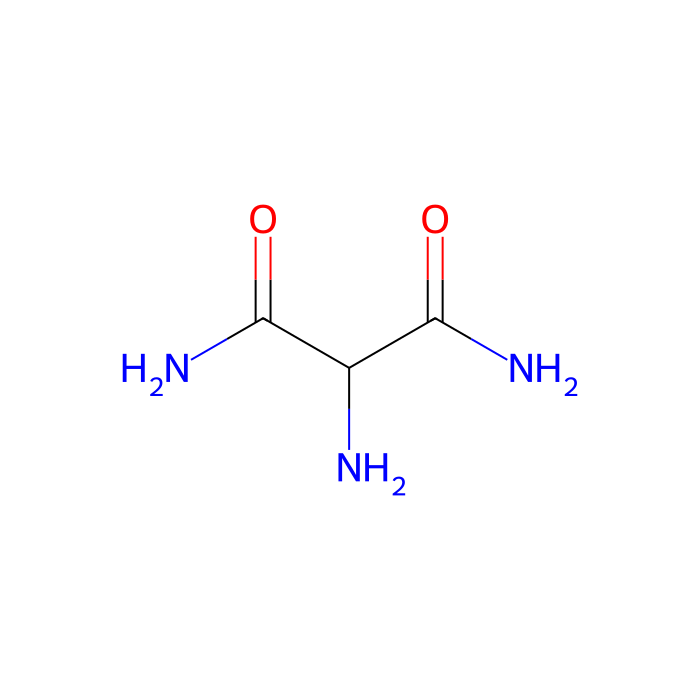
Determine the necessary mass, volume, or concentration for preparing a solution.
2-Aminomalonamide - ≥95% , CAS No.62009-47-6
AVAILABLE TO ORDER
GRADE & PURITY ≥95%
Storage
Room temperature
Shipped In
Normal
Taxonomy Tree
| Kingdom | Organic compounds |
|---|---|
| Superclass | Organic acids and derivatives |
| Class | Carboxylic acids and derivatives |
| Subclass | Amino acids, peptides, and analogues |
| Intermediate Tree Nodes | Amino acids and derivatives - Alpha amino acids and derivatives |
| Direct Parent | Alpha amino acid amides |
| Alternative Parents | 1,3-dicarbonyl compounds Primary carboxylic acid amides Organopnictogen compounds Organic oxides Monoalkylamines Hydrocarbon derivatives |
| Molecular Framework | Aliphatic acyclic compounds |
| Substituents | Alpha-amino acid amide - 1,3-dicarbonyl compound - Carboxamide group - Primary carboxylic acid amide - Organic nitrogen compound - Hydrocarbon derivative - Organic oxide - Organopnictogen compound - Primary amine - Organooxygen compound - Organonitrogen compound - Primary aliphatic amine - Organic oxygen compound - Carbonyl group - Amine - Aliphatic acyclic compound |
| Description | This compound belongs to the class of organic compounds known as alpha amino acid amides. These are amide derivatives of alpha amino acids. |
| External Descriptors | Not available |
Find and download the COA for your product by matching the lot number on the packaging.
| Lot Number | Certificate Type | Date | Item |
|---|---|---|---|
 I2301020 | Certificate of Analysis | Aug 10, 2023 | A185601 |
| I2301021 | Certificate of Analysis | Aug 10, 2023 | A185601 |
| I2301022 | Certificate of Analysis | Aug 10, 2023 | A185601 |
| I2301023 | Certificate of Analysis | Aug 10, 2023 | A185601 |
| I2301024 | Certificate of Analysis | Aug 10, 2023 | A185601 |
| I2301025 | Certificate of Analysis | Aug 10, 2023 | A185601 |
| I2301026 | Certificate of Analysis | Aug 10, 2023 | A185601 |
| I2301027 | Certificate of Analysis | Aug 10, 2023 | A185601 |
| H2309287 | Certificate of Analysis | Jul 20, 2023 | A185601 |
| H2309288 | Certificate of Analysis | Jul 20, 2023 | A185601 |
| H2309291 | Certificate of Analysis | Jul 20, 2023 | A185601 |
| C2308664 | Certificate of Analysis | Jul 29, 2022 | A185601 |
| K2214312 | Certificate of Analysis | Jul 29, 2022 | A185601 |
| K2214353 | Certificate of Analysis | Jul 29, 2022 | A185601 |
| Molecular Weight | 117.11 |
|---|---|
| XLogP3 | -2.600 |
| Hydrogen Bond Donor Count | 3 |
| Hydrogen Bond Acceptor Count | 3 |
| Rotatable Bond Count | 2 |
| Exact Mass | 117.054 Da |
| Monoisotopic Mass | 117.054 Da |
| Topological Polar Surface Area | 112.000 Ų |
| Heavy Atom Count | 8 |
| Formal Charge | 0 |
| Complexity | 108.000 |
| Isotope Atom Count | 0 |
| Defined Atom Stereocenter Count | 0 |
| Undefined Atom Stereocenter Count | 0 |
| Defined Bond Stereocenter Count | 0 |
| Undefined Bond Stereocenter Count | 0 |
| The total count of all stereochemical bonds | 0 |
| Covalently-Bonded Unit Count | 1 |
H302:Harmful if swallowed
H315:Causes skin irritation
H319:Causes serious eye irritation
H335:May cause respiratory irritation
P261:Avoid breathing dust/fume/gas/mist/vapors/spray.
P264:Wash hands [and …] thoroughly after handling.
P270:Do not eat, drink or smoke when using this product.
P271:Use only outdoors or in a well-ventilated area.
P280:Wear protective gloves/protective clothing/eye protection/face protection.
P321:Specific treatment (see ... on this label).
P330:Rinse mouth.
P302+P352:IF ON SKIN: wash with plenty of water.
P304+P340:IF INHALED: Remove person to fresh air and keep comfortable for breathing.
P305+P351+P338:IF IN EYES: Rinse cautiously with water for several minutes. Remove contact lenses if present and easy to do - continue rinsing.
P362+P364:Take off contaminated clothing and wash it before reuse.
P405:Store locked up.
P403+P233:Store in a well-ventilated place. Keep container tightly closed.
P501:Dispose of contents/container to an approved waste disposal plant.
P264+P265:Wash hands [and …] thoroughly after handling. Do not touch eyes.
P301+P317:IF SWALLOWED: Get medical help.
P337+P317:If eye irritation persists: Get medical help.
P332+P317:If skin irritation occurs: Get medical help.
P319:Get medical help if you feel unwell.
No application protocols (e.g., WB, IHC, IF, FC) are applicable to this small-molecule reagent. For chemical use, general handling suggestions include:
For detailed, validated protocols, consult primary literature on condensations and acylations of α‑aminomalonamide derivatives and adapt to your substrate and scale.
No specific biological roles are provided for this product. As a small, synthetic building block, 2-aminomalonamide is primarily intended for chemical research and synthesis.
General biochemical context (not item-specific, no clinical claims):
Important note: This product is for research use only and is not intended for diagnostic, therapeutic, or other clinical applications.
2-Aminomalonamide is not a standard biological buffer and does not have a defined buffering range like HEPES, Tris, or phosphate. Its primary use case is as a synthetic building block rather than a buffering agent.
Practical notes (if dissolution in aqueous systems is required for research workflows):
For buffer-making needs, select established systems (phosphate, acetate, citrate, Tris, MOPS, HEPES) with validated pKa values and ionic strengths appropriate to your application.
Selecting greener media for handling 2-aminomalonamide often centers on solvent choice and coupling auxiliaries, as the substrate itself is a nitrogen-rich, nonvolatile solid.
Greener solvent considerations (general):
Comparison snapshot (general; not item-specific specs):
Process-intensification ideas:
Always validate green substitutions with small-scale trials to confirm chemoselectivity and crystallization behavior.
No pharmacopeial status or excipient role is specified for this item. 2-Aminomalonamide is supplied for research use only.
Formulation/manufacturing context (general considerations for small polar building blocks; not item-specific claims):
Important: This product is not approved for use as an excipient or active ingredient. It must not be used in human or veterinary applications.
Item-specific specifications (this listing):
General/literature and computed properties (for context; not item specifications):
Note: For authoritative numerical specifications (mp, water content, residual solvents, elemental analysis), consult the lot-specific CoA and Specification Sheet.
Item-specific grade/purity: Not specified for this item; refer to CoA/Spec Sheet.
Guidance on grades and what to look for (general):
Stabilizers/additives:
What to check on receipt (best practices):
Note: Always rely on the lot-specific CoA/Spec Sheet for authoritative purity and specification limits.
As a compact, bifunctional nucleophile bearing an α‑amine and two amide groups, 2-aminomalonamide serves as a versatile building block for N‑acylation, condensations, and heterocycle assembly.
Representative application domains (literature/general organic chemistry):
Practical considerations:
General conditions reported in the literature for transformations of α‑aminomalonamide motifs (guidance only; optimize for your substrate and scale):
N‑Acylation of the α‑amine:
Imine formation/cyclocondensation with carbonyls:
Protection of the α‑amine (Boc, Cbz):
Amide activation for further elaboration:
Note: Given the substrate’s high polarity, co-solvents (DMSO, DMF) and salt-formation strategies often improve kinetics and handling.
Authoritative safety information is provided in the SDS. No GHS classification details are specified in the Product Data for this item.
General laboratory safety guidance for aminodiamides (not item-specific):
Storage and handling (per Product Data): Store at room temperature. Keep tightly closed, in a dry place away from incompatible materials. Always refer to the SDS for definitive guidance.
2-Aminomalonamide is a highly polar, strongly hydrogen-bonding solid. Solvent choice is therefore governed by hydrogen-bond donor/acceptor capacity and ability to disrupt the diamide lattice.
General miscibility/solubility tendencies (literature/structure-based):
When to choose which solvent:
Practical tips:
Brief comparison (general):
Always verify solvent compatibility with downstream steps and bases/acids used in your route.
Storage (item-specific):
General handling and reconstitution (guidance):
Documentation: For lot-specific guidance on stability, moisture limits, and solution shelf life, refer to the CoA/Spec Sheet and SDS.
Research Use Note: For research use only.
A bifunctional, highly polar small molecule featuring one α-amino substituent flanked by two amide carbonyls on a three‑carbon backbone.
Structural features (general/literature description):
Computed/literature identity (for reference; not item specifications):
2D structure in words: a three‑carbon chain where the terminal carbons are amide carbonyls; the central carbon bears one hydrogen and one exocyclic amino group, rendering the center chiral.
Functional group set: one nucleophilic primary amine (α to two carbonyls) and two relatively inert carboxamide groups. This constellation enables orthogonal reactivity and selective derivatization.
Key synthetic maneuvers (general/literature-based):
Retrosynthetic value:
Analytical handles:
Not applicable. This product is a small-molecule chemical reagent and is not an antibody, protein, or assay reagent with biological target specificity. No antigen, epitope, clone, isotype, or species reactivity information applies.