Determine the necessary mass, volume, or concentration for preparing a solution.
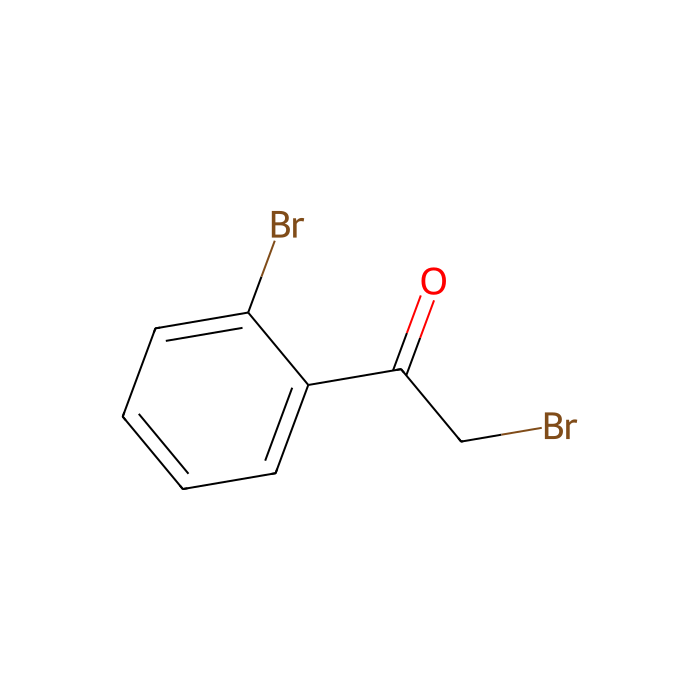
2,2'-Dibromoacetophenone is used in the preparation of 4-phenylthiazol-2(3H)-one derivatives as anticonvulsant agents.
Taxonomy Tree
| Kingdom | Organic compounds |
|---|---|
| Superclass | Organic oxygen compounds |
| Class | Organooxygen compounds |
| Subclass | Carbonyl compounds |
| Intermediate Tree Nodes | Ketones - Aryl ketones - Phenylketones |
| Direct Parent | Alkyl-phenylketones |
| Alternative Parents | Benzoyl derivatives Aryl alkyl ketones Bromobenzenes Aryl bromides Vinylogous halides Alpha-haloketones Organobromides Organic oxides Hydrocarbon derivatives Alkyl bromides |
| Molecular Framework | Aromatic homomonocyclic compounds |
| Substituents | Alkyl-phenylketone - Benzoyl - Aryl alkyl ketone - Bromobenzene - Halobenzene - Aryl bromide - Aryl halide - Monocyclic benzene moiety - Benzenoid - Alpha-haloketone - Vinylogous halide - Alkyl halide - Hydrocarbon derivative - Organic oxide - Alkyl bromide - Organobromide - Organohalogen compound - Aromatic homomonocyclic compound |
| Description | This compound belongs to the class of organic compounds known as alkyl-phenylketones. These are aromatic compounds containing a ketone substituted by one alkyl group, and a phenyl group. |
| External Descriptors | Not available |
Find and download the COA for your product by matching the lot number on the packaging.
| Lot Number | Certificate Type | Date | Item |
|---|---|---|---|
| Certificate of Analysis | Mar 05, 2025 | B151941 | |
| Certificate of Analysis | Mar 05, 2025 | B151941 | |
| Certificate of Analysis | Mar 05, 2025 | B151941 | |
| Certificate of Analysis | Mar 05, 2025 | B151941 | |
| Certificate of Analysis | Mar 05, 2025 | B151941 | |
| Certificate of Analysis | Mar 05, 2025 | B151941 | |
| Certificate of Analysis | Jun 11, 2022 | B151941 | |
| Certificate of Analysis | Jun 11, 2022 | B151941 | |
| Certificate of Analysis | Jun 11, 2022 | B151941 |
| Sensitivity | light sensitive; Moisture sensitive |
|---|---|
| x_refractive_index | 1.6100 to 1.6140 |
| x_flash_point_drop_centigrade | 108 °C |
| x_boil_point_char | 100°C/1.5mmHg |
| Molecular Weight | 277.94 |
| XLogP3 | 3.100 |
| Hydrogen Bond Donor Count | 0 |
| Hydrogen Bond Acceptor Count | 1 |
| Rotatable Bond Count | 2 |
| Exact Mass | 277.876 Da |
| Monoisotopic Mass | 275.879 Da |
| Topological Polar Surface Area | 17.100 Ų |
| Heavy Atom Count | 11 |
| Formal Charge | 0 |
| Complexity | 147.000 |
| Isotope Atom Count | 0 |
| Defined Atom Stereocenter Count | 0 |
| Undefined Atom Stereocenter Count | 0 |
| Defined Bond Stereocenter Count | 0 |
| Undefined Bond Stereocenter Count | 0 |
| The total count of all stereochemical bonds | 0 |
| Covalently-Bonded Unit Count | 1 |
H290:May be corrosive to metals
H314:Causes severe skin burns and eye damage
H318:Causes serious eye damage
P234:Keep only in original container.
P260:Do not breathe dust/fume/gas/mist/vapors/spray.
P264:Wash hands [and …] thoroughly after handling.
P280:Wear protective gloves/protective clothing/eye protection/face protection.
P321:Specific treatment (see ... on this label).
P363:Wash contaminated clothing before reuse.
P390:Absorb spillage to prevent material damage.
P301+P330+P331:IF SWALLOWED: Rinse mouth. Do NOT induce vomiting.
P304+P340:IF INHALED: Remove person to fresh air and keep comfortable for breathing.
P405:Store locked up.
P406:Store in corrosive resistant/... container with a resistant inner liner.
P501:Dispose of contents/container to an approved waste disposal plant.
P264+P265:Wash hands [and …] thoroughly after handling. Do not touch eyes.
P305+P354+P338:IF IN EYES: Immediately rinse with water for several minutes. Remove contact lenses if present and easy to do. Continue rinsing.
P317:Get emergency medical help.
P302+P361+P354:IF ON SKIN: Take off Immediately all contaminated clothing. Immediately rinse with water for several minutes.
P316:Get emergency medical help immediately.