≥97%(GC) for sensitive chromatographic and analytical workflows requiring minimal baseline interference.
🌡
Storage & shipping
Room temperature Ships Normal Check lot-specific COA for exact specifications.
📋
Quality documents
SDS, COA, datasheet, and spec sheet available for download. Lot-specific COA accessible via lot number lookup.
📚
Literature proof
Cited in 0 peer-reviewed publications across chromatography, organic synthesis, and cross-coupling reactions.
Overview
It was used in the synthesis of 2-alkylidenetetrahydrofurans, diphenyllead(IV) thiosemicarbazonates and pyrazolonates. It was used as starting reagent in the synthesis of 2-ethylfumaric acid.
This compound belongs to the class of organic compounds known as beta-keto acids and derivatives. These are organic compounds containing an aldehyde substituted with a keto group on the C3 carbon atom.
External Descriptors
Not available
1. Djoumbou Feunang Y, Eisner R, Knox C, Chepelev L, Hastings J, Owen G, Fahy E, Steinbeck C, Subramanian S, Bolton E, Greiner R, and Wishart DS. ClassyFire: Automated Chemical Classification With A Comprehensive, Computable Taxonomy. Journal of Cheminformatics, 2016, 8:61.
Determine the necessary mass, volume, or concentration for preparing a solution.
Dilution Calculator
Determine the dilution needed to prepare a stock solution.
Reconstitution Calculator
Reviews
Customer Reviews
Application Protocols
Not applicable. No immunoassays or bioassay protocols (WB, IHC, IF, FC) pertain to this small‑molecule reagent. For practical use, see Reaction & Applications and Reaction Conditions for synthetic procedures.
Biological Roles
This compound is a synthetic β‑ketoester used as a chemical building block. It is not a known endogenous metabolite or cofactor.
General context (literature): β‑Ketoesters can mimic 1,3‑dicarbonyl motifs encountered in biochemical ligands, but 2‑ethylacetoacetic acid ethyl ester itself has no established physiological role.
Reactivity in biological media: The β‑dicarbonyl unit can exist in keto–enol tautomerism; in aqueous buffers under strong acid/base, hydrolysis to alcohol/acid (or subsequent decarboxylation to ketones) can occur. Such reactions are of chemical interest but are not biological functions.
Research use only: Per Product Data, this material is for research use only and not for diagnostic, therapeutic, or other clinical applications.
Buffer Applications
Not typically applicable. 2‑Ethylacetoacetic acid ethyl ester is a hydrophobic β‑ketoester prone to hydrolysis in strongly acidic or basic aqueous buffers; it is not used as a buffering agent. For lab work involving this reagent, select organic media discussed under Solvent Selection and Reaction & Applications.
Green Alternatives
While the substance itself is the target reagent, greener choices can be made for reaction media and processing (literature/general):
Prefer 2‑MeTHF or CPME over THF/MTBE where feasible:
2‑MeTHF is bio‑derived, has higher boiling point, better phase separation for workups, and reduced peroxide concerns vs THF.
CPME offers low miscibility with water and broad stability; good for enolate chemistry and extractions.
Replace DMF/DMSO when possible:
MeCN, 2‑MeTHF, or green esters (EtOAc, propylene carbonate in select cases) can provide similar outcomes with improved EHS profiles.
Catalysis and conditions:
Use organocatalysts (e.g., secondary amines) for Michael/Knoevenagel to avoid heavy metals.
Employ solvent‑free or high‑solids conditions for condensations when practicable.
Illustrative comparison (literature):
THF vs 2‑MeTHF in enolate alkylation
Sustainability: 2‑MeTHF preferred (bio‑based, lower energy for separation)
Low‑temp performance: THF widely validated; 2‑MeTHF often comparable
Workup: 2‑MeTHF facilitates aqueous separations; THF is fully miscible with water
Toluene vs CPME in condensations
Air stability: CPME shows lower peroxide formation tendency than ethers like THF/MTBE
Boiling range: CPME bp ~106 °C (literature) enables moderate‑temp reflux vs higher bp toluene
Tradeoffs: Solubility and reaction rates may vary; always evaluate on small scale before process adoption.
Pharmaceutical Uses
No excipient or pharmacopeial status is specified for this item; refer to CoA/Spec Sheet. In a research/manufacturing development context (literature/general):
Role: Versatile intermediate for assembling substituted ketones and heterocycles that may be explored in medicinal chemistry campaigns.
Processing considerations:
Residual solvent and impurity control via distillation or chromatographic purification may be required before downstream transformations.
Hydrolysis/decarboxylation sequences can be leveraged to access substituted methyl ketones.
Regulatory note: This catalog item is for research use only and is not intended for human or veterinary use as a drug or excipient. No therapeutic claims are made.
Physical Properties
Note: No item-specific specifications are provided. The following are literature/general values for reference only; consult the CoA/Spec Sheet for item-specific specifications.
Aggregate state/appearance: Typically a colorless to pale yellow liquid (literature)
Boiling point: Often reported near the low 200s °C at ambient pressure (literature; β‑ketoesters of this size commonly bp ≈ 200–210 °C)
Melting point: Liquid at room temperature (literature)
Density: Frequently near ~1.0–1.03 g/mL at 20–25 °C for related β‑ketoesters (literature range)
Refractive index: β‑Ketoesters of similar structure often nD20 ≈ 1.430–1.440 (literature)
Solubility:
Water: Limited (β‑ketoesters are sparingly soluble; hydrolysis under strong aqueous base/acid conditions is possible) (literature)
Organic: Miscible with common organic solvents (e.g., alcohols, ethers, esters, hydrocarbons) (literature)
Acidity/enolization: Pronounced enol/enolate formation due to 1,3‑dicarbonyl activation; α‑C pKa typically ~10–13 in alcohols and ~9–11 in aprotic media for β‑ketoesters (literature, qualitative)
Partitioning: Moderately lipophilic relative to ethyl acetoacetate due to α‑ethyl substituent (literature, qualitative)
Important: Do not treat the above as product specifications. For exact values applicable to this lot (e.g., density, refractive index), see the product’s CoA/Spec Sheet.
Quality and Grades
Grade/purity: Not specified for this item; refer to CoA/Spec Sheet.
Appearance: Not specified for this item; refer to CoA/Spec Sheet.
What grade typically implies (general guidance):
Research-grade β‑ketoesters are commonly suitable for synthetic applications, alkylations, condensations, and heterocycle synthesis. HPLC or GC assay values, acid value, water content, and stabilizer status are often controlled and listed on the CoA.
Low UV-absorbing grades can be helpful when monitoring reactions by HPLC/UV; however, no UV cutoff or absorbance specs are provided here.
Stabilizers/inhibitors: Not specified for this item; refer to CoA/Spec Sheet. If present (general case), stabilizers can suppress self‑condensation or polymerization; their presence may influence base-sensitive reactions.
Documentation to consult:
Certificate of Analysis (CoA): Lot-specific assay, residual solvents, and impurity profile (if available).
Spec Sheet: Any physical property ranges and handling notes adopted for this catalog item.
Practical QC tips (general): Verify identity by GC–MS or 1H/13C NMR (diagnostic β‑ketoester signals: enolic proton if present, methine at α‑C, ethyl group resonances), and check water content (Karl Fischer) before moisture‑sensitive reactions.
Reaction and Applications
Typical uses of 2‑ethylacetoacetic acid ethyl ester (literature/general):
Enolate chemistry and C–C bond formation:
α‑Alkylation: Deprotonation (e.g., NaOEt/EtOH, LDA/THF) gives the corresponding enolate for SN2 alkylation with primary halides or Michael acceptors. The preinstalled α‑ethyl substituent biases monosubstitution and can influence diastereoselectivity in further transformations.
Michael addition: Soft nucleophile toward α,β‑unsaturated carbonyls; often catalyzed by secondary amines or base.
Condensation reactions:
Knoevenagel condensations with aldehydes/ketones to form substituted enones; subsequent cyclizations enable heterocycle assembly.
Claisen condensations and acylations at the active methine position provide access to elaborated β‑dicarbonyl frameworks.
Heterocycle synthesis:
Hantzsch dihydropyridine synthesis (as a 1,3‑dicarbonyl partner), formation of pyrazoles (with hydrazines), isoxazoles (with hydroxylamines), and pyridones.
Functional group interconversions:
Hydrolysis/decarboxylation sequence (the acetoacetic ester synthesis) to furnish substituted methyl ketones after workup and thermal decarboxylation.
Transesterification to alternate alkyl esters under acid/base catalysis.
Building block in flavors, agrochemicals, and fine chemical intermediates (literature; non-clinical, for research/manufacturing development only).
Practical tips:
Choose base and temperature to control enolate geometry and reactivity (LDA at −78 to −20 °C for kinetic control; alkoxides in alcohol for classical conditions).
Use dry, oxygen‑free conditions for sensitive steps; quench enolates carefully (NH4Cl, HOAc) to avoid over‑alkylation or retro‑condensation.
Monitor by GC or HPLC; β‑ketoesters often show distinct UV absorbance near 210–230 nm (literature, qualitative).
Reaction Conditions
General, literature-based guidance (not product specifications):
Enolate generation and alkylation:
Base/solvent: LDA or LiHMDS in dry THF or 2‑MeTHF, −78 to −20 °C; or NaOEt/EtONa in EtOH (0 °C to reflux) for classical acetoacetic ester alkylation.
Electrophiles: Primary alkyl bromides/iodides (SN2), allylic halides, benzyl halides; use phase‑transfer conditions for less reactive substrates.
Typical times: 0.5–4 h after base formation; monitor by TLC/GC.
Michael additions:
Conditions: Secondary amine catalysis (e.g., piperidine) in EtOH or 2‑MeTHF at rt–60 °C; or base-promoted (K2CO3, DBU) in MeCN/EtOH.
Notes: Control temperature to minimize self‑condensation; remove water if equilibrium-limited.
Condensations (Knoevenagel/Hantzsch):
Solvent: EtOH, iPrOH, toluene, or greener ethers (2‑MeTHF, CPME).
Catalysts: Piperidine, ammonium acetate, or basic alumina (heterogeneous) depending on substrate.
Hydrolysis/decarboxylation sequence:
Hydrolysis: Aqueous base or acid (careful control to avoid over‑cleavage); follow by acidification.
Decarboxylation: Thermal (often 120–180 °C in aqueous acid or neat, literature dependent) to form substituted ketones.
Workup/purification:
Quench enolates with saturated NH4Cl or HOAc; extract into organic phase; wash to remove salts and amines.
Purify by vacuum distillation or flash chromatography; avoid high bath temperatures to limit decomposition.
Always optimize on small scale and consult primary literature for substrate‑specific conditions and expected yields.
Safety and Handling
GHS/Classification: Not specified for this item; refer to SDS for authoritative classification, H‑statements, and pictograms.
Expected hazards (general, literature): Combustible organic liquid; can cause irritation on contact with skin/eyes; harmful if swallowed or inhaled. β‑Ketoesters can undergo hydrolysis under strong acid/base conditions, releasing alcohols/ketones.
PPE: Use lab coat, safety goggles, and suitable chemical-resistant gloves (e.g., nitrile). Work in a fume hood to avoid inhalation of vapors and to control odors.
Storage incompatibilities: Avoid strong bases (risk of rapid enolate formation/condensation), strong acids (acid-catalyzed hydrolysis/transesterification), strong oxidizers, and reactive metals. Keep away from ignition sources and heat.
Handling notes:
Minimize moisture exposure to limit hydrolysis.
For reactions requiring strong bases (e.g., NaOEt, LDA), add base at low temperature to control enolate formation.
Do not distill to dryness; thermal decomposition can occur.
First aid (overview; follow SDS):
Inhalation: Move to fresh air; seek medical attention if symptoms persist.
Skin/eye contact: Rinse with plenty of water for at least 15 minutes; remove contaminated clothing; obtain medical advice if irritation continues.
Ingestion: Rinse mouth; do not induce vomiting; seek medical attention.
Spill/Fire response: Absorb small spills with inert material (vermiculite). Use CO2, dry chemical, or alcohol-resistant foam for fire. Always defer to the SDS for detailed emergency guidance.
Solvent Selection
This product is a liquid reagent, not typically used as a bulk solvent. The following guidance addresses solvents used with this β‑ketoester in synthesis (literature/general):
Polarity class: Moderately polar, protophilic substrate; dissolves well in ethers (THF, MTBE), polar aprotics (DMF, DMSO, MeCN), esters (EtOAc), and alcohols (EtOH, iPrOH).
Dielectric/miscibility (literature, qualitative): Readily miscible with most organic solvents; limited water compatibility due to hydrolysis risk under acidic/basic aqueous conditions.
Choosing a medium:
Enolate alkylations: Use anhydrous THF or toluene (LDA, LiHMDS; −78 to 0 °C) for high kinetic control; or EtOH/EtONa for classical acetoacetic ester alkylations (thermodynamic control, reflux).
Michael additions/Knoevenagel: Alcohols (EtOH, iPrOH) or greener ethers (2‑MeTHF, CPME) often perform well with secondary amine catalysts or base.
Transesterification-sensitive sequences: Prefer aprotic media (THF, toluene) and avoid prolonged heating in alcohols.
Small comparison (literature trends):
THF vs 2‑MeTHF: 2‑MeTHF is greener and tolerates water better; THF offers broader precedent and lower viscosity at low temperature.
DMF/DMSO: Excellent solvation for salts but harder work‑up and EHS concerns; consider MeCN or 2‑MeTHF when feasible.
Drying/conditioning: Use dry solvents and inert atmosphere when working with strong bases or moisture‑sensitive electrophiles to minimize hydrolysis and side reactions.
Storage and Reconstitution
Storage conditions (from Product Data): Store at room temperature. Ship under normal conditions.
Container: Keep tightly closed in a dry, well‑ventilated place. Use amber glass to limit light exposure if long-term storage is anticipated.
Atmosphere: For moisture/base‑sensitive work, consider storing under inert gas (nitrogen/argon) after opening to minimize hydrolysis and oxidation (general recommendation).
Stability considerations (general): Avoid prolonged exposure to strong acids/bases or elevated temperatures to prevent hydrolysis and decomposition. Do not distill to dryness.
Reconstitution: Not applicable; product is typically supplied as a neat liquid. If solidifies under cold conditions, allow to warm to ambient and mix thoroughly before use.
Handling after opening: Record open date; check for changes in odor, color, or GC purity before critical applications. Refer to CoA/Spec Sheet for any lot-specific stability guidance.
Structure and Identity
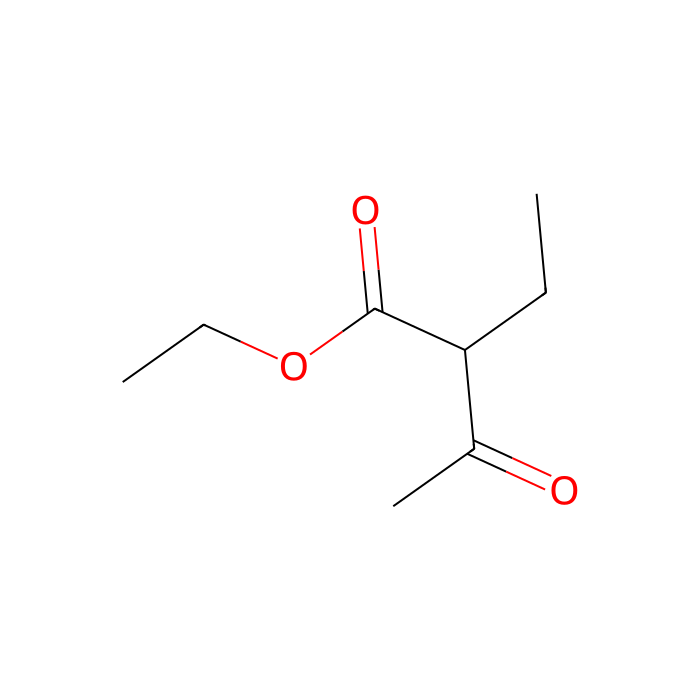
Brief: 2‑Ethylacetoacetic Acid Ethyl Ester is a β‑ketoester (an acetoacetate bearing an α‑ethyl substituent). It is typically used as a versatile C3 synthon and enolate donor in C–C bond‑forming chemistry.
Item-specific identifiers (from Product Data):
SKU: E139068
Product name: 2-Ethylacetoacetic Acid Ethyl Ester
CAS: 607-97-6
InChIKey: Not specified for this item; refer to CoA/Spec Sheet.
SMILES: Not specified for this item; refer to CoA/Spec Sheet.
Literature/computed identity (non-specification; for reference):
Structural features: β‑dicarbonyl system (enolizable α‑C bearing an ethyl substituent), one ester carbonyl and one ketone carbonyl. The α‑carbon is prochiral; material is usually racemic.
2D description: An ethyl ester (–COOEt) attached to the α‑substituted methine (–CH–) which is flanked by a ketone carbonyl (–C(=O)–CH3). The α‑carbon bears an ethyl side chain (–CH2CH3), creating an unsymmetrical β‑ketoester scaffold.
Synthetic Utility
Functional groups and reactivity: The β‑ketoester motif (ketone + ester) stabilizes the α‑carbanion via resonance, enabling selective deprotonation and C–C bond formation. The installed α‑ethyl group provides substitution that can bias stereochemical outcomes in subsequent steps and reduce over‑alkylation.
Named/related reactions (literature):
Acetoacetic Ester Synthesis: Alkylation at the α‑position followed by hydrolysis and decarboxylation to give substituted methyl ketones.
Knoevenagel/Michael cascades: Condensation with carbonyls to enones; further conjugate additions form complex architectures.
Hantzsch synthesis: Construction of 1,4‑dihydropyridines using β‑ketoesters, aldehydes, and ammonia/amine sources.
Pyrazole/Isoxazole formation with hydrazines/hydroxylamines.
Retrosynthetic value: Serves as a C3 synthon; enables masked acyl/methyl equivalents after hydrolysis/decarboxylation. The ester group allows orthogonal manipulations (transesterification, reduction to diols via sequential steps, etc.).
Practical guidance:
Choice of base controls regio-/chemoselectivity: LDA/LiHMDS in aprotic ethers for kinetic enolates; NaOEt/EtONa in EtOH for classical conditions.
Electrophiles: Primary alkyl halides, Michael acceptors, acylating agents (via enolate acylation), and imines (Mannich-type) are common partners.
Workup: Acidic quench to protonate enolates; avoid prolonged acidic aqueous exposure to limit hydrolysis.
Target Specificity
Not applicable. This product is a small-molecule β‑ketoester reagent, not an antibody, enzyme, or affinity reagent. No antigen/epitope or species reactivity is relevant.
We use cookies to ensure the website functions properly and, where permitted, to improve your experience. You can manage your preferences at any time in Settings. Learn more in our Cookie Policy.
Shall we send you a message when we have discounts available?
Remind me later
Thank you! Please check your email inbox to confirm.
Products are supplied to verified businesses, institutions, and qualified professionals for research and development use only. Not for use in humans, animals, diagnosis, or therapy.

 C2327093