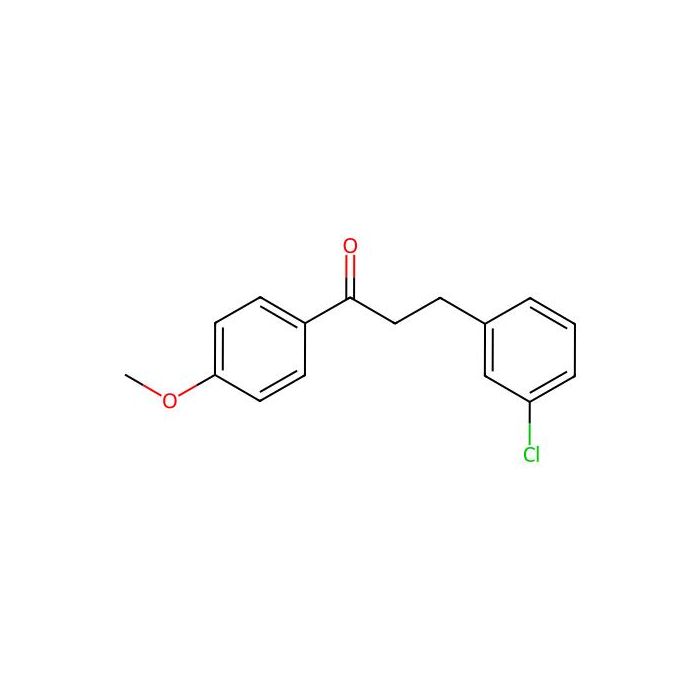
This compound belongs to the class of organic compounds known as retro-dihydrochalcones. These are a form of normal dihydrochalcones that are structurally distinguished by the lack of oxygen functionalities at the C2'- and C6'-positions.
External Descriptors
Not available
1. Djoumbou Feunang Y, Eisner R, Knox C, Chepelev L, Hastings J, Owen G, Fahy E, Steinbeck C, Subramanian S, Bolton E, Greiner R, and Wishart DS. ClassyFire: Automated Chemical Classification With A Comprehensive, Computable Taxonomy. Journal of Cheminformatics, 2016, 8:61.
Determine the necessary mass, volume, or concentration for preparing a solution.
Dilution Calculator
Determine the dilution needed to prepare a stock solution.
Reconstitution Calculator
Reviews
Customer Reviews
Application Protocols
No vendor-validated biological application protocols are provided for this item. As a general synthetic intermediate, protocol choice depends on the transformation of interest (see Reaction Conditions and Synthetic Utility tabs).
General handling/dissolution (for assay stock preparation):
Prepare a concentrated stock solution in dry DMSO or acetonitrile (e.g., 10–50 mM), filter through 0.22 µm PTFE, and store aliquots to minimize freeze–thaw. Verify stability by LC-MS over intended storage duration.
Synthetic workflow examples (outline):
Reductive amination: Combine ketone (1.0 eq), amine (1.2–2.0 eq), AcOH (0.2–0.5 eq) in MeOH; add NaBH(OAc)3 (1.2–1.5 eq) at rt, stir 4–16 h, quench with sat. NaHCO3, extract with EtOAc, purify by silica gel.
Suzuki coupling on the aryl chloride: Pd2(dba)3 (1 mol%), XPhos (2 mol%), K3PO4 (2–3 eq), boronic acid (1.2 eq) in 1,4-dioxane/H2O (4:1), 90–100 °C, 6–12 h; work up and purify.
Note: These are literature-style general outlines and must be optimized for the exact substrate and scale.
Biological Roles
This catalog item is a synthetic organic intermediate; no specific biological role is assigned in the Product Data. The following notes provide general context for this chemical class (aryl alkyl ketones with anisole and chloroaryl substituents):
Aryl ketones are common fragments in bioactive molecules and screening libraries due to their planar aromatic surfaces and a polar carbonyl that can engage in hydrogen-bond acceptance. The para-methoxy substituent modulates electron density and lipophilicity; the chloro substituent increases metabolic stability and influences binding through halogen bonding (literature, general trends).
Metabolism (general): aryl methoxy groups can undergo O-demethylation (CYP-mediated) to phenols; benzylic positions may be oxidized. The aryl chloride is typically metabolically robust but can undergo dehalogenation in specific enzymatic contexts.
Protein interactions: the ketone carbonyl can act as a weak H-bond acceptor; however, electrophilicity is modest and typically does not form covalent adducts under physiological conditions (unlike activated α,β-unsaturated ketones).
Important: The product is designated for research use only (as provided). It is not intended for diagnostic, therapeutic, or in vivo use. Any biological evaluation should be conducted under appropriate institutional approvals and safety protocols.
Buffer Applications
Not typically applicable. This compound is a hydrophobic organic building block, not a buffering agent. It does not form defined conjugate acid/base pairs within physiological pH ranges suitable for buffering.
Practical note: When used in biochemical assays, dissolve first in a suitable organic co-solvent (e.g., DMSO or acetonitrile), then dilute into aqueous buffer keeping final organic content low (commonly ≤1–2%) to maintain assay integrity. Validate solubility and absence of colloid formation by DLS or light-scattering if needed.
Green Alternatives
While this is a solid/liquid building block rather than a solvent, greener choices relate to solvents, reagents, and process design used with it.
Greener solvent substitutions (general guidance):
Replace chlorinated solvents (e.g., DCM) with ethyl acetate, 2-MeTHF, CPME, or dimethyl carbonate when feasible.
Use toluene or 2-MeTHF instead of THF for Grignard/addition steps if equivalent performance is observed, benefiting from higher boiling points and improved safety metrics.
Oxidation/reduction alternatives:
Reductive aminations: Prefer catalytic hydrogenation (H2, Pd/C) over cyanoborohydride when substrate is tolerant, minimizing cyanide waste.
Baeyer–Villiger: Consider H2O2/formic acid (in situ peracid) or enzyme-catalyzed BV oxidations to reduce halogenated oxidant use.
Cross-coupling improvements:
Use aqueous micellar catalysis (TPGS-750-M, Savie) to run Suzuki couplings of the aryl chloride in water-rich media, reducing organic solvent consumption.
Apply modern precatalysts (Pd-NHC) at ppm to low mol% loadings; recover catalysts when possible.
Small comparison (illustrative):
THF vs 2-MeTHF: similar polarity; 2-MeTHF derived from renewable furfural, higher bp (80 °C) enables lower pressure distillations and improved solvent recovery.
DCM vs EtOAc: EtOAc is biodegradable with lower toxicity; DCM offers superior solvation but higher environmental/health concerns.
Process considerations:
Design crystallization-based isolations to avoid silica-intensive chromatography.
Implement solvent swaps to greener options during workup (e.g., use EtOAc/IPA/Heptane systems).
Pharmaceutical Uses
No pharmacopeial or excipient status is provided for this item. It is supplied for research use only.
General context (for chemists in drug discovery and process development):
Role: synthetic intermediate and SAR fragment. The anisyl (4-OMe) and meta-chloro aryl motifs are prevalent in lead optimization to tune potency, solubility, and metabolic stability.
Formulation screening: If used as a reference material or research tool compound, typical solvent vehicles include DMSO or PEG-containing cosolvent systems due to low aqueous solubility (general for aryl ketones). Solid forms (if crystalline) may exhibit polymorphism; solid-state characterization (PXRD/DSC/TGA) is advisable for reproducible exposure in in vitro studies.
Analytical methods: HPLC/UPLC with UV detection at 210–280 nm; LC-MS (ESI/APCI) for identity; stability-indicating methods to monitor O-demethylation or reduction to the corresponding alcohol under stress.
Compliance note: Absent any pharmacopeial monograph or GMP statement, this product should not be used in drug product manufacture without additional qualification and supplier audits.
Physical Properties
Item-specific specifications are not provided in the Product Data. For authoritative values, consult the CoA/Spec Sheet.
Appearance: Not specified for this item; refer to CoA/Spec Sheet.
Molecular weight: Not specified for this item; refer to CoA/Spec Sheet.
Melting point: Not specified for this item; refer to CoA/Spec Sheet. (Aryl alkyl ketones of similar size are often low-melting solids or high-boiling liquids; literature values vary by substitution.)
Boiling point: Not specified for this item; refer to CoA/Spec Sheet.
Density: Not specified for this item; refer to CoA/Spec Sheet.
Refractive index: Not specified for this item; refer to CoA/Spec Sheet.
LogP (octanol/water): Not specified for this item; refer to CoA/Spec Sheet. (Literature trend: para-methoxy/aryl-chloro ketones are typically lipophilic.)
Solubility: Expected to be soluble in common organic solvents (e.g., dichloromethane, ethyl acetate, THF, acetonitrile) and sparingly soluble in water (general expectation for aryl ketones). Item-specific data: Not specified; refer to CoA/Spec Sheet.
UV–Vis: Aryl ketones and anisoles typically show strong UV absorbance ~200–280 nm (literature, general). Item-specific cutoff: Not specified; refer to CoA/Spec Sheet.
General physical-chemical considerations (literature):
The para-methoxy group increases electron density and can shift UV absorption slightly bathochromically relative to unsubstituted propiophenone. The meta-chloro substituent increases molecular polarizability and lipophilicity, often raising boiling point relative to non-halogenated analogs.
Quality and Grades
Grade/Purity: Not specified for this item; refer to CoA/Spec Sheet. Without an explicit grade (e.g., AR, technical, ≥98%, HPLC grade), users should verify suitability for their application via the CoA and, if necessary, incoming QC.
Context on common grades (general information for researchers):
Research/Analytical grade (≥97–99%): Suitable for routine synthesis and screening; typical residual solvents and trace metal levels are controlled but not necessarily at ultra-trace levels.
High-purity/screening grade (≥98–99.5%): Preferred for medicinal chemistry and SAR where assay interference must be minimized.
HPLC/LCMS grade (when specified for solvents): Low UV background and particulate levels; not directly applicable to solids unless stated as “LCMS validated” for purity.
Stabilizers and additives:
None stated for this item. If stabilizers (e.g., BHT) or inhibitors are present, they will be declared on the CoA/Spec Sheet. Absence of such a note here does not imply absence—verify on the CoA.
Analytical verification (recommended best practices):
Identity: 1H/13C NMR, HRMS, and IR (C=O ~1680–1710 cm−1, anisole C–O–C stretches), plus HPLC/GC purity.
Impurities to monitor (general): anisole and chloroarene starting materials, positional isomers, over-alkylated side products, and aldol/condensation byproducts.
Documentation: Request batch-specific CoA and, where available, NMR or chromatograms to confirm suitability for critical applications.
Reaction and Applications
As a para-methoxy/meta-chloro substituted aryl–alkyl ketone, this compound serves as a versatile intermediate for medicinal chemistry and materials-oriented syntheses.
Reduction to secondary alcohols (NaBH4, catalytic hydrogenation) for generating chiral analogs via subsequent resolution or asymmetric reduction (CBS, Noyori, Ru/diamine catalysts).
Reductive amination to install diverse amines (NaBH3CN, NaBH(OAc)3, or catalytic H2/Raney Ni/Pd).
Wittig/Horner–Wadsworth–Emmons olefinations to access styrenes/trans-cinnamate analogs with defined E/Z selectivity.
Baeyer–Villiger oxidation to aryl esters/phenoxyacetates (mCPBA, peracids), modulated by substituent effects (para-OMe favors migration of the anisyl group in many cases).
Alpha-functionalization:
Enolate generation (LDA, KHMDS) enabling alkylation, acylation, or aldol couplings; the anisyl ring can stabilize adjacent anions via resonance.
Halogenation (NBS/NCS) at the benzylic alpha-position followed by substitution.
Aromatic substitutions and cross-couplings:
The meta-chloro aryl unit is a handle for Pd-catalyzed Suzuki–Miyaura, Buchwald–Hartwig, or Sonogashira couplings (aryl chloride activation with BrettPhos/XPhos/PEPPSI systems).
Electrophilic aromatic substitution on the anisole ring (Friedel–Crafts acylations/alkylations, nitration under controlled conditions). The para-OMe directs ortho/para on its ring; the chloro ring is deactivated and meta-directing.
Photophysical and materials contexts:
The anisyl group can enhance conjugation and UV absorbance; derivatization yields fragments for OLED probes or photoinitiators (general examples).
Practical tips:
Use dry, oxygen-free conditions for base-sensitive steps (enolate chemistry, metal-catalyzed couplings).
For Pd-catalyzed activation of aryl chloride, employ electron-rich bulky ligands, elevated temperature (80–120 °C), and bases like K3PO4, Cs2CO3 in toluene/dioxane/DMF.
Monitor reactions by HPLC/LCMS; anisole UV response is strong at 254 nm.
Reaction Conditions
Typical conditions for common transformations of aryl–alkyl ketones with anisole/aryl chloride motifs (literature, general guidance; optimize per substrate):
Reductive amination:
Solvent: MeOH, EtOH, or DCE/MeOH; Base: AcOH or Ti(OiPr)4 (optional); Reductant: NaBH(OAc)3 (rt–40 °C, 2–16 h). Catalytic H2 (Pd/C, 1–10 bar H2, rt–50 °C) is greener when compatible.
Nucleophilic addition (Grignard/organolithium):
Solvent: anhydrous THF or 2-MeTHF; Temp: −78 to 0 °C; Quench: NH4Cl. Protect anisole from demethylation by avoiding strong Lewis acids during workup.
Wittig/HWE olefination:
Base: NaH or KHMDS in THF/THF–toluene; Temp: 0–25 °C (Wittig), −78 to 25 °C (HWE); E-selectivity favored with phosphonate reagents and stoichiometric base.
Baeyer–Villiger oxidation:
Reagent: mCPBA (1.2–1.5 eq) in DCM, 0 °C to rt, 2–24 h; or H2O2 (30%) with catalytic acids in AcOH/MeCN. Monitor for over-oxidation/hydrolysis.
Enolate alkylation:
Base: LDA (1.1–1.5 eq) in THF at −78 to −20 °C; Electrophiles: primary alkyl halides, allyl/benzyl bromides. Quench to keep temperatures low to minimize retro-aldol or over-alkylation.
Cross-coupling on aryl chloride ring:
Suzuki–Miyaura: Pd2(dba)3 (1–2 mol%) + XPhos/BrettPhos (2–4 mol%), base K3PO4 or Cs2CO3, solvent dioxane/H2O (4:1) or toluene, 80–110 °C, 2–18 h.
Buchwald–Hartwig amination: Pd-precatalyst (e.g., Pd-PEPPSI or Pd2(dba)3 + BrettPhos), base NaOtBu or Cs2CO3, toluene or dioxane, 90–120 °C.
Analytical monitoring:
HPLC/UPLC at 254 nm; LC-MS for mass balance; 1H NMR to track carbonyl consumption (singlet near 2.9–3.5 ppm for benzylic methylene may shift upon transformation, literature general).
Yields: Highly substrate- and condition-dependent; consult primary literature and perform small-scale optimization.
Safety and Handling
Hazard classification data for this specific item are not provided. Always review the product’s SDS for authoritative safety and regulatory details.
GHS classification: Not specified for this item; refer to SDS.
Signal word, pictograms, H-statements: Not specified for this item; refer to SDS.
General hazards (based on class: aryl alkyl ketones, anisoles, aryl chlorides):
May cause skin/eye irritation on contact; inhalation of vapors or dust may be irritating (general). Avoid inhalation and contact.
Combustible organic compound; keep away from ignition sources. Use in well-ventilated areas or a fume hood.
Recommended PPE and engineering controls:
Wear lab coat, safety glasses or goggles, and appropriate chemical-resistant gloves (e.g., nitrile). Use fume hood when handling powders or volatile solvents.
Incompatibilities and reactivity (general):
Strong oxidizers (risk of exotherm/oxidation).
Strong bases or nucleophiles can participate in nucleophilic aromatic substitution on activated rings only under forcing conditions; ketone carbonyl may undergo typical nucleophile additions.
Avoid prolonged exposure to strong acids/bases that may induce demethylation (anisole) or aldol/condensation at the carbonyl alpha-position.
First aid (summary; consult SDS for details):
Skin: Wash with soap/water. Remove contaminated clothing.
Eyes: Rinse cautiously with water for several minutes; remove contacts if present and easy.
Inhalation: Move to fresh air; seek medical attention if symptoms persist.
Ingestion: Rinse mouth; seek medical advice.
Waste disposal: Collect organic waste according to institutional hazardous waste protocols; do not discharge to drain.
Solvent Selection
This product is an organic small-molecule building block rather than a solvent. However, solvent choice is crucial for its handling, dissolution, reactions, and purification.
General miscibility/solubility expectations (literature, general):
Likely soluble in moderately polar aprotic media (e.g., dichloromethane, THF, acetonitrile, ethyl acetate) and aromatic/aliphatic hydrocarbons (toluene, hexanes to varying degrees). Poor aqueous solubility expected.
Selection guidance by task:
Reaction medium: For nucleophilic additions to the ketone or metalations alpha to the carbonyl, use dry polar aprotics (THF, Et2O, 2-MeTHF) under inert atmosphere. For electrophilic aromatic substitution on the anisole ring, use chlorinated solvents or nitrobenzene/sulfolane (as needed) balancing reactivity and safety.
Purification: Normal-phase silica gel using hexanes/EtOAc or hexanes/MTBE gradients separates anisole/chloroarene isomers effectively. Reverse-phase (C18, MeCN/H2O with 0.1% formic acid) is viable for LC-MS guided purification.
Crystallization: If solid, trials from EtOAc/hexanes, toluene/hexanes, or EtOH/water (antisolvent) are common starting points.
Small comparison (general):
DCM vs EtOAc: DCM gives faster kinetics, better solvation for aryl ketones; EtOAc is greener and often adequate for workups.
THF vs 2-MeTHF: Similar polarity; 2-MeTHF offers greener profile and higher boiling point, aiding temperature control and recovery.
Storage and Reconstitution
Storage conditions: Room temperature (as provided in Product Data). Protect from light and moisture to maintain quality. Store tightly closed in the original container.
Shipped in: Not specified for this item; refer to CoA/Spec Sheet.
Stability: Item-specific shelf-life and stability are not provided; consult CoA. In general, aryl ketones are stable under dry, ambient conditions.
Reconstitution/dissolution:
For synthetic use or analytical preparation, dissolve in appropriate anhydrous organic solvents (e.g., DCM, THF, EtOAc, toluene, MeCN) depending on the application. For bioassay stocks, DMSO or MeCN are commonly used; filter through a 0.22 µm PTFE membrane if particulate is observed.
If crystallinity/hygroscopicity affects handling, gently warm (≤40 °C) or use an ultrasonic bath to aid dissolution. Avoid prolonged heating.
Packaging and handling tips:
Minimize headspace exposure for air/moisture-sensitive operations (e.g., enolate chemistry) by backfilling with inert gas after opening.
Record open date and retain aliquots for reproducibility.
Research Use Note: For research use only (as provided). Do not use in humans or for clinical/diagnostic purposes.
Structure and Identity
A substituted aryl–alkyl ketone featuring para-methoxy and meta-chloro aryl substituents on a propiophenone scaffold; useful as an intermediate in arylketone synthesis and SAR exploration.
SMILES: Not specified for this item; refer to CoA/Spec Sheet.
Molecular formula: Not specified for this item; refer to CoA/Spec Sheet.
Molecular weight: Not specified for this item; refer to CoA/Spec Sheet.
Structural features (general, based on chemical name):
Core functionality: a propiophenone (aryl–CO–CH2–CH3) framework, i.e., an aryl alkanone (ketone).
Aryl substituents: one ring substituted with 4-methoxy (para-OMe); the other aryl fragment bears a 3-chloro (meta-Cl) substituent.
Functional groups: aromatic rings (π-systems), an aryl ketone carbonyl (sp2 C=O), an anisole ether (Ar–O–CH3), and an aryl chloride (Ar–Cl).
Stereochemistry: none expected (acyclic ketone, no stereogenic centers).
2D description in words: a carbonyl carbon bonded to a 4-methoxyphenyl ring on one side and a 3-chlorophenethyl fragment on the other, forming a diaryl-substituted propiophenone-like skeleton.
Note: Exact constitutional isomerism implied by the name is consistent with an aryl–alkyl ketone; confirm definitive structure via the CoA/SDS for this specific catalog item.
Synthetic Utility
Key functional elements and their uses (general to aryl–alkyl ketones bearing 4-OMe and 3-Cl substituents):
Ketone carbonyl (electrophile):
Reductive amination to diverse secondary/tertiary amines (NaBH(OAc)3, NaCNBH3, catalytic hydrogenation), enabling rapid library expansion.
Olefination (Wittig/HWE) to generate styrenyl linkers for conjugation or photophysical tuning.
Alpha-position (enolizable):
Enolate chemistry with LDA/KHMDS enables C–C bond formation (alkylation, aldol) and installation of handles for further diversification.
Halogenation (NBS/NCS) facilitates subsequent cross-couplings or substitutions.
Aryl chloride (cross-coupling handle):
Pd-catalyzed Suzuki (with boronic acids/esters), Buchwald–Hartwig amination, or Sonogashira to elaborate the meta-chloro ring; modern ligand sets (BrettPhos, SPhos, XPhos, RuPhos, NHCs) activate aryl chlorides efficiently.
Anisole (para-OMe) ring:
Directs electrophilic substitution ortho/para; demethylation (BBr3, AlCl3/thiols) reveals the phenol for further derivatization (ether/ester formation, SNAr as leaving group via O-activations).
Retrosynthetic value:
Accessible via Friedel–Crafts acylation or acylation/cross-coupling sequences; the presence of both an activating (OMe) and deactivating (Cl) substituent allows orthogonal functionalization strategies.
Purification/analysis tips:
Strong UV response at 254 nm; LC-MS readily detects [M+H]+. Silica chromatography with hexanes/EtOAc (5–40%) typically effective; watch for tailing due to carbonyl–silica interactions—add 0.1–1% Et3N if needed.
Target Specificity
Not applicable. This product is a small-molecule chemical building block, not a biological affinity reagent. No target, antigen, epitope, or isotype information is associated with this item in the Product Data.
Frequently Asked Questions
How should this product be stored?
Store at room temperature.
What are the CAS number, molecular formula and molecular weight?
The CAS Number is 898762-26-0, the molecular formula is C16H15ClO2, and the molecular weight is 274.74 g/mol. InChIKey STRUNZJWUWZXEI-UHFFFAOYSA-N.
What documentation is provided?
Available product documentation, including Certificates of Analysis (COA), Safety Data Sheets (SDS), and specification sheets, is shown in the product document area. Document availability and access follow the current site policy.
We use cookies to ensure the website functions properly and, where permitted, to improve your experience. You can manage your preferences at any time in Settings. Learn more in our Cookie Policy.
Shall we send you a message when we have discounts available?
Remind me later
Thank you! Please check your email inbox to confirm.
Products are supplied to verified businesses, institutions, and qualified professionals for research and development use only. Not for use in humans, animals, diagnosis, or therapy.