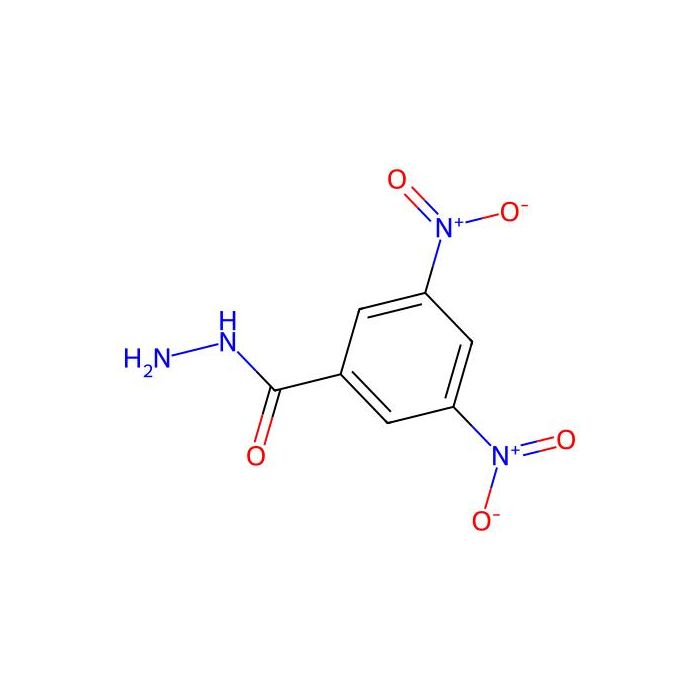
This compound belongs to the class of organic compounds known as nitrobenzenes. These are compounds containing a nitrobenzene moiety, which consists of a benzene ring with a carbon bearing a nitro group.
External Descriptors
Not available
1. Djoumbou Feunang Y, Eisner R, Knox C, Chepelev L, Hastings J, Owen G, Fahy E, Steinbeck C, Subramanian S, Bolton E, Greiner R, and Wishart DS. ClassyFire: Automated Chemical Classification With A Comprehensive, Computable Taxonomy. Journal of Cheminformatics, 2016, 8:61.
Determine the necessary mass, volume, or concentration for preparing a solution.
Dilution Calculator
Determine the dilution needed to prepare a stock solution.
Reconstitution Calculator
Reviews
Customer Reviews
Application Protocols
Item-specific, vendor-validated protocols are not provided for this product. Below is general, literature-style guidance for a common application with acyl hydrazides.
Example: Hydrazone formation with an aldehyde (general procedure)
Dissolve 3,5-dinitrobenzohydrazide (1.0 equiv) in ethanol (0.05–0.1 M). Gentle warming may be needed to achieve dissolution.
Add the aldehyde or ketone partner (1.0–1.2 equiv) and glacial acetic acid (0.1 equiv).
Stir at room temperature 2–6 h (or reflux for hindered substrates), monitoring by TLC or HPLC (UV 300–360 nm).
Upon completion, cool (if refluxed) and add water to induce precipitation. Collect the solid by filtration, wash with cold ethanol/water, and dry in vacuo.
Characterize by 1H/13C NMR, IR (C=N ~1610–1650 cm−1), and HRMS.
Notes:
Use anhydrous solvent to minimize hydrolysis and side reactions. For poorly soluble substrates, switch to DMF or add 5–10% DMSO as cosolvent.
If reversibility is an issue, add a mild dehydrating agent (e.g., 3 Å molecular sieves) or remove water azeotropically.
These instructions are provided as general literature guidance only. Validate and optimize for your specific substrates and scales.
Biological Roles
Item-specific biological data: Not specified for this item; refer to literature for any biochemical interactions.
General context (no clinical claims):
3,5-Dinitrobenzohydrazide is a synthetic, small-molecule aromatic acyl hydrazide. It does not have a known endogenous biological role. Nitroaromatic hydrazides can interact with biomolecules via covalent condensation with carbonyl groups (e.g., aldehydes present in oxidized biomacromolecules), forming hydrazone linkages under mildly acidic conditions.
The hydrazide functional group is widely used in chemical biology as a conjugation handle for labeling oxidized glycans on proteins or polysaccharides after periodate oxidation. While 3,5-dinitrobenzohydrazide could, in principle, participate in such chemistries, its electron-poor aryl backbone typically reduces nucleophilicity relative to aliphatic or aniline-derived hydrazides; thus specialized conditions (acid catalysis, higher concentrations) may be required for efficient bioconjugation.
Reduction of nitro groups in nitroaromatics can dramatically alter physicochemical properties (e.g., increased basicity/affinity to biomolecules), but such transformations are synthetic steps rather than biological processes.
Safety note for bio-related work: Hydrazides and nitroaromatics can present cytotoxicity; handle exclusively as a research chemical with appropriate containment. Any use in biochemical assays should incorporate appropriate controls for nonspecific reactivity and background signal.
Buffer Applications
This compound is not a buffering agent and is not typically employed to prepare buffer systems. If using 3,5-dinitrobenzohydrazide in aqueous media (e.g., for hydrazone formation with biomolecules), select a compatible buffer based on the reaction:
Hydrazone formation: mildly acidic buffers (e.g., 50–100 mM acetate, pH 4.5–5.5) can accelerate condensation of hydrazides with aldehydes/ketones. Aniline catalysts are sometimes used in chemical biology, but the electron-poor aryl hydrazide itself may require higher concentrations or longer times.
Stability considerations: avoid strongly basic buffers which can hydrolyze acyl hydrazides over time; avoid buffers containing reactive carbonyls (e.g., glyoxal-containing solutions) that may consume the reagent.
For routine buffer recipes, refer to standard buffer tables; this product does not define a specific buffering range or capacity.
Green Alternatives
Selecting greener conditions for work with 3,5-dinitrobenzohydrazide focuses on solvent choice and minimizing hazardous reagents in transformations.
Greener solvent choices (general guidance):
Prefer ethanol, isopropanol, or water/ethanol mixtures for hydrazone condensations instead of DMF or DMSO when solubility permits.
For coupling or activation steps, consider propylene carbonate or Cyrene (dihydrolevoglucosenone) as DMF/NMP substitutes; assess solubility and reaction rates empirically.
Avoiding hazardous reagents:
For Curtius-type sequences, ensure in situ generation and immediate consumption of acyl azides; evaluate alternative amide-coupling routes (e.g., EDC/HOBt-free variants using Oxyma/EDC in green solvents) to bypass azide intermediates.
For nitro reductions, catalytic hydrogenation (H2/Pd, EtOH) is typically greener than stannous chloride or iron/acid reductions, minimizing metal salt waste.
Example comparison (literature-guided):
DMF vs EtOH/H2O (hydrazone formation): EtOH/H2O reduces toxicity and improves EHS profile, with comparable rates under mild acid catalysis when solubility is sufficient.
POCl3-mediated cyclodehydration vs PPA (polyphosphoric acid) or catalytic dehydrations: choose conditions that limit chlorinated waste and enable safer quench/workup.
Process considerations:
Use minimal solvent volumes (high-solids processing) and recover solvents by distillation.
Employ buffered aqueous media where possible to avoid excess strong acids/bases.
Trade-offs: greener solvents may reduce solubility or rate; conduct small-scale screens to balance EHS benefits with yield and selectivity.
Pharmaceutical Uses
Item-specific pharmacopeial status or excipient role: Not specified for this item; refer to CoA/Spec Sheet.
General, non-clinical context:
Aromatic acyl hydrazides are common synthetic intermediates in medicinal chemistry campaigns. 3,5-Dinitrobenzohydrazide can serve as a building block to access ureas, carbamates, amides, amines (via Curtius route), and heterocycles (e.g., 1,3,4-oxadiazoles) after appropriate transformations.
The nitro substituents are often strategic handles: reduction to diamines followed by further functionalization enables exploration of structure–activity relationships around electron-withdrawing/electron-donating ring patterns.
In formulation science, hydrazides are generally not employed as excipients due to potential reactivity with carbonyl-containing excipients or APIs. Consequently, this substance is best viewed as a synthetic intermediate for API discovery and development rather than a formulation aid.
Compliance and quality:
Any use in regulated settings would require thorough characterization, impurity profiling, and control of residual solvents and inorganic reagents. This listing is for research use only and is not intended for human or veterinary use.
Physical Properties
Item-specific specifications (this lot): Not specified for this item; refer to CoA/Spec Sheet.
Literature/general properties (typical for this compound class):
Physical state: crystalline solid (aromatic acyl hydrazides are typically solids due to strong H-bonding and planarity).
Polarity: high polarity with multiple H-bond donors (two NH) and acceptors (carbonyl O, nitro O’s), favoring solubility in polar aprotic/strongly polar protic solvents.
Solubility (qualitative, literature): sparingly soluble in water at neutral pH; soluble in DMSO, DMF, NMP; limited-to-moderate solubility in alcohols (MeOH, EtOH), very low in nonpolar solvents (hexanes, toluene). Solubility improves upon warming and with small amounts of base due to hydrogen-bond disruption.
Acid-base behavior: terminal –NH2 and amide –NH are weak bases/weak acids; overall compound is neutral at physiological pH. No strongly ionizable groups (pKa values not well established; amide N typically nonbasic; terminal hydrazide NH2 weakly basic).
Partitioning: Expected low logP due to multiple heteroatoms; favors polar phases (quantitative logP not confirmed).
Thermal behavior: Aromatic acyl hydrazides often show high melting points and may decompose on strong heating; avoid prolonged temperatures near decomposition (consult SDS/CoA for exact values).
Note: For definitive BP/MP, density, refractive index, and UV cutoff for this catalog item, consult the CoA/Spec Sheet.
Quality and Grades
Item-specific grade/purity: Not specified for this item; refer to CoA/Spec Sheet.
Interpreting typical grades (general guidance):
Research/biochemical grade indicates suitability for research workflows with defined impurity limits and often tighter control over residual solvents, heavy metals, and moisture.
Analytical or HPLC grade (when applicable) emphasizes low UV absorbance and stringent particulate/trace impurity control to support analytical methods.
“Assay” or purity values (e.g., ≥98%) define the minimum content by a specific method (titration, HPLC/GC, qNMR). For hydrazides, Karl Fischer moisture and residual inorganic salts (from hydrazide synthesis) may be critical.
Stabilizers/additives:
This item is not indicated to contain stabilizers. If a stabilizer were present (e.g., acid scavenger), it would be listed on the CoA. Hydrazides generally do not require stabilizers when stored dry and protected from light.
What to look for on the CoA for this compound class:
Identity confirmation (1H/13C NMR consistent with acyl hydrazide, IR amide C=O ~1650–1700 cm−1, nitro stretches ~1520/1350 cm−1).
Purity/chromatographic profile (HPLC area percent), melting point range (often sharp for pure solids), residual solvents (e.g., DMF/DMSO), water content, and inorganic residue (sulfate/chloride from workup).
Contact Aladdin Scientific for lot-specific CoA and analytical details if your application requires defined impurity thresholds.
Reaction and Applications
Derivatization/condensation chemistry:
The terminal hydrazide –NH2 readily condenses with aldehydes and ketones to afford acyl hydrazones (–CO–NH–N=CHR). These are useful for analytical derivatization or as intermediates in dynamic covalent chemistry and conjugation to carbonyl-bearing materials (e.g., oxidized polysaccharides).
Rearrangements and conversions:
Nitrosation of acyl hydrazides (e.g., NaNO2/HCl or isoamyl nitrite) can generate acyl azides, which undergo Curtius rearrangement to isocyanates, enabling access to ureas, carbamates, and amines after trapping. The electron-poor aryl ring can influence rates and stability.
Heterocycle synthesis:
Acyl hydrazides react with carboxylic acid derivatives or are doubly acylated then cyclodehydrated (e.g., POCl3, SOCl2, P2O5) to form 1,3,4-oxadiazoles or 1,3,4-oxadiazin-2-ones. Alternatively, reaction with aldehydes followed by oxidative cyclization affords heteroaryl frameworks.
Reductive transformations:
The aromatic nitro groups can be chemoselectively reduced (e.g., Fe/AcOH, SnCl2/HCl, catalytic hydrogenation) to the corresponding diamino benzohydrazide, unlocking electrophilic aromatic substitution or coupling (diazotization) pathways.
Materials/linking applications:
The acyl hydrazide can form reversible hydrazone linkages with carbonyl-functional polymers or surfaces for pH-responsive materials. Electron-withdrawing nitro groups reduce hydrazide nucleophilicity relative to aliphatic analogs—use mild acid catalysis to drive condensations.
Practical tips:
Dry solvents and remove adventitious carbonyl impurities. Use 0.1–1 equiv AcOH in alcohols for faster hydrazone formation. Monitor by IR (disappearance of C=O of carbonyl partner and appearance of C=N ~1610–1650 cm−1) or HPLC/LC–MS.
Reaction Conditions
General literature guidance for this compound class (optimize for your substrates):
Temperature/time: rt to reflux, 1–16 h depending on substrate solubility and sterics.
Workup: concentrate, triturate with cold Et2O/hexanes or precipitate with water; purify by recrystallization or chromatography.
Nitrosation → acyl azide (for Curtius):
Reagents: NaNO2 (1.1–1.5 equiv) in 1–3 M HCl at 0–5 °C; or isoamyl nitrite in MeCN with acid.
Conditions: maintain ≤5 °C during addition; then warm to 20–80 °C to effect Curtius in an inert solvent (toluene) with a trapping nucleophile (ROH, R2NH).
Caution: acyl azides are energetic; generate in situ and consume immediately under controlled conditions.
1,3,4-Oxadiazole formation (via diacylhydrazide):
Form diacylhydrazide using acid chlorides/EDC-type couplings, then cyclodehydrate with POCl3 (neat or in chlorobenzene) at 70–110 °C, 2–8 h. Quench cautiously into ice and neutralize.
Nitro reductions:
H2 (1–4 bar), Pd/C (5–10 wt%), EtOH or EtOH/EtOAc, rt–50 °C, 2–12 h; or SnCl2·2H2O in EtOH/HCl at reflux.
Analytical monitoring:
LC–MS (ESI–), HPLC with UV 254–360 nm (nitroaryl chromophore), IR (amide C=O ~1650–1700 cm−1; hydrazone C=N ~1610–1650 cm−1).
Note: These are literature-style conditions; adapt to scale, safety, and substrate reactivity.
Safety and Handling
Item-specific GHS details: Not specified for this item; refer to SDS for authoritative classification, H-statements, and pictograms.
General hazards (literature/analogous compounds):
May cause irritation to skin, eyes, and respiratory tract. Nitroaromatic compounds can present toxicity with prolonged exposure; hydrazides can be sensitizers or harmful if swallowed/inhaled. Avoid dust formation.
Thermal decomposition can release nitrogen oxides (NOx). Do not heat to decomposition; avoid contact with strong oxidizers or strong reducing agents.
PPE and engineering controls:
Wear lab coat, safety glasses or chemical splash goggles, and appropriate chemical-resistant gloves (e.g., nitrile). Handle solids in a fume hood to prevent inhalation of dust.
Use local exhaust ventilation when weighing, transferring, or dissolving the compound. Keep containers tightly closed.
Incompatibilities and precautions:
Avoid strong oxidizing agents and reducing agents; avoid strong acids or bases during storage. Hydrazides can slowly react with carbonyl-containing reagents; store away from reactive aldehydes/ketones.
Although not a typical peroxide former, minimize exposure to air/moisture to maintain quality.
First aid overview (consult SDS for details):
Inhalation: move to fresh air; seek medical attention if symptoms occur.
Skin/eye contact: rinse with water for at least 15 minutes; remove contaminated clothing; seek medical attention for persistent irritation.
Ingestion: rinse mouth; do not induce vomiting; seek medical attention.
Always defer to the product SDS for definitive hazard information and emergency procedures. Research use only.
Solvent Selection
Polarity class and miscibility (general guidance):
3,5-Dinitrobenzohydrazide is a polar, hydrogen-bonding solid. It dissolves best in highly polar aprotic solvents (DMSO, DMF, NMP) and in hot polar protic solvents (MeOH, EtOH). It is typically insoluble in nonpolar media (hexanes) and only sparingly soluble in moderately polar solvents (EtOAc, MeCN at ambient temperature).
Practical selection tips:
Stock solutions for screening: prepare at 10–100 mM in anhydrous DMSO; dilute into reaction or assay medium immediately before use to minimize precipitation.
For condensations with aldehydes/ketones: ethanol or methanol with a catalytic acid (AcOH) provides homogeneous conditions; DMF can be used for poorly soluble partners.
For dehydrative cyclizations (e.g., oxadiazole formation): use non-nucleophilic, high-boiling solvents (toluene, chlorobenzene, or neat POCl3/SOCl2 systems) per literature procedures.
Small comparison (typical behavior):
DMSO vs DMF: DMSO offers greater solvating power and is often preferred for initial dissolution; DMF facilitates some coupling chemistries and is easier to remove than DMSO.
Alcohols vs water: alcohols enhance solubility and support acid-catalyzed condensations; water alone often gives limited solubility unless cosolvents or pH adjustment are used.
Drying note: hygroscopic uptake is limited, but anhydrous solvents improve reproducibility in condensation and coupling reactions involving hydrazides.
Additional handling guidance (general best practice for acyl hydrazides):
Store in a tightly closed container in a cool, dry, and well-ventilated area. Protect from moisture, heat, and direct light. Use a desiccator if ambient humidity is high.
Keep away from strong oxidizing and reducing agents and from reactive carbonyl-containing reagents during storage.
Reconstitution/stock solutions:
Prepare concentrated stock solutions in anhydrous DMSO, DMF, or NMP (e.g., 10–100 mM). For reactions in protic media, ethanol or methanol can be used; warm gently to aid dissolution.
Filter 0.2 µm if particulate matter is present. Record solvent, concentration, and date of preparation.
Stability of solutions (general):
DMSO/DMF stocks are typically stable for days to weeks at 2–8 °C when protected from moisture and air; prepare fresh solutions for sensitive applications. Avoid repeated freeze–thaw; aliquot stocks.
Aqueous solutions are not recommended except transiently during reactions; hydrolysis may occur under strongly basic or acidic conditions.
Disposal: Follow institutional and local regulations for nitroaromatic and hydrazide-containing waste; segregate from oxidizers and reducing agents.
For lot-specific stability/retest period and any special shipping details, consult the CoA and SDS.
Structure and Identity
Brief description: 3,5-Dinitrobenzohydrazide is the hydrazide of 3,5-dinitrobenzoic acid, featuring an acyl hydrazide (–CONHNH2) conjugated to a nitro-substituted benzene ring (nitro groups at the meta positions 3 and 5).
Item-specific (from Product Data):
CAS: 2900-63-2
CID: 3329932
InChIKey: 142885 (as provided)
Storage: Room temperature
Grade/Purity: Not specified for this item; refer to CoA/Spec Sheet.
Appearance: Not specified for this item; refer to CoA/Spec Sheet.
Literature/Computed identifiers (for reference; not item specifications):
Common name: 3,5-dinitrobenzoic acid hydrazide
Molecular formula (literature): C7H6N4O5
Molecular weight (literature): ~226.14 g/mol
Structural features: aromatic ring (C6), two strongly electron-withdrawing nitro substituents (–NO2) at 3,5; one amide carbonyl (–C(=O)–) linked to a hydrazide (–NH–NH2). The terminal –NH2 provides nucleophilicity and condensation activity toward carbonyls; the nitro groups deactivate the ring toward electrophilic substitution and enable potential SNAr at activated positions.
SMILES (literature, one of several valid forms): O=N+c1cc(C(=O)NN)cc(N+[O-])c1
2D structure in words: a benzene ring bearing nitro groups meta to each other and a carboxamide hydrazide at the para-equivalent axis (ring carbon 1). The carbonyl is directly attached to the ring; distal to carbonyl is –NH–NH2.
Synthetic Utility
Functional group leverage:
Hydrazide handle (–CONHNH2):
Condensation with C=O electrophiles to give acyl hydrazones.
N-acylation at terminal –NH2 to form diacylhydrazides, precursors to 1,3,4-oxadiazoles under dehydrative cyclization.
Nitro groups (meta, 3,5):
Selective reduction to diamines for subsequent diazotization, coupling, or amide formation.
Facilitate SNAr at activated positions under strong nucleophilic conditions (though 3,5-disubstitution limits positions available for substitution).
Retrosynthetic value:
Starting from 3,5-dinitrobenzoic acid, conversion to the acyl chloride or activated ester followed by hydrazinolysis gives the hydrazide. The hydrazide serves as a branch point to numerous scaffolds without revisiting acid halide handling.
Named/typical transformations (literature):
Curtius rearrangement (via acyl azide from hydrazide nitrosation).
Cyclodehydration to 1,3,4-oxadiazoles using POCl3, SOCl2, or P2O5.
Hydrazone formation in EtOH/AcOH or MeOH/AcOH at rt–reflux.
Practical notes:
Use stoichiometric control to avoid overacylation when preparing diacylhydrazides. Maintain anhydrous conditions for coupling steps. Electron-withdrawing nitro groups can decrease hydrazide nucleophilicity; modest acid catalysis often restores practical rates.
Target Specificity
This product is a small-molecule reagent, not a biological targeting agent. No antigen/epitope, clone, isotype, or species reactivity applies.
Item-specific data: Not applicable.
Guidance: For biochemical conjugations, any “specificity” arises from chemoselective reaction of the hydrazide with carbonyl groups (aldehydes/ketones) rather than biological recognition.
We use cookies to ensure the website functions properly and, where permitted, to improve your experience. You can manage your preferences at any time in Settings. Learn more in our Cookie Policy.
Shall we send you a message when we have discounts available?
Remind me later
Thank you! Please check your email inbox to confirm.
Products are supplied to verified businesses, institutions, and qualified professionals for research and development use only. Not for use in humans, animals, diagnosis, or therapy.