This compound belongs to the class of organic compounds known as n-acetylarylamines. These are acetamides where one or more amide hydrogens is substituted by an aryl group.
External Descriptors
Not available
1. Djoumbou Feunang Y, Eisner R, Knox C, Chepelev L, Hastings J, Owen G, Fahy E, Steinbeck C, Subramanian S, Bolton E, Greiner R, and Wishart DS. ClassyFire: Automated Chemical Classification With A Comprehensive, Computable Taxonomy. Journal of Cheminformatics, 2016, 8:61.
Determine the necessary mass, volume, or concentration for preparing a solution.
Dilution Calculator
Determine the dilution needed to prepare a stock solution.
Reconstitution Calculator
Reviews
Customer Reviews
Application Protocols
No tested biological assay protocols are provided for this item in the product data. As a chemical building block, usage protocols are reaction-specific.
General laboratory guidance (non-item-specific):
Preparation of stock solutions: Dissolve to 10–100 mg/mL in DMSO or DMF for screening; filter sterilize if needed for biological assays (0.2 µm PTFE). Record exact concentration gravimetrically.
Reaction setup: For hydrolysis or oxidation examples (see Reaction Conditions), charge solvent and reagent under appropriate temperature control, add 3-acetamidopyridine in portions, and monitor by TLC/HPLC.
Workup/purification: Standard aqueous quench, extraction with EtOAc, drying (Na2SO4/MgSO4), and concentration. Purify by crystallization or silica gel chromatography using EtOAc/hexanes or MeOH/DCM gradients as appropriate.
Note: For any specific synthetic transformation, consult peer-reviewed literature and adapt conditions to your substrate, scale, and safety constraints.
Biological Roles
Item-specific biological roles: Not specified; this product is supplied for research use only.
General biochemical context (no clinical claims):
Structural motif: Pyridine-containing amides are common in medicinal chemistry as bioisosteres and H-bonding motifs. The acetamide reduces basicity of the amino group and can modulate permeability and target binding in exploratory SAR studies.
Protonation behavior: The pyridine nitrogen can be protonated under acidic conditions, increasing aqueous solubility; the amide remains largely neutral under physiological pH, acting as an H-bond donor/acceptor motif.
Enzymatic relevance: While 3-acetamidopyridine itself is not a known metabolite, amide-bearing pyridines can be substrates for generic amidases or undergo N-oxidation on the ring nitrogen by flavin monooxygenase in biological systems (general literature patterns for pyridines and amides).
Use in assay development: The compound can serve as a heteroaromatic fragment or handle for conjugation in probe development, leveraging the amide for linker installation.
Note: No therapeutic or diagnostic use is intended. Any biological testing should be performed under appropriate institutional guidelines, and compound identity/purity should be verified for the study at hand.
Buffer Applications
3-Acetamidopyridine is not typically used as a buffering agent. While the pyridine nitrogen is basic and can be protonated, the compound is a solid building block rather than a standard buffer component.
Practical notes (general):
If an aqueous medium is required, limited solubility may necessitate co-solvents (e.g., ≤10% DMSO or ethanol) or acidification to form the pyridinium salt to increase solubility.
For buffering near pH ~5–6, dedicated buffer systems such as acetate, MES, or citrate are preferred due to well-characterized pKa values, buffer capacities, and low UV/background signals.
Recommendation: Use established biological/analytical buffers for pH control and reserve 3-acetamidopyridine for its role as a synthetic intermediate or probe component.
Green Alternatives
As a solid building block, 3-acetamidopyridine itself is not replaced per se; however, greener choices can be made for solvents and reagents used with it.
Replace DMF/DMAc with: Cyrene (dihydrolevoglucosenone), N-butyl pyrrolidone (NBP), or propylene carbonate where compatible.
Replace acetonitrile with: Ethyl acetate or ethanol for crystallizations and some reactions; 2-methyltetrahydrofuran (2-MeTHF) for extractions and some couplings.
2-MeTHF vs THF: 2-MeTHF has bio-based origins, higher boiling point, and better phase separation in aqueous workups; may reduce peroxide hazard relative to THF, but still monitor.
Cyrene vs DMF: Cyrene offers comparable polarity with improved environmental profile; viscosity is higher and some base-sensitive substrates may be affected.
Reagent choices:
Amidation/deprotection: For hydrolytic deprotection, use aqueous ethanol or water under catalytic acid/base rather than strong chlorinated reagents, when feasible.
Reductions: Consider catalytic hydrogenation or transfer hydrogenation (where compatible) in ethanol/isopropanol versus stoichiometric hydrides.
Waste minimization:
Favor crystallization-induced purification over silica chromatography when possible.
Employ telescoped sequences (protection → transformation → deprotection) to reduce solvent usage and workup steps.
Pharmaceutical Uses
Item-specific pharmacopeial or excipient status: Not specified for this item; no monograph indicated.
General formulation/manufacturing context (no therapeutic claims):
Intermediate: 3-Acetamidopyridine can serve as a masked form of 3-aminopyridine during synthetic campaigns toward active pharmaceutical ingredients (APIs), enabling steps that would be complicated by a free aniline-like amine (e.g., selective electrophilic functionalizations, metal-catalyzed couplings with minimized coordination issues).
Impurity control: When used upstream, residual levels are typically controlled by standard ICH impurity guidelines in API processes. Analytical methods (HPLC/UPLC with UV detection exploiting the pyridine chromophore) provide suitable sensitivity.
Solid-state behavior: The amide functionality promotes hydrogen-bonded crystal lattices, often facilitating crystallization-based purifications in ethanol or ethyl acetate.
Developability considerations: The acetamide reduces basicity and may improve handling and stability relative to the free amine; it can be deprotected under controlled hydrolytic conditions late in the sequence.
Note: This product is offered solely for research and process development. It is not intended for human or animal administration as a finished drug or excipient.
Physical Properties
Item-specific physical specifications (for this catalog item):
Appearance: Not specified for this item; refer to CoA/Spec Sheet.
Molecular formula: Not specified for this item; refer to CoA/Spec Sheet.
Molecular weight: Not specified for this item; refer to CoA/Spec Sheet.
Literature/typical properties for 3-acetamidopyridine (non-item-specific; verify against primary literature/SDS before use):
Phase at ambient conditions: typically a crystalline solid (literature/general observation for acylated aminopyridines).
Acid–base: basic pyridine nitrogen (conjugate acid pKa often around 5–6, literature), neutral amide (non-basic carbonyl, weakly acidic N–H).
Hydrogen bonding: strong H-bond acceptor (pyridine N, carbonyl O) and donor (amide N–H), leading to comparatively high melting points and moderate water miscibility relative to hydrocarbons.
Solubility (qualitative, literature): generally soluble in polar protic (MeOH, EtOH) and polar aprotic solvents (DMF, DMSO, NMP); limited to moderate solubility in water, depending on crystal form and temperature.
Partition behavior: expected low to moderate polarity; logP predicted to be modest (<1) due to heteroatoms and amide functionality (qualitative prediction, not a specification).
Volatility: negligible under ambient conditions; appropriate for weighing on an open bench with standard precautions.
Note: Do not interpret the above as specifications for this SKU. Where exact numerical values (mp, bp, density, refractive index) are required, consult primary references or determine experimentally.
Quality and Grades
Item-specific grade/purity information: Not specified for this item; refer to CoA/Spec Sheet.
How to interpret common grades (general guidance):
Analytical/Reagent grade: Typically meets tight limits on purity and common inorganic/organic impurities; appropriate for most synthetic and analytical tasks.
HPLC grade (for solvents) / Low UV grade: Ensures minimal UV-absorbing impurities; not generally applicable to this solid building block.
Pharma/USP/EP grade: Conforms to pharmacopeial monographs where applicable (often not available for niche heteroaromatic building blocks).
Stabilizers and additives:
None are typically required for amide solids like 3-acetamidopyridine. If a stabilizer or anti-caking agent were used, it would be declared on the CoA.
Quality considerations specific to 3-acetamidopyridine (general):
Residual solvents: DMF/DMAc/DMSO can be used in synthesis and may persist at trace levels; headspace GC is commonly used for release testing.
Identity: 1H/13C NMR should show an amide N–H (often downfield, hydrogen-bonding dependent), pyridine protons (characteristic pattern), and an acetamide methyl singlet near 2 ppm (solvent-dependent). IR shows strong C=O stretch ~1650–1690 cm−1 (literature).
Purity assessment: HPLC/GC area % and elemental analysis can be used. Water by KF for hygroscopicity assessment if relevant.
Always consult the CoA/Spec Sheet for the definitive specifications for SKU A151789.
Reaction and Applications
Manufacturer applications: Not specified in the product data for this item.
General research applications (literature/general):
Protecting-group strategy: The acetamido substituent serves as a protecting group for 3-aminopyridine. It attenuates basicity and nucleophilicity of the aniline-like nitrogen, enabling transformations on the pyridine ring with reduced side reactions. Subsequent hydrolysis regenerates 3-aminopyridine.
Supramolecular chemistry: Dual H-bonding character (amide N–H donor; carbonyl and pyridine N acceptors) makes it useful as a synthon in crystal engineering and host–guest systems.
Ligand precursor: Amide-containing pyridines can be elaborated into chelating ligands (e.g., via further acylation, N-oxidation, or substitution) for coordination chemistry studies.
Functional group interconversions: The amide can be transformed into nitriles (via dehydration, e.g., SOCl2/POCl3 pathways on related systems, literature-dependent) or reduced to amines (e.g., borane or hydrosilylation methods), offering access to diversified aminopyridines after deprotection or modification.
Directed metalation/activation: The acetamido group is a mild electron-withdrawing/directing group; in certain regimes, it can influence regioselectivity of electrophilic substitutions or facilitate ortho-like metalation patterns on related heteroarenes (method-dependent; verify with literature precedents for pyridines).
Typical downstream uses:
Intermediate in API and agrochemical synthesis where the 3-aminopyridine motif is masked as the acetamide for stability and selectivity.
Building block for coupling into ureas, imides, or heterocycles after amide manipulation.
Reaction Conditions
General, literature-informed conditions for common operations on 3-acetamidopyridine (non-item-specific; optimize per substrate and scale):
Hydrolytic deprotection (to 3-aminopyridine):
Acidic: 2–6 M HCl or H2SO4 in water or aqueous ethanol, 70–100°C, 1–12 h. Monitor by HPLC; neutralize and isolate the free base or salt as needed.
Basic: 1–5 M NaOH or KOH in water/ethanol, 60–100°C, 2–16 h. Work up by neutralization and extraction or direct crystallization of the amine salt.
N-oxidation of the pyridine nitrogen:
mCPBA (1.1–1.5 equiv) in DCM or MeCN, 0–25°C, 1–6 h. Alternatively, H2O2 (30%) in AcOH at 25–50°C. Quench peracid carefully; control exotherm.
Amide activation/transformation:
For coupling to ureas/imides: Activate with CDI or carbodiimide (EDC/HOBt or DCC) if converting to downstream amide/urea derivatives via nucleophilic partners; solvent: DMF/MeCN; 0–25°C to RT, 2–16 h.
Amide reduction: BH3·THF or BH3·DMS (1.5–3 equiv), 0–25°C then reflux as needed; or catalytic hydrosilylation (e.g., polymethylhydrosiloxane with Ir/Ru catalysts) under inert atmosphere.
Electrophilic substitution on the ring:
Pyridine rings are relatively deactivated; prior activation (e.g., N-oxide formation or formation of a pyridinium salt) can enhance rates. Solvents: Ac2O, AcOH, or polar aprotics; temperatures 50–120°C.
Notes:
Dry, oxygen-free conditions may be required for strong base metalations or moisture-sensitive reagents.
Always verify compatibility of the acetamide with chosen reagents to avoid unintended hydrolysis.
Safety and Handling
Item-specific hazard information (from Product Data):
Signal word: Not specified for this item; refer to SDS.
H-Statements: Not specified for this item; refer to SDS.
GHS classification/pictograms: Not specified for this item; refer to SDS.
General safety guidance (literature/general):
Likely hazards: Aromatic amides and pyridine derivatives can cause skin/eye irritation and may be harmful if swallowed or inhaled. Treat as a Combustible Solid. Avoid dust formation and inhalation.
PPE: Wear lab coat, safety glasses, and appropriate chemical-resistant gloves (e.g., nitrile). Use in a fume hood to control dust/aerosols.
Storage incompatibilities: Keep away from strong oxidizers and strong acids/bases that could promote hydrolysis or salt formation. Segregate from nitrosating agents.
Handling tips: Minimize exposure to moisture if precise weighing is needed; amide solids can absorb limited moisture due to hydrogen bonding networks. Use clean, dry tools.
First aid overview: If on skin, wash with soap and water; for eyes, rinse cautiously with water for several minutes; if inhaled, move to fresh air; if ingested, rinse mouth. Seek medical advice for any persistent symptoms. Always follow site-specific SOPs.
Fire safety: Use water spray, CO2, dry chemical, or foam. Combustion may produce CO/CO2 and nitrogen oxides; firefighters should wear SCBA.
Definitive safety and regulatory information must be taken from the product SDS for this exact SKU.
Solvent Selection
Applicability: As a solid heteroaromatic amide, 3-acetamidopyridine is a building block rather than a solvent. This section addresses solvents suitable for dissolving and reacting it.
General miscibility/solubility guidance (literature/general):
Polar aprotic: DMF, DMSO, NMP, DMAc — typically provide excellent solubility via strong dipolar interactions with the amide and pyridine nitrogen.
Polar protic: Methanol, ethanol, isopropanol — often good solubility; useful for crystallizations and salt manipulations.
Water: Limited to moderate solubility; can increase upon protonation (e.g., forming the pyridinium salt under acidic conditions).
Less polar: Acetonitrile often acceptable; ethyl acetate may be moderate; toluene/hexanes typically poor.
Selection by use case:
Reaction medium for coupling or substitution on the ring: DMF or DMSO are common due to high solvency and high boiling points.
Crystallization/purification: Ethanol or ethyl acetate/hexane mixtures are often useful; water co-solvents can tune crystallinity via hydrogen bonding.
Stock solutions for screening: DMSO (for assay plates) or DMF for library synthesis; filter through 0.2 µm when necessary.
Comparison (general):
DMF vs DMSO: DMF often lower viscosity and easier workup; DMSO higher polarity and thermal stability but more challenging to remove.
Greener choices: 2-MeTHF, EtOAc, or ethanol can sometimes replace DMF/MeCN for workups and recrystallizations; see Green Alternatives.
Storage and Reconstitution
Item-specific storage/shipping:
Storage conditions: Room temperature (per Product Data)
Shipped in: Normal
General handling and stability (literature/general):
Keep tightly closed in a dry, well-ventilated place. Store in the original container with a desiccant if ambient humidity is high, as amide solids may occlude moisture in the lattice.
Protect from strong acids/bases if long-term storage is planned to avoid slow hydrolysis.
Avoid prolonged exposure to elevated temperatures; although thermally stable as an amide, excessive heat can promote decomposition.
Reconstitution/solution preparation:
For synthetic use or stock solutions, dissolve in DMSO, DMF, ethanol, or methanol. Gentle warming (30–40°C) and sonication can assist dissolution.
Aqueous solutions are best prepared by adding a small amount of co-solvent or by protonating the pyridine nitrogen with dilute mineral acid to form a soluble salt; prepare fresh to minimize hydrolysis.
Suggested working concentrations: 10–100 mg/mL in DMSO/DMF for library stock; filter through 0.2 µm if required.
Shelf-life considerations:
Under dry, room-temperature storage, solid materials of this class are typically stable for years. For definitive retest/expiry, refer to the item’s CoA or label.
Structure and Identity
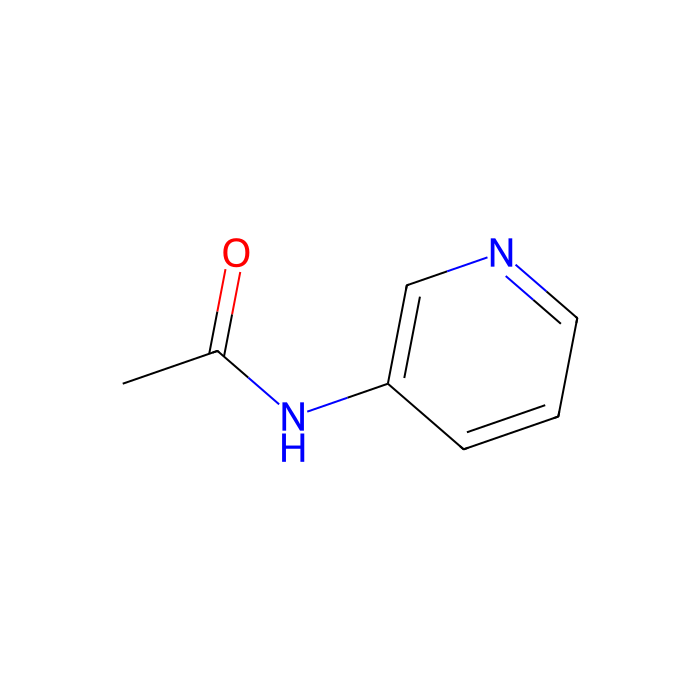
3-Acetamidopyridine is a mono-functionalized pyridine bearing an acetamido substituent at the 3-position of the ring.
Item-specific (Product Data):
SKU: A151789
Product name: 3-Acetamidopyridine
CAS: 5867-45-8
Storage conditions: Room temperature
Shipped in: Normal
Category: 全部 / 可售 / 化学和生化试剂
Research use: For research use only
InChIKey (item-specific): Not specified for this item; refer to CoA/Spec Sheet.
SMILES (item-specific): Not specified for this item; refer to CoA/Spec Sheet.
Molecular formula (item-specific): Not specified for this item; refer to CoA/Spec Sheet.
Molecular weight (item-specific): Not specified for this item; refer to CoA/Spec Sheet.
Structural features (general chemistry description):
Aromatic heterocycle: a six-membered pyridine ring (one ring nitrogen, sp2 hybridized) with alternating double bonds.
Functional group: a primary amide (acetamide) —NH–C(=O)–CH3 attached at the meta (3) position relative to the ring nitrogen.
Hydrogen-bonding functionality: one amide N–H donor and two strong acceptors (pyridine N and amide carbonyl O).
2D depiction (verbal): a pyridine ring with the ring N at position 1; at carbon 3, an –NH–C(=O)–CH3 substituent projects outward. No stereocenters; planar conjugated scaffold with resonance between the amide and the aromatic system.
Synthetic Utility
Key functional elements and their reactivity (general/literature):
Amide (–NH–C(=O)–CH3): serves as a protecting group for the amino functionality; robust toward many bases and nucleophiles, but cleavable by hydrolysis (acidic or basic). It can participate in H-bond templating and direct reactivity.
Pyridine ring: offers a Lewis basic nitrogen and an electron-deficient aromatic system conducive to N-oxidation, electrophilic activation (e.g., formation of pyridinium salts), and cross-coupling when appropriately halogenated.
Transformations enabled:
Deprotection to 3-aminopyridine: Acidic (HCl, H2SO4) or basic (NaOH, K2CO3) hydrolysis.
N-oxidation: mCPBA or H2O2/acetic acid systems on pyridine nitrogen to afford the N-oxide, altering directing effects and reactivity.
Amide manipulation: Conversion to other acyl groups (via transamidation or acyl exchange strategies under activating conditions) to tune properties.
Reductive pathways: Amide reduction to the corresponding amine using borane complexes or catalytic hydrosilylation (method-dependent); caution with over-reduction of the ring.
Metalation/functionalization: Under strongly basic conditions (e.g., TMP bases, LDA with additive ligands), directed metalation adjacent to the amide has literature precedent in related heteroarenes; subsequent trapping with electrophiles can elaborate the ring (verify positional selectivity for pyridine systems).
Utility summary: 3-Acetamidopyridine is a versatile masked-amine heteroarene, enabling stepwise functionalization of the pyridine core while preserving a convertible amide handle.
Target Specificity
Not applicable. 3-Acetamidopyridine is a small-molecule chemical building block and not a biological macromolecule or affinity reagent. No antigen/epitope, clone, isotype, or species reactivity information applies.
Item-specific targeting data: Not specified for this item.
Frequently Asked Questions
What is the purity of this product?
This product is supplied at ≥98% purity (chemical assay). Lot-specific values are stated on the Certificate of Analysis.
How should this product be stored?
Store at room temperature.
How is this product shipped?
This product ships under standard ambient conditions. No temperature-controlled packaging is required.
What are the CAS number, molecular formula and molecular weight?
The CAS Number is 5867-45-8, the molecular formula is C7H8N2O, and the molecular weight is 136.15 g/mol. InChIKey JVYIBLHBCPSTKF-UHFFFAOYSA-N.
What documentation is provided?
Available product documentation, including Certificates of Analysis (COA), Safety Data Sheets (SDS), and specification sheets, is shown in the product document area. Document availability and access follow the current site policy.
We use cookies to ensure the website functions properly and, where permitted, to improve your experience. You can manage your preferences at any time in Settings. Learn more in our Cookie Policy.
Shall we send you a message when we have discounts available?
Remind me later
Thank you! Please check your email inbox to confirm.
Products are supplied to verified businesses, institutions, and qualified professionals for research and development use only. Not for use in humans, animals, diagnosis, or therapy.

 C2321454