This compound belongs to the class of organic compounds known as benzamides. These are organic compounds containing a carboxamido substituent attached to a benzene ring.
External Descriptors
Not available
1. Djoumbou Feunang Y, Eisner R, Knox C, Chepelev L, Hastings J, Owen G, Fahy E, Steinbeck C, Subramanian S, Bolton E, Greiner R, and Wishart DS. ClassyFire: Automated Chemical Classification With A Comprehensive, Computable Taxonomy. Journal of Cheminformatics, 2016, 8:61.
Determine the necessary mass, volume, or concentration for preparing a solution.
Dilution Calculator
Determine the dilution needed to prepare a stock solution.
Reconstitution Calculator
Reviews
Customer Reviews
Application Protocols
Not applicable. No immunoassay or bioassay protocols (e.g., WB, IHC, IF, FC) are associated with this small-molecule building block.
General handling tip for assay use
Prepare concentrated stocks in DMSO or ethanol, filter if needed (0.22 µm PTFE), and dilute into assay buffer with vigorous mixing to avoid precipitation. Validate final solvent content with your assay tolerance.
Biological Roles
This product is a synthetic aromatic small molecule used primarily as a chemical building block. No endogenous biological role is associated with 3-cyanobenzamide.
General context (literature): Aromatic amide/nitrile motifs are common fragments in medicinal chemistry campaigns due to their metabolic stability and capacity for directional hydrogen bonding. 3-Cyanobenzamide can serve as a fragment for SAR exploration, enabling vector growth from the amide (hydrogen-bond donor/acceptor) and nitrile (weak acceptor) positions.
Enzymatic interactions: No specific biochemical target or pathway is inherent to 3-cyanobenzamide. Any observed bioactivity would be context-dependent for a given derivative or conjugate.
Research Use Note
For research use only (per Product Data). Not for human or veterinary use, clinical diagnostics, or consumption.
Buffer Applications
3-Cyanobenzamide is not a buffering agent and is not typically used to prepare buffer systems. It lacks a suitable conjugate acid/base pair in a biological pH window for buffering capacity.
Practical note
When dissolving for biochemical assays, select an appropriate buffer (e.g., phosphate, HEPES) and use a minimal amount of co-solvent (DMSO or ethanol) to achieve stock solutions. Validate solubility and assay compatibility.
Green Alternatives
Greener chemistry considerations focus on solvent and reagent choice rather than the substrate itself.
Replace DMF/NMP with safer polar aprotics where possible: Cyrene (dihydrolevoglucosenone), propylene carbonate, or dimethyl sulfone for certain couplings; 2-MeTHF or ethanol for workups/crystallizations.
For analytical dissolution, prioritize ethanol or water/ethanol blends before resorting to DMSO/DMF.
Reagent selection for key transformations:
Nitrile hydrolysis: Use catalytic hydration (e.g., metal-catalyzed with water) or aqueous buffered conditions instead of harsh mineral acids/bases when feasible.
Reductions: Favor catalytic hydrogenation with H2 over stoichiometric metal hydrides; if hydrides are necessary, consider safer alternatives and quench protocols.
Energy and waste:
Employ microwave or flow methods to reduce reaction times and energy input for otherwise sluggish aromatic substitutions.
Design crystallizations that minimize halogenated solvent use; leverage antisolvent precipitation with greener alcohols.
Illustrative comparison (general)
Traditional: DMF or NMP for couplings; LiAlH4 for nitrile reduction; chlorinated solvents for workup.
Greener alternative: Ethanol or 2-MeTHF as reaction/workup solvent; catalytic hydrogenation (Pd/C, H2) for reductions; ethyl acetate or methyl tert-butyl ether for extractions.
Always balance green metrics with reaction performance and safety; verify alternatives at small scale.
Pharmaceutical Uses
No pharmacopeial excipient status or formulation role is specified for this item; refer to CoA/Spec Sheet if this material is to be used as a reference standard.
General, non-clinical context (literature/practice)
Synthetic intermediate: 3-Cyanobenzamide is frequently employed as a building block to access meta-carboxamide or meta-carboxyl derivatives, heterocycles, and aryl-extended scaffolds in medicinal chemistry. It can be incorporated during lead optimization to modulate polarity, H-bonding, and metabolic stability.
Reference/analytical material: May be used as a research analytical standard for method development (HPLC/LC–MS) involving amide/nitrile aromatics, subject to internal qualification.
Important: No therapeutic or clinical claims are made. For research and manufacturing development only, with appropriate internal qualification and QA oversight if used beyond discovery research.
Physical Properties
Item-specific specifications are not provided in the Product Data. Refer to the product’s CoA/Spec Sheet for any guaranteed numeric specifications.
Literature/general reference values and qualitative behavior (for planning only)
Physical state: Typically a crystalline solid (aromatic amide/nitrile class).
Polarity: Moderately polar due to amide; overall relatively low volatility.
Acid–base: The amide NH is weakly acidic; the nitrile is neutral. No practical pKa in water for deprotonation under standard conditions (amide deprotonation requires strong base, literature).
Solubility profile (literature, qualitative):
Water: low to moderate solubility typical of benzamides; can increase with heating or pH adjustment (amidic hydrogen bonding aids limited aqueous solubility).
Organic solvents: soluble in polar aprotic solvents (DMSO, DMF, NMP); sparingly to moderately soluble in alcohols; limited solubility in nonpolar hydrocarbons.
Partitioning: The presence of both amide and nitrile generally lowers logP relative to alkylbenzenes of similar size (qualitative literature inference).
Thermal behavior: Aromatic amides typically exhibit melting in the mid-to-high °C range and decompose before boiling at ambient pressure (literature trend for solids of this class).
Do not treat the above as product specifications. For exact MP, water content, residual solvents, or spectral data, consult the CoA/Spec Sheet for this specific lot.
Quality and Grades
Item-specific grade/purity: Not specified for this item; refer to CoA/Spec Sheet.
Guidance on typical grades for small-molecule building blocks like 3-cyanobenzamide (general information):
Research grade: Suitable for most synthetic and screening work. Impurity profiles focus on identity and assay; trace metals not typically controlled unless relevant.
High-purity/assay ≥98–99% (when offered): Facilitates cleaner reaction profiles and more reproducible analytical data (NMR, HPLC). Check UV cutoffs if using in analytical chromatography; amide/nitrile aromatics usually have manageable UV backgrounds.
LC/MS or HPLC grade (when applicable to solvents/standards): Ensures low non-volatile residue and minimal UV-absorbing impurities; less commonly assigned to solid reagents but relevant if product is used as a reference standard.
Stabilizers: Not typically required for this class; none specified for this item.
What to look for on the CoA/Spec Sheet
Identification: 1H NMR and/or IR consistent with amide (∼1650–1680 cm−1) and nitrile (∼2220–2260 cm−1) stretches (literature).
Assay/purity: Method (HPLC/GC/quantitative NMR), and acceptance criteria.
Residual solvents, water content, and appearance: Lot-specific; consult CoA.
Storage statement: Room temperature for this item per Product Data; confirm retest date and packaging (e.g., amber glass, desiccant if applicable).
Reaction and Applications
As a bifunctional aromatic (amide + nitrile), 3-cyanobenzamide is a useful intermediate in medicinal chemistry and materials discovery.
Representative applications (literature/general):
Nitrile transformations:
Hydrolysis to amide/acid derivatives: The ring nitrile can be converted to meta-carboxamide or meta-carboxylic acid under acidic/basic conditions, enabling access to m-carboxybenzamide or isophthalic acid amide motifs.
Reduction: Partial reduction to amidine or full reduction to meta-benzylamine amide derivatives using hydride (e.g., DIBAL-H for partial; LiAlH4 for full) or catalytic hydrogenation.
Cyclizations: Nitrile can participate in heterocycle formation (e.g., imidate intermediates leading to 1,3,4-oxadiazoles after coupling with hydrazides, literature routes).
Amide site derivatization:
N-acyl protection or conversion to imidates/imidoyl chlorides under activating conditions for subsequent transformations.
Formation of ureas/thioureas via reaction of the amide with carbamoyl transfer reagents (after activation), or conversion to nitrile via dehydrative strategies if needed.
Aromatic ring chemistry:
Electrophilic substitution is deactivated and meta-directing due to the strong −M/−I effects of both substituents; nitration/sulfonation favor positions meta to substituents (literature).
Cross-coupling after prefunctionalization (e.g., bromination then Suzuki/Miyaura) can elaborate the scaffold while retaining amide/nitrile handles.
Use polar aprotic solvents to enhance reactivity in SNAr or coupling chemistry.
Monitor by LC–MS; the amide/nitrile pair provides strong IR handles (~2220–2260 and ~1650–1680 cm−1, literature).
Reaction Conditions
The following are general, literature-based guidelines for transformations of 3-cyanobenzamide; they are not product specifications.
Nitrile hydrolysis to amide/acid:
Conditions: Aqueous acid (e.g., 6 M HCl, reflux) or base (e.g., NaOH, reflux) with prolonged heating; greener alternatives employ catalytic hydration in water or water/alcohol at 80–120°C.
Notes: Control for partial vs full hydrolysis; monitor by LC–MS/IR (nitrile band ~2220–2260 cm−1, literature).
Nitrile reduction:
Catalytic hydrogenation: Pd/C or Raney Ni, H2 (1–10 bar), alcohol or ethanol/EtOAc solvent, 20–60°C, affords primary amines; amide typically stable but verify for over-reduction.
Hydride reagents: DIBAL-H (−78 to 0°C) for partial reduction to aldehyde equivalents/imines; LiAlH4 (0–60°C) for full reduction; strict anhydrous conditions and controlled quench required.
Electrophilic aromatic substitution:
Strong deactivation requires forcing conditions (e.g., fuming HNO3/H2SO4 for nitration). Reactions proceed meta to deactivating groups; control temperature carefully to minimize overreaction.
Cross-coupling (after halogenation):
Suzuki–Miyaura: Pd(0)/phosphine catalysts, base (K2CO3, Cs2CO3), dioxane/H2O or 2-MeTHF/H2O, 60–100°C.
Buchwald–Hartwig amination: Pd/XPhos or related ligands, strong base (NaOtBu), toluene or 2-MeTHF, 80–110°C.
Workup and purification
Take advantage of differential solubility: product often precipitates from water/alcohol mixes. Avoid prolonged basic aqueous exposure if amide integrity is critical.
Safety and Handling
Safety details specific to this catalog item (GHS classification, signal word, H-statements, pictograms) are not specified for this item; refer to SDS.
General safety considerations for aromatic amide/nitrile solids (literature/practice; not item-specific):
Likely hazards: May cause skin/eye irritation and respiratory irritation as a dust. Avoid inhalation and contact. Not known as a strong sensitizer, but handle prudently.
Personal protective equipment: Use lab coat, safety glasses, and appropriate gloves (e.g., nitrile). Handle powders in a fume hood to minimize dust exposure.
Incompatibilities: Strong oxidizers (general precaution). Strong bases can deprotonate the amide under forcing conditions; strong acids/bases may promote hydrolysis of the amide at elevated temperature.
Thermal stability: Solid, non-volatile; avoid excessive heating to prevent decomposition. Do not distill to dryness.
Hygiene measures: Avoid generating dust; use dedicated spatulas; wash hands after handling.
First aid (overview; defer to SDS):
Inhalation: Move to fresh air; seek medical attention if symptoms persist.
Skin/eye contact: Rinse with copious water; remove contaminated clothing; obtain medical advice for persistent irritation.
Ingestion: Rinse mouth; do not induce vomiting; seek medical attention.
Always consult the product SDS for authoritative hazard, exposure limits, and spillage/firefighting guidance before use.
Solvent Selection
3-Cyanobenzamide is a polar, hydrogen-bonding capable aromatic solid. Solvent choice depends on the operation (dissolution, reaction, crystallization, or analysis).
Polarity and miscibility (literature/general):
Highly soluble: DMSO, DMF, NMP due to strong H-bond accepting ability and polarity.
Moderate solubility: Methanol, ethanol, isopropanol; hot alcohols often improve dissolution.
Limited solubility: Ethyl acetate, acetone (variable); often adequate for workups or recrystallizations.
Poor solubility: Aliphatic hydrocarbons, toluene (unless heated or with co-solvent).
Use scenarios:
Synthesis: Choose polar aprotic solvents (DMF/DMSO/NMP) for SNAr, amidation coupling, or metal-catalyzed functionalization on the ring.
Purification/crystallization: Ethanol/water, isopropanol, or EtOAc/hexanes mixtures can be tuned; the amide enables selective precipitation from less polar media.
Analytical: For HPLC, dissolve in acetonitrile/water with a small DMSO co-solvent if needed; monitor UV at aromatic wavelengths (e.g., 220–280 nm, literature practice).
Comparison (general):
DMF vs DMSO: DMF often offers better solubility for amide-bearing aromatics; DMSO may provide higher polarity but can complicate workup.
MeOH/EtOH: Greener alternatives but may limit solubility; useful as antisolvents for crystallization.
Select the least hazardous solvent that achieves required solubility and reaction performance; validate with a small-scale solubility screen.
Storage and Reconstitution
Item-specific storage: Room temperature (per Product Data). Shipped under normal conditions.
Packaging: Typically supplied in tightly sealed glass vials. Store in a dry place, protected from excessive heat and direct light.
Stability: Aromatic amide/nitrile solids are generally stable on the bench when dry and protected from contaminants (literature). Avoid prolonged exposure to moisture if subsequent moisture-sensitive reactions are planned.
Reconstitution/dissolution (general guidance):
For synthetic use: Dissolve in polar aprotic solvents (DMF, DMSO, NMP) or hot alcohols as needed. Filter to remove particulates prior to use in analytical methods.
Stock solutions: Prepare in dry solvent; for biological assays use DMSO or ethanol stock, store aliquots at −20°C to minimize freeze–thaw, and bring to room temperature before opening to avoid condensation.
Shelf life: Not specified for this item; refer to CoA/Spec Sheet. Use retest date information where provided.
Research Use Note: For research use only (per Product Data).
Structure and Identity
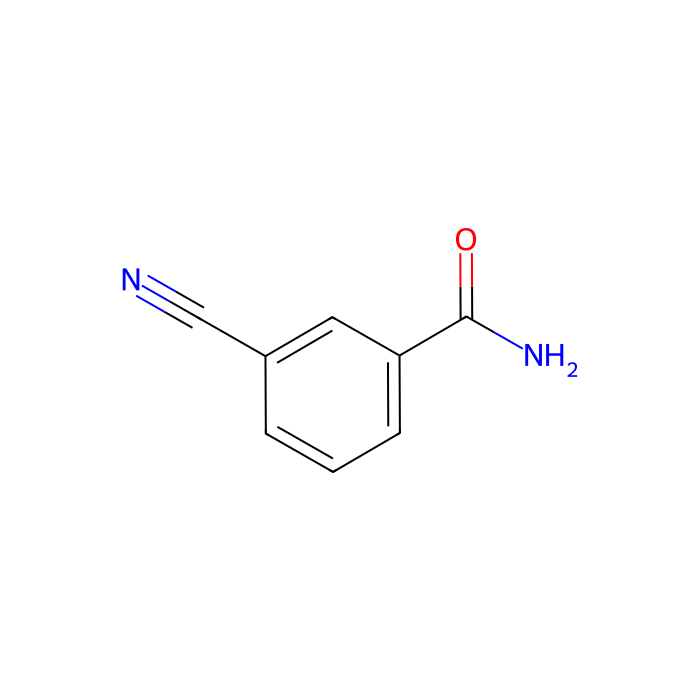
3-Cyanobenzamide is an aromatic bifunctional building block bearing both a benzamide (carboxamide) and a nitrile.
Item-specific identifiers (from Product Data)
SKU: C333574
CAS: 3441-01-8
CID: 76974
InChIKey: 272479 (as listed in catalog)
Storage/Shipping: Room temperature; shipped under normal conditions
Computed/literature structural information (for reference; not item specifications)
Preferred IUPAC name (literature): 3-cyanobenzamide (meta-cyanobenzamide)
Molecular formula (literature): C8H6N2O
Molecular weight (literature): ~146.15 g/mol
Structural features: A benzene ring bearing two meta-separated, strongly electron-withdrawing substituents: an amide group (–CONH2) and a cyano group (–C≡N). No stereocenters; planar aromatic core dominates.
2D description: Six-membered benzene ring with –CONH2 at position 1 and –C≡N at position 3 (meta). The amide carbonyl is conjugated with the ring; the nitrile is sp-hybridized and linear.
Notes
Identity elements not explicitly provided in the Product Data (e.g., canonical SMILES, standardized InChIKey) are shown as literature references for structural context only.
Synthetic Utility
Functional handles and reactivity (literature/general):
Amide group (–CONH2):
Activation to acid chloride (e.g., via SOCl2/oxalyl chloride) typically requires prior conversion of the amide to the acid; direct activation of primary amides is limited. Alternatively, use dehydrative coupling (e.g., CDI) to form imidates/amide derivatives.
Directed metalation adjacent to amide can be exploited with strong bases for further elaboration (specialized conditions).
Nitrile group (–C≡N):
Hydrolysis to acids/amides under acidic/basic conditions affords isophthalic derivatives for divergent synthesis.
Nucleophilic additions (e.g., organometallics) give imines/ketimines that can be trapped or hydrolyzed.
Reductive transformations permit access to amidines or benzylamines.
Aromatic core:
Strongly deactivated (−M/−I), favoring meta substitution in electrophilic aromatic substitution; prefunctionalization (e.g., halogenation under forcing conditions) enables cross-coupling (Suzuki, Buchwald–Hartwig after amide protection/activation as needed).
Retrosynthetic value
Serves as a convergent node allowing late-stage installation of either acid-derived functions (from nitrile hydrolysis) or amine/alcohol vectors (from nitrile reduction), while the amide can engage in hydrogen bonding to tune properties.
Practical notes
Employ polar aprotic media to enhance rates in SNAr and coupling.
Protect or transiently activate the amide when incompatible with strong bases or dehydrating agents.
Target Specificity
Not applicable. This product is a small-molecule chemical and not an affinity reagent. No antigen, epitope, clone, isotype, or species reactivity information applies.
We use cookies to ensure the website functions properly and, where permitted, to improve your experience. You can manage your preferences at any time in Settings. Learn more in our Cookie Policy.
Shall we send you a message when we have discounts available?
Remind me later
Thank you! Please check your email inbox to confirm.
Products are supplied to verified businesses, institutions, and qualified professionals for research and development use only. Not for use in humans, animals, diagnosis, or therapy.

 D2308847