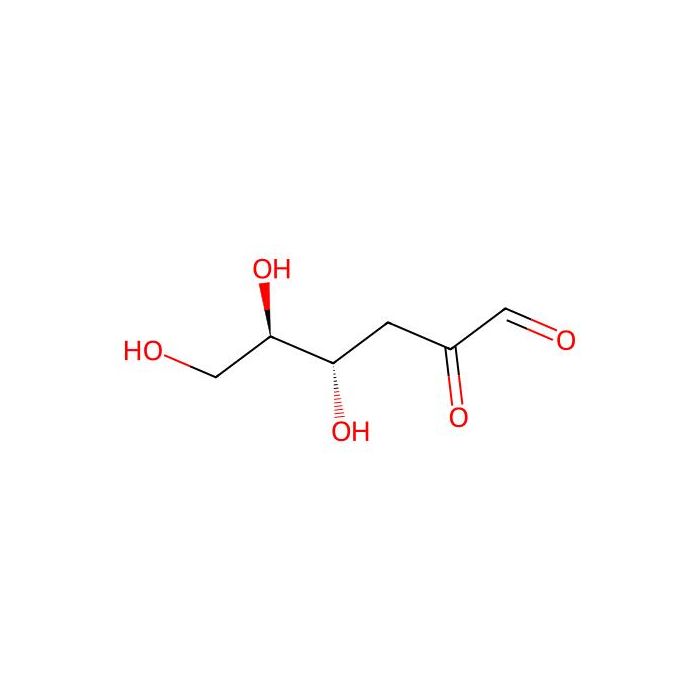
3-Deoxyglucosone , CAS No.4084-27-9

CAS: 4084-27-9 Cat. No.: D650932 Formula: C6H10O5 Molecular Weight: 162.14 EC Number: 811-252-3 PubChem CID: 114839
AVAILABLE TO ORDER
Synonyms
erythro-Hexosulose, 3-deoxy-|(4S,5R)-4,5,6-trihydroxy-2-oxohexanal|3-deoxy-2-ketoglucose|3-Deoxy-erythro-hexosulose|2-Keto-3-deoxyglucose|D-3-Deoxyglucosone|3-Deoxy-D-glucosone|3-deoxyglucosulose|3-Deoxyglucosone|3-deoxy Glucosone|D-erythro-Hexosulose, 3-deoxy-|3-deoxy-erythro-hexos-2-ulose|3-Deoxy-D-erythro-hexos-2-ulose|3-deoxy-D-erythro-hexosulose|D-erythro-Hexos-2-ulose, 3-deoxy-
Storage
Store at -20°C
Shipped In
Ice chest + Ice pads
★
Size
Germany (EU)
USA*
Price
Qty
5mg
D650932-5mg
Made to order · 8–12 wks
€1,007.36
Enter a quantity for the sizes you want to add.

Overview

3-Deoxyglucosone (3-Deoxy-D-glucosone) is a reactive intermediate of the Maillard reaction and the polyol pathway. 3-Deoxyglucosone rapidly reacts with protein amino groups to form advanced glycation end products ( AGEs ), such as imidazolone, it is the most specific AGE for 3-DG. 3-Deoxyglucosone synergizes with low glucose to potentiate GLP-1 secretion and is considered as a biomarker for diabetes .

In Vitro

3-Deoxyglucosone (80 ng/ml-1000 ng/ml; 1 hour) markedly increases GLP-1 secretion by 1.23-folds in 300 ng/ml or 1000 ng/ml 3DG-treated group. But at alower concentration (80 ng/ml) has no effects. 3-Deoxyglucosone (300 ng/ml; 1 hour) dramatically increases intracellular Ca 2+ levels by Fluo-3/AM determination (2.5 μM for 30 mins). But 3DG does not affect intracellular cAMP levels in a cAMP Elisa assay. 3-Deoxyglucosone (300 ng/ml; 1 hour) significantly increases the protein expression levels of TAS1R2, TAS1R3, and TRPM5 under both glucose-free and highconditions. MCE has not independently confirmed the accuracy of these methods. They are for reference only. Western Blot AnalysisCell Line: STC-1 cells Concentration: 300 ng/ml Incubation Time: 1 hour Result: Upregulated TAS1R2, TAS1R3, and TRPM5 expression.

In Vivo

3-Deoxyglucosone (intragastric administration; 20 mg/kg; single dose) impairs glucose tolerance with increased AUC, but the plasma Glukagon levels are not significantly different. It developes impaired glucose regulation (IGR) with obviously pancreatic islet cell dysfunction in kunming mice and SD-rats. 3-deoxyglucosone (gastric gavage; 5-50 mg/kg; once daily; 2 weeks) is significantly increased in the upper small intestine (1.4-fold), lower small intestine (1.4-fold), ileum (1.4-fold) and colon (two fold) compared with the basal levels in the corresponding control group. In addition, the protein expressions of TAS1R2, TAS1R3 and TRPM5 in both duodenum and colon are significantly decreased. MCE has not independently confirmed the accuracy of these methods. They are for reference only. Animal Model: SD ratsDosage: 5, 20 and 50 mg/kg Administration: oral administration; once daily; 2 weeks Result: Was capable of accumulating in intestinal tissue and thereby decreased secretion of GLP-1 and insulin.

Specifications

Synonyms
erythro-Hexosulose, 3-deoxy- | (4S,5R)-4,5,6-trihydroxy-2-oxohexanal | 3-deoxy-2-ketoglucose | 3-Deoxy-erythro-hexosulose | 2-Keto-3-deoxyglucose | D-3-Deoxyglucosone | 3-Deoxy-D-glucosone | 3-deoxyglucosulose | 3-Deoxyglucosone | 3-deoxy Glucosone | D-erythro-Hexosulose, 3-deoxy- | 3-deoxy-erythro-hexos-2-ulose | 3-Deoxy-D-erythro-hexos- Show more
Biochemical and Physiological Mechanisms
3-Deoxyglucosone (3-Deoxy-D-glucosone) is a reactive intermediate of the Maillard reaction and the polyol pathway. 3-Deoxyglucosone rapidly reacts with protein amino groups to form advanced glycation end products ( AGEs ), such as imidazolone, it is the m
Storage
Store at -20°C
Shipped In
Ice chest + Ice pads
This product requires cold chain shipping. Ground and other economy services are not available.
Names and Identifiers
SMILES
C(C(C(CO)O)O)C(=O)C=O
IUPAC Name
(4S,5R)-4,5,6-trihydroxy-2-oxohexanal
InChIKey
ZGCHLOWZNKRZSN-NTSWFWBYSA-N
InChI
1S/C6H10O5/c7-2-4(9)1-5(10)6(11)3-8/h2,5-6,8,10-11H,1,3H2/t5-,6+/m0/s1
Isomeric SMILES
C([C@@H]([C@@H](CO)O)O)C(=O)C=O
WGK Germany
3
RTECS
MQ3390000
PubChem CID
114839
Molecular Weight
162.14

Advanced Data

Taxonomic Classification

Taxonomy Tree

KingdomOrganic compounds
SuperclassLipids and lipid-like molecules
ClassFatty Acyls
SubclassFatty alcohols
Intermediate Tree Nodes Not available
Direct ParentFatty alcohols
Alternative Parents Medium-chain aldehydes  Beta-hydroxy ketones  Alpha ketoaldehydes  Secondary alcohols  Polyols  Primary alcohols  Organic oxides  Hydrocarbon derivatives  
Molecular FrameworkAliphatic acyclic compounds
Substituents Fatty alcohol - Medium-chain aldehyde - Beta-hydroxy ketone - Alpha-ketoaldehyde - Secondary alcohol - Ketone - Polyol - Primary alcohol - Organooxygen compound - Organic oxide - Organic oxygen compound - Carbonyl group - Alcohol - Aldehyde - Hydrocarbon derivative - Aliphatic acyclic compound
DescriptionThis compound belongs to the class of organic compounds known as fatty alcohols. These are aliphatic alcohols consisting of a chain of a least six carbon atoms.
External Descriptors deoxyketohexose - deoxyglucose
3D Structure
Interactive Chemical Structure Model


Certificates (CoA,COO,BSE/TSE and Analysis Chart)
C of A & Other Certificates(BSE/TSE, COO):
Analytical Chart:
Chemical and Physical Properties
x_refractive_indexn20D1.51 (Predicted)
x_boil_point_char400.09° C at 760 mmHg (Predicted)
x_melt_point_char73-75° C
Molecular Weight162.14
XLogP3-2.400
Hydrogen Bond Donor Count3
Hydrogen Bond Acceptor Count5
Rotatable Bond Count5
Exact Mass162.053 Da
Monoisotopic Mass162.053 Da
Topological Polar Surface Area94.800 Ų
Heavy Atom Count11
Formal Charge0
Complexity144.000
Isotope Atom Count0
Defined Atom Stereocenter Count2
Undefined Atom Stereocenter Count0
Defined Bond Stereocenter Count0
Undefined Bond Stereocenter Count0
The total count of all stereochemical bonds0
Covalently-Bonded Unit Count1
Safety and Hazards(GHS)
x_symbol
x_signal_word
Warning
x_hazard_statements

H315:Causes skin irritation

H319:Causes serious eye irritation

H335:May cause respiratory irritation

x_precautionary_statements

P261:Avoid breathing dust/fume/gas/mist/vapors/spray.

P264:Wash hands [and …] thoroughly after handling.

P271:Use only outdoors or in a well-ventilated area.

P280:Wear protective gloves/protective clothing/eye protection/face protection.

P321:Specific treatment (see ... on this label).

P302+P352:IF ON SKIN: wash with plenty of water.

P304+P340:IF INHALED: Remove person to fresh air and keep comfortable for breathing.

P305+P351+P338:IF IN EYES: Rinse cautiously with water for several minutes. Remove contact lenses if present and easy to do - continue rinsing.

P362+P364:Take off contaminated clothing and wash it before reuse.

P405:Store locked up.

P403+P233:Store in a well-ventilated place. Keep container tightly closed.

P501:Dispose of contents/container to an approved waste disposal plant.

P264+P265:Wash hands [and …] thoroughly after handling. Do not touch eyes.

P337+P317:If eye irritation persists: Get medical help.

P332+P317:If skin irritation occurs: Get medical help.

P319:Get medical help if you feel unwell.

x_wgk_germany
3
x_rtecs
MQ3390000
FAQs and Articles
Citations of This Product
Solution Calculators
Reviews

Customer Reviews

Shall we send you a message when we have discounts available?

Remind me later

Thank you! Please check your email inbox to confirm.

Oops! Notifications are disabled.