4,4'-Dihydroxybenzophenone is as a UV light stabilizer. It and its derivatives are found in cosmetics, plastics, films, adhesives and coatings, optical fiber, and printed circuit boards. It is the precursor to certain polycarbonate polymers.
This compound belongs to the class of organic compounds known as benzophenones. These are organic compounds containing a ketone attached to two phenyl groups.
External Descriptors
benzophenones
1. Djoumbou Feunang Y, Eisner R, Knox C, Chepelev L, Hastings J, Owen G, Fahy E, Steinbeck C, Subramanian S, Bolton E, Greiner R, and Wishart DS. ClassyFire: Automated Chemical Classification With A Comprehensive, Computable Taxonomy. Journal of Cheminformatics, 2016, 8:61.
Determine the necessary mass, volume, or concentration for preparing a solution.
Dilution Calculator
Determine the dilution needed to prepare a stock solution.
Reconstitution Calculator
Reviews
Customer Reviews
Application Protocols
Not applicable as standardized bioassay/diagnostic protocols. For chemical use:
Preparing stock solutions (general): dissolve to 10–100 mg/mL in DMSO, DMF, ethanol, or acetone; warm gently and sonicate if needed. Filter (0.45 μm PTFE) to clarify.
For polymer/additive studies: pre-dry the solid, then blend with resin or reactive monomers; document temperature profile and residence time to avoid discoloration.
No WB/IHC/IF/FC or related biological application protocols are associated with this item.
Biological Roles
This product is a synthetic aromatic diol/ketone and is not a biological buffer, enzyme, or nutrient.
General chemistry context (literature):
Benzophenone scaffolds display strong UV absorption due to extended conjugation; dihydroxy substitution modulates acidity and photophysics but does not confer a known endogenous biological role.
Phenolic benzophenones can undergo ionization near alkaline pH and may interact with proteins or membranes in model systems via hydrophobic and H-bonding interactions; these interactions are used in analytical or materials studies rather than inherent biochemistry.
Research use note: For in vitro studies only as a chemical standard or material modifier; not intended for use in living systems. No claims of biological activity or therapeutic relevance are made for this catalog item.
Practical guidance:
For biochemical assays that require solubilization, prepare concentrated stocks in DMSO or ethanol and dilute into assay buffers, monitoring final organic content to avoid denaturation artifacts.
Adsorption to plastics/glass can occur for hydrophobic aromatics; pre-rinse or use glass vials for accurate dosing.
Buffer Applications
Not typically used as a buffering agent. 4,4′-Dihydroxybenzophenone is a neutral organic solid (phenolic diol) without a defined buffering range. For experimental work requiring dissolution in aqueous media, employ standard biological buffers (e.g., phosphate, Tris) and dissolve this compound via co-solvent addition or alkaline adjustment to form soluble phenolates, then re-acidify if precipitation is desired.
Green Alternatives
While 4,4′-dihydroxybenzophenone itself is a targeted building block/additive, process choices around it can be made greener.
Greener solvent choices (literature guidance):
Prefer bio-based ethanol or isopropanol for dissolution/recrystallization when feasible instead of chlorinated solvents.
Use acetone or ethyl acetate for O-alkylation/esterification workups in place of DMF/DMSO where solubility allows.
For carbonate formation/transesterification, dimethyl/diethyl carbonate (DMC/DEC) are greener carbonylation agents versus phosgene or triphosgene.
Energy and workup:
Employ solvent recycling and antisolvent crystallizations to minimize waste.
Use catalytic esterification (e.g., organocatalysts or solid acids) instead of stoichiometric coupling reagents when compatible.
Comparison snapshot (literature-based):
DMF vs. Acetone: DMF offers higher solubility but is reprotoxic and high-boiling; acetone is low-toxicity and readily recoverable.
DCM vs. Ethyl acetate: DCM is effective but volatile and problematic for worker exposure; ethyl acetate provides similar polarity with better EHS profile.
Phosgene/Triphosgene vs. DMC/DEC: DMC/DEC are safer carbonyl sources; may require higher temperatures or catalysts to reach comparable conversions.
Tradeoffs: Greener choices may increase reaction time/temperature or alter selectivity; verify performance at small scale before process adoption.
Pharmaceutical Uses
No pharmacopeial grade or excipient designation is specified for this item.
General, non-clinical context (literature):
The benzophenone chromophore is used in analytical laboratories as a UV-absorbing standard or marker; 4,4′-dihydroxy substitution provides altered spectra and solubility useful for method development.
In materials R&D for packaging or device polymers, phenolic benzophenones are explored as UV-modifying comonomers or additives; any such uses must comply with regulatory and extractables/leachables assessments.
Manufacturing/formulation considerations:
If used as a process intermediate or analytical standard, ensure impurity profiles, residual solvents, and trace metals meet internal quality requirements; verify with CoA.
For UV-based analytical methods, document extinction coefficients and solvent dependence (determined in-house) rather than assuming literature values.
Regulatory note: This catalog item is for research use only and is not intended for human or veterinary applications.
Physical Properties
Item-specific specs were not provided. The following values are literature/typical for 4,4′-dihydroxybenzophenone (for reference only; not specifications for this catalog item):
Appearance (literature): off-white to light tan crystalline solid.
Melting point: typically ~210–215 °C (literature, varies by source and purity).
Boiling point: not commonly reported; compound chars/decomposes before boiling at ambient pressure (literature).
Molecular formula: C13H10O3 (literature)
Molecular weight: 214.22 g/mol (literature)
Solubility (qualitative, literature):
Low in water; increases in basic aqueous media due to phenolate formation.
Soluble in polar organic solvents (e.g., ethanol, methanol, acetone, DMF, DMSO); moderately in ethyl acetate; limited in aliphatic hydrocarbons.
Acid–base: phenolic pKa values typically near ~10 for para-phenols; deprotonation with bases (literature, exact values vary by substitution and medium).
LogP: expected moderate hydrophobicity due to aromatic core with two phenols; reported values in the ~2 range in some databases (literature; source-dependent).
UV–Vis: strong π→π* absorption in near-UV typical of benzophenones and phenols; exact maxima depend on solvent and ionization state (literature).
Item-specific parameters such as Karl Fischer water, trace metals, UV cutoff, RI: Not specified for this item; refer to CoA/Spec Sheet.
Quality and Grades
Item-specific grade/purity: Not specified for this item; refer to CoA/Spec Sheet.
Interpreting grades (general guidance for professional users):
Research-grade solids may be suitable for most synthesis and materials applications; verify impurity profile (phenolic content, residual solvents, ash/metals) if sensitive to color or polymerization performance.
HPLC/UV grade (if offered for this compound by a supplier) typically targets low UV baseline and stringent volatile/particulate specs—useful when 4,4′-dihydroxybenzophenone is used as a UV reference or in trace analyses.
Polymer/intermediate grade (if applicable) may emphasize controlled color (APHA), low residual salts, and defined particle size for compounding.
Stabilizers/antioxidants: Not typically required for this phenolic ketone; none are specified for this item. If stabilizers are of concern in your application (e.g., polymer additive R&D), confirm on the CoA.
Documentation best practices:
Request the current CoA for each lot to confirm assay method (e.g., HPLC/GC), water content, and any metal/halide limits relevant to your process.
For optical or polymer applications, review UV–Vis trace and color metrics when available.
Reaction and Applications
Applications focus on the phenolic and benzophenone functionalities. Examples below are literature-based general use cases for 4,4′-dihydroxybenzophenone in synthesis and materials R&D.
Polymer and materials chemistry:
UV-absorbing comonomer or additive: the conjugated benzophenone–diol motif imparts UV screening and rigidity; used in polyester/polycarbonate research via transesterification or phosgene-free carbonate formation (e.g., with diphenyl carbonate) to incorporate bis-aryl carbonate linkages.
Crosslinkable/curable systems: phenolic OH groups enable etherification with epoxides (novolac-like curing chemistry) and urethane formation with diisocyanates.
Small-molecule transformations:
O-alkylation (Williamson ether synthesis) to access bis-aryl ethers; bases such as K2CO3 or Cs2CO3 in acetone/DMF.
Esterification (DCC/EDC + DMAP) to prepare diesters (protecting group strategies or pro-monomers).
Carbonyl chemistry: selective reduction of the benzophenone to benzhydrol derivatives (NaBH4 limitations due to phenols; often use hydrosilanes or catalytic hydrogenation with protection of OH as needed).
Electrophilic substitution on the rings is deactivated para to OH by the existing OH groups; metalation (e.g., ortho-lithiation adjacent to phenols) can be leveraged after protection.
Photochemistry/analytics:
Benzophenone chromophore provides strong UV absorbance useful for calibration standards and photophysical investigations (e.g., excited-state energy transfer studies) (literature use).
Practical notes:
Drying prior to moisture-sensitive coupling improves conversions.
If both OH groups must react equally, use slight excess of electrophile and phase-transfer or polar aprotic media to balance reactivity.
Reaction Conditions
General, literature-based conditions for common transformations of 4,4′-dihydroxybenzophenone (guidance only; optimize for your system):
O-Alkylation (bis-ether formation):
Reagents: Alkyl halide (1.5–2.5 eq per OH), K2CO3 or Cs2CO3 (2–3 eq), catalytic KI (optional).
Solvent: acetone, acetonitrile, or DMF.
Temperature/time: reflux 2–16 h (acetone/MeCN) or 60–90 °C (DMF); monitor by TLC/HPLC.
Notes: Dry conditions improve rates; phase-transfer catalysts (e.g., TBAB) can accelerate in less polar media.
Esterification (diesters):
Reagents: acid anhydride or acyl chloride (2.2–2.5 eq), base (pyridine/Et3N) or DCC/EDC plus DMAP.
Solvent: DCM, THF, or EtOAc.
Temperature/time: 0 °C to rt, 2–18 h.
Notes: For green alternatives, use acid anhydrides with catalytic DMAP in EtOAc.
Carbonate formation:
Reagents: dimethyl/diethyl carbonate (3–10 eq) with base (K2CO3) or transesterification catalysts.
Solvent: neat DMC/DEC or high-boiling ether/ester.
Temperature/time: 90–140 °C, several hours; remove alcohol byproduct to drive equilibrium.
Carbonyl reduction to benzhydrol:
Reagents: NaBH4 (with OH protection) or borane/pinakolborane; catalytic hydrogenation (Pd/C) under H2 (with protected phenols).
Solvent: MeOH, THF, or toluene depending on system.
Temperature/time: 0–25 °C, 1–6 h (hydrides); 1–5 bar H2, 25–60 °C for catalytic routes.
Purification:
Recrystallization from EtOH/IPA or EtOAc/hexane mixtures.
Silica chromatography using gradients of EtOAc/hexanes; add 0.1–1% Et3N if tailing occurs due to phenolic interactions.
Safety and Handling
Product Data hazard fields (this listing):
Signal Word: Not specified for this item; refer to SDS.
H-Statements: Not specified for this item; refer to SDS.
GHS Classification: Not specified for this item; refer to SDS.
Pictograms: Not specified for this item; refer to SDS.
General GHS guidance (literature, non-binding): Aromatic dihydroxybenzophenones are commonly classified as eye/skin irritants and may cause respiratory irritation as nuisance dust. Always consult the specific SDS for authoritative classification and first-aid instructions.
Use in a chemical fume hood to avoid dust inhalation. Avoid aerosolization; minimize dust generation.
PPE: lab coat, safety glasses or splash goggles, appropriate chemical-resistant gloves (e.g., nitrile), and particulate mask if dust is present.
Incompatibilities: strong oxidizers; strong bases will form phenolates (handle pressure/heat evolution appropriately); acyl/alkylating agents can react with phenolic OH groups.
Fire safety: organic solid; may burn. Avoid ignition sources and dust accumulation (combustible dust hazard in bulk handling).
First-aid overview (consult SDS):
Skin/eye contact: rinse with water for several minutes; remove contaminated clothing/contacts; seek medical evaluation if irritation persists.
Inhalation: move to fresh air; seek medical attention if symptoms occur.
Ingestion: rinse mouth; do not induce vomiting unless directed by medical personnel.
Waste: dispose according to local regulations; segregate from oxidizers; label phenolic organic waste appropriately.
Solvent Selection
This product is a low-volatility aromatic diol/ketone solid. Solvent choice is dictated by intended operation (dissolution, reaction, crystallization, or analytical prep).
Polarity/miscibility (literature):
Poorly soluble in water at neutral pH; solubility increases substantially in basic aqueous media via phenolate formation.
Good solubility in polar organics: DMSO, DMF, NMP, acetone, acetonitrile, alcohols; moderate in ethyl acetate and chlorinated solvents; limited in nonpolar hydrocarbons.
Typical use scenarios:
Reaction medium for O-alkylation/esterification: DMF, acetone, or acetonitrile with a mild base (e.g., K2CO3).
Crystallization/purification: alcohols (EtOH/IPA) or ethyl acetate/hexane mixtures can provide workable solubility–selectivity balance.
Analytical prep/standards: DMSO or methanol stock solutions; dilute into acetonitrile/water with base if needed to reduce adsorption.
Comparison notes (literature):
DMSO/DMF maximize solubility but are higher boiling and harder to remove.
Acetone/MeCN facilitate faster workups but may require warming to fully dissolve concentrated loads.
Aqueous alkaline solutions (e.g., pH 10–11 carbonate) dissolve the phenolate salts; neutralization can precipitate the free phenol for isolation.
Practical tips:
Pre-warm solvents (40–60 °C) to aid dissolution.
Avoid excessive basicity if ketone reduction or side reactions are a concern.
Storage and Reconstitution
Storage conditions (Product Data): Room temperature. Shipped under normal conditions.
General storage guidance (solid, literature best practice):
Keep tightly closed in a dry, well-ventilated place. Protect from prolonged light exposure to avoid color change.
Use desiccant if ambient humidity is high; phenolic solids can adsorb moisture leading to caking.
Segregate from strong oxidizers and strong bases.
Reconstitution/dissolution:
Organic stocks: prepare in DMSO, DMF, ethanol, methanol, acetone, or ethyl acetate. Warm (40–60 °C) and/or sonicate to accelerate dissolution.
Aqueous use: dissolve by adding a small amount of co-solvent or by basifying (e.g., Na2CO3) to form soluble phenolates; re-acidify to precipitate the free phenol if required.
Filtration: use PTFE or PVDF membranes; avoid cellulose esters if strongly basic solutions are used.
Stability:
No item-specific stability data are provided. For long-term projects, prepare aliquots to minimize repeated opening. Monitor for discoloration as an indicator of impurity or oxidation.
Item-specific details such as shelf life, stabilizers, water/impurity limits: Not specified for this item; refer to CoA/Spec Sheet.
Structure and Identity
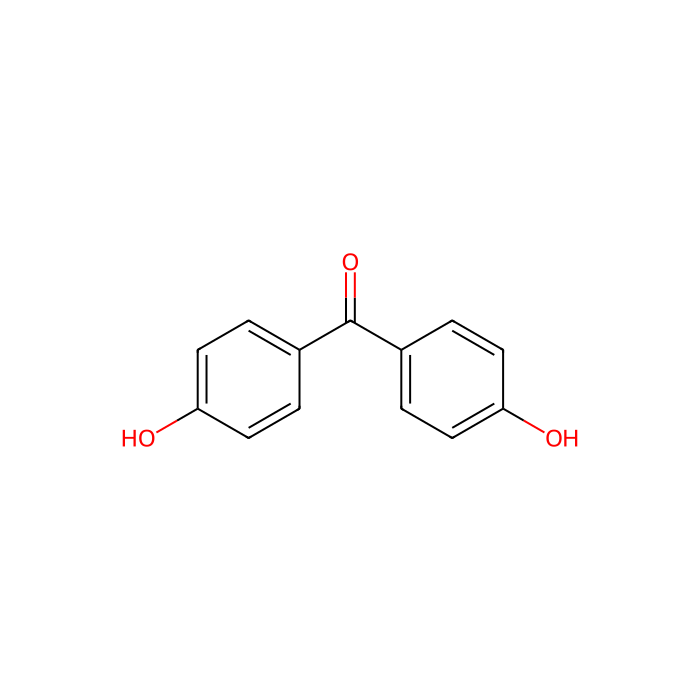
Brief description: 4,4′-Dihydroxybenzophenone is an aromatic ketone bearing two para-phenolic groups (one on each ring of the benzophenone core).
Product Data identifiers (as provided by the listing):
CAS: 611-99-4
CID: 69150
InChIKey (Product Data): 328694
SMILES (Product Data): Not specified for this item; refer to CoA/Spec Sheet.
Literature/computed identifiers (for reference; not item-specific specs):
Preferred IUPAC name (literature): 4,4′-dihydroxybenzophenone
Core scaffold: benzophenone (diphenyl ketone) with a carbonyl connecting two phenyl rings.
Functional groups: two para-phenols (Ar–OH) and one aryl ketone (Ar–CO–Ar).
Conjugation: extended π-system across two rings and carbonyl; capable of π–π interactions and UV absorption.
2D description: two para-hydroxyphenyl rings linked via a central carbonyl; OH groups at positions para to the carbonyl linkage on each ring; no stereocenters.
Synthetic Utility
4,4′-Dihydroxybenzophenone combines a reactive aryl ketone with two para-phenolic OH groups, enabling orthogonal transformations.
Phenolic chemistry:
O-alkylation/arylation: Williamson ether synthesis to bis-aryl ethers; SNAr with activated aryl fluorides after base activation.
O-acylation/esterification: access to diesters (e.g., carbonate, benzoate) for protection or as monomers.
Carbonate formation: reaction with dialkyl carbonates (DMC/DEC) or carbonate coupling reagents to yield poly- or oligocarbonates (materials applications).
Carbonyl chemistry:
Reduction to benzhydrol derivatives using hydride donors or catalytic hydrogenation (often with OH protection to avoid side reactions).
Imine/enamine chemistry is not typical due to aryl ketone stability, but activation (e.g., via TiCl4) can enable further transformations.
Directed metalation/cross-coupling:
After protection of OH (e.g., as methyl ethers), metalation ortho to the phenolic oxygen can introduce substituents; subsequent cross-couplings (Suzuki, Buchwald–Hartwig) on halogenated derivatives expand diversity.
Retrosynthetic value:
Serves as a symmetrical di-functional core for building dendrimers, photoactive linkers, and rigid spacers.
Practical points:
Base choice (K2CO3 vs. NaH vs. t-BuOK) tunes selectivity and minimizes over-alkylation or ketone side reactions.
Protection as silyl or benzyl ethers can improve compatibility with strong nucleophiles/reductants.
Target Specificity
Not applicable. This product is a small-molecule chemical, not an antibody, enzyme, or affinity reagent. No target, epitope, clone, or species reactivity data apply.
We use cookies to ensure the website functions properly and, where permitted, to improve your experience. You can manage your preferences at any time in Settings. Learn more in our Cookie Policy.
Shall we send you a message when we have discounts available?
Remind me later
Thank you! Please check your email inbox to confirm.
Products are supplied to verified businesses, institutions, and qualified professionals for research and development use only. Not for use in humans, animals, diagnosis, or therapy.

 I2206755