This compound belongs to the class of organic compounds known as 1,3-dioxanes. These are organic compounds containing 1,3-dioxane, an aliphatic six-member ring with two oxygen atoms in ring positions 1 and 3.
External Descriptors
Not available
1. Djoumbou Feunang Y, Eisner R, Knox C, Chepelev L, Hastings J, Owen G, Fahy E, Steinbeck C, Subramanian S, Bolton E, Greiner R, and Wishart DS. ClassyFire: Automated Chemical Classification With A Comprehensive, Computable Taxonomy. Journal of Cheminformatics, 2016, 8:61.
Determine the necessary mass, volume, or concentration for preparing a solution.
Dilution Calculator
Determine the dilution needed to prepare a stock solution.
Reconstitution Calculator
Reviews
Customer Reviews
Application Protocols
No assay or bioanalytical application protocols are specified for this item. As a synthetic building block, usage protocols are reaction‑specific.
General laboratory workflow examples (literature-style, non-validated)
Small‑scale esterification screen: dissolve substrate and this alcohol in dry DCM, cool to 0 °C, add DCC (1.2 eq) and DMAP (5 mol%), stir at rt and monitor by TLC; filter dicyclohexylurea, concentrate, and purify by silica gel chromatography.
TEMPO oxidation to aldehyde: set up biphasic CH2Cl2/NaHCO3(aq), add catalytic TEMPO and KBr, cool 0–5 °C, add NaOCl dropwise, stir to completion, quench with Na2S2O3, extract, dry, and purify. Confirm acetal integrity by NMR.
For any specific, validated protocol, consult peer‑reviewed literature and adapt to your substrate and scale.
Biological Roles
This compound is a small synthetic acetal alcohol used primarily as a chemical building block. It is not a native metabolite or established biochemical cofactor.
General notes (literature-based, non-clinical)
Functional motif: primary alcohols can engage in enzyme‑mimetic or biomaterials chemistries (e.g., ester linkages), and acetal groups are acid‑labile, a feature sometimes exploited in stimulus‑responsive materials. However, there are no recognized endogenous biological roles for 5‑ethyl‑1,3‑dioxane‑5‑methanol.
Biocompatibility and toxicity have not been characterized here. Any biological or cell‑based use requires independent assessment of cytotoxicity and solvent effects.
Research use limitation
For research use only (per Product Data). Not for diagnostic or therapeutic applications.
Buffer Applications
Not typically applicable. 5‑Ethyl‑1,3‑dioxane‑5‑methanol is not a buffering agent and does not constitute a conventional buffer system.
Practical note
If used in aqueous reactions or bioconjugation contexts, select an appropriate buffer for the chemistry at hand (e.g., phosphate, bicarbonate, or acetate). Keep in mind that acidic buffers can promote acetal hydrolysis; neutral to mildly basic conditions better preserve the 1,3‑dioxane ring.
Green Alternatives
Applicability
This item is a functional reagent/building block rather than a process solvent. “Green alternatives” are best considered for the solvents and reagents used with it rather than replacing the molecule itself.
Greener solvent choices for typical operations (literature guidance)
Esterifications/couplings: replace DCM with ethyl acetate or 2‑MeTHF; use EDC·HCl in aqueous MeCN or green amide coupling systems when feasible.
Oxidations: prefer catalytic TEMPO/bleach in water/EtOAc biphasic systems or O2‑mediated oxidations over chromium(VI) reagents; Dess–Martin can be acceptable with careful waste handling.
Mitsunobu alternatives: use greener alcohol activation routes (e.g., sulfonate then displacement in 2‑MeTHF or MeCN) to avoid hydrazine/azo waste.
Comparison snapshot (general)
DCM → EtOAc or 2‑MeTHF: reduced toxicity, similar solvency for neutral organics.
THF → 2‑MeTHF/CPME: lower peroxide rates, bio‑derived content (2‑MeTHF), higher bp for process flexibility.
Cr(VI) oxidants → TEMPO/O2 or TEMPO/NaOCl: dramatically improved EHS profile.
Tradeoffs
Aprotic greener solvents may alter rates/selectivity; validate on small scale.
Aqueous media can increase acetal hydrolysis risk; include buffers or switch to aprotic conditions when acetal retention is critical.
Pharmaceutical Uses
No excipient or pharmacopeial status is specified for this item; refer to CoA/Spec Sheet.
General process-chemistry context (non-clinical)
Potential role as an intermediate: the primary alcohol allows installation of pro-moieties (esters, carbonates, carbamates), while the acetal can serve as a latent carbonyl functionality that is unmasked in late‑stage steps under mild acid. Such features can be useful in route scouting for small‑molecule APIs.
Protecting‑group strategy: cyclic acetals like 1,3‑dioxanes are common carbonyl protecting groups due to stability under basic/nucleophilic conditions and clean removal with dilute acids.
Compliance note
Any use in cGMP or regulated settings requires full characterization, impurity profiling, and verification that residual solvents, elemental impurities, and stabilizers meet internal or pharmacopeial requirements. No such specifications are provided here.
Physical Properties
Item-specific specifications
Appearance: Not specified for this item; refer to CoA/Spec Sheet.
Literature/computed (non-spec) information — for context only
Phase at ambient conditions: expected liquid or low‑melting solid (general expectation for small acetal alcohols; verify on CoA/SDS for this item).
Solubility: primary alcohol plus acetal oxygen atoms suggest high solubility in polar organic solvents (MeOH, EtOH, acetone, acetonitrile, ethyl acetate) and appreciable solubility in water; exact values not located (literature expectation).
Polarity: polar, hydrogen‑bond donor (1× OH) and acceptor (acetal O atoms); aprotic acetal ring itself is neutral.
Refractive index, density, bp/mp, pKa/logP: Not specified for this item; refer to CoA/Spec Sheet. Typical primary alcohol pKa (water) ~15–16; pKa of conjugate acid of acetals is far below 0 under superacid conditions (literature, qualitative).
Notes for users
Handle as a polyfunctional organic with moderate polarity; expect miscibility with many organic reaction media. For exact use-critical properties (bp, density, water content), consult the item’s CoA.
Quality and Grades
Item-specific grade/purity
Grade/Purity: Not specified for this item; refer to CoA/Spec Sheet.
How to interpret grades (general guidance)
Analytical/Reagent grade indicates tight control of assay and key impurities; suitable for most synthesis and analytical workflows.
HPLC/LC‑MS grades indicate low nonvolatile and low UV‑absorbing backgrounds; useful when the material is used as a solvent/additive or analyte standard in chromatography.
Water, peroxide, and metal content: Not specified for this item; refer to CoA/Spec Sheet.
Implications for this compound type
As a multifunctional acetal alcohol, trace acids can promote decomposition; grades intended for synthesis often limit acidity and stabilizing additives. If your process is acid‑sensitive, prefer lots with low acid number (verify on CoA) and store away from acidic vapors.
UV cutoff and residual solvents are application‑specific; consult CoA when planning spectroscopic analyses or GMP documentation.
Lot-specific documentation
Always review the item’s Certificate of Analysis (CoA) for: assay (%), residual solvents, water (Karl Fischer), and any stabilizers. Request a full specification sheet for release criteria if you require regulated or validated use.
Reaction and Applications
Use themes (literature/general chemistry)
Protected functionality platform: the 1,3‑dioxane is a cyclic acetal that masks a carbonyl equivalent, while the pendant primary alcohol is free for diversification. This duality enables stepwise syntheses where carbonyl reactivity is suppressed.
Primary alcohol transformations: esterifications (DCC/DMAP, EDCI), carbonate/urethane formation, Mitsunobu inversion to access substituted ethers, sulfonate (Ms/Ts) formation followed by displacement, and oxidative elaboration (TEMPO/bleach, Swern, Dess–Martin) to aldehydes/acids.
Acetal chemistry: under Brønsted acid catalysis, the 1,3‑dioxane ring can undergo hydrolysis to reveal the parent carbonyl (often an aldehyde or ketone equivalent) and diol fragment, or transacetalization with other diols.
Polymer/monomer design: the primary OH enables incorporation into polyesters/polyurethanes; the acetal may later be cleaved to trigger degradability (“acetal-cleavable” linkers in materials chemistry).
Practical tips
Dry, neutral conditions help preserve the acetal during functionalization of the alcohol. Include a hindered base (e.g., 2,6‑lutidine) in acid‑generating couplings.
For Mitsunobu, use non‑nucleophilic solvents (THF, toluene) and monitor to prevent acetal opening; avoid added acids.
For oxidations, mild systems (TEMPO/NaOCl, PDC in DMF, or DMP in DCM) are typically compatible with acetals; work at 0–25 °C and neutralize acids promptly in workup.
For deprotection, catalytic p‑TsOH in acetone/aqueous media or AcOH/H2O gives controlled ring opening; monitor by TLC/GC/MS.
Reaction Conditions
General literature guidance (not product specifications)
Esterification of the primary alcohol: DCC (1.1–1.5 eq) with catalytic DMAP (5–10 mol%) in DCM, THF, or EtOAc at 0–25 °C, 2–16 h. Work under neutral conditions to preserve the acetal.
Oxidation to aldehyde/acid: TEMPO (2–10 mol%), NaOCl (1.2–2.0 eq active chlorine) in biphasic CH2Cl2/H2O with NaHCO3 buffer, 0–5 °C to rt, 0.5–3 h; or Dess–Martin periodinane (1.3 eq) in DCM at 0–25 °C, 0.5–2 h. Acetals typically survive these conditions.
Mitsunobu etherification: DEAD/DIAD (1.1–1.5 eq) and PPh3 (1.1–1.5 eq) in THF or toluene at 0–25 °C, 2–6 h. Avoid acids; ensure rigorous dryness to minimize acetal hydrolysis.
Tosylation/mesylation: TsCl or MsCl (1.1–1.5 eq), pyridine or Et3N (2–3 eq), DCM or MeCN, 0–25 °C, 1–4 h; follow with SN2 displacement in polar aprotic solvents (DMF, DMSO, MeCN).
Acetal deprotection: p‑TsOH (1–10 mol%) in acetone/H2O, MeOH/H2O, or THF/H2O at rt–50 °C, 0.5–6 h. Monitor by TLC/GC; neutralize promptly.
Notes
Control pH: maintain neutral to basic conditions unless deliberate deprotection is intended.
Solvent choice can bias rates/selectivity; aprotic media generally slow hydrolysis of the acetal relative to protic/aqueous systems.
Safety and Handling
Item-specific hazard information
Signal word: Not specified for this item; refer to SDS.
H-statements: Not specified for this item; refer to SDS.
GHS classification/pictograms: Not specified for this item; refer to SDS.
General safety guidance (literature/good practice; defer to SDS for authoritative data)
Likely hazards: organic liquids bearing alcohol functions are commonly combustible and may cause eye/skin irritation. Treat as a combustible, irritant organic until confirmed otherwise.
Incompatibilities: strong acids can catalyze acetal hydrolysis, generating the corresponding carbonyl/diol fragments; avoid prolonged contact with mineral acids. Avoid strong oxidizers (may oxidize the alcohol). Bases are generally tolerated but strong bases can induce transacetalization in the presence of carbonyls.
PPE: lab coat, safety glasses or splash goggles, and appropriate chemically resistant gloves (e.g., nitrile). Use in a fume hood to minimize vapors/aerosols.
First aid (overview): eye/skin contact—flush with water for 15 minutes; inhalation—move to fresh air; ingestion—rinse mouth, do not induce vomiting; seek medical attention in all cases. Follow SDS instructions.
Fire safety: use CO2, dry chemical, or alcohol‑resistant foam. Cool containers with water spray if safe.
Handling tips: keep containers tightly closed. Minimize exposure to moisture and strong acids to limit acetal cleavage. Ground/bond during transfer if flammable per SDS.
Solvent Selection
Applicability
This product is primarily a functionalized building block (acetal alcohol), not typically used as a bulk solvent. Solvent selection below refers to choosing media for reactions that use this compound.
General solvent considerations (literature guidance)
Polarity/solubility profile: soluble in polar organics (MeOH, EtOH, acetone, MeCN, EtOAc); often soluble in moderately polar ethers (THF, 2‑MeTHF). Water solubility is expected to be significant due to the primary OH and two acetal oxygens.
Acid sensitivity: avoid strongly acidic media if preservation of the 1,3‑dioxane acetal is required. Neutral or mildly basic solvents are preferred for transformations at the primary alcohol (e.g., esterification with carbodiimides, Williamson ether synthesis under mild base).
Hydrogen-bonding: the OH enables participation in H‑bond networks; protic solvents can accelerate acetal hydrolysis; aprotic media help maintain acetal integrity.
When to choose specific solvents
Protection-sensitive work: use dry, aprotic solvents (DCM, toluene, THF, MeCN) with added base or buffer to suppress adventitious acid.
Aqueous/bioconjugation-like coupling: mixed media (DMF/H2O, MeCN/H2O) with mild bases (NaHCO3) can be effective; monitor for hydrolysis.
High-temperature processes: choose higher‑bp aprotic solvents (toluene, CPME) if heating is necessary, ensuring absence of acids.
Storage and Reconstitution
Item-specific conditions
Storage: Room temperature (per Product Data). Keep container tightly closed.
Shipped in: Normal (ambient) conditions.
General handling recommendations
Protect from moisture and strong acids to minimize acetal hydrolysis during storage. Store in a dry, well‑ventilated place away from acid vapors and oxidizing agents.
If supplied as a liquid, dispense under dry air or nitrogen when feasible. If supplied as a solid or low‑melting solid (verify appearance on CoA), gently warm to liquefy only if needed and cool before closing to limit headspace moisture.
Do not freeze unless required by your internal SOP; freeze–thaw is not relevant unless formulated solutions are prepared.
Solution preparation
Prepare stock solutions in dry, aprotic solvents (e.g., DCM, THF, MeCN, EtOAc) for synthetic use. Clearly label concentration and date. For aqueous solutions, buffer near neutral pH to reduce acetal cleavage, and prepare fresh.
Shelf-life
No specific retest date is provided. For long-term projects, periodically verify identity/purity by NMR/GC/LC and check for signs of hydrolysis (appearance of carbonyl signals). Refer to the lot-specific CoA for any retest or expiry information.
Structure and Identity
Item-specific identifiers (from Product Data)
CAS: 5187-23-5
PubChem CID: 78860
InChIKey: 24020 (as provided)
SMILES: Not specified for this item; refer to CoA/Spec Sheet.
Literature/computed identity details
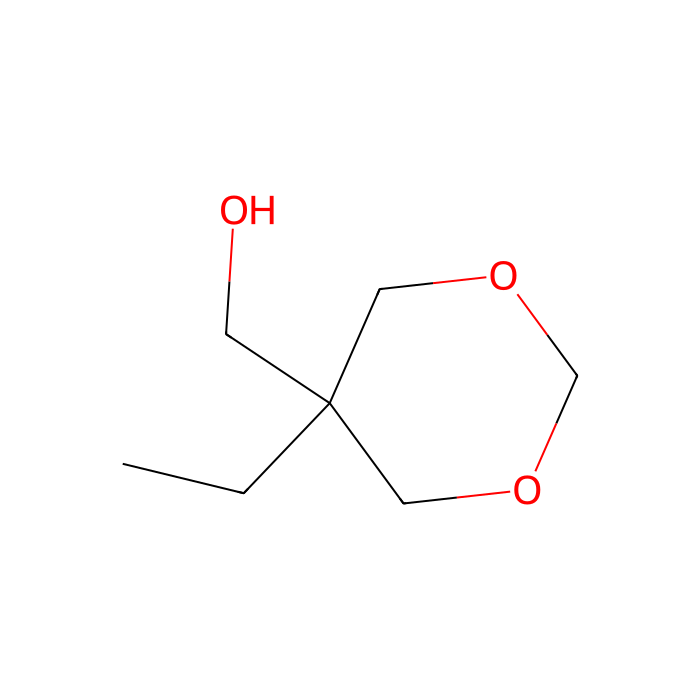
Preferred name: 5-Ethyl-1,3-dioxane-5-methanol
Molecular formula (literature): C7H14O3
Molecular weight (literature): ~146.18 g/mol
Structural features (general chemistry description)
Core scaffold: a saturated six‑membered 1,3‑dioxane ring (two ring oxygens at positions 1 and 3).
Substitution pattern: at C-5 (the acetal carbon), two substituents are present: an ethyl group (–CH2CH3) and a hydroxymethyl group (–CH2OH). This makes C-5 a tertiary acetal center embedded in the ring.
Functional groups: cyclic acetal (1,3-dioxane) plus a primary alcohol. No stereocenters are mandated by the name; C-5 can be prochiral depending on substitution, but the ring itself is achiral unless substituted asymmetrically elsewhere.
2D depiction in words: a six‑member ring containing O–C–C–O–C–C; the carbon opposite the O–O segment (C-5) bears two substituents, one being ethyl and the other being a –CH2OH. The remaining ring carbons are methylene units.
Synthetic Utility
Functional group leverage
Primary alcohol: amenable to oxidation (TEMPO/DMP/Swern), O‑alkylation (via sulfonate formation and SN2), esterification (DCC/EDC, acid chlorides/anhydrides), and carbonate/carbamate formation.
Cyclic acetal (1,3‑dioxane): masks a carbonyl; stable to many bases and nucleophiles; cleaved by aqueous acid to the parent carbonyl/diol. Can undergo transacetalization with other diols under acid catalysis.
Retrosynthetic logic
The molecule can be viewed as an acetal derived from an aldehyde/ketone and a 1,3‑diol, bearing an additional pendant primary alcohol for orthogonal manipulation. This enables “protect‑functionalize‑deprotect” sequences.
Named/representative transformations (literature)
Mitsunobu etherification at the primary OH (R–OH to R–OR′) while retaining the acetal in neutral media.
TEMPO/NaOCl oxidation to aldehyde, followed by Wittig/HWE to install vinyl chains; acetal maintained throughout, then acid cleavage to unveil a carbonyl at a late stage.
Carbamate formation with CDI or DSC for linkage into polymers/bioconjugates.
Orthogonality
Choose conditions that avoid acid generation when the acetal must persist. Conversely, exploit mild acids (AcOH, p‑TsOH) for selective acetal opening without disturbing base‑sensitive moieties.
Target Specificity
Not applicable. This product is a small organic building block and is not a biomolecule, antibody, or inhibitor with defined biological targets. No target, epitope, or species reactivity information is provided or expected.
Frequently Asked Questions
How should this product be stored?
Store at room temperature.
What is the purity of this product?
This product is supplied at ≥98% purity (chemical assay). Lot-specific values are stated on the Certificate of Analysis.
How is this product shipped?
This product ships under standard ambient conditions. No temperature-controlled packaging is required.
What are the CAS number, molecular formula and molecular weight?
The CAS Number is 5187-23-5, the molecular formula is C7H14O3, and the molecular weight is 146.18 g/mol. InChIKey BGFBWRWYROQISE-UHFFFAOYSA-N.
What documentation is provided?
Available product documentation, including Certificates of Analysis (COA), Safety Data Sheets (SDS), and specification sheets, is shown in the product document area. Document availability and access follow the current site policy.
We use cookies to ensure the website functions properly and, where permitted, to improve your experience. You can manage your preferences at any time in Settings. Learn more in our Cookie Policy.
Shall we send you a message when we have discounts available?
Remind me later
Thank you! Please check your email inbox to confirm.
Products are supplied to verified businesses, institutions, and qualified professionals for research and development use only. Not for use in humans, animals, diagnosis, or therapy.

 I2224389