This compound belongs to the class of organic compounds known as n-acyl-l-alpha-amino acids. These are n-acylated alpha amino acids which have the L-configuration of the alpha-carbon atom.
External Descriptors
L-alanine derivative - N-acetyl-L-amino acid
1. Djoumbou Feunang Y, Eisner R, Knox C, Chepelev L, Hastings J, Owen G, Fahy E, Steinbeck C, Subramanian S, Bolton E, Greiner R, and Wishart DS. ClassyFire: Automated Chemical Classification With A Comprehensive, Computable Taxonomy. Journal of Cheminformatics, 2016, 8:61.
Determine the necessary mass, volume, or concentration for preparing a solution.
Dilution Calculator
Determine the dilution needed to prepare a stock solution.
Reconstitution Calculator
Reviews
Customer Reviews
Application Protocols
No assay-specific protocols are provided for this small-molecule reagent. For typical uses:
Amide coupling (solution phase): Dissolve Ac-Ala-OH (1.0 eq) and amine partner (1.0–1.2 eq) in dry DMF. Add Oxyma (1.1 eq) and EDCI (1.1 eq) at 0–5 °C, then base (DIPEA, 2–3 eq). Stir at 20–25 °C, monitor by HPLC, quench with aqueous acid, and purify.
Preparation of stock solutions: Make 100–500 mM stocks in water, MeOH, or DMSO depending on application. Filter (0.22 μm) for analytical work. Adjust pH if full dissolution is needed in water.
For analytical characterization, validate methods (HPLC/LC-MS, qNMR) using your laboratory’s SOPs. Item-specific tested applications and recommended conditions are not specified for this item; refer to your internal method development or contact technical support.
Biological Roles
General biochemistry (literature; no clinical claims):
Alanine is a proteinogenic amino acid central to nitrogen metabolism and the alanine cycle. N-terminal acetylation is a common post-translational modification in eukaryotic proteins, influencing stability and interactions.
N-acetyl-L-alanine itself is not a widespread primary metabolite, but N-acetylated amino acids serve as models for studying peptide bond behavior, enzymatic deacylation (amidases, deacetylases), and transport/recognition of N-blocked residues.
Charge and transport: At physiological pH, the carboxylate is deprotonated while the amide remains neutral; this impacts uptake and partitioning across membranes compared to zwitterionic free amino acids.
Enzymatic susceptibility: The terminal amide is generally resistant to proteases that require a free N-terminus, making N-acetylated residues valuable probes for N-terminal processing enzymes.
Analytical standards: N-acetyl amino acids can be used as reference materials in metabolomic method development to test separation of N-blocked vs free amino acids.
Note: The above roles describe general properties of N-acetylated alanine derivatives and related systems. They are provided as background context only and are not item-specific performance claims.
Buffer Applications
Ac-Ala-OH is not a conventional buffering agent. While it contains a carboxylic acid (typical pKa ~2.8–3.5 for N-acetylated amino acids), it lacks a complementary basic site with suitable pKa to form an effective physiological buffer pair.
Practical guidance:
For pH control, use established buffers (e.g., acetate pH 3.6–5.6, phosphate pH 6.0–8.0, HEPES pH 6.8–8.2) rather than Ac-Ala-OH.
Ac-Ala-OH solutions can be prepared in buffers for biochemical assays; adjust pH with compatible acids/bases as needed.
Refer to other sections (Reaction & Applications, Synthetic Utility) for scenarios where Ac-Ala-OH is most relevant.
Green Alternatives
Sustainability considerations in using Ac-Ala-OH center largely on solvent/reagent choices for coupling and purification rather than the substrate itself.
Greener choices (literature/general):
Solvents:
Replace DMF/NMP with 2-MeTHF, CPME, MeCN/H2O, or bio-based solvents when solubility allows.
Employ water-promoted amide bond formation (e.g., EDCI or DMTMM in aqueous MeCN or water/EtOH) to reduce hazardous solvent use.
Coupling reagents:
Favor less hazardous additives like OxymaPure (vs. HOBt/HOAt). Consider DMTMM (MeOH/H2O-compatible) to avoid carbodiimide urea waste.
Purification:
Use aqueous crystallization or salt-switching over silica chromatography where possible. Employ greener eluents (ethyl acetate, MeOH, heptane) and minimize halogenated solvents.
Illustrative comparison (general):
DMF + HATU + DIPEA: High performance, but DMF and uronium salts have safety and waste concerns.
2-MeTHF + DIC + Oxyma: Good performance for many couplings; lower solvent hazard profile; manageable urea byproduct.
MeCN/H2O + EDCI + Oxyma: Often effective; enables aqueous workups and reduced VOC mass.
Trade-offs:
Solubility constraints may necessitate a small fraction of DMF/DMSO.
Some green reagents show slower kinetics; mild heating or longer reaction times may be required.
Document and justify any use of higher-hazard media via solvent selection guides (e.g., CHEM21, GSK) and process safety assessment.
Pharmaceutical Uses
No therapeutic or clinical claims are made. The following describes general formulation/manufacturing contexts for amino-acid derivatives (literature):
Excipients and processing aids: N-acetylated amino acids are occasionally explored as co-formers in cocrystals, crystallization modifiers, or as model compounds to probe salt/cocrystal screening workflows.
Analytical reference: May serve as a system suitability/reference compound in chromatographic methods differentiating N-acetylated vs free amino acids.
Probing stability: Employed in forced-degradation studies to benchmark amidic stability and to evaluate peptide coupling impurities in drug-substance manufacturing.
Item-specific pharmacopeial status, residual solvent compliance, endotoxin/bioburden, and metal limits are not specified for this item; refer to the CoA/Spec Sheet if such attributes are critical to your application.
Physical Properties
Item-specific specifications (this lot):
Appearance: Not specified for this item; refer to CoA/Spec Sheet.
Grade/Purity: Not specified for this item; refer to CoA/Spec Sheet.
Literature/general reference values (for N-acetyl-L-alanine or racemate; ranges reflect source variability and stereochemistry):
Physical form: Typically a white to off-white crystalline solid (literature)
Melting point: Commonly reported in the ~140–170 °C range (literature; dependent on enantiopurity, hydration, and measurement method)
Solubility: Highly soluble in water; soluble in polar protic solvents (MeOH, EtOH); low solubility in nonpolar solvents (hexanes, toluene) (literature)
Acid–base properties: Carboxyl pKa typically ~2.8–3.5 for N-acetylated amino acids; amide nitrogen non-basic (literature)
LogP/LogD: Expected low/negative logP and high LogD dependence on pH due to carboxylate formation above pKa (literature)
Optical rotation: Stereochemistry-dependent; values vary with solvent and concentration (literature; not specified for this item)
Density, refractive index, UV cutoff: Not typically reported for this solid; Not specified for this item; refer to CoA/Spec Sheet.
Notes for use:
The free acid can form salts (e.g., sodium) under basic conditions, greatly increasing aqueous solubility.
Hygroscopicity is generally low to moderate, but solid can absorb moisture depending on storage; dry before critical measurements if needed.
Quality and Grades
Item-specific grade/purity: Not specified for this item; refer to CoA/Spec Sheet.
Context for this material (general guidance):
Typical supply forms: N-acetyl amino acids are offered in research, biochemical, or peptide synthesis grades. Higher grades emphasize low inorganic/metal content, low residual solvents, and well-defined optical purity where applicable.
Peptide synthesis relevance: When used as a building block, specifications that often matter include enantiomeric excess (ee), residual water, residual solvents, and assay by HPLC/quantitative NMR. UV absorbance is low for aliphatic residues; “HPLC grade” for solids generally implies high assay purity and low UV-active impurities.
Stabilizers: Not typically required for this compound; none are specified for this item. If stabilizers are ever used, they should be declared on the CoA.
Documentation: For release testing, consult the lot-specific CoA for assay, enantiomeric purity, residual solvent profile, and any metal/peroxide limits if relevant to your application.
Selection tips:
For stereosensitive syntheses, confirm the absolute configuration (L vs DL vs D) on the CoA.
For analytical applications, request chromatographic traces to verify impurity profile around the target retention window.
Reaction and Applications
Primary uses (general, literature-based):
N-terminally blocked amino-acid building block: Ac-Ala-OH is used to introduce an N-acetylated alanine residue in solution-phase peptide synthesis and fragment couplings.
Model substrate: Useful for studying amide bond formation kinetics, racemization behavior at Cα, and enzymatic specificity toward N-acetylated residues.
Bases: DIPEA, NMM, collidine; for water-compatible systems, NaHCO3 or triethylamine.
Solvents: DMF, NMP, DCM, MeCN/H2O, 2-MeTHF.
Notes: Control pH 7–9 for carbodiimide couplings to minimize O→N acyl migration and hydrolysis.
Esterification to protected esters (e.g., Ac-Ala-OMe) using MeOH/HCl (Fischer) or DCC/DMAP with alcohols; useful intermediates for further couplings.
Mixed anhydride formation (e.g., with isobutyl chloroformate) followed by nucleophilic amine addition to furnish peptides.
Solid-phase context: While this is a free acid with an N-acetyl cap, it can be coupled to a resin-bound amine to grow sequences from an N-acetyl alanine N-terminus.
Practical tips:
Racemization: Cα racemization risk is low for alanine but increases under strong base or prolonged activation; use Oxyma/HOAt analogs and limit base equivalents/time.
Workup: Aqueous acid/base extractions can switch ionization state to aid partitioning; avoid strong base if enantiopurity is critical.
Analytics: Monitor by HPLC with aqueous-organic gradients; carboxylate gives early retention; derivatization may aid UV detection if needed.
Reaction Conditions
General conditions for transformations involving Ac-Ala-OH (literature guidance; optimize for your system):
Amide coupling to a primary amine:
Reagents: HATU (1.1–1.5 eq) or COMU (1.1–1.5 eq), base DIPEA (2–3 eq).
Solvent: DMF, NMP, or 2-MeTHF/DMF (1:1) if solubility limits arise.
Temperature/time: 0–25 °C, 0.5–4 h; monitor by TLC/HPLC. Typical isolated yields: 75–95% for unhindered amines.
Notes: Include Oxyma to suppress racemization; minimize extended pre-activation.
Carbodiimide-mediated coupling (EDCI or DIC):
Reagents: EDCI (1.2 eq) + Oxyma (1.2 eq); base NMM or DIPEA (2 eq).
Solvent: DMF or MeCN/H2O (4:1 to 9:1) for more sustainable protocols.
Temperature/time: 0–25 °C, 1–6 h. Byproduct urea precipitates (DIC) may simplify workup.
Esterification (to Ac-Ala-OR):
Fischer: ROH (solvent), catalytic H2SO4 or HCl(g) in MeOH; 0–40 °C for volatile alcohols; neutralize and extract.
Steglich: DCC (1.1 eq), catalytic DMAP (0.1 eq), ROH (1.5 eq) in DCM; 0–25 °C, 2–6 h. Filter DCU, concentrate, and purify.
Salt formation:
Neutralize with NaHCO3/Na2CO3 in water to form carboxylate salts; isolate by lyophilization if needed.
These are representative conditions; actual performance depends on partner sterics/electronics, solvent, and scale. Always confirm enantiopurity post-reaction if stereochemistry is critical.
Safety and Handling
Item-specific GHS information:
Signal Word: Not specified for this item; refer to SDS.
H-Statements: Not specified for this item; refer to SDS.
GHS Classification/Pictograms: Not specified for this item; refer to SDS.
General laboratory safety guidance (literature/standard practice):
Likely of low acute toxicity as an amino-acid derivative; nonetheless, handle as a laboratory chemical. Avoid inhalation of dusts and contact with eyes/skin. Use in a fume hood when weighing or when generating aerosols.
Recommended PPE: lab coat, safety glasses, disposable nitrile gloves. Use dust control measures; avoid ingestion.
Incompatibilities: Strong bases convert the acid to carboxylate salts; strong oxidizers generally to be avoided. Amide is stable under neutral conditions but can hydrolyze under strong acid/base and elevated temperature.
First aid (overview; defer to SDS):
Inhalation: Move to fresh air; seek medical attention if symptoms persist.
Skin/eyes: Rinse with water for several minutes; remove contaminated clothing; seek medical attention if irritation continues.
Ingestion: Rinse mouth; do not induce vomiting; seek medical advice.
Fire: Organic solid; use water spray, CO2, dry chemical, or foam. Thermal decomposition may produce CO/CO2 and nitrogen oxides; firefighters wear SCBA.
Handling tips: Keep container tightly closed to prevent moisture uptake. Minimize repeated freeze–thaw of solutions; prepare single-use aliquots where practical.
Always consult the product-specific SDS for authoritative, up-to-date hazard and first-aid information.
Solvent Selection
Polarity and ionization: As a small N-acetylated amino acid, Ac-Ala-OH bears a carboxylic acid (pKa ~3). It is neutral in acidic media and anionic (carboxylate) above pH ~3–4. The amide nitrogen is non-basic. Solubility follows ionization state.
Solubility profile (literature/general):
Water: High solubility; increases further at basic pH (carboxylate salt).
Alcohols (MeOH, EtOH, i-PrOH): Good to moderate solubility; can aid in recrystallization with water as an anti-solvent.
Polar aprotic (DMF, DMSO, NMP): Excellent solubility; commonly used for coupling reactions.
Peptide/amide coupling: DMF, DMAc, NMP, or greener options like 2-MeTHF or aqueous MeCN with water-miscible bases. DMSO works but can complicate workup.
Salt formation and analytical prep: Aqueous buffers (pH > 4) or ammonium bicarbonate for LC-MS compatibility.
Crystallization/purification: Water/alcohol mixtures or EtOAc with a polar co-solvent depending on counterions.
Quick comparison (general):
DMF: Excellent solubility, widely validated for coupling; regulatory burden and sustainability concerns.
2-MeTHF: Greener, useful when substrate is sufficiently soluble; sometimes needs co-solvent.
Water/MeCN: Attractive for water-tolerant coupling systems (e.g., EDCI), simplifies workup; requires compatible reagents.
Adjust solvent to the ionization state (acid vs carboxylate) to tune solubility and chromatographic behavior.
Storage and Reconstitution
Item-specific storage: Store at 2–8 °C (from Product Data). Shipped on wet ice to maintain temperature control.
Long-term stability (general guidance): Keep tightly closed in a dry container, protected from light and ambient moisture. For multi-month storage, refrigeration (2–8 °C) is appropriate; desiccation recommended. Avoid prolonged exposure to elevated temperatures.
Reconstitution (general):
Aqueous: Dissolve in water or buffer; adjust pH above the carboxyl pKa (e.g., pH 4–8) to accelerate dissolution if needed.
Organic: Readily soluble in DMF, DMSO, MeOH, EtOH. Prepare concentrated stocks (e.g., 0.1–0.5 M) as appropriate for coupling reactions.
Sterile prep (analytical/biochemical): Filter through 0.22 μm after dissolution. Use freshly prepared solutions when possible.
Freeze–thaw: If storing solutions, aliquot and freeze at −20 °C to avoid repeated freeze–thaw. Thaw at room temperature and mix to ensure homogeneity.
Disposal: Follow institutional and local regulations for organic chemical waste; neutralize acidic solutions as appropriate before disposal.
Note: No stabilizers, water content limits, or specific shelf-life are specified for this item; refer to the CoA/Spec Sheet and SDS for lot-specific guidance.
Structure and Identity
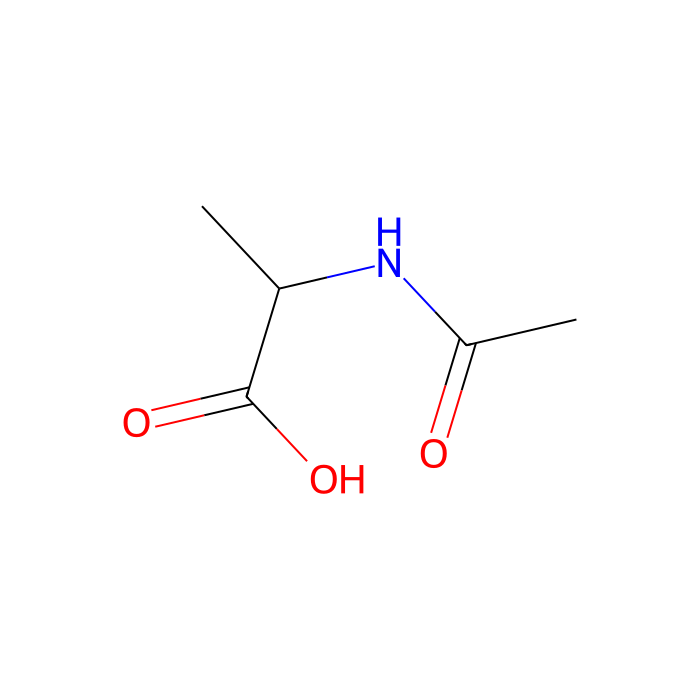
Brief description: Ac-Ala-OH is the N-acetylated, free-carboxyl form of alanine, commonly used as an N-terminally blocked amino-acid building block in peptide chemistry.
From Product Data (item-specific):
SKU: A105813
Product Name: Ac-Ala-OH
CAS: 97-69-8
InChIKey: 189077 (as provided)
Storage: Store at 2-8°C; shipped on wet ice
Research use: For research use only
Literature/computed identity (general reference; not an item specification):
Preferred name: N-acetyl-L-alanine (commonly supplied as the L- or racemic form; specific stereochemistry not specified for this item)
Stereochemistry: alanine center is chiral (Cα); the L-configuration is typical in peptide contexts, but stereochemistry is not specified for this item.
2D structural description (general): An acetyl group (CH3–CO–) attached to the amino nitrogen of alanine; the α-carbon bears a methyl side chain and a carboxylic acid. The molecule presents an amide linkage (Ac–NH–) followed by the α-chiral center and a terminal –CO2H group.
Synthetic Utility
Functional handles and reactivity (general):
Carboxylic acid: Amenable to activation (carbodiimides, uronium/phosphonium salts, mixed anhydrides) for amide bond formation with amines, enabling installation of an N-acetyl-L-Ala residue into peptides and peptidomimetics.
Amide (N-acetyl): Non-nucleophilic under typical conditions; confers N-terminal blocking, preventing further N-acylation and simplifying regiochemical control in fragment couplings.
Stereocenter (Cα): L-configuration is preferred in biopolymers; maintain stereochemical integrity by minimizing base strength, activation time, and temperature.
Applications:
Solution-phase peptide synthesis: Coupling to amines bearing orthogonal protections (e.g., Boc-, Cbz-, Fmoc- on downstream residues or scaffolds) to assemble N-acetylated sequences.
Diversification: Esterification to generate activated esters (e.g., pNP, NHS esters) as isolable intermediates for conjugation chemistry.
Probes and tags: Serves as a minimal N-acetylated motif appended to scaffolds to modulate polarity and H-bonding.
Retrosynthetic value:
Many N-acetylated peptide fragments can be disconnected to Ac-Ala-OH + amine partner, allowing modular library synthesis.
Analytical considerations:
LC-MS: Readily ionizes in negative mode (carboxylate), weaker in positive mode unless adducted. Derivatization (e.g., with AQC, OPA) can enhance UV/fluorescence for trace analysis.
Target Specificity
Not applicable. This product is a small-molecule amino-acid derivative, not an antibody or biological targeting reagent. No antigen, epitope, isotype, or species reactivity applies.
We use cookies to ensure the website functions properly and, where permitted, to improve your experience. You can manage your preferences at any time in Settings. Learn more in our Cookie Policy.
Shall we send you a message when we have discounts available?
Remind me later
Thank you! Please check your email inbox to confirm.
Products are supplied to verified businesses, institutions, and qualified professionals for research and development use only. Not for use in humans, animals, diagnosis, or therapy.

 H2617013