Determine the necessary mass, volume, or concentration for preparing a solution.
Taxonomy Tree
| Kingdom | Organic compounds |
|---|---|
| Superclass | Organic oxygen compounds |
| Class | Organooxygen compounds |
| Subclass | Carbonyl compounds |
| Intermediate Tree Nodes | Aldehydes |
| Direct Parent | Medium-chain aldehydes |
| Alternative Parents | Alpha-hydrogen aldehydes Organic oxides Hydrocarbon derivatives |
| Molecular Framework | Aliphatic acyclic compounds |
| Substituents | Medium-chain aldehyde - Alpha-hydrogen aldehyde - Organic oxide - Hydrocarbon derivative - Aliphatic acyclic compound |
| Description | This compound belongs to the class of organic compounds known as medium-chain aldehydes. These are an aldehyde with a chain length containing between 6 and 12 carbon atoms. |
| External Descriptors | Fatty aldehydes |
Find and download the COA for your product by matching the lot number on the packaging.
| Lot Number | Certificate Type | Date | Item |
|---|---|---|---|
| Certificate of Analysis | Jan 26, 2026 | A302164 | |
| Certificate of Analysis | Jan 26, 2026 | A302164 | |
| Certificate of Analysis | Jan 19, 2026 | A302164 | |
| Certificate of Analysis | Jan 19, 2026 | A302164 | |
| Certificate of Analysis | Jan 19, 2026 | A302164 | |
| Certificate of Analysis | Jan 19, 2026 | A302164 | |
| Certificate of Analysis | Jan 19, 2026 | A302164 | |
| Certificate of Analysis | Jan 19, 2026 | A302164 | |
| Certificate of Analysis | Feb 09, 2023 | A302164 |
| x_melt_point_char | -8°C |
|---|---|
| Molecular Weight | 114.14 |
| XLogP3 | -0.200 |
| Hydrogen Bond Donor Count | 0 |
| Hydrogen Bond Acceptor Count | 2 |
| Rotatable Bond Count | 5 |
| Exact Mass | 114.068 Da |
| Monoisotopic Mass | 114.068 Da |
| Topological Polar Surface Area | 34.100 Ų |
| Heavy Atom Count | 8 |
| Formal Charge | 0 |
| Complexity | 58.900 |
| Isotope Atom Count | 0 |
| Defined Atom Stereocenter Count | 0 |
| Undefined Atom Stereocenter Count | 0 |
| Defined Bond Stereocenter Count | 0 |
| Undefined Bond Stereocenter Count | 0 |
| The total count of all stereochemical bonds | 0 |
| Covalently-Bonded Unit Count | 1 |
H302:Harmful if swallowed
H312:Harmful in contact with skin
H332:Harmful if inhaled
P261:Avoid breathing dust/fume/gas/mist/vapors/spray.
P264:Wash hands [and …] thoroughly after handling.
P270:Do not eat, drink or smoke when using this product.
P271:Use only outdoors or in a well-ventilated area.
P280:Wear protective gloves/protective clothing/eye protection/face protection.
P330:Rinse mouth.
P363:Wash contaminated clothing before reuse.
P301+P312:IF SWALLOWED: call a POISON CENTER/doctor/... IF you feel unwell.
P302+P352:IF ON SKIN: wash with plenty of water.
P304+P340:IF INHALED: Remove person to fresh air and keep comfortable for breathing.
P501:Dispose of contents/container to an approved waste disposal plant.
No vendor-tested biological application protocols are specified for this item.
General laboratory protocols (literature-style, for chemistry use):
These are illustrative starting points; adjust stoichiometry and conditions to your substrate and scale. Always perform appropriate safety assessments before scale-up.
This product is intended for research use only. No clinical or therapeutic claims are made.
Biochemical context (literature/general):
Guidance:
For specific bioconjugation strategies with this dialdehyde, validate conditions empirically and confirm conjugation via orthogonal assays (SDS-PAGE shift, UV/Vis, MS, or activity retention).
Adipaldehyde is not a buffering reagent and is not used to prepare pH buffer systems.
For actual buffer preparation guidance, refer to dedicated buffering agents rather than this reagent.
As a difunctional aldehyde reagent, greener practice focuses on route design, solvent choice, and oxidation/reduction protocols rather than replacement of the reagent itself.
Greener considerations (literature/general):
| Application | Conventional | Greener alternative | Trade-offs | |---|---|---|---| | Olefination | DCM, toluene | 2-MeTHF, CPME, anisole | May affect Wittig ylide stability and rates | | Reductive amination | MeOH/EtOH with NaBH3CN | EtOH/i-PrOH with H2, Pd/C or BH3CN-free methods (e.g., formic acid/transfer hydrogenation) | Catalyst handling; over-reduction risk | | Oxidation to adipic acid | HNO3 (legacy) | TEMPO/bleach, Oxone, O2 with nitroxyl catalysts | Selectivity control; aqueous waste | | Extraction/workup | DCM | EtOAc, MTBE | Partitioning and volatility differences |
Conclusion: Replace hazardous solvents/oxidants with safer alternatives when compatible, and design convergent routes to minimize steps.
No therapeutic or clinical use is claimed. This product is for research use only.
Formulation/manufacturing context (literature/general):
Practical advice:
Item-specific specifications
Literature/computed values and general guidance (non-spec)
Note: Numeric values for bp, mp, density, refractive index, UV cutoff, water/peroxide/metal content are not specified for this item; consult the CoA/SDS or measure under your conditions if critical.
Item-specific quality information
Interpreting grades (general guidance)
Practical quality considerations for dialdehydes
For regulatory or process use, obtain a full CoA, lot-specific assay, and impurity profile.
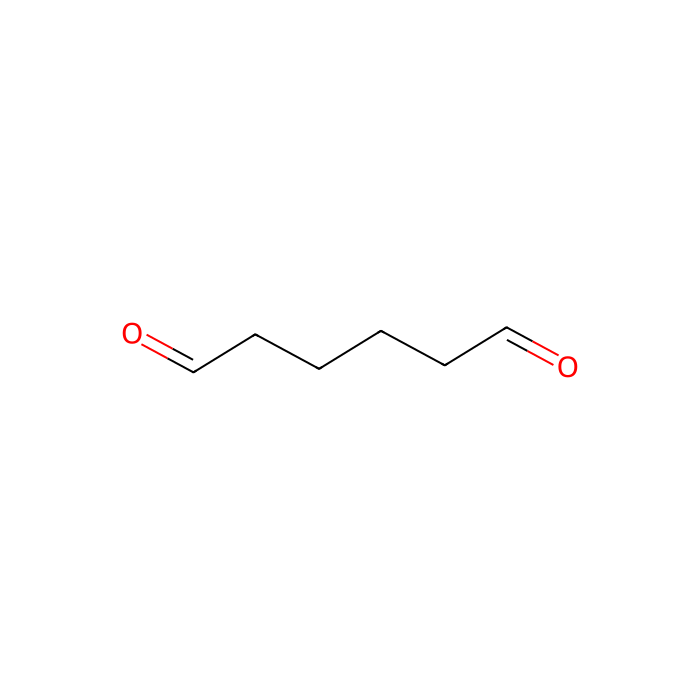
Adipaldehyde (hexane-1,6-dial) is a versatile difunctional building block for constructing C6-spaced linkers and for iterative carbonyl chemistry.
Key application areas (literature/general):
Practical tips:
General conditions below are literature-style guidance (non-item-specific); optimize for your system.
Monitoring and workup:
GHS and hazard data (Product Data)
General safety guidance for aliphatic dialdehydes (literature/general)
Always consult the product’s SDS for authoritative hazard, exposure limits, and emergency procedures.
This product is a bifunctional aldehyde reagent rather than a solvent. However, solvent choice is critical to its handling and reactivity.
| Scenario | Preferred solvent | |---|---| | Reductive amination | MeOH, EtOH, or MeCN with controlled acid; or DCM with silane-based reductants | | Wittig/olefination | Anhydrous THF or toluene under inert atmosphere | | Oxidation to diacid | Aqueous-organic biphasic (e.g., t-BuOH/H2O) with NaClO2 or buffered oxidants | | Acetalization/protection | Toluene or DCM with catalytic acid and drying agent |
Choose solvents based on the intended transformation and sensitivity to water/nucleophiles.
Item-specific storage and shipping
General storage guidance for dialdehydes (literature/general)
Dispose of expired or oxidized material according to institutional hazardous waste protocols. Always consult the SDS for detailed stability and incompatibility information.
Overview
Structural features (literature/general chemistry)
Notes on identifiers
Functional group set: Two terminal aldehydes separated by a four-carbon spacer. This symmetry offers robust difunctional entry points for convergent synthesis.
Transformations (literature/general):
Strategic use:
Notes: Control base strength to avoid aldol/self-condensation; employ inert atmosphere and dry solvents to maintain aldehyde integrity.
Not applicable. This product is a small-molecule chemical reagent, not a biological targeting agent, antibody, or ligand with defined target specificity.