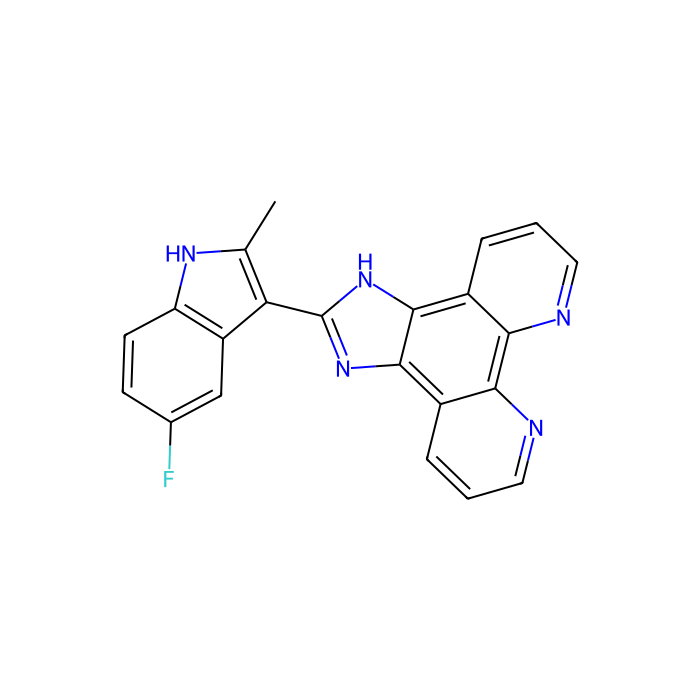
APTO-253 (LOR-253, LT-253) inhibits c-Myc expression and selectively induces CDKN1A (p21), promotes G0-G1 cell-cycle arrest, and triggers apoptosis in acute myeloid leukemia (AML) cells. APTO-253 is also an inducer of KLF4 (Krüppel-like factor 4).
Storage
Store at -20°C
Shipped In
Ice chest + Ice pads
This product requires cold chain shipping. Ground and other economy services are not available.
This compound belongs to the class of organic compounds known as phenanthrolines. These are aromatic polycyclic compounds containing the phenanthroline skeleton, which is a derivative of phenanthrene, and consists of two pyridine rings non-linearly joined by a benzene ring.
External Descriptors
Not available
1. Djoumbou Feunang Y, Eisner R, Knox C, Chepelev L, Hastings J, Owen G, Fahy E, Steinbeck C, Subramanian S, Bolton E, Greiner R, and Wishart DS. ClassyFire: Automated Chemical Classification With A Comprehensive, Computable Taxonomy. Journal of Cheminformatics, 2016, 8:61.
Determine the necessary mass, volume, or concentration for preparing a solution.
Dilution Calculator
Determine the dilution needed to prepare a stock solution.
Reconstitution Calculator
Reviews
Customer Reviews
Application Protocols
No vendor-validated application protocols are provided for this SKU. The following are general, non-validated guidelines for small-molecule handling in discovery assays. Adjust to your system and consult the CoA/SDS.
General small-molecule dosing workflow (cell-based assays):
Prepare a concentrated stock in DMSO (e.g., tens of mM if soluble). Verify solubility and stability by visual inspection and, ideally, LC–MS/HPLC.
Create serial dilutions in DMSO to minimize precipitation during aqueous dilution.
Add to pre-warmed media to achieve desired final concentrations with identical vehicle % across controls and treatments. Mix gently to avoid local supersaturation.
Incubate per assay design, then quantify endpoints (e.g., reporter activity, target mRNA/protein by RT-qPCR/western, viability assays). Include vehicle controls and, if possible, orthogonal counterscreens.
Biochemical/biophysical assays (general):
Confirm interference liabilities (autofluorescence, absorbance, redox activity) before high-throughput use. Employ detergent and bovine serum albumin controls to reduce nonspecific aggregation where relevant.
Analytics and documentation:
Record lot number, stock concentration, solvent, preparation date, and storage conditions on each aliquot. Re-verify concentration by UV or quantitative NMR when precision is critical.
Biological Roles
Context for research use (no medical/clinical claims):
Literature context: APTO-253 has been reported in the academic literature as a small molecule explored for modulation of gene expression programs associated with oncogenic signaling, including reports of effects on MYC transcriptional activity and DNA secondary structure interactions (e.g., G-quadruplex contexts). These descriptions are literature-based and must be validated independently in any given biological system.
Research utility (general):
Chemical probe candidate for studying transcriptional regulation, cellular stress responses, and apoptosis pathways in cell models (literature). Outcome and selectivity are cell-type and context dependent.
Tool for building structure–activity relationships (SAR) relative to heteroaromatic scaffolds reported to influence promoter architectures.
Assay classes where such probes are commonly evaluated:
Reporter assays (promoter activity, luciferase), RT-qPCR for target mRNA levels, western blot/ELISA for protein expression changes, and chromatin/intercalation biophysics where relevant (e.g., CD, FRET, thermal melting) — all pending validation for this specific compound.
Important caveats:
Mechanistic assignments should be corroborated using orthogonal assays and negative controls (inactive analogs, vehicle controls).
Off-target and nuisance mechanisms (redox cycling, colloidal aggregation, PAINS-like behaviors) should be ruled out empirically; deploy counterscreens and detergent controls as needed.
Always treat findings as preliminary until replicated across independent methods.
Buffer Applications
This item is a research small molecule and is not a buffering reagent. Therefore, buffer formulation guidance (pKa, buffer capacity, recipes) is not applicable.
Practical notes for working solutions:
If diluting DMSO stocks into aqueous buffers or cell culture media, pre-test for precipitation and maintain consistent vehicle percentages across controls and treatments.
For biochemical assays, use buffer systems compatible with your readout (e.g., HEPES, Tris, phosphate) and verify that neither the buffer components nor ionic strength interfere with compound solubility or assay signals.
Green Alternatives
Green chemistry considerations pertain mainly to solvent choices for stock preparation and assay dilution, as APTO-253 itself is the analyte rather than a process reagent.
Comparison of common stock solvents (general considerations):
DMSO
Pros: High solvating power for heteroaromatics; miscible with water; widely accepted in screening assays.
Cons: High boiling point complicates removal; potential cell toxicity at >0.5–1% v/v; not “benign” per several solvent guides.
Ethanol (EtOH)
Pros: Renewable feedstocks available; favorable green metrics; easy to remove.
Cons: Lower solvency for some aromatic heterocycles; can perturb biological assays at modest % v/v.
2-Propanol
Pros: Better green profile than many aprotic dipolar solvents; rapid evaporation.
Cons: Limited solubility for polar/planar heteroaromatics; water miscibility can cause precipitation upon dilution.
PEG-400/propylene glycol
Pros: Low volatility; useful as co-solvents/vehicles.
Cons: Viscous; limited compatibility with some assays and analytics.
Practical guidance:
Start with DMSO for small-scale screening; where possible, transition to EtOH or aqueous vehicles with minimal organic content once solubility allows.
Minimize solvent volumes, employ micro-aliquoting to reduce waste, and use closed, low-loss dispensing to lower VOC emissions.
Document and justify solvent selection against institutional green-chemistry policies.
Pharmaceutical Uses
No excipient or compendial formulation role is provided for this catalog item, and it is supplied strictly for research use only (Product Data). Do not use for human or veterinary applications.
Context (general, non-clinical):
Small molecules of this class may be evaluated in discovery settings for target engagement and ADME profiling, but such activities are outside the scope of this product listing and require appropriate approvals and controls.
For in vitro work, prepare DMSO or ethanol stocks and dilute into assay-compatible media with vehicle-matched controls.
For exploratory in vivo method development in research settings, formulation screens commonly explore aqueous vehicles with co-solvents (e.g., DMSO, PEG-400, propylene glycol) and surfactants (e.g., Tween 80); establish stability and sterility as required by institutional protocols.
Regulatory note:
No pharmacopeial monograph or GMP status is indicated. Any translation toward regulated use would require dedicated sourcing, quality systems, and comprehensive characterization—not covered by this product.
Physical Properties
Authoritative, item-specific physicochemical data are not provided in the Product Data for this SKU. Do not treat the following as specifications; consult the CoA/SDS for lot-specific details.
Appearance: Not specified for this item; refer to CoA/Spec Sheet.
Molecular weight: Not specified for this item; refer to CoA/Spec Sheet.
Molecular formula: Not specified for this item; refer to CoA/Spec Sheet.
Melting point: Not specified for this item; refer to CoA/Spec Sheet.
Boiling point: Not applicable/relevant for this solid research compound; Not specified for this item; refer to CoA/Spec Sheet.
Density: Not specified for this item; refer to CoA/Spec Sheet.
LogP/logD: Not specified for this item; refer to CoA/Spec Sheet.
pKa: Not specified for this item; refer to CoA/Spec Sheet.
Refractive index: Not applicable for solids; Not specified for this item; refer to CoA/Spec Sheet.
Many screening compounds are soluble in DMSO at 10–50 mM stock concentrations. Actual solubility of APTO-253 must be verified experimentally.
Aqueous solubility may require co-solvents (e.g., DMSO-to-buffer dilution) or carriers (e.g., PEG-400, cyclodextrins) depending on target working concentrations.
Notes for practitioners:
Validate solvent compatibility (DMSO, DMF, ethanol) with your bioassay and plastics. Filter-sterilize solutions when required for cell-based studies (0.22 µm PES or PTFE, solvent compatible). Avoid heat to dissolve unless stability is confirmed.
Quality and Grades
Grade/purity: Not specified for this item; refer to CoA/Spec Sheet. For screening compounds, vendors commonly provide HPLC purity and identity confirmation (e.g., 1H NMR/HRMS); verify on the lot-specific documentation.
Interpreting common quality annotations (general guidance):
HPLC or UPLC purity (e.g., ≥95%): Indicates the chromatographic area percent of the main peak under specified conditions. Important for SAR and bioassay reproducibility.
Residual solvents/water, inorganic residues, counter-ions: Can affect solubility and biological assay baselines; consult the CoA for quantified limits if provided.
Salt form vs free base/neutral form: Confirm the exact form supplied (free base, HCl salt, etc.) to calculate accurate molar concentrations and to anticipate solubility/handling differences.
Stabilizers: Not specified for this item; refer to CoA/Spec Sheet. If none are listed, assume neat compound only.
What is specific to this item:
Storage condition is specified as −20°C, shipped cold (Product Data). No other item-specific quality metrics are provided here; therefore, users should rely on the CoA/SDS for chromatographic purity, identity, and any residuals.
Practical recommendations:
Upon receipt, document lot, verify identity against CAS and (if available) analytical traces, and prepare single-use aliquots of stock solution to maintain quality across experiments.
Reaction and Applications
This product is supplied as a finished small-molecule research compound and is not typically employed as a synthetic reagent or catalyst.
Not typically applicable:
It is generally not used for stoichiometric transformations (e.g., oxidations, reductions), organometallic catalysis, or as a protecting-group reagent.
Relevant applications (research context):
Utilization as a chemical probe or screening hit in cell-based and biochemical assays to study pathways of transcriptional regulation and stress responses (literature). Any pathway associations should be validated in your system; avoid extrapolations to clinical contexts.
Practical notes for use in assays:
Prepare accurately quantified DMSO stocks, verify solubility, and maintain consistent vehicle controls across dose–response studies.
Confirm compound integrity over time by LC–MS or HPLC when running multi-day experiments.
If you require a reagent for a specific transformation (e.g., cross-coupling, amide formation), refer to Aladdin’s reagent catalog sections rather than this screening compound.
Reaction Conditions
Not applicable to this item as a reaction reagent. APTO-253 is sold as a completed small molecule for research evaluations rather than for use in chemical transformations.
For researchers seeking context on handling in solution (general good practice rather than reaction conditions):
Prepare concentrated DMSO stock solutions under anhydrous conditions when possible. Confirm solubility visually and by analytical methods.
For aqueous assay dilutions, add the DMSO stock slowly to buffered media with gentle mixing to minimize local supersaturation and precipitation.
Monitor stability over the experimental timeframe by LC–MS or HPLC, especially in light-exposed or elevated-temperature conditions.
If you require specific reaction parameters (temperatures, catalysts, yields) for synthetic chemistry, consult the primary literature for the synthesis of the APTO-253 scaffold or derivatives; such parameters are not part of this product’s intended use.
Safety and Handling
Safety summary (authoritative details are in the SDS; the following is general guidance only):
GHS classification, signal word, pictograms, H-statements: Not specified for this item; refer to CoA/Spec Sheet and SDS. Treat as a laboratory chemical of unknown toxicity; minimize exposure.
Storage: Store at −20°C (Product Data). Keep tightly closed, desiccated, and protected from light as appropriate for small molecules.
Shipping: Shipped in ice chest with ice pads (Product Data) to maintain low temperature.
Good laboratory practice (GLP-style recommendations):
PPE: Laboratory coat, safety glasses, and appropriate chemical-resistant gloves (e.g., nitrile). Use in a chemical fume hood to avoid inhalation of dust or vapors.
Incompatibilities: Unknown from Product Data. As a precaution, segregate from strong oxidizers, strong acids/bases, and reactive reducing agents until compatibility is confirmed from the SDS.
First aid (general): If skin contact occurs, wash with soap and water. If eye contact, rinse cautiously with water for several minutes and seek medical attention. If inhaled, move to fresh air. If ingested, rinse mouth; do not induce vomiting; seek medical attention. Always follow institutional protocols.
Waste: Dispose according to local regulations. Collect DMSO or organic stock solutions as hazardous waste. Decontaminate surfaces with suitable solvents/detergents compatible with APTO-253 and your bench materials.
Notes:
Avoid repeated freeze–thaw of stocks to limit degradation and contamination.
Label solutions with preparation date, solvent, and concentration; include hazard warnings per SDS.
Solvent Selection
APTO-253 is a small-molecule screening compound. Without item-specific solubility data, solvent selection should prioritize compatibility with intended assays and materials.
Primary stock solvent (common practice):
DMSO: First-line solvent for many heteroaromatic small molecules. Compatible with cryostorage and routine HTS workflows. Verify solubility empirically before setting stock concentration.
Secondary/alternative solvents (assay-dependent):
DMF: Similar solubilizing power; consider only if DMSO is unsuitable. Check plastic compatibility and cytotoxicity.
Ethanol (EtOH): Useful for less polar compounds; may enable aqueous cosolvent dilution but can perturb cell assays at modest % v/v.
PEG-400 or propylene glycol: Vehicles for in vivo method development or solubility enhancement (research use only); viscosity may limit pipetting in HTS.
Aqueous buffers: Typically require DMSO-seeded dilution or surfactants/cyclodextrins. Confirm no precipitation upon dilution.
Miscibility/compatibility (general):
DMSO is fully miscible with water and many organics; however, limit final DMSO to assay-tolerated levels (commonly ≤0.1–1% v/v; establish tolerance for your system).
Selection tips:
Start with small-scale solubility tests (visual, nephelometry, or LC-based). Record precipitation thresholds during aqueous dilution.
Filter or centrifuge turbid solutions before dosing to ensure dose accuracy.
For spectroscopic assays, verify solvent background and any compound autofluorescence or absorbance that could interfere with readouts.
Storage and Reconstitution
Storage conditions (item-specific):
Store at −20°C (Product Data). Protect from moisture; protect from light if the compound is known or suspected to be photosensitive. Maintain in a tightly closed container with desiccant.
Shipping: Shipped in ice chest with ice pads (Product Data) to preserve low-temperature chain of custody.
Reconstitution and aliquoting (general guidance for small molecules):
Allow the container to equilibrate to room temperature in a desiccator before opening to minimize condensation.
Dissolve in an appropriate solvent (commonly DMSO) to prepare a concentrated stock solution. Actual solubility for APTO-253 is not specified; verify empirically.
Filter sterilize (0.22 µm) if sterility is required for cell-based work and the solvent is filter-compatible.
Prepare single-use aliquots in solvent-resistant microtubes to avoid multiple freeze–thaw cycles. Label with compound name, lot, concentration, solvent, and date.
Stability considerations:
Long-term stability, solution stability, and freeze–thaw tolerance are Not specified for this item; refer to CoA/Spec Sheet. As general practice, store DMSO stocks at −20°C or −80°C and avoid repeated warming.
Research use note:
For research use only. Not for human or veterinary use. Always consult the CoA and SDS for the most accurate, lot-specific handling and stability information.
Structure and Identity
Brief overview: APTO-253 is a research small molecule supplied for discovery and screening workflows. The exact structural identifiers for this catalog item are limited in the Product Data; consult the CoA/SDS for definitive identity attributes.
Product name: APTO-253 (SKU: A413688)
CAS: 916151-99-0 (Product Data)
PubChem CID: 11960271 (Product Data)
InChIKey: 239587 (as provided; note this is non-standard length—verify on CoA/SDS)
SMILES: Not specified for this item; refer to CoA/Spec Sheet.
Molecular formula: Not specified for this item; refer to CoA/Spec Sheet.
Molecular weight: Not specified for this item; refer to CoA/Spec Sheet.
Structural features (general, literature):
Literature describes APTO-253 as a heteroaromatic small molecule bearing fused aromatic/heteroaromatic motifs and polar functionalities consistent with DMSO solubility for stock preparation. Exact ring system and substituents should be verified against primary literature or the product CoA.
2D structure description (general guidance):
Without a verified SMILES or InChI, a definitive 2D depiction cannot be asserted here. For structural verification, cross-check the CAS (916151-99-0) on PubChem (CID 11960271) and reconcile with the CoA to ensure correct stereochemistry, functional group count, and indexing prior to use in cheminformatics or LIMS registration.
Identity best practices:
Confirm identity by matching CAS, lot-specific NMR/HRMS (if provided in CoA), and any available HPLC/UPLC retention data before initiating biological assays.
Synthetic Utility
APTO-253 is provided as a finished research compound and is not intended for use as a synthetic building block or reagent.
Non-applicability:
Not commonly used as a coupling partner, electrophile/nucleophile in synthesis, or as a ligand/catalyst.
If structural modification is desired (medicinal chemistry/analogue synthesis):
Use the literature or PubChem entry (CID 11960271) to identify the reported scaffold and plan de novo synthesis or late-stage diversification. Such activities fall outside the scope of this catalog item and require independent route scouting, characterization, and IP due diligence.
Practical recommendation:
Source dedicated starting materials and reagents from the reagents section of the catalog for synthetic workflows, reserving this item for biological or analytical evaluations only.
Target Specificity
Target specificity data (e.g., antigen, epitope, clone, species reactivity) are applicable to biological macromolecules such as antibodies or ligands. This product is a small-molecule research compound, and no target-specific binding data are provided in the Product Data for this SKU.
Item-specific target profile: Not specified for this item; refer to CoA/Spec Sheet and primary literature if pursuing mechanism-of-action studies.
Note (literature context, for planning only): Reports have associated APTO-253 with modulation of MYC-related transcriptional programs; however, definitive target-binding specificity and selectivity should be established empirically in your own assays using orthogonal methods. Avoid treating literature summaries as product specifications.
We use cookies to ensure the website functions properly and, where permitted, to improve your experience. You can manage your preferences at any time in Settings. Learn more in our Cookie Policy.
Shall we send you a message when we have discounts available?
Remind me later
Thank you! Please check your email inbox to confirm.
Products are supplied to verified businesses, institutions, and qualified professionals for research and development use only. Not for use in humans, animals, diagnosis, or therapy.

 E2327762