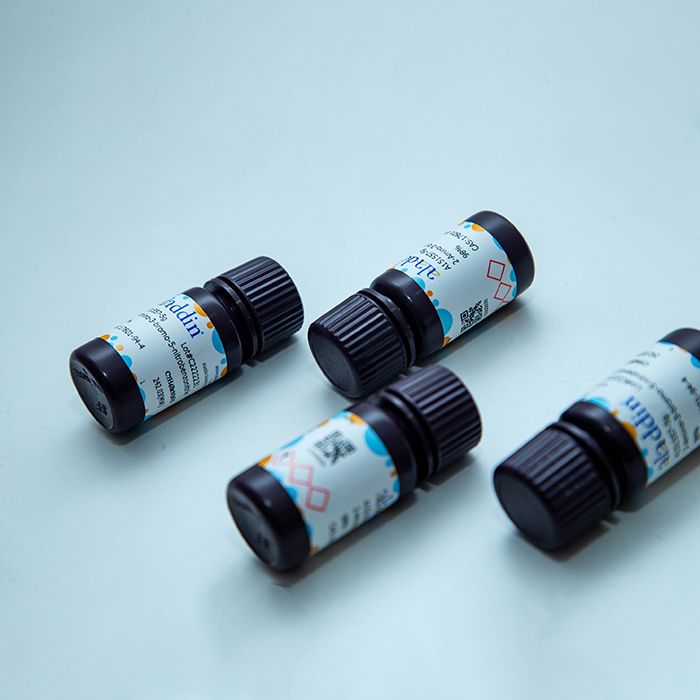
GRADE & PURITYMoligand™?Moligand™ — Aladdin's line of ligands and bioactive small molecules. Use for receptor, pathway, and binding studies needing defined small-molecule tools.10mM in DMSO
Determine the necessary mass, volume, or concentration for preparing a solution.
Dilution Calculator
Determine the dilution needed to prepare a stock solution.
Reconstitution Calculator
Reviews
Customer Reviews
Application Protocols
No tested applications or recommended dilutions are provided for this item. The following are general best practices for small-molecule tools and screening compounds and must be optimized by the user.
Stock preparation: Dissolve in anhydrous DMSO to 10–50 mM. Vortex and, if needed, brief sonication. Filter through a 0.22 µm low-binding filter if particulate persists.
Aliquoting: Dispense into amber, low-bind tubes or plates to minimize adsorption and light exposure. Store frozen as single-use aliquots.
Plate-based assays: Prepare serial dilutions in DMSO, then back-dilute into assay buffer/media to achieve final vehicle ≤0.1–0.5% v/v (cells) or ≤2% v/v (biochemical), unless otherwise validated.
Controls: Include vehicle-only, positive control (if available), and negative/inactive analog controls. Run in technical triplicate and at least three biological replicates for robust statistics.
Data quality: Monitor Z′-factor, signal-to-background, and compound interference (auto-fluorescence/absorbance). Confirm results with an orthogonal assay modality.
For detailed, item-specific instructions, consult the CoA/Spec Sheet or contact technical support.
Biological Roles
Item-specific biological target, mechanism, or phenotype data are not provided in this listing. The notes below describe common roles of small-molecule research compounds in experimental biology and should be adapted to your protocol.
Tool-compound role: Such molecules are often used to interrogate cellular signaling, validate targets, and establish exposure–response relationships in biochemical and cell-based models.
Selectivity profiling: It is good practice to assess selectivity across closely related enzymes/receptors (e.g., kinases, small GTPases, epigenetic enzymes) using panel assays, thereby supporting mechanistic conclusions.
Kinetic behavior: If the compound class is known in the literature to show covalent or time-dependent binding, incorporate preincubation and washout studies to distinguish reversible vs irreversible effects and confirm on-target action.
Orthogonal confirmation: Combine chemical perturbation with genetic methods (knockdown/knockout, rescue mutants) to strengthen causal linkage between the compound and observed phenotype.
Dosing strategy: Establish cellular EC50/IC50 values under defined conditions. Titrate DMSO content and verify that vehicle does not confound results. Measure intracellular concentration where feasible to correlate potency with exposure.
For ARS-1323 specifically, consult primary literature and the CoA/SDS for definitive target, assay, and handling guidance. No biological claims are made for this catalog entry beyond research use only.
Buffer Applications
This product is a small-molecule research compound rather than a buffering agent. Consequently, it is not used to establish or control pH in biochemical systems.
Practical notes for use in buffers (general)
When dosing into buffered media, prepare a concentrated DMSO stock and dilute into the buffer of interest (e.g., PBS, HEPES, Tris) with rapid mixing to minimize local supersaturation.
Maintain consistent vehicle concentration across conditions (commonly ≤0.1–0.5% v/v DMSO in cell culture) and confirm compound solubility/absence of precipitation visually and by light scattering or filtration.
Avoid extreme pH unless stability data support it; many heteroaromatics degrade under strong acid/base.
No item-specific buffering properties or pKa data are provided for this listing.
Green Alternatives
As a bioactive small molecule used at micro- to milligram scale, ARS-1323 is not typically a bulk process solvent or reagent where green-chemistry substitution drives major EHS gains. Nevertheless, greener handling considerations can still improve sustainability.
Stock preparation: Prefer high-solvency, lower-toxicity media where feasible. While DMSO is standard, assess ethanol/water cosolvent systems for early screening if solubility permits, thereby reducing reliance on dipolar aprotic solvents (DMF/NMP) with higher EHS concerns.
Dilution media: Use buffered aqueous systems with biodegradable surfactants (e.g., polysorbates) where compatible with your assay to minimize organic solvent use.
Waste minimization: Design concentration–response studies to use minimal volumes. Pool compatible mother plates and employ acoustic dispensing to reduce DMSO consumption.
Illustrative comparison (general guidance)
DMSO vs DMF/NMP: DMSO offers strong solvency with a better EHS profile than DMF/NMP; choose DMSO when possible.
PEG400/aqueous vehicles vs nonpolar co-solvents: For in vivo research formulations, PEG/aqueous systems can reduce volatile organic emissions compared to hydrocarbons—balance against viscosity and injection tolerability.
Note: No alternative “green” analog of ARS-1323 itself is implied; suggestions address solvent and workflow choices around its use.
Pharmaceutical Uses
No pharmacopeial status, excipient role, or manufacturing/formulation specifications are provided for this item. This product is supplied strictly for research use only.
Context (general, non-clinical)
Small molecules of this type may be formulated for preclinical research using common laboratory vehicles (e.g., DMSO, PEG400, aqueous buffers with surfactants). Any in vivo use must follow institutional approvals and is outside the scope of this catalog description.
Do not infer therapeutic indications, dosing, or clinical suitability from the product name. No clinical or medical claims are made for this item.
If you require documentation for regulated development activities, request detailed specifications, impurity profiles, and stability data via CoA/Spec Sheet and conduct independent qualification per your quality system.
Physical Properties
Item-specific physicochemical specifications are not listed in the Product Data for this catalog entry. Do not infer values without verification.
Appearance: Not specified for this item; refer to CoA/Spec Sheet.
Melting point: Not specified for this item; refer to CoA/Spec Sheet.
Boiling point: Not specified for this item; refer to CoA/Spec Sheet.
Density: Not specified for this item; refer to CoA/Spec Sheet.
Solubility: Not specified for this item; refer to CoA/Spec Sheet.
logP/logD: Not specified for this item; refer to CoA/Spec Sheet.
pKa: Not specified for this item; refer to CoA/Spec Sheet.
Refractive index/UV cutoff: Not specified for this item; refer to CoA/Spec Sheet.
General guidance (literature/practice, not item specification)
Bioactive small molecules of this class are commonly supplied as solids or films and are typically reconstituted in anhydrous DMSO to prepare concentrated stocks (e.g., 10–50 mM) for assay use.
If aqueous use is required, serial dilution from DMSO into buffered media with surfactant (e.g., 0.01–0.1% Tween 80 or Pluronic) can help mitigate precipitation; verify compatibility with your assay.
Always confirm exact solubility and stability for this item by consulting the CoA/SDS and performing a small-scale test dilution.
Quality and Grades
Grade/Purity: Not specified for this item; refer to CoA/Spec Sheet.
Interpretation and guidance
In small-molecule screening libraries and chemical probe offerings, materials are commonly supplied at high chemical purity as verified by HPLC/UPLC and NMR/MS. However, no specific purity, residual solvent profile, or analytical acceptance criteria are provided for this item; rely on the CoA accompanying your lot.
If your application is sensitive to trace impurities (e.g., biochemical assays at low nanomolar levels, MS quantitation), review the CoA for: chromatographic purity, identity confirmation (MS/HRMS, NMR), water content (Karl Fischer), and residual solvents. Where unspecified, perform incoming QC under your internal methods.
UV absorbance characteristics, stabilizers, metal contaminants, and endotoxin/bioburden controls are not specified for this listing and should not be assumed. Request the Spec Sheet if needed for regulated workflows.
Best practices
Record lot numbers and retain CoAs for data traceability.
For bioassays, prepare single-use aliquots from freshly opened containers to minimize freeze–thaw and adventitious hydrolysis/oxidation.
Reaction and Applications
This catalog entry is positioned as a research small molecule rather than a synthetic reagent. Consequently, it is not typically used as a stoichiometric reagent or catalyst in preparative organic chemistry.
Research application contexts (general, not item-specific claims)
Chemical biology: Employed as a tool compound in target-validation studies, pathway interrogation, and phenotypic screening. Users often benchmark activity and selectivity against literature data for the named scaffold.
In vitro assays: Commonly evaluated in biochemical enzyme assays, protein–ligand binding studies (e.g., SPR, ITC, DSF), and cellular readouts (proliferation, reporter assays). Establish concentration–response curves with appropriate vehicle controls.
ADME profiling: Solubility, permeability (PAMPA/Caco-2), metabolic stability (microsomes/hepatocytes), and plasma protein binding are typical characterization experiments for such compounds.
Practical tips
Prepare fresh DMSO stocks; minimize freeze–thaw. Validate compound integrity by LC–MS before critical studies.
Include counterscreens to assess off-target effects and assay interference (e.g., redox cycling, fluorescence quenching). Employ orthogonal assay modalities where possible.
For covalent or time-dependent inhibitors (literature class-dependent), incorporate preincubation time courses to capture slow-binding behavior; verify reversibility/irreversibility by dilution-chase experiments.
No item-specific reactivity or named-reaction use cases are provided for this product.
Reaction Conditions
Not applicable in the conventional sense: ARS-1323 is offered as a bioactive research compound rather than a reagent or catalyst used to run chemical reactions.
Stock solutions: Prepare in anhydrous DMSO (typical 10–50 mM), vortex and sonicate if needed. Verify clarity and concentration by UV or quantitative NMR where appropriate.
Biochemical assays: Start with 0.1–10 µM working ranges, maintaining constant vehicle controls. If time-dependent effects are suspected, preincubate with target up to 30–60 minutes.
Cellular assays: Establish non-cytotoxic vehicle levels (often ≤0.1–0.5% DMSO). Confirm solubility upon dilution into media containing serum/proteins.
Stability: Protect from light; minimize time at ambient temperature. Use single-use aliquots to avoid freeze–thaw degradation.
No item-specific temperatures, catalysts, or yields are applicable.
Safety and Handling
Hazard classification for this specific item is not provided in the Product Data.
GHS classification: Not specified for this item; refer to SDS.
Signal word / H-statements / P-statements: Not specified for this item; refer to SDS.
Pictograms: Not specified for this item; refer to SDS.
General laboratory precautions (not a substitute for SDS)
For research use only. Handle in a fume hood using standard PPE: lab coat, safety glasses, and appropriate chemically resistant gloves (e.g., nitrile). Avoid inhalation of dust/aerosols and skin/eye contact.
Avoid exposure to heat, light, and moisture. Keep containers tightly closed. Use clean, dry tools to prevent contamination.
Incompatibilities (general): Strong oxidizers and strong acids/bases may cause degradation for many organic small molecules; verify specifics in the SDS.
First aid overview: In case of skin/eye contact, rinse with water for at least 15 minutes and seek medical attention. If inhaled, move to fresh air. If ingested, rinse mouth; do not induce vomiting unless directed by medical personnel. Refer immediately to the SDS and institutional protocols.
Spill response: Absorb with inert material (e.g., vermiculite), collect for disposal in accordance with local regulations. Decontaminate surfaces with suitable solvent compatible with the material and lab SOPs.
Always consult the item-specific SDS for authoritative hazard, handling, and disposal guidance.
Solvent Selection
Item-specific solubility data are not provided. The guidance below reflects common practice for hydrophobic research compounds and should be validated experimentally for this item.
Primary stock solvent (general practice): Anhydrous DMSO due to broad solvency, compatibility with cell-based assays at ≤0.1–0.5% v/v, and stability at low temperature.
Alternative solvents (if compatible): DMF or NMP for higher-concentration stocks; ethanol or isopropanol for biochemical assays tolerant of protic solvents; PEG400 or Kolliphor-based vehicles for in vivo formulation research (non-clinical).
Aqueous work: Dilute DMSO stocks into buffered media with vigorous mixing and optional surfactant (e.g., 0.01–0.1% Tween 80 or Pluronic F-68) to reduce precipitation. Filter through low-binding 0.22 µm membranes when appropriate.
Selection considerations
Polarity: Many bioactive heteroaromatics show poor water solubility but dissolve readily in dipolar aprotic solvents (DMSO > DMF > acetonitrile). Test minimal DMSO content that preserves solubility and assay performance.
Stability: Avoid prolonged exposure to strong light, elevated temperature, or high pH. Prepare fresh dilutions immediately before use.
DMF: strong solvency; can affect certain enzymes/cells; typically limit ≤1% v/v.
Ethanol: biocompatible in some assays but lower solvency; may cause precipitation upon dilution.
Confirm solvent choice empirically for your exact application.
Storage and Reconstitution
Item-specific conditions from Product Data
Storage conditions: Store at -80°C.
Shipped in: Dry ice packs + Cold packs.
Additional guidance (general best practice; not item specification)
Upon receipt: Keep frozen. Allow the container to equilibrate to room temperature in a desiccator before opening to prevent condensation.
Reconstitution: If solid/film, dissolve in anhydrous DMSO to prepare a concentrated stock (e.g., 10–50 mM). Mix thoroughly to ensure complete dissolution. If solubility is uncertain, start at lower concentrations and titrate upward.
Aliquoting: Prepare single-use aliquots in amber vials or low-bind tubes to avoid repeated freeze–thaw cycles and light exposure.
Storage of solutions: Store DMSO stocks at -80°C. Avoid frost-free freezers that cycle temperatures. Record preparation date and concentration.
Stability monitoring: Periodically verify integrity by LC–MS or HPLC. Discard solutions showing precipitation, discoloration, or decomposition.
Unspecified parameters
Appearance, exact solubility, and long-term stability: Not specified for this item; refer to CoA/Spec Sheet.
Research use only: Not for human or veterinary use.
Structure and Identity
Product name: ARS-1323 (SKU: A656105)
CAS: 1698024-73-5
PubChem CID: 137003167
InChIKey: Not specified for this item; refer to CoA/Spec Sheet.
SMILES: Not specified for this item; refer to CoA/Spec Sheet.
Molecular formula: Not specified for this item; refer to CoA/Spec Sheet.
Molecular weight: Not specified for this item; refer to CoA/Spec Sheet.
Structural features
Item-specific structural details (ring systems, functional groups, stereochemistry): Not specified for this item; refer to CoA/Spec Sheet.
Contextual/literature note
ARS-1323 is referenced in the chemical biology literature as a small-molecule research compound. Specific structure descriptors (SMILES/InChIKey), if needed for computational work or database registration, should be sourced from the Certificate of Analysis (CoA) or authoritative databases using the provided CAS and CID. (Literature reference guidance only, not item specification.)
2D structure description (general)
Without the definitive SMILES/InChI for this particular lot, a precise atom-by-atom 2D description cannot be provided. Users should download the structure from a trusted cheminformatics source via the listed CAS or CID and verify stereochemical annotations prior to docking, QSAR, or CADD workflows.
Synthetic Utility
This product is intended as a finished research compound, not as a general-purpose building block. Accordingly, it is not typically deployed as a reagent, protecting group, or coupling partner in routine organic synthesis.
How it may feature in chemistry workflows (general)
Reference standard: May be used as a comparator in SAR campaigns to benchmark potency/selectivity against derivative series.
Analytical control: Serves as a positive control in bioassays or as a retention-time/ion-fragment standard in LC–MS method development when the same scaffold is investigated.
Derivatization (advanced users): With full structural knowledge from literature and appropriate rights, chemists may design close analogs for SAR. However, this listing does not provide functional-group handles or reactivity guidance for derivatization.
No item-specific functional-group reactivity, protecting-group compatibility, or named-reaction applicability is provided for this product.
Target Specificity
Target, mechanism, and selectivity data: Not specified for this item; refer to CoA/Spec Sheet and primary literature.
Guidance
If ARS-1323 is to be used as a tool compound for a particular biological target, consult peer-reviewed sources to confirm target engagement, potency metrics (e.g., Ki/IC50), and off-target profile. Validate in your system using orthogonal assays and appropriate positive/negative controls.
No antigen/epitope/clone/isotype information applies; this product is not an antibody.
Need help choosing the grade?
Our grade selection guide covers purity, stabilizer status, and application suitability for all variants in our catalog.
We use cookies to ensure the website functions properly and, where permitted, to improve your experience. You can manage your preferences at any time in Settings. Learn more in our Cookie Policy.
Shall we send you a message when we have discounts available?
Remind me later
Thank you! Please check your email inbox to confirm.
Products are supplied to verified businesses, institutions, and qualified professionals for research and development use only. Not for use in humans, animals, diagnosis, or therapy.