Zwitterionic detergent. Solubilizes proteins for 2D analysis, including membrane proteins.
Storage
Store at 2-8°C
Shipped In
Wet ice
This product requires cold chain shipping. Ground and other economy services are not available.
Note
Wherever possible, you should prepare and use solutions on the same day. However, if you need to make up stock solutions in advance, we recommend that you store the solution as aliquots in tightly sealed vials at -20°C. Generally, these will be useable for up to one month. Before use, and prior to opening the vial we recommend that you allow your product to equilibrate to room temperature for at least 1 hour. Need more advice on solubility, usage and handling? Please visit our frequently asked questions (FAQ) page for more details.
This compound belongs to the class of organic compounds known as n-acyl amines. These are compounds containing a fatty acid moiety linked to an amine group through an ester linkage.
External Descriptors
Not available
1. Djoumbou Feunang Y, Eisner R, Knox C, Chepelev L, Hastings J, Owen G, Fahy E, Steinbeck C, Subramanian S, Bolton E, Greiner R, and Wishart DS. ClassyFire: Automated Chemical Classification With A Comprehensive, Computable Taxonomy. Journal of Cheminformatics, 2016, 8:61.
Determine the necessary mass, volume, or concentration for preparing a solution.
Dilution Calculator
Determine the dilution needed to prepare a stock solution.
Reconstitution Calculator
Reviews
Customer Reviews
Application Protocols
No item-specific, validated protocols are provided in the Product Data. Below are general, literature-style procedures to guide use; optimize to your system.
Membrane Protein Extraction
Resuspend cell pellet or membrane prep in: 50 mM Tris-HCl pH 8.0, 150 mM NaCl, 1% w/v ASB-14, protease inhibitors.
Incubate 30–60 min at 4–25°C with gentle rotation.
Membrane disruption: Inserts its C14 tail into lipid bilayers, lowering membrane integrity and enabling extraction of integral membrane proteins and lipids into micellar phases.
Protein–detergent complexes (PDCs): Stabilizes hydrophobic surfaces of proteins post-extraction by forming PDCs, which can preserve solubility and, in some cases, partial activity.
Isoelectric focusing compatibility: As a zwitterion with minimal net charge over typical pH ranges, ASB-14 reduces interference with protein migration during IEF compared to ionic detergents.
Chaotrope synergy: Exhibits additive effects with urea/thiourea, enhancing denaturation/solubilization of complex proteomes prior to 2D-PAGE.
Enzymology impact: Like most detergents, can inhibit or modulate enzyme activity by altering protein conformation or sequestering cofactors; effects are concentration- and system-dependent.
Summary: While not a biological metabolite, ASB-14 is a versatile tool for manipulating membrane structures and protein solubility in vitro. Its zwitterionic headgroup and amide linkage underpin its wide adoption in proteomic sample preparation.
Buffer Applications
ASB-14 is commonly formulated into lysis and solubilization buffers for proteomics and membrane biology (literature/general guidance). Example use-cases:
2D-PAGE lysis buffer (IEF-compatible):
7–8 M urea, 2 M thiourea, 1–2% w/v ASB-14, 20–40 mM DTT or TCEP, 0.5–1% CHAPS (optional), ampholytes as needed. Filter and use freshly. This composition reduces streaking and improves solubilization of hydrophobic proteins.
Membrane extraction buffer:
20–50 mM Tris-HCl pH 7.5–8.0, 150 mM NaCl, 0.5–2% ASB-14, protease inhibitors. Incubate 30–60 min at 4–25°C with gentle agitation; clarify by ultracentrifugation.
Sample cleanup considerations:
For downstream MS, remove ASB-14 via protein precipitation (acetone/TCA), SPE, phase-transfer surfactant strategies, or FASP-like protocols before LC–MS.
Enzyme assays:
Use sub-CMC levels (e.g., 0.01–0.05%) to mitigate aggregation without excessive activity perturbation; titrate empirically.
Compatibility:
Works across pH 6–9 typical of protein buffers; stable in urea/thiourea systems. High salt may induce clouding—adjust detergent or ionic strength.
Note: The above are literature-style formulations. Optimize concentrations for your sample matrix and confirm with small-scale tests.
Green Alternatives
Context: “Green” in surfactant selection weighs biodegradability, toxicity, and downstream analytical removability. ASB-14 is a synthetic zwitterionic surfactant with excellent solubilization; alternatives may reduce environmental impact or improve biocompatibility.
Sugar-based detergents (e.g., DDM, LMNG): Often more biodegradable and gentler to proteins; may offer improved stability for some membrane proteins but can be costlier and have higher CMC variability.
Bile salt derivatives (e.g., CHAPS): Zwitterionic and relatively MS-friendly upon removal; generally milder but sometimes less effective on highly hydrophobic targets.
Short-chain sulfobetaines: Higher CMCs and lower hydrophobicity reduce persistence but can be less potent solubilizers.
Nonionic green surfactants (alkyl polyglucosides): Better environmental profiles; limited use in high-urea proteomics due to background and removal challenges.
Tradeoffs:
ASB-14 provides strong solubilization and IEF compatibility; greener options may sacrifice extraction strength or introduce analytical background.
Practical steps regardless of choice:
Use minimum effective concentration and small volumes.
Implement detergent capture/removal methods to prevent environmental release.
Validate alternative detergents on a small scale to ensure comparable protein yield and integrity before switching.
Pharmaceutical Uses
No pharmacopeial/excipient status is provided for this item. Not specified for this item; refer to CoA/Spec Sheet.
General context (non-clinical, research-only):
Zwitterionic surfactants like ASB-14 are primarily used in research workflows (protein extraction, analytical sample prep). They are not commonly employed as approved pharmaceutical excipients.
In pre-formulation research, similar surfactants can be screened to study membrane interactions, permeability models, or to aid in solubilizing hydrophobic candidates in discovery assays. Such use remains strictly non-clinical and for laboratory evaluation only.
Compliance note:
This product is labeled For research use only and is not intended for diagnostic, therapeutic, or in vivo applications.
Physical Properties
Item-specific specs: Not specified for this item; refer to CoA/Spec Sheet.
Literature/general properties for ASB-14 (qualitative unless noted):
Physical state/appearance: Typically a white to off-white solid or waxy flakes/powder at ambient temperatures; highly hygroscopic behavior is not generally reported, but surfactants can cake upon moisture uptake.
Solubility: Readily soluble in water, producing clear micellar solutions at concentrations above the CMC; also soluble in many polar organic solvents (e.g., methanol) and in chaotrope-containing mixtures (urea/thiourea). Insoluble in nonpolar hydrocarbons.
Critical micelle concentration (CMC): Commonly reported in the low sub-mM to ~mM range depending on ionic strength and temperature (literature, method-dependent). Exact value is not specified for this item.
Aggregation behavior: Forms micelles and mixed micelles with other detergents (e.g., CHAPS, sulfobetaines); can form stable protein–detergent complexes.
pH stability: Zwitterionic headgroup retains internal charge over wide pH; amide is stable under neutral conditions. Strong base/acid may cause hydrolysis over time (literature).
Foaming and cloud point: Moderate foaming; cloud point phenomena may appear in high-salt or denaturant systems (literature observations).
Partitioning: Amphiphilic; effective at disrupting lipid bilayers and solubilizing membrane proteins via hydrophobic tail insertion and polar headgroup hydration.
Always consult the product CoA/SDS for definitive item-specific data such as water content, residual salts, or stabilizers (if any).
Quality and Grades
Item-specific grade/purity: Not specified for this item; refer to CoA/Spec Sheet.
Guidance on interpreting grades for life-science detergents (general):
Biochemistry/Proteomics grade: Typically emphasizes low UV-absorbing impurities, low ionic contaminants (Na+/K+/Cl−), and reduced peroxide/carbonyl species that can modify proteins. Suitable for IEF/2D-PAGE where streaking and background must be minimized.
Molecular biology grade: Focuses on nuclease/protease absence and low endotoxin, helping preserve nucleic acids/proteins during extraction.
Chromatography grade: Low baseline in UV-visible detection and minimal surfactant-derived artifacts.
What to look for on the CoA/Spec Sheet (item-specific):
Assay (%), water, ash/inorganic residue: Not specified for this item; refer to CoA/Spec Sheet.
Conductivity/ionic content: Critical for IEF compatibility.
UV absorbance profile: Important for spectroscopic workflows.
Metals/endotoxin/bioburden: Relevant to sensitive proteomics.
Stabilizers/antioxidants:
If present, they will be listed on the CoA/SDS. For detergents used with redox-sensitive proteins, absence of reactive stabilizers is preferred. Not specified for this item; refer to CoA/Spec Sheet.
Reaction and Applications
ASB-14 is primarily a life-science reagent rather than a synthetic reagent. Its key applications are in protein chemistry and analytical workflows (literature/general knowledge):
Membrane protein solubilization: Efficiently disrupts lipid bilayers via its C14 tail while maintaining a net-neutral zwitterionic headgroup, facilitating extraction of GPCRs, transporters, and complexes. Often used alone or with CHAPS/DDM.
2D electrophoresis (IEF → SDS-PAGE): Widely used in sample lysis buffers with urea/thiourea to minimize aggregation and streaking. The amide-containing headgroup can be more compatible with high urea than standard sulfobetaines.
Proteomics sample prep: Aids in delipidation and solubilization prior to digestion. Detergent removal (by SPE, precipitation, phase-transfer, or FASP-like workflows) is required pre-LC–MS.
Refolding/renaturation screens: Employed at sub-CMC to stabilize partially unfolded intermediates.
Mixed-micelle systems: Combines with other detergents to tune CMC and micelle size, optimizing activity/stability of particular proteins.
Practical tips:
Concentration: Start with 0.5–2% w/v for tough membranes; reduce for soluble proteins (0.05–0.2%).
Temperature: Warm gently (room temp to 30–37°C) to hasten dissolution; avoid prolonged heating.
Compatibility: Works in 7–8 M urea and up to ~2 M thiourea in typical 2D lysis buffers; check for precipitation when adding salts or after freeze–thaw.
Removal: Consider detergent-compatible proteases or removal before tryptic digestion to preserve MS sensitivity.
Reaction Conditions
This section is not typically applicable because ASB-14 functions as a surfactant in biochemical workflows rather than a stoichiometric reagent or catalyst in organic synthesis.
Working concentration: Commonly 0.05–2% w/v, adjusted to sample needs. Higher levels may be used for especially recalcitrant membranes.
Temperature: Dissolves at room temperature; mild warming (≤37°C) can speed dissolution. Avoid prolonged heating.
pH: Effective across pH 6–9 for most protein buffers; zwitterionic headgroup minimizes net charge effects on IEF.
Additives: Compatible with 7–8 M urea and up to ~2 M thiourea in typical 2D-PAGE buffers; reducing agents (DTT/TCEP) and protease inhibitor cocktails are commonly included.
For any quantitative, item-specific conditions (e.g., residual conductivity limits for IEF), consult the CoA/Spec Sheet.
Safety and Handling
Hazard information (from Product Data):
Signal Word: Not specified for this item; refer to SDS.
H-Statements: Not specified for this item; refer to SDS.
GHS Classification/Pictograms: Not specified for this item; refer to SDS.
General safety guidance for zwitterionic detergents (literature/good laboratory practice):
Irritation: Surfactants may cause skin, eye, and respiratory irritation. Avoid inhalation of dust/aerosols and contact with eyes/skin.
PPE: Wear lab coat, safety glasses, and suitable gloves (e.g., nitrile). Use in a fume hood when handling powders or preparing concentrated solutions.
First aid (overview): If inhaled, move to fresh air. In case of skin contact, wash with soap and water. For eye exposure, rinse with water for several minutes and seek medical advice. If ingested, rinse mouth and seek medical attention. Always follow SDS.
Incompatibilities: Strong oxidizers; strong acids/bases can hydrolyze the amide or affect headgroup integrity over time. Avoid prolonged exposure to elevated temperatures that may promote degradation or discoloration.
Environmental precautions: Surfactants can be harmful to aquatic organisms at sufficient concentration. Prevent release to the environment; collect spills with inert absorbent and dispose per institutional and local regulations.
Thermal hazards: Avoid generating dust; some organic surfactants are combustible as solids. Store away from ignition sources.
Always defer to the product’s SDS for authoritative classification, response measures, and disposal guidance.
Solvent Selection
Relevance: ASB-14 is itself a surfactant used to prepare aqueous or mixed solvent systems; classic “solvent selection” for dissolving another solute is less applicable. Practical guidance is provided below.
General selection and compatibility (literature/general knowledge):
Primary medium: Water. ASB-14 forms clear solutions above its CMC and can be used from ~0.05–2% w/v in protein work (optimize experimentally).
Chaotropes: Highly compatible with urea and thiourea systems (e.g., for 2D-PAGE lysis buffers). Helps reduce protein aggregation and streaking during IEF.
Alcohols/organics: Soluble in methanol, ethanol, and isopropanol; also used in mixed aqueous/organic buffers for delipidation and membrane solubilization.
Salts and pH: Zwitterionic headgroup is broadly pH-stable; high ionic strength can alter micelle size and clouding behavior—titrate conditions.
When to choose ASB-14 vs alternatives:
ASB-14: Strong membrane solubilizer; amide linkage can improve compatibility with urea/thiourea compared with simple sulfobetaines.
CHAPS: Gentler, preserves protein activity better but often less potent on very hydrophobic complexes.
DDM (n-dodecyl-β-D-maltoside): Excellent for membrane protein stability; milder solubilization; sugar-based, often pricier.
Tip: Prepare concentrated stocks (e.g., 10% w/v in water) and dilute freshly into the working buffer to minimize precipitation in high-salt or denaturant matrices.
General handling and reconstitution (literature/good practice):
Solid handling: Minimize exposure to ambient humidity to prevent caking. Reseal promptly after opening.
Stock solutions: Prepare fresh aqueous stocks (e.g., 10% w/v) using high-purity water. Gentle warming (≤37°C) with stirring/sonication can aid dissolution. Filter if necessary (0.22 µm) to remove particulates.
Aliquoting: Divide stocks into working aliquots to avoid repeated freeze–thaw. Store at 2–8°C for short term; for longer storage, validate stability at ≤−20°C (literature practice) and avoid multiple freeze–thaw cycles.
Light/air exposure: Routine ambient light is acceptable; avoid prolonged heat exposure. Cap tightly to limit evaporation/contamination.
Compatibility checks: In high-urea/thiourea buffers, prepare immediately before use to minimize decomposition of additives and potential phase separation.
Expiry and specifications:
Retest/expiry date, stabilizers, water content: Not specified for this item; refer to CoA/Spec Sheet.
Always equilibrate refrigerated solutions to room temperature and mix before use to redissolve any cold-induced aggregates.
Structure and Identity
Item-specific identifiers (from Product Data):
Product Name: ASB-14
SKU: A275232
CAS: 216667-08-2
PubChem CID: 4046965
InChIKey: 368973 (truncated as provided)
SMILES: Not specified for this item; refer to CoA/Spec Sheet.
Molecular Formula: Not specified for this item; refer to CoA/Spec Sheet.
Molecular Weight: Not specified for this item; refer to CoA/Spec Sheet.
General structural description (literature/general knowledge):
Compound type: Zwitterionic surfactant of the amidosulfobetaine class, commonly referred to as “ASB-14.”
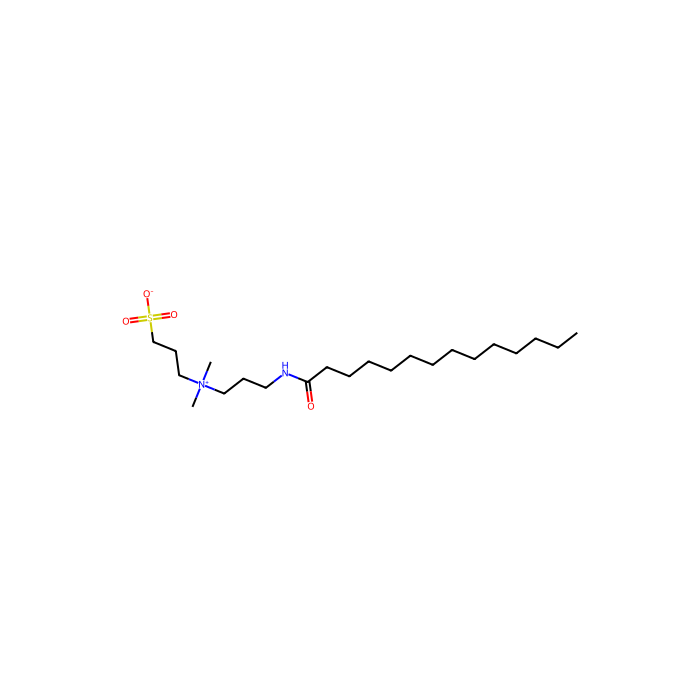
Core motif: A long C14 linear aliphatic (myristyl) chain attached via an amide linker to a tertiary dimethylammonium bearing a propane-sulfonate group (inner salt). Overall charge is net neutral (zwitterion) over a broad pH range.
Functional groups: Long alkyl chain (hydrophobic), amide (polar/ H-bond donor-acceptor), quaternary ammonium (cationic center), sulfonate (anionic center). No stereocenters; expected as a single constitutional isomer.
2D structure in words: From left to right: a straight C14 alkyl tail – carbonyl – NH – propyl spacer – N+(CH3)2 – propyl – SO3−, where the ammonium and sulfonate form an internal betaine pair.
Notes:
“ASB-14” is distinct from conventional betaines (e.g., SB3-14) by having an amide between tail and headgroup, which often improves protein compatibility in denaturing systems (urea/thiourea, IEF).
Synthetic Utility
ASB-14 is not typically used as a chemical building block; its primary role is as a surfactant in biochemical preparations.
General notes (literature):
Micellar catalysis: While many surfactants enable micellar organic catalysis, ASB-14’s zwitterionic nature and strong binding to hydrophobic species could, in principle, support micellar media for certain reactions. However, nonionic surfactants (e.g., TPGS-750-M, Triton-type) are far more common in synthetic micellar catalysis.
Phase transfer: The internal salt character is distinct from classical quaternary ammonium phase-transfer catalysts; ASB-14 is rarely chosen for this role.
Conclusion: Choose ASB-14 for biochemical solubilization and proteomics, not for mainstream synthetic chemistry. For green micellar synthesis, consider dedicated surfactants designed for catalysis.
Target Specificity
Not applicable. ASB-14 is a small-molecule surfactant and does not possess antigen/epitope specificity, clone, isotype, or species reactivity. Use the sections on Reaction & Applications, Buffer Applications, and Application Protocols for relevant guidance.
We use cookies to ensure the website functions properly and, where permitted, to improve your experience. You can manage your preferences at any time in Settings. Learn more in our Cookie Policy.
Shall we send you a message when we have discounts available?
Remind me later
Thank you! Please check your email inbox to confirm.
Products are supplied to verified businesses, institutions, and qualified professionals for research and development use only. Not for use in humans, animals, diagnosis, or therapy.

 I2618280