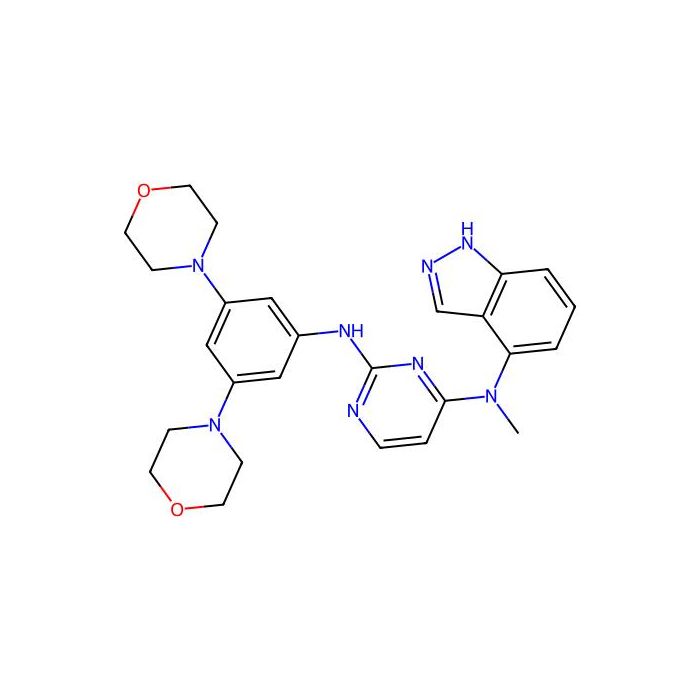
AZ12672857 is an orally active inhibitor of EphB4 ( IC 50 =1.3 nM) and Src kinases . AZ12672857 shows good inhibition of proliferation of c-Src transfected 3T3 cells (IC 50 =2 nM) as well as autophosphorylation of EphB4 in transfected CHO-K1 cells (IC 50 =9 nM)
In Vitro
AZ12672857 shows only modest inhibition of CYP P450 (IC 50 =5 μM against 2C9 and 3A4, >10 μM against 1A4, 2D6 and 2C19). AZ12672857 inhibits p-KDR in HUVEC with an IC 50 of 240 nM and inhibits p-PDGFR-βin MG63 cell line with an IC 50 of 58 nM. MCE has not independently confirmed the accuracy of these methods. They are for reference only.
IC50& Target:Src
Specifications
Specifications & Purity
10mM in DMSO
Biochemical and Physiological Mechanisms
AZ12672857 is an orally active inhibitor of EphB4 ( IC 50 =1.3 nM) and Src kinases . AZ12672857 shows good inhibition of proliferation of c-Src transfected 3T3 cells (IC 50 =2 nM) as well as autophosphorylation of EphB4 in transfected CHO-K1 cells (IC 50
Storage
Store at -80°C
Shipped In
Dry ice packs + Cold packs
This product requires cold chain shipping. Ground and other economy services are not available.
Determine the necessary mass, volume, or concentration for preparing a solution.
Dilution Calculator
Determine the dilution needed to prepare a stock solution.
Reconstitution Calculator
Reviews
Customer Reviews
Application Protocols
No item-specific validated application protocols are provided in the Product Data.
General research-use workflow for a small-molecule screening compound:
Stock preparation: Dissolve in anhydrous DMSO to 10–50 mM. Sonication or gentle warming (≤40 °C) may assist dissolution; verify no degradation by LC–MS.
Aliquoting: Dispense single-use aliquots (e.g., 10–50 µL) in low-bind, airtight vials or plates; flush with inert gas if oxidation is a concern.
Storage: Freeze aliquots at −80 °C (see Storage & Reconstitution). Avoid repeated freeze–thaw.
Assay dosing: Thaw rapidly, vortex, and dose into assay media to reach the desired final concentration; keep final DMSO ≤0.5–1% v/v or per assay tolerance.
Stability check: Include time-zero and endpoint LC–MS samples to confirm concentration and integrity under assay conditions.
For any specialized use (e.g., biophysical binding, crystallography soaks, chemoproteomics), develop method-specific protocols based on confirmed structural and solubility data.
Biological Roles
Item-specific biological targets, pathways, or mechanisms for AZ12672857 are not provided in the Product Data. No medical or clinical claims are made; this product is for research use only.
If this compound has been described in the literature (use CAS 945396-55-4 or PubChem CID 49831162 for searches), any reported target associations or pathway effects should be treated as literature information and independently verified in your lab.
In discovery workflows, such compounds are typically evaluated for binding, enzymatic inhibition/activation, or phenotypic effects across panels relevant to the research objective.
Practical considerations:
Confirm absence of pan-assay interference (PAINS) behaviors, redox activity, aggregation (use detergent controls), and fluorescence/absorbance overlap with assay readouts.
Determine basic ADME-like properties relevant to in vitro work: stability in buffer, microsomal stability (if applicable), and permeability across model membranes (e.g., PAMPA) as research metrics only.
For chemical biology applications, ensure appropriate controls (vehicle controls, inactive analogs if available) and orthogonal assays (biochemical vs. cellular) to corroborate findings.
Please consult primary literature and the CoA for any target-related information; all functional characterizations should be established empirically for your batch.
Buffer Applications
AZ12672857 is a small organic research compound and is not a buffering agent. Therefore, classical buffer system guidance (e.g., phosphate, Tris, HEPES recipes) is not directly applicable to this product.
Practical notes related to buffers (general):
When dosing into aqueous buffers, prepare concentrated DMSO or ethanol stocks and dilute into the buffer with vigorous mixing to avoid precipitation. Keep final organic co-solvent ≤0.5–1% v/v if assay-compatible.
Evaluate compound stability across the intended pH range (commonly pH 6.5–8.0 for biochemical assays). Perform time-course LC–MS to monitor degradation.
If the compound is poorly soluble, consider using solubilizing excipients (cyclodextrins) or surfactants at low levels while verifying they do not interfere with the assay.
For buffer formulations themselves, refer to dedicated buffering reagents; this product does not serve that role.
Green Alternatives
As a specific discovery compound, AZ12672857 is not substitutable by a “greener” chemical with equivalent structure. However, greener practices can be applied to its handling and formulation.
Solvent considerations:
Prefer MeCN or EtOH over DMF/NMP when feasible for analytics and workup due to better environmental/health profiles.
For stock solutions, limit DMSO concentration in final assays to the minimal level compatible with solubility (often ≤0.5–1% v/v).
Process mass intensity (PMI): Scale experiments judiciously; microplate formats and microscale analytics reduce solvent consumption and waste.
Energy and storage: Consolidate shipments on dry ice/cold packs to reduce logistic footprint; store in energy-efficient ultra-low freezers with proper inventory management to minimize door-open time.
Waste management: Segregate halogenated from non-halogenated solvent waste; neutralize and quench reagents prior to disposal per institutional policy.
Illustrative solvent comparison (general):
DMSO: excellent solvency; not volatile; persistent in waste streams.
MeCN: volatile and recyclable; toxic but manageable with controls; LC-compatible.
EtOH/i-PrOH: renewable origins possible; good co-solvents; assay-compatible at low %.
EtOAc/MEK/2-MeTHF for prep work: greener alternatives to chlorinated solvents for extractions and crystallizations when compatible with the compound’s polarity.
Adopt DoE-driven solvent screening to identify the least hazardous viable medium.
Pharmaceutical Uses
No pharmacopeial status, excipient role, or formulation specification is provided for AZ12672857 in the Product Data. This item is supplied strictly for research use only; no medical or clinical use is implied.
Potential lab-context uses (non-clinical):
Internal discovery research such as hit validation and SAR exploration.
In vitro assay development as a research reference compound, pending in-house verification.
If preformulation-style information is desired for research studies (not for human/animal use), determine:
Solubility in biorelevant media (FaSSIF/FeSSIF simulants) purely as physicochemical characterization.
Chemical stability versus pH/light/oxidants; solid-state form (XRPD/DSC/TGA) if material handling is critical.
No dosage form or GMP manufacturing guidance is applicable to this catalog item.
For any application intersecting regulated environments, consult your institutional policies and do not use this material for diagnostic or therapeutic purposes.
Physical Properties
Item-specific physicochemical constants are not provided in the Product Data.
Appearance: Not specified for this item; refer to CoA/Spec Sheet.
Melting point / Boiling point: Not specified for this item; refer to CoA/Spec Sheet.
Density / Refractive index: Not specified for this item; refer to CoA/Spec Sheet.
LogP / cLogP / pKa: Not specified for this item; refer to CoA/Spec Sheet.
Aqueous solubility / organic solubility: Not specified for this item; refer to CoA/Spec Sheet.
Public databases associated with CAS 945396-55-4 or PubChem CID 49831162 may contain calculated physicochemical parameters (e.g., predicted logP, polar surface area, HBD/HBA counts). Treat those as literature/computed values and confirm experimentally for your batch.
Practical guidance when properties are unknown:
Begin with a solubility scout in high-boiling polar aprotic solvents (e.g., DMSO) for stock solutions. If needed, test DMF, NMP, or co-solvent systems (EtOH/PEG400/water with surfactant) in small scale.
For chromatographic method setup, start with reverse-phase LC (C18) and a water–acetonitrile gradient containing 0.1% formic acid; adjust based on retention and ionization response.
If solid at RT, determine approximate melting behavior via DSC or capillary MP; if oil, determine viscosity and stability versus temperature/light.
Quality and Grades
Item-specific grade and purity are not included in the Product Data.
Grade/Purity: Not specified for this item; refer to CoA/Spec Sheet.
What the grade means (general): For small-molecule screening compounds, typical catalog offerings are supplied at research grade, with purity commonly assessed by LC–UV/LC–MS and reported as area% at a defined wavelength. Exact acceptance criteria vary by product; consult the CoA for this SKU (A655514).
Analytical characterization (general expectations): May include 1H NMR, MS/HRMS, HPLC chromatogram, water/volatile content by Karl Fischer/TGA (when relevant). Absence or presence of stabilizers will be noted on the CoA.
Impurity considerations: Trace synthetic residues (salts, solvents) can influence bioassay outcomes. If your application is sensitive (e.g., biophysical binding, electrophysiology), consider re-purifying or performing a quick orthogonal check (qNMR; LC at multiple wavelengths).
Batch traceability: Record lot number from label/CoA. For hit validation, procure the same lot or cross-validate across lots.
Custom QC: On request, Aladdin Scientific may accommodate custom QC documentation or repackaging for screening campaigns; inquire with technical support.
Reaction and Applications
This product is listed as a finished small-molecule research compound rather than a general-purpose reagent or building block. As such, it is primarily used in screening, probe validation, or as a reference material rather than as a reaction component.
Applicable uses (general, non-clinical):
In vitro screening: Create DMSO stocks (e.g., 10–50 mM) for biochemical or biophysical assays; confirm solubility and stability under assay conditions.
Analytical reference: Use as a retention-time or MS response reference if part of a known panel; establish calibration curves where quantitative analyses are needed.
Control material: Employed as a positive/negative control once its activity in a given assay is documented in your lab; document lot-dependence.
Not typically applicable:
Named synthetic reactions (e.g., cross-coupling, reductions) are generally not relevant unless AZ12672857 is being derivatized for SAR. Without structural information, prescriptive reaction guidance is inappropriate.
Practical tips:
Verify identity/purity before biological testing (orthogonal LC–MS and NMR checks).
Assess stability in working buffers (pH, redox, light) via time-course LC–MS.
If derivatization is intended, first obtain the structure from the CoA/literature and plan protection/deprotection accordingly.
Reaction Conditions
This product is not intended as a general reagent, and no item-specific reaction conditions are provided.
If you plan to modify AZ12672857 (e.g., to create analogs or conjugates), first obtain the verified structure (via CoA or literature). Then choose conditions compatible with the identified functional groups (e.g., mild amide couplings for amines/acids, Suzuki–Miyaura for aryl boron/halide pairs, or click chemistry for azide/alkyne handles). These are general literature strategies and must be adapted to the actual structure.
Absent structural data, prescriptive temperatures, catalysts, and yields would be speculative and are not provided here.
For analytical and handling conditions (applicable):
Prepare stock solutions in DMSO under inert atmosphere if oxidative sensitivity is suspected; store frozen at −80°C to align with the storage guidance.
Use light protection (amber vials) until photostability is established.
Validate any heating steps (e.g., for dissolution) with a small aliquot and monitor for degradation by LC–MS.
Safety and Handling
Hazard information is not provided in the Product Data for this specific item. Handle as a research chemical of unknown toxicity.
Signal Word / H-Statements / GHS Classification / Pictograms: Not specified for this item; refer to SDS.
General PPE: Lab coat, safety glasses, and suitable chemically resistant gloves (e.g., nitrile). Use in a certified chemical fume hood to avoid inhalation of dusts/aerosols.
Storage Incompatibilities (general): Keep away from strong oxidizers and strong acids/bases unless compatibility is known. Avoid sources of ignition and prolonged exposure to air, moisture, and light until stability is confirmed.
Spill/Exposure (overview): For small spills, absorb with inert material and collect for disposal; avoid dust formation. On skin contact, wash with soap and water. On eye contact, rinse cautiously with water for several minutes. If inhaled, move to fresh air. Seek medical attention as appropriate. Always defer to the SDS for authoritative instructions.
Waste Disposal: Dispose of contents/container in accordance with institutional, local, and national regulations for organic laboratory chemicals.
Stability Considerations: Discovery compounds can be sensitive to hydrolysis, oxidation, and photolysis. Minimize freeze–thaw cycles, exclude moisture, and protect from light until stability data are established.
SDS: Obtain the item-specific SDS from Aladdin Scientific; that document supersedes any general guidance here.
Solvent Selection
With no item-specific solubility data provided, select solvents using a staged, evidence-driven approach typical for discovery compounds.
Primary stock solvent (typical): DMSO is the default for small-molecule screening stocks due to broad solvating power and assay compatibility at low final %.
Secondary options: DMF or NMP (for difficult solutes); volatile co-solvents for preparative work include MeCN, MeOH, EtOH, i-PrOH, acetone, EtOAc, or toluene depending on polarity/aromaticity (verify experimentally).
Aqueous formulations: If aqueous work is required, explore co-solvent systems (e.g., 5–20% DMSO or ethanol), cyclodextrins, or mild surfactants (Tween-80, Pluronic F-127) while controlling for assay interference.
pH adjustment: If the molecule is ionizable (unknown here), modest pH adjustment can improve solubility; avoid extreme pH without stability data.
Chromatography solvents: For analytical LC, start with water/MeCN or water/MeOH with 0.1% FA or 10 mM ammonium formate (ESI-MS compatible). For normal-phase/flash, choose hexanes/EtOAc or DCM/MeOH gradients as indicated by TLC.
Drying and stability: Dry hygroscopic solvents prior to use when water sensitivity is suspected. Protect solutions from light and air until stability is confirmed.
Comparison note: DMSO offers unmatched solvency for diverse scaffolds, while MeCN/MeOH provide volatility for recovery; choose based on downstream needs (assay vs. isolation).
Storage and Reconstitution
Follow ultra-low temperature storage and cold-chain handling to maintain integrity.
Storage Conditions (item-specific): Store at −80 °C.
Shipped In (item-specific): Dry ice packs + Cold packs, preserving the ultra-low chain of custody.
Form at receipt: Appearance is not specified for this item; refer to CoA/Spec Sheet. Upon arrival, allow external condensation to evaporate before opening the primary container to avoid moisture ingress.
Reconstitution (general):
Preferred solvent: anhydrous DMSO for concentrated stocks (e.g., 10–50 mM). Filter sterilize (0.22 µm PTFE) if particulate is observed and filtration is compatible.
If aqueous work is required, dilute DMSO stocks into buffer with strong mixing; consider co-solvents/surfactants if needed and assay-compatible.
Aliquoting: Prepare single-use aliquots to minimize freeze–thaw cycles. Use amber vials if light sensitivity is suspected.
Stability: Item-specific stability, water content, and degradation pathways are not specified for this item; refer to CoA/Spec Sheet. Verify stability by periodic LC–MS.
Handling tips: Work quickly on cold blocks when possible; return unused material promptly to −80 °C. Record thaw times and number of cycles for each aliquot.
Always defer to the item’s CoA and SDS for definitive storage, handling, and stability instructions.
Structure and Identity
Brief: AZ12672857 is a cataloged small-molecule research compound (screening/tool candidate). Item-specific structural identifiers are not fully provided in the Product Data.
Product Name: AZ12672857 (code name)
CAS: 945396-55-4
PubChem CID: 49831162 (for literature reference only)
InChIKey: Not specified for this item; refer to CoA/Spec Sheet.
SMILES: Not specified for this item; refer to CoA/Spec Sheet.
Molecular Formula: Not specified for this item; refer to CoA/Spec Sheet.
Molecular Weight: Not specified for this item; refer to CoA/Spec Sheet.
Structural features (general guidance):
The precise 2D/3D structure is not included in the provided Product Data. If structural details are required for docking, QSAR, or analytical method development, consult the CoA/Spec Sheet or authoritative databases using the provided CAS or PubChem CID.
When working without a confirmed structure, treat the compound as a generic organic small molecule: plan for potential aromatic content, heteroatoms, and multiple functional groups typical of discovery compounds; verify experimentally before committing to scale-up.
Identity confirmation best practices (general):
Use orthogonal methods (HRMS, 1H/13C NMR, LC–MS retention time versus reference) to confirm identity and purity before critical experiments.
For plate-based screening, record the batch/lot number and link to the CoA to ensure reproducibility across campaigns.
Synthetic Utility
AZ12672857 is sold as a target small molecule, not as a building block or reagent. Without structural disclosure in the Product Data, detailed synthetic transformations cannot be recommended.
Not typically applicable:
Use as a coupling partner, catalyst, or reagent is not anticipated unless performing derivative synthesis for SAR. In such cases, obtain verified structural information (from CoA/literature) and plan functional group interconversions accordingly.
General guidance if derivatization is pursued (structure-dependent; literature-level):
Identify latent functional handles (e.g., aryl halides for cross-coupling, amines/carboxyls for amide linkages) for tag installation (biotin/fluorophores) or solubility tuning.
Use protecting-group strategies consistent with any base/acid-sensitive motifs once identified by NMR/IR/MS analysis.
Establish stability-indicating analytics (LC–MS, UPLC-UV) to track modifications and impurities.
In the absence of item-specific functionality data, treat AZ12672857 as a finished research compound whose primary value lies in screening and reference applications rather than as a synthetic intermediate.
Target Specificity
No target, epitope, or binding specificity information is provided in the Product Data for AZ12672857.
This catalog entry is not an antibody or biologic; thus, attributes such as clone, isotype, antigen, or species reactivity are not applicable.
If literature associates this compound with a biological target, consider that information as literature-only and confirm independently in your own assays using orthogonal methods.
For accurate target annotations in your records, cite your internal validation results and link them to the specific lot/CoA.
We use cookies to ensure the website functions properly and, where permitted, to improve your experience. You can manage your preferences at any time in Settings. Learn more in our Cookie Policy.
Shall we send you a message when we have discounts available?
Remind me later
Thank you! Please check your email inbox to confirm.
Products are supplied to verified businesses, institutions, and qualified professionals for research and development use only. Not for use in humans, animals, diagnosis, or therapy.