
Determine the necessary mass, volume, or concentration for preparing a solution.
| Activity Type | Activity Value -log(M) | Mechanism of Action | Activity Reference | Publications (PubMed IDs) |
|---|
Information
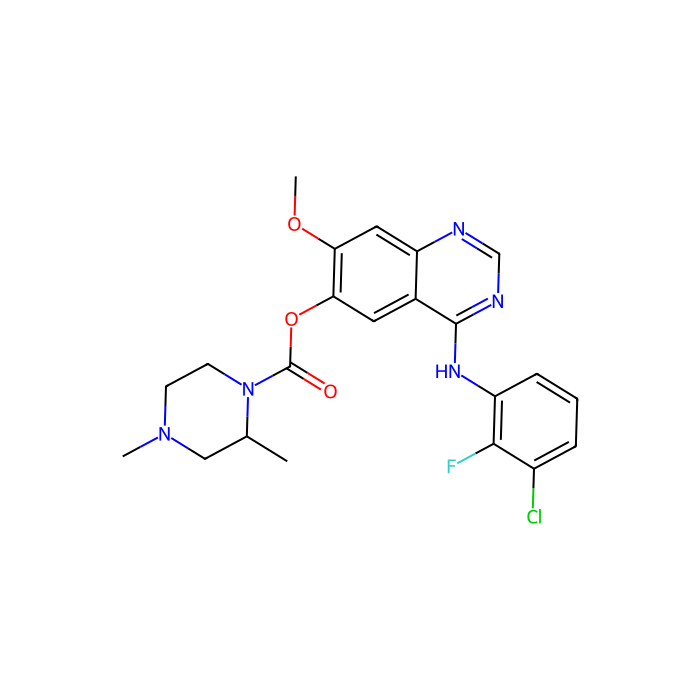
AZD3759 is a potent, oral active, CNS-penetrantEGFRinhibitor withIC50of 0.3 nM, 0.2 nM, and 0.2 nM for EGFR (WT), EGFR (L858R), and EGFR (exon 19Del), respectively. Phase 1.
Targets
EGFR (L858R) (Cell-free assay); EGFR (exon 19Del) (Cell-free assay); EGFR (WT) (Cell-free assay) 0.2 nM; 0.2 nM; 0.3 nM
In vitro
In H3255 (L858R) cells, AZD3759 inhibits EGFR phosphorylation with IC50 of 7.2 nM. AZD3759 demonstrates inhibitory effects on both the pEGFR pathway and cell proliferation of EGFR mutation-derived cells PC-9 and H3255 with IC50 of 7.7 nM and 7 nM, respectively, showing mo activity on cell proliferation of H838 cells.
In vivo
AZD3759 shows good oral bioavailability in dogs, and penetrates extensively into monkey brain. In a brain metastasis PC-9 (Exon19Del) model, AZD3759 (15 mg/kg) causes significant dose-dependent antitumor efficacy.
Cell Research(from reference)
Cell lines:PC-9 (exon 19Del), H3255 (L858R) and H838 (wt) cells
Concentrations:~30 mM
Incubation Time:72 h
Taxonomy Tree
| Kingdom | Organic compounds |
|---|---|
| Superclass | Organoheterocyclic compounds |
| Class | Diazanaphthalenes |
| Subclass | Benzodiazines |
| Intermediate Tree Nodes | Quinazolines |
| Direct Parent | Quinazolinamines |
| Alternative Parents | Piperazine carboxylic acids Aniline and substituted anilines Anisoles Alkyl aryl ethers Aminopyrimidines and derivatives N-methylpiperazines Chlorobenzenes Fluorobenzenes Aryl chlorides Aryl fluorides Imidolactams Carbamate esters Heteroaromatic compounds Trialkylamines Azacyclic compounds Carbonyl compounds Organofluorides Organic oxides Organochlorides Hydrocarbon derivatives |
| Molecular Framework | Aromatic heteropolycyclic compounds |
| Substituents | Quinazolinamine - Piperazine-1-carboxylic acid - Anisole - Aniline or substituted anilines - Phenol ether - Alkyl aryl ether - Aminopyrimidine - Fluorobenzene - Halobenzene - Chlorobenzene - N-alkylpiperazine - N-methylpiperazine - Aryl chloride - 1,4-diazinane - Monocyclic benzene moiety - Aryl halide - Aryl fluoride - Imidolactam - Pyrimidine - Piperazine - Benzenoid - Heteroaromatic compound - Carbamic acid ester - Tertiary amine - Tertiary aliphatic amine - Ether - Azacycle - Organic nitrogen compound - Organohalogen compound - Organochloride - Carbonyl group - Organofluoride - Organonitrogen compound - Organooxygen compound - Hydrocarbon derivative - Organic oxide - Organic oxygen compound - Amine - Aromatic heteropolycyclic compound |
| Description | This compound belongs to the class of organic compounds known as quinazolinamines. These are heterocyclic aromatic compounds containing a quianazoline moiety substituted by one or more amine groups. |
| External Descriptors | Not available |
| Activity Type | Activity Value -log(M) | Mechanism of Action | Activity Reference | Publications (PubMed IDs) |
|---|
| Activity Type | Activity Value -log(M) | Mechanism of Action | Activity Reference | Publications (PubMed IDs) |
|---|
| Activity Type | Relation | Activity value | Units | Action Type | Journal | PubMed Id | doi | Assay Aladdin ID |
|---|
| Activity Type | Relation | Activity value | Units | Action Type | Journal | PubMed Id | doi | Assay Aladdin ID |
|---|
| Activity Type | Relation | Activity value | Units | Action Type | Journal | PubMed Id | doi | Assay Aladdin ID |
|---|
| Activity Type | Relation | Activity value | Units | Action Type | Journal | PubMed Id | doi | Assay Aladdin ID |
|---|
| Activity Type | Relation | Activity value | Units | Action Type | Journal | PubMed Id | doi | Assay Aladdin ID |
|---|
| Activity Type | Relation | Activity value | Units | Action Type | Journal | PubMed Id | doi | Assay Aladdin ID |
|---|
| Activity Type | Relation | Activity value | Units | Action Type | Journal | PubMed Id | doi | Assay Aladdin ID |
|---|
| Activity Type | Relation | Activity value | Units | Action Type | Journal | PubMed Id | doi | Assay Aladdin ID |
|---|
| Activity Type | Relation | Activity value | Units | Action Type | Journal | PubMed Id | doi | Assay Aladdin ID |
|---|
| Activity Type | Relation | Activity value | Units | Action Type | Journal | PubMed Id | doi | Assay Aladdin ID |
|---|
| Activity Type | Relation | Activity value | Units | Action Type | Journal | PubMed Id | doi | Assay Aladdin ID |
|---|
| Activity Type | Relation | Activity value | Units | Action Type | Journal | PubMed Id | doi | Assay Aladdin ID |
|---|
| Activity Type | Relation | Activity value | Units | Action Type | Journal | PubMed Id | doi | Assay Aladdin ID |
|---|
| Activity Type | Relation | Activity value | Units | Action Type | Journal | PubMed Id | doi | Assay Aladdin ID |
|---|
| Activity Type | Relation | Activity value | Units | Action Type | Journal | PubMed Id | doi | Assay Aladdin ID |
|---|
| Activity Type | Relation | Activity value | Units | Action Type | Journal | PubMed Id | doi | Assay Aladdin ID |
|---|
| Activity Type | Relation | Activity value | Units | Action Type | Journal | PubMed Id | doi | Assay Aladdin ID |
|---|
| Activity Type | Relation | Activity value | Units | Action Type | Journal | PubMed Id | doi | Assay Aladdin ID |
|---|
| Activity Type | Relation | Activity value | Units | Action Type | Journal | PubMed Id | doi | Assay Aladdin ID |
|---|
| Activity Type | Relation | Activity value | Units | Action Type | Journal | PubMed Id | doi | Assay Aladdin ID |
|---|
| Activity Type | Relation | Activity value | Units | Action Type | Journal | PubMed Id | doi | Assay Aladdin ID |
|---|
| Activity Type | Relation | Activity value | Units | Action Type | Journal | PubMed Id | doi | Assay Aladdin ID |
|---|
| Activity Type | Relation | Activity value | Units | Action Type | Journal | PubMed Id | doi | Assay Aladdin ID |
|---|
| Activity Type | Relation | Activity value | Units | Action Type | Journal | PubMed Id | doi | Assay Aladdin ID |
|---|
| Activity Type | Relation | Activity value | Units | Action Type | Journal | PubMed Id | doi | Assay Aladdin ID |
|---|
| Activity Type | Relation | Activity value | Units | Action Type | Journal | PubMed Id | doi | Assay Aladdin ID |
|---|
| Activity Type | Relation | Activity value | Units | Action Type | Journal | PubMed Id | doi | Assay Aladdin ID |
|---|
| Activity Type | Relation | Activity value | Units | Action Type | Journal | PubMed Id | doi | Assay Aladdin ID |
|---|
| Activity Type | Relation | Activity value | Units | Action Type | Journal | PubMed Id | doi | Assay Aladdin ID |
|---|
| Activity Type | Relation | Activity value | Units | Action Type | Journal | PubMed Id | doi | Assay Aladdin ID |
|---|
| Activity Type | Relation | Activity value | Units | Action Type | Journal | PubMed Id | doi | Assay Aladdin ID |
|---|
| Activity Type | Relation | Activity value | Units | Action Type | Journal | PubMed Id | doi | Assay Aladdin ID |
|---|
| Activity Type | Relation | Activity value | Units | Action Type | Journal | PubMed Id | doi | Assay Aladdin ID |
|---|
| Activity Type | Relation | Activity value | Units | Action Type | Journal | PubMed Id | doi | Assay Aladdin ID |
|---|
| Activity Type | Relation | Activity value | Units | Action Type | Journal | PubMed Id | doi | Assay Aladdin ID |
|---|
| Activity Type | Relation | Activity value | Units | Action Type | Journal | PubMed Id | doi | Assay Aladdin ID |
|---|
Find and download the COA for your product by matching the lot number on the packaging.
| Lot Number | Certificate Type | Date | Item |
|---|---|---|---|
 F2224252 | Certificate of Analysis | Jan 19, 2026 | A413895 |
| F2224253 | Certificate of Analysis | Jan 19, 2026 | A413895 |
| E23251124 | Certificate of Analysis | Mar 04, 2025 | A413895 |
| E23251125 | Certificate of Analysis | Mar 04, 2025 | A413895 |
| E23251130 | Certificate of Analysis | Mar 04, 2025 | A413895 |
| E23251145 | Certificate of Analysis | Mar 04, 2025 | A413895 |
| E23251156 | Certificate of Analysis | Mar 04, 2025 | A413895 |
| E23251172 | Certificate of Analysis | Mar 04, 2025 | A413895 |
| E23251179 | Certificate of Analysis | Mar 04, 2025 | A413895 |
| E23251175 | Certificate of Analysis | May 06, 2023 | A413895 |
| E23251186 | Certificate of Analysis | May 06, 2023 | A413895 |
| F2224254 | Certificate of Analysis | May 31, 2022 | A413895 |
| F2224255 | Certificate of Analysis | May 31, 2022 | A413895 |
| Solubility | Solubility (25°C) In vitro DMSO: 92 mg/mL (200.04 mM); Ethanol: 44 mg/mL warmed with 50ºC Water: bath (95.67 mM); Water: Insoluble; |
|---|---|
| dmso_mg_max_solubility | 91 |
| dmso_mM_max_solubility | 197.869102 |
| water_mg_max_solubility | <1 |
| Molecular Weight | 459.9 |
| XLogP3 | 4.100 |
| Hydrogen Bond Donor Count | 1 |
| Hydrogen Bond Acceptor Count | 8 |
| Rotatable Bond Count | 5 |
| Exact Mass | 459.147 Da |
| Monoisotopic Mass | 459.147 Da |
| Topological Polar Surface Area | 79.800 Ų |
| Heavy Atom Count | 32 |
| Formal Charge | 0 |
| Complexity | 649.000 |
| Isotope Atom Count | 0 |
| Defined Atom Stereocenter Count | 1 |
| Undefined Atom Stereocenter Count | 0 |
| Defined Bond Stereocenter Count | 0 |
| Undefined Bond Stereocenter Count | 0 |
| The total count of all stereochemical bonds | 0 |
| Covalently-Bonded Unit Count | 1 |
H302:Harmful if swallowed
H315:Causes skin irritation
H319:Causes serious eye irritation
H335:May cause respiratory irritation
P261:Avoid breathing dust/fume/gas/mist/vapors/spray.
P305+P351+P338:IF IN EYES: Rinse cautiously with water for several minutes. Remove contact lenses if present and easy to do - continue rinsing.
No tested application protocols are provided in the product data for this item.
General recommendations (non-item-specific):
Please consult your internal SOPs and the lot-specific documentation for any validated procedures.
Item-specific biological characterization is not provided in the product data.
General/literature context:
Practical research uses (non-clinical):
Caveats:
For rigorous use, pair this compound with lot-specific analytical data (purity/identity), confirm solubility under assay conditions, and document vehicle effects. Always adhere to the “Research Use Only” notice and avoid any clinical or diagnostic application.
This product is not a buffering agent and is not typically used to set or control pH.
Practical guidance for assay buffers (general):
If buffer-related specifications (pH stability range, salt compatibility) are critical for your workflow, determine them empirically for your lot or consult relevant literature; item-specific data are not provided here.
Because AZD3759 is a research ligand rather than a bulk solvent or reagent, “green alternatives” are best considered in terms of formulation and handling practices.
Greener choices (general considerations):
Illustrative comparison (formulation focus):
Always validate alternative solvents for chemical stability and assay performance before scale-up.
No clinical or therapeutic claims are made for this product. It is supplied strictly for research use only.
Relevant non-clinical, pharmaceutical R&D contexts:
Regulatory/quality notes:
Use constraints:
Item-specific physicochemical constants have not been provided in the product data.
Practical notes (general guidance, not item-specific specifications):
What Moligand™ generally implies (contextual explanation; not item-specific specs):
Critical notes for this specific listing:
Quality assurance in practice (recommendations):
This product is supplied as a research-use small-molecule ligand (not primarily as a synthetic reagent). Consequently, its core value is in discovery and analytical contexts rather than as a building block.
Research applications (general, non-clinical):
Practical considerations:
Note: If you intend to derivatize or immobilize the molecule for chemoproteomics or affinity enrichment, consult structural disclosures and ensure functional handles are compatible with your coupling chemistry. Item-specific reactivity is not provided here.
Conventional synthetic reaction conditions are not directly applicable because this product is supplied as a final small-molecule ligand, not a reagent. Nonetheless, users frequently need handling conditions for biophysical/biochemical experimentation.
General assay handling conditions (non-item-specific):
Item-specific parameters such as pKa-dependent solubility, exact stability windows, and incompatibilities are not provided; determine empirically for your use case.
Hazard classification details have not been supplied for this item in the product data.
General laboratory safety guidance (defer to SDS for authoritative instructions):
Always consult the lot-specific SDS delivered with the product for definitive hazard, toxicological, and disposal guidance.
Item-specific solubility data are not provided. The following is general guidance for small-molecule heteroaromatic ligands used in discovery assays.
Selection tips (general):
Always confirm solvent choice with small-scale tests and the lot-specific CoA.
Reconstitution and handling (general guidance; not item-specific specifications):
Item-specific attributes such as exact solubility, solution stability, and form (free base vs. salt) are Not specified for this item; refer to the lot CoA/Spec Sheet and confirm empirically under your assay conditions.
Structural features (general/literature context):
2D structure description:
Notes:
This listing is for a finished research ligand rather than a synthetic building block. As such, it is not commonly employed as a reagent or intermediate in standard organic transformations.
How it may still support synthetic/medchem workflows (general):
Notably, without item-specific functional group disclosure (e.g., free amines, phenols, alkynes), we cannot recommend reaction classes or named transformations. If you intend to modify the molecule, obtain definitive structural identifiers (SMILES/InChI) and confirm reactivity through small-scale scouting and analytical verification.
Target specificity data are not provided in the product listing and should not be inferred from the product name alone.
For rigorous research, determine target engagement in your system using orthogonal assays (e.g., biochemical enzyme assays, cellular target-occupancy measurements, CETSA/thermal shift) and include appropriate positive/negative controls.
Our grade selection guide covers purity, stabilizer status, and application suitability for all variants in our catalog.
View Moligand™ grade guide →