GRADE & PURITYMoligand™?Moligand™ — Aladdin's line of ligands and bioactive small molecules. Use for receptor, pathway, and binding studies needing defined small-molecule tools.10mM in DMSO
Moligand™, 10mM in DMSO Moligand™ for sensitive chromatographic and analytical workflows requiring minimal baseline interference.
🌡
Storage & shipping
Store at -80°C Ships Dry ice packs + Cold packs Check lot-specific COA for exact specifications.
📋
Quality documents
SDS, COA, datasheet, and spec sheet available for download. Lot-specific COA accessible via lot number lookup.
📚
Literature proof
Cited in 50 peer-reviewed publications across chromatography, organic synthesis, and cross-coupling reactions.
Overview
Information
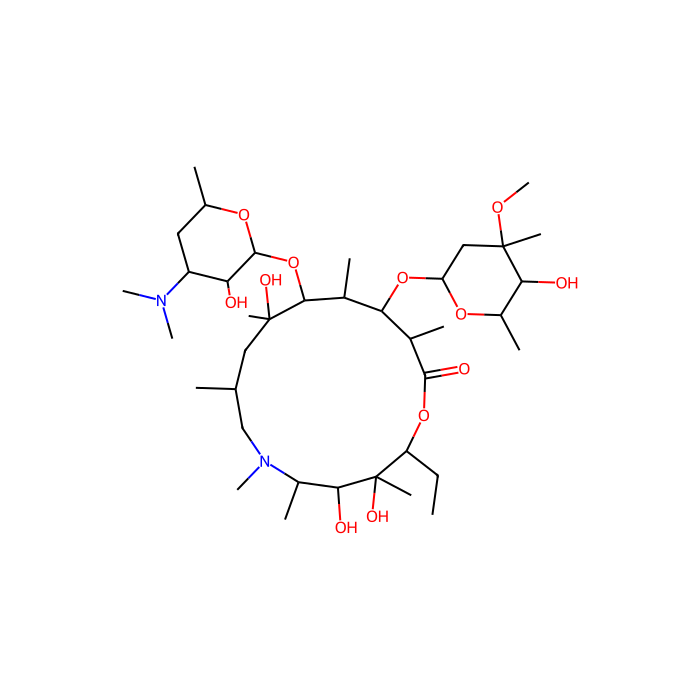
Azithromycin (CP-62993, XZ-450) is an antibiotic by inhibiting protein synthesis, used for the treatment of bacterial infections. In vitro
Azithromycin reduces about 40% of IL-8 mRNA and protein expression in cystic fibrosis (CF) cells reaching the levels of non-CF cells. Azithromycin results in 50% and 70% reduction of NF-kappaB and AP-1 DNA binding, respectively, leading to levels of non-CF cells. Azithromycin significantly enhances the intensity of a co-stimulatory molecule, CD80, on DCs but not CD86 and CD40 in dendritic cells (DCs). Azithromycin significantly increases the production of IL-10 and Clarithromycin (CAM) significantly inhibits the production of IL-6 by DCs. Azithromycin increases IL-10 and CAM decreases IL-2 productions significantly, when naive T cells derived from spleen are co-cultured with DCs treated in advance with LPS and these macrolides. Azithromycin selectively inhibits fluid-phase endocytosis of horseradish peroxidase and lucifer yellow in J774 mouse macrophages. Azithromycin delays sequestration of receptor-bound transferrin and peroxidase-anti-peroxidase immune complexes into cell-surface endocytic pits and vesicles. Azithromycin down-regulates cell surface transferrin receptors, but not Fc gamma receptors, by causing a major delay in the accessibility of internalized transferrin receptors to the recycling route, without slowing down subsequent efflux, resulting in redistribution of the surface pool to an intracellular pool. Azithromycin inserts into the DOPC lipid bilayer, so as to decrease its cohesion and to facilitate the merging of DPPC into the DOPC fluid matrix.
We use cookies to ensure the website functions properly and, where permitted, to improve your experience. You can manage your preferences at any time in Settings. Learn more in our Cookie Policy.
Shall we send you a message when we have discounts available?
Remind me later
Thank you! Please check your email inbox to confirm.
Products are supplied to verified businesses, institutions, and qualified professionals for research and development use only. Not for use in humans, animals, diagnosis, or therapy.