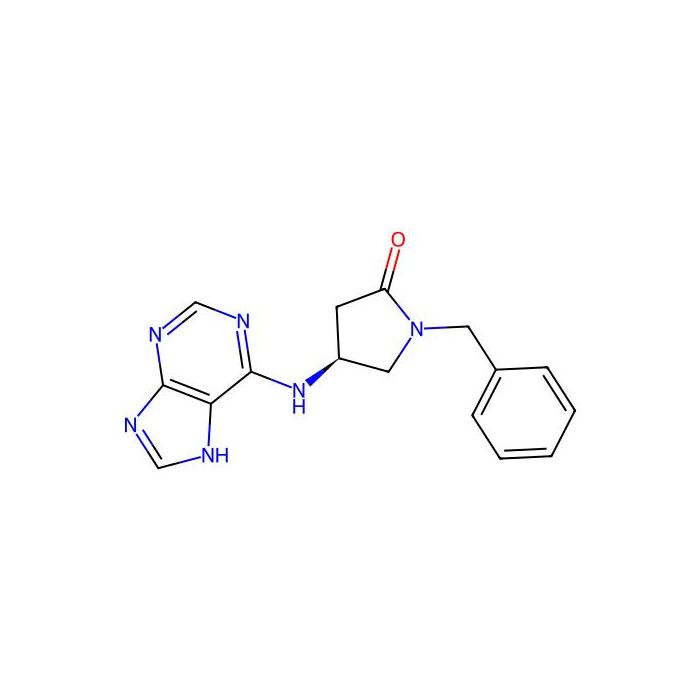
Benpyrine is a highly specific and orally active TNF-α inhibitor with a K D value of 82.1 μM. Benpyrine tightly binds to TNF-α and blocks its interaction with TNFR1, with an IC 50 value of 0.109 µM. Benpyrine has the potential for TNF-α mediated inflammatory and autoimmune disease research
In Vitro
Benpyrine (5-20 µM; 14 hours; RAW264.7 cells) pretreatment results in a dose-dependent decrease in the phosphorylation of IκBα in RAW264.7 cells (stimulated with 10 ng/mL TNF-α or 1 μg/mL LPS). Benpyrine abolishes the TNF-α-induced nuclear translocation of NF-κB/p65 in RAW264.7 cells. Benpyrine only blocks cell death induced by TNF-α WT and Y 119 A, and increases the cell survival rate up to 80%. Benpyrine does not obviously affect L 57 A- and Y 59 L-induced cytotoxicity in L929 cells. MCE has not independently confirmed the accuracy of these methods. They are for reference only. Western Blot AnalysisCell Line: RAW264.7 cells Concentration: 5 µM, 10 µM, 20 µM Incubation Time: 14 hours Result: Resulted in a dose-dependent decrease in the phosphorylation of IκBα.
In Vivo
Benpyrine (25-50 mg/kg; oral gavage; daily; for 2 weeks; Balb/c mice) treatment significantly relieves the symptoms of collagen-induced arthritis. Benpyrine dose-dependently decreases the levels of proinflammatory cytokines, such as IFN-γ, IL-1β and IL-6, and increases the concentration of the anti-inflammatory cytokine IL-10 . Endotoxemia murine model shows that Benpyrine (25 mg/kg) could attenuate TNF-α-induced inflammation, thereby reducing liver and lung injury . MCE has not independently confirmed the accuracy of these methods. They are for reference only. Animal Model: Balb/c mice (18-20 g) injected with collagen Dosage: 25 mg/kg, 50 mg/kg Administration: Oral gavage; daily; for 2 weeks Result: Relieved the symptoms of collagen-induced arthritis in mice.
IC50& Target:KD: 82.1 μM (TNF-α)
Specifications
Specifications & Purity
10mM in DMSO
Biochemical and Physiological Mechanisms
Benpyrine is a highly specific and orally active TNF-α inhibitor with a K D value of 82.1 μM. Benpyrine tightly binds to TNF-α and blocks its interaction with TNFR1, with an IC 50 value of 0.109 µM. Benpyrine has the potential for TNF-α mediated inflammat
Storage
Store at -80°C
Shipped In
Dry ice packs + Cold packs
This product requires cold chain shipping. Ground and other economy services are not available.
Determine the necessary mass, volume, or concentration for preparing a solution.
Dilution Calculator
Determine the dilution needed to prepare a stock solution.
Reconstitution Calculator
Reviews
Customer Reviews
Application Protocols
General protocols (research use only; adapt to your assay)
Preparing a DMSO master stock
Warm vial to room temperature in a desiccator. Brief spin to collect solids.
Add DMSO to prepare a 10–50 mM stock (calculate volume once molecular weight is confirmed from CoA or PubChem). Vortex and, if needed, brief sonication until fully dissolved.
Optionally pass through a low-protein-binding 0.2 µm filter if validated for recovery.
Dilution into assay buffer (biochemical assays)
Prepare intermediate DMSO dilutions to minimize final DMSO (target ≤0.1–0.5% v/v).
Add compound last to a vigorously mixed buffer to avoid local supersaturation. Inspect for precipitation; if present, consider 0.01–0.05% nonionic surfactant if assay-tolerant.
Cell-based assays
Confirm media compatibility; pre-warm media and add compound from DMSO stock with rapid mixing. Maintain consistent DMSO across wells.
Assess compound stability over the assay window by UPLC–UV or LC–MS.
Plate management
Use low-bind polypropylene plates/tubes for hydrophobic molecules. Seal plates to limit evaporation.
Minimize freeze–thaw cycles by aliquoting master stocks (see Storage tab).
Note
All concentrations and volumes depend on the confirmed molecular weight and assay design; verify using the CoA/Spec or PubChem record.
Biological Roles
Item-specific (from Product Data)
No biological mechanism, target, or pathway information is provided for Benpyrine.
General context
As supplied, Benpyrine is a research-use small molecule without assigned physiological role. It may be utilized as a test article or putative probe in discovery biology, pending user-defined assays.
Without structural and mechanistic disclosure, no conclusions can be drawn regarding endogenous occurrence, metabolism, or biochemical pathway engagement.
Best practices for exploratory biology
Establish baseline cytotoxicity and assay interference (e.g., detergent-sensitive readouts, fluorescence quenching/auto-fluorescence) before target-specific testing.
Determine stability in relevant biological matrices (assay buffer, culture media with serum, microsomes) by LC–MS to avoid misattribution of activity to degradation products.
Profile nonspecific binding (plasticware, serum proteins) if potency shifts with dilution or time.
Compliance note
For research use only. Not intended for diagnostic, therapeutic, or clinical applications.
Buffer Applications
Not typically applicable.
Benpyrine is not a buffering agent and is not used to set or maintain pH. For experiments involving this compound, choose assay buffers based on biological target requirements (e.g., HEPES, phosphate, Tris) and validate compound solubility/stability in the chosen buffer.
Practical tip: prepare intermediate DMSO stocks and dilute into buffer with vigorous mixing to minimize precipitation; keep final DMSO within assay tolerance.
Green Alternatives
Context: For handling small-molecule screening compounds like Benpyrine, the main environmental lever is solvent selection for stock preparation, dilution, and analytics rather than replacing the compound itself.
Greener solvent considerations (general)
Prefer ethanol or isopropanol over chlorinated solvents when feasible for cleaning and preliminary solubility tests.
For assay dilutions, maximize aqueous buffer content and minimize DMSO carryover while preserving solubility and activity readouts.
For LC methods, optimize MeCN/H2O gradients; consider MeOH/H2O where sensitivity allows (MeOH has a better green profile than MeCN but different selectivity).
MeOH: greener, but may require higher backpressure and different selectivity.
Operational practices with green impact
Prepare higher-concentration master stocks to reduce solvent volume footprint.
Use micro-aliquots to avoid discard after freeze–thaw cycles.
Implement solvent recycling where validated for analytical methods.
Pharmaceutical Uses
Not a pharmacopeial excipient; no formulation role is specified for this item.
General context for discovery/development (non-clinical)
Benpyrine may serve as a research reference or screening hit during early discovery. Any preformulation work (solubility, stability vs. pH, lipophilicity) should be considered exploratory and non-GMP.
There is no USP/EP/JP monograph or compendial status indicated. Do not use for human or veterinary applications.
Best practices (preclinical research only)
If dose-formulation studies are planned in vitro/in vivo models, characterize:
Solubility across biorelevant media and pH.
Chemical stability and adsorption to plastics.
Vehicle tolerability (e.g., DMSO, PEG400, Captisol) in the intended model.
Document batch identity/purity with the provided CoA and in-house orthogonal analytics.
Physical Properties
Item-specific (from Product Data)
Appearance: Not specified for this item; refer to CoA/Spec Sheet.
Not specified for this item; refer to CoA/Spec Sheet
Melting point (MP): Not specified for this item; refer to CoA/Spec Sheet.
Boiling point (BP): Not specified for this item; refer to CoA/Spec Sheet.
Density: Not specified for this item; refer to CoA/Spec Sheet.
Refractive index: Not specified for this item; refer to CoA/Spec Sheet.
Solubility: Not specified for this item; refer to CoA/Spec Sheet.
logP/logD, pKa: Not specified for this item; refer to CoA/Spec Sheet.
General guidance (literature/practice)
Small-molecule library members are commonly reconstituted in anhydrous DMSO to prepare 10–50 mM stocks; aqueous solubility is then evaluated by serial dilution into assay buffers (keep final DMSO ≤0.1–1% v/v as assay allows).
If precipitation occurs on dilution, evaluate co-solvent strategies (DMSO→buffer with 0.01–0.1% Tween-80 or 1–10% PEG400/glycerol, as assay-compatible) and confirm concentration by UPLC–UV or LC–MS.
Hygroscopicity and polymorphism can affect handling; check the CoA for any notes on form (free base/salt, solvate, hydrate) and water content if available.
For unknown photolability, protect from light during preparation and storage (amber vials/foil).
Quality and Grades
Item-specific (from Product Data)
Grade/Purity: Not specified for this item; refer to CoA/Spec Sheet.
How to interpret quality for small-molecule library items (general guidance)
Identity: Typically supported by LC–MS and, where applicable, NMR. Verify that the provided CoA/Spec includes at least an LC–MS trace with correct mass and a retained chromatographic peak.
Purity reporting: May be by HPLC/UPLC (UV at multiple wavelengths) or LC–MS TIC; ensure the method and detection wavelength(s) are stated. If purity thresholds (e.g., ≥95%) are not specified, test internally for critical applications.
Counter ions/form: Confirm if the item is supplied as free base/acid, salt (e.g., HCl, TFA), or solvate; stoichiometry influences molecular weight for solution prep.
Residual solvents/water/metals/UV cutoff: Not specified for this item; refer to CoA/Spec Sheet.
Stabilizers: Not specified for this item; refer to CoA/Spec Sheet. If none are declared, assume neat material.
Recommended incoming QC (best practice)
Visual inspection, weigh-check vs. label.
Fast LC–MS for identity and gross purity; orthogonal HPLC if needed.
Karl Fischer for moisture if hygroscopicity is suspected.
Reconfirm concentration of DMSO stocks by quantitative 1H NMR or calibrated UPLC–UV.
Reaction and Applications
Applicability: Benpyrine (CAS 2550398-89-3) is offered here as a small-molecule library member for research screening and analytical reference. It is not primarily positioned as a synthetic reagent.
Research applications (general, non-therapeutic)
High-throughput and fragment/lead screening: prepare defined-concentration DMSO stocks for biochemical, biophysical, or cell-based assays.
Orthogonal profiling: use in panel assays (enzymatic, receptor-binding, phenotypic) to contextualize activity signals and identify off-target liabilities.
Analytical reference: LC–MS method development, retention-time indexing, and stability/solubility studies under assay-relevant conditions.
Practical tips for screening use
Ensure a single, fully dissolved stock by staged concentration: pre-wet vial with a few drops DMSO, vortex, then bring to final volume.
Verify solubility by visual inspection and by UPLC immediately after prep and after freeze–thaw to assess precipitation.
Minimize DMSO in assays; prepare intermediate dilutions to reach final ≤0.1–0.5% v/v where possible.
Stability checks: incubate at assay temperature in buffer for the assay duration and re-assay by LC to confirm chemical integrity (hydrolysis/oxidation monitoring).
Note
Without disclosed structure, do not assume reactivity, photostability, or redox behavior; characterize if your workflow is sensitive to these variables.
Reaction Conditions
Not typically applicable.
This product is offered as a screening/reference small molecule rather than as a reagent for conducting named reactions. No canonical reaction conditions (solvent, temperature, catalysts, yields) are associated with this listing.
General note (if user plans chemistry on the material)
Determine stability windows by exposing small aliquots to acid/base, oxidative, reductive, and thermal conditions, then analyze by LC–MS/NMR to map compatible conditions before attempting any transformations.
Safety and Handling
Item-specific (from Product Data)
GHS classification: Not specified for this item; refer to SDS.
Signal word / H-statements / Pictograms: Not specified for this item; refer to SDS.
General safety guidance (defer to SDS as authoritative)
Handle as a potentially harmful organic solid/liquid of unknown toxicity. Work in a chemical fume hood.
Personal protective equipment: lab coat, safety glasses, and appropriate chemically resistant gloves (e.g., nitrile). Avoid inhalation of dust/aerosols and skin/eye contact.
Cold-chain handling: product is stored at -80°C and shipped on dry ice + cold packs. Allow containers to equilibrate in a desiccator to prevent condensation before opening. Avoid thermal shock to glass vials.
Incompatibilities (generic): avoid strong oxidizers, strong acids/bases, and reactive reducing agents until specific functional groups are known. Keep away from ignition sources if volatile organics are involved.
First aid (overview; see SDS):
Skin/eye contact: rinse with water for at least 15 minutes; remove contaminated clothing; seek medical advice.
Inhalation: move to fresh air; monitor respiration; seek medical attention if symptoms persist.
Ingestion: rinse mouth; do not induce vomiting; obtain medical assistance.
Spill response: contain and absorb with inert material, avoid dust generation, collect for disposal as hazardous chemical waste.
Waste: dispose in accordance with local regulations; do not discharge to drains.
Solvent Selection
Applicability: As a small-molecule library compound with unspecified structure, solvent choice should be guided empirically to achieve reliable stocks and assay-compatible working solutions.
General solvent strategy (practice-based)
Primary solvent: anhydrous DMSO for 10–50 mM master stocks; verify clarity after vortex/brief sonication.
Secondary options (if DMSO-insoluble): DMF or NMP for master stock, then dilute into buffer or media; check assay/material compatibility.
Aqueous work: dilute DMSO stocks slowly into buffer with vigorous mixing to minimize precipitation; consider 0.01–0.1% nonionic surfactant (Tween-80/Pluronic) if permissible.
Volatile organics for analytical work: MeCN/H2O or MeOH/H2O with 0.1% FA or NH4OAc for LC; IPA may help dissolve highly lipophilic analytes.
Useful comparison (general)
DMSO: broad solvency, excellent for HTS stocks; potential biological interference at >0.5–1% v/v.
DMF/NMP: strong solvency; higher boiling points, possible cytotoxicity—use minimal carryover into assays.
Ethanol: greener co-solvent, limited for very nonpolar chemotypes.
Practical tips
Filter 0.2 µm only if compatible; many drug-like molecules adsorb—validate recovery.
Record exact solvent grade and water content; solubility can shift with small amounts of water.
Confirm actual concentration by analytical assay when solubility is borderline.
Storage and Reconstitution
Item-specific (from Product Data)
Storage conditions: Store at -80°C.
Shipped in: Dry ice packs + Cold packs.
General best practices for small-molecule library items
Upon receipt: keep frozen; allow to equilibrate in a desiccator to avoid condensation before opening. Record lot, receive date, and storage location.
Solid material: store in airtight, moisture-protected amber vials with desiccant. If hygroscopic, consider inert-atmosphere storage.
Solution stocks: prepare anhydrous DMSO master stocks (typical 10–50 mM), aliquot into low-bind tubes, flush headspace with inert gas if possible, and store at -80°C.
Freeze–thaw: avoid repeated cycles; use single-use aliquots. Track number of thaws if aliquots are reused.
Light and moisture: protect from light (amber vials/foil) and minimize moisture ingress; water uptake can reduce solubility and promote degradation.
Stability monitoring: periodically confirm integrity by LC–MS or UPLC–UV (e.g., quarterly or before critical studies).
Reconstitution notes
Molecular weight is not provided here; obtain from CoA/Spec or PubChem CID 95327594 to calculate precise stock concentrations.
If insoluble in DMSO at intended concentration, step down concentration or evaluate DMF/NMP stocks, then dilute into assay-compatible media with minimal carryover.
Structure and Identity
Item-specific (from Product Data)
SKU: B655290
Product name: Benpyrine
CAS: 2550398-89-3
PubChem CID: 95327594
Storage: Store at -80°C
Shipping: Dry ice packs + Cold packs
Research use: For research use only
Not specified for this item; refer to CoA/Spec Sheet
Molecular formula: Not specified for this item; refer to CoA/Spec Sheet.
Molecular weight: Not specified for this item; refer to CoA/Spec Sheet.
SMILES: Not specified for this item; refer to CoA/Spec Sheet.
InChIKey: Not specified for this item; refer to CoA/Spec Sheet.
General chemistry notes (structure description)
The 2D structure, functional groups, ring systems, and stereochemistry are not provided here. To ensure correct identity in your lab records and databases, retrieve the structural record associated with PubChem CID 95327594 and cross-check against the Aladdin CoA/Spec.
Recommended identity confirmation upon receipt (general best practice):
High-resolution LC–MS (exact mass and isotope pattern)
1H/13C NMR in DMSO-d6 or CDCl3 (dependent on solubility)
HPLC/UPLC purity trace and UV spectrum if applicable
FTIR for functional group fingerprinting if needed
Synthetic Utility
Applicability: With no structural information provided here, Benpyrine is not positioned as a synthetic reagent or building block in this listing.
General guidance if synthetic elaboration is intended (user-driven)
Obtain the exact structure (e.g., via PubChem CID 95327594) and assess functional handles (halogens, heteroatoms, carbonyls, aryl systems) for derivatization strategies.
Cross-couplings (Suzuki–Miyaura, Buchwald–Hartwig) if aryl/vinyl halides or pseudohalides are present.
Nucleophilic substitutions or SNAr on activated heteroarenes.
Amide couplings (EDC/HATU) if carboxylates/amines are present.
Protecting-group and stability considerations should be based on experimentally determined sensitivity to acid/base, nucleophiles, oxidants, and light.
Recommendation
Until structure and reactivity are verified, treat the compound as a final test article rather than a precursor for multistep synthesis.
Target Specificity
Not specified for this item; refer to CoA/Spec Sheet.
No protein/biomolecular target, binding epitope, or selectivity data are provided for Benpyrine in this catalog entry.
If used in target discovery, employ chemoproteomics, thermal shift assays, or orthogonal biochemical panels to deconvolute putative targets.
We use cookies to ensure the website functions properly and, where permitted, to improve your experience. You can manage your preferences at any time in Settings. Learn more in our Cookie Policy.
Shall we send you a message when we have discounts available?
Remind me later
Thank you! Please check your email inbox to confirm.
Products are supplied to verified businesses, institutions, and qualified professionals for research and development use only. Not for use in humans, animals, diagnosis, or therapy.