Determine the necessary mass, volume, or concentration for preparing a solution.
Information
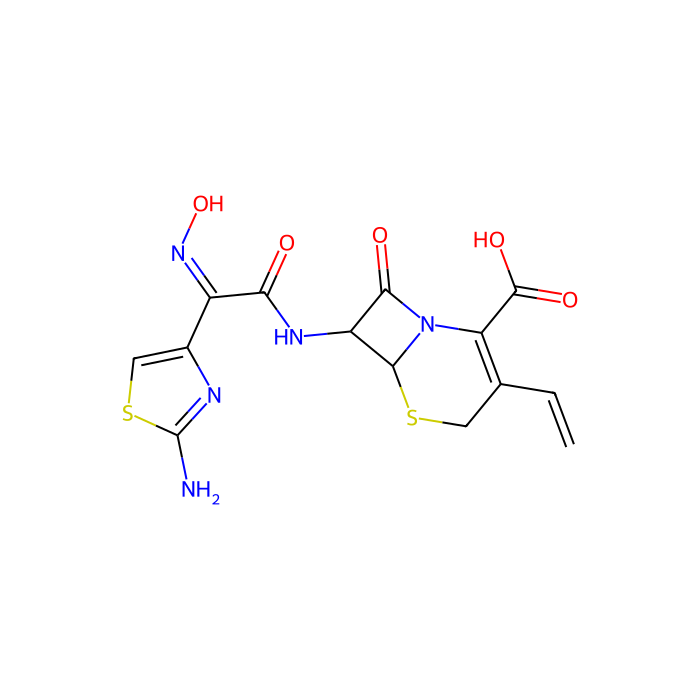
Cefdinir (FK 482, PD 134393, CI-983) is an oral cephalosporin antibiotic, used to treat bacterial infections in many different parts of the body.
In vitro
Cefdinir, a new oral 2-amino-5-thiazolyl cephalosporin, inhibits the luminol-amplified chemiluminescence (LACL) response of human neutrophils stimulated by PMA but not opsonized zymosan, in a concentration-dependent but not time-dependent manner. Cefdinir inhibits LACL generation in cell-free systems consisting of H2O2, NaI, and either horseradish peroxidase or amyeloperoxidase-containing neutrophil extract. Cefdinir impairs LACL response induced by the calcium ionophore A23187 and FMLP, and this impairment is increased in cytochalasin B-treated neutrophils. Cefdinir directly inhibits the activity of myeloperoxidase-containing neutrophil extract released into the extracellular medium during neutrophil stimulation by soluble mediators, but has no effect on that released into the phagolysosome during phagocytosis. Cefdinir demonstrates excellent activity against a wide range of gram-positive and gram-negative bacteria. Cefdinir is resistant to a broad variety of β-lactamases and exhibits a β-lactam stability profile generally better than those observed with cefaclor and cefuroxime. Cefdinir elimination is primarily mediated by the kidney. Cefdinir interacts with the dipeptide transporters PEPT1 and PEPT2. Cefdinir tubular reabsorption is substantial, that Cefdinir tubular secretion is inhibitable by probenecid, and that this secretion is probably mediated by the renal organic anion secretory pathway.
In vivo
Cell Data
cell lines:
Concentrations:
Incubation Time:
Powder Purity:≥99%
| x_specific_rotation | -65° (C=1,0.1mol/L pH7.0 phoshate Buffer) |
|---|---|
| x_melt_point_char | 190 °C(dec.) |
H315:Causes skin irritation
H319:Causes serious eye irritation
H335:May cause respiratory irritation
H317:May cause an allergic skin reaction
H334:May cause allergy or asthma symptoms or breathing difficulties if inhaled
P261:Avoid breathing dust/fume/gas/mist/vapors/spray.
P305+P351+P338:IF IN EYES: Rinse cautiously with water for several minutes. Remove contact lenses if present and easy to do - continue rinsing.
P280:Wear protective gloves/protective clothing/eye protection/face protection.
P302+P352:IF ON SKIN: wash with plenty of water.
P321:Specific treatment (see ... on this label).
P405:Store locked up.
P501:Dispose of contents/container to an approved waste disposal plant.
P264:Wash hands [and …] thoroughly after handling.
P284:[In case of inadequate ventilation] Wear respiratory protection.
P271:Use only outdoors or in a well-ventilated area.
P304+P340:IF INHALED: Remove person to fresh air and keep comfortable for breathing.
P403+P233:Store in a well-ventilated place. Keep container tightly closed.
P272:Contaminated work clothing should not be allowed out of the workplace.
P333+P313:IF SKIN irritation or rash occurs: Get medical advice/attention.
P362+P364:Take off contaminated clothing and wash it before reuse.
P264+P265:Wash hands [and …] thoroughly after handling. Do not touch eyes.
P337+P317:If eye irritation persists: Get medical help.
P332+P317:If skin irritation occurs: Get medical help.
P319:Get medical help if you feel unwell.
P342+P316:If experiencing respiratory symptoms: Get emergence medical help immediately.
Our grade selection guide covers purity, stabilizer status, and application suitability for all variants in our catalog.
View Moligand™ grade guide →