This compound belongs to the class of organic compounds known as indanediones. These are compounds containing an indane ring bearing two ketone groups.
External Descriptors
Not available
1. Djoumbou Feunang Y, Eisner R, Knox C, Chepelev L, Hastings J, Owen G, Fahy E, Steinbeck C, Subramanian S, Bolton E, Greiner R, and Wishart DS. ClassyFire: Automated Chemical Classification With A Comprehensive, Computable Taxonomy. Journal of Cheminformatics, 2016, 8:61.
Determine the necessary mass, volume, or concentration for preparing a solution.
Dilution Calculator
Determine the dilution needed to prepare a stock solution.
Reconstitution Calculator
Reviews
Customer Reviews
Application Protocols
No tested or validated application protocols (e.g., specific assay formats, recommended dilutions, or analytical methods) are provided for this item in the Product Data.
General laboratory guidance (literature/general):
Stock solution preparation: Dissolve chlorindione in DMSO to 10–50 mM. Vortex and, if needed, warm gently (<40 °C). Filter through 0.2 µm PTFE for sterile or particle‑free stocks.
Working solutions: Dilute stocks into buffer or medium immediately before use, keeping final DMSO ≤0.5–1% v/v to minimize effects on enzyme activity or assay readouts. Inspect for precipitation.
Storage of solutions: Aliquot stocks to minimize freeze–thaw; protect from light. Verify stability by LC/UV over your study time frame.
Controls: Include vehicle controls and, when appropriate, an orthogonal tool compound. Confirm results across independent assays.
For detailed, validated protocols tailored to your application, perform preliminary solubility/stability testing and consult the primary literature on indandione‑based tool compounds.
Biological Roles
Note: The following describes mechanistic/biochemical context only. This product is for research use only and is not for clinical or diagnostic use.
Vitamin K cycle interference (literature/general): Chlorindione belongs to the indandione class of vitamin K antagonists. Compounds in this class are used as tool molecules to probe the vitamin K epoxide/quinone reduction pathway catalyzed by vitamin K epoxide reductase (VKOR). Inhibition of VKOR decreases regeneration of reduced vitamin K, thereby suppressing γ‑glutamyl carboxylation in model systems.
Protein post‑translational modification studies: By limiting reduced vitamin K availability, chlorindione can be employed to modulate the enzymatic γ‑carboxylation of glutamate residues in in vitro assays, enabling investigation of cofactor dependence, enzyme kinetics, and structure–activity relationships.
ADME‑relevant traits (literature/general): The aromatic/halogenated scaffold implies moderate lipophilicity and potential plasma protein affinity in biochemical milieu; these features affect in vitro binding assays and partitioning in cell‑free systems. Such properties should be characterized empirically for a given assay format (e.g., nonspecific binding to plastics vs. serum proteins).
Off‑target considerations: Indandione scaffolds can interact with other redox or carbonyl‑binding proteins in biochemical panels. Orthogonal controls and counter‑screens are recommended in chemical biology experiments.
Always implement appropriate controls (vehicle, inactive analogs) and confirm findings with complementary methods.
Buffer Applications
Chlorindione is not a buffering agent and is not used to prepare pH buffer systems. For biochemical assays where chlorindione is evaluated as a tool compound:
Use standard biological buffers (e.g., HEPES, Tris, PBS) appropriate for the target enzyme or assay, and introduce chlorindione via a concentrated stock in DMSO or another compatible cosolvent.
Maintain a low final cosolvent concentration (commonly ≤0.5–1% v/v) to avoid perturbing buffer capacity or enzyme activity.
Verify solubility and absence of precipitation upon dilution into the chosen buffer; brief sonication and premixing with a small amount of ethanol can help if compatible with the assay.
For buffer recipes, pKa values, and capacity calculations, refer to the documentation of the chosen buffering agent; these parameters are not intrinsic to chlorindione.
Green Alternatives
This section is primarily relevant to solvents and high‑volume auxiliaries. Chlorindione is a research compound (solid) rather than a process solvent or reagent used in bulk quantities, so “green substitution” typically focuses on the solvent system chosen to dissolve or process it.
Greener handling strategies (literature/general):
Prefer bio‑based or low‑hazard solvents where solubility allows (e.g., ethanol or isopropanol instead of chlorinated solvents).
For bioassays, minimize DMSO content in aqueous buffers and evaluate ethanol as an alternative cosolvent when compatible with the biological system.
In chromatography, start with heptane/ethyl acetate or cyclopentyl methyl ether (CPME)/ethyl acetate gradients before resorting to dichloromethane.
Trade‑offs
Ethanol has a better EHS profile than DMF/DMSO but may offer lower solubility; ensure complete dissolution and assay compatibility.
CPME is a greener replacement for DCM in some separations, yet selectivity and recovery may differ; verify with small‑scale trials.
Conclusion
As a specialty solid, the principal opportunity to improve sustainability with chlorindione is solvent selection and minimization, not substitution of the molecule itself.
Pharmaceutical Uses
This product is supplied strictly for research use only and is not intended for human or veterinary use.
Tool/standard: Chlorindione has historically been studied within the vitamin K antagonist chemotype and may be employed as a reference standard in analytical methods, formulation screening, and stability studies related to indandione scaffolds.
Preformulation considerations: As a moderately hydrophobic aromatic diketone, chlorindione typically requires organic cosolvents for dissolution. Solubilization strategies for lab studies include DMSO or ethanol stocks, complexation with cyclodextrins, or incorporation into lipid/polymeric carriers for delivery in model systems.
Excipient compatibility (general): Evaluate interactions with amines (can catalyze enolization), strong bases, and reactive nucleophiles. Antioxidants and light protection may improve stability depending on matrix.
No pharmacopeial monograph or compendial excipient role is claimed in this listing. Any development‑oriented work should be confined to nonclinical laboratory experiments.
Physical Properties
Item-specific physicochemical specifications (BP, MP, density, UV cutoff, water/peroxide/metal limits, etc.): Not specified for this item; refer to CoA/Spec Sheet.
General/literature expectations for chlorindione and related 2‑aryl‑1,3‑indandiones (for informational context only):
Physical state: typically a crystalline solid; color can range off‑white to pale yellow depending on trace impurities and polymorph (literature/general).
Solubility profile (literature/general):
Sparingly soluble in water.
Soluble in polar aprotic organics (e.g., DMSO, DMF, acetone) and moderately soluble in lower alcohols (ethanol, methanol). Often handled as concentrated DMSO stock for bioassays.
Acid/base behavior (literature/general): 1,3‑diketone capable of keto–enol tautomerism; aryl substitution reduces but does not eliminate enol content; the ring carbonyls are weakly enolizable and support hydrogen bonding and metal chelation.
Partitioning (literature/general): aromatic/halogenated character suggests moderate hydrophobicity (logP > 1), facilitating membrane permeability in biochemical systems; exact logP not provided here.
Notes
Where precise numerical values are required for your method validation or safety assessment, please consult the item’s Certificate of Analysis (CoA) or Specification Sheet.
Quality and Grades
Grade/Purity for this specific item: Not specified for this item; refer to CoA/Spec Sheet.
Appearance for this specific item: Not specified for this item; refer to CoA/Spec Sheet.
How to interpret grades and documentation (general guidance):
If labeled as “research grade,” materials are intended for laboratory R&D and are not certified for clinical or food use. Analytical documentation (CoA) typically includes identity confirmation (e.g., NMR/IR/HPLC), purity by HPLC/GC, and loss on drying.
If an HPLC assay is provided, note that indandione chromophores absorb in the UV; HPLC grade solvents/reagents used for purity assessment minimize UV baseline noise.
Stabilizers: No stabilizer information is provided for this item. If a stabilizer is added to certain lots, it will be disclosed on the CoA/label. Absence of a stabilizer may increase sensitivity to light/heat; store accordingly at −20 °C as directed.
Batch-to-batch consistency: For structure‑specific research (e.g., enzymology of vitamin K cycle), verify lot identity by your in‑house method (1H NMR, HRMS) when critical.
Documentation to request/consult:
CoA and Spec Sheet: definitive source for purity, analytical methods, residual solvents, and any metals/halogen content if applicable.
SDS: definitive source for hazard classification and safe handling.
Reaction and Applications
Applications emphasized for this catalog item: Manufacturer applications were not provided; content below reflects general/literature uses of chlorindione in research chemistry.
Chemical biology tool compound (literature/general): Chlorindione is a member of the vitamin K antagonist class (indandiones), widely used as a reference inhibitor for studying the vitamin K cycle (e.g., enzymology of vitamin K epoxide reductase, VKOR) and post‑translational γ‑carboxylation of glutamate residues in model systems.
Coordination/chelation chemistry: The 1,3‑diketone motif can engage in keto–enol tautomerism and chelate certain metal ions in model complexes, enabling spectroscopic probes or crystallographic standards. Aryl substitution modulates acidity and binding.
Materials/dye chemistry (by analogy to indandione scaffolds): Although many dye syntheses employ unsubstituted 1,3‑indandione as a Michael donor/acceptor in push–pull chromophores, chlorindione’s para‑chloroaryl substituent tunes electron distribution and has been explored in structure–property studies of conjugated systems (literature/general). Suitability should be assessed case‑by‑case due to reduced reactivity at C‑2.
Analytics and standards: Serves as a small‑molecule reference in chromatographic and spectroscopic method development for indandione‑type chemotypes.
Practical notes
Sensitivity: Protect from strong base during handling to avoid undesired enolization‑induced side chemistry on the indandione core.
Purification: Normal‑phase silica with DCM/EtOAc or toluene/EtOAc gradients is commonly effective; monitor under UV due to strong chromophore.
Reaction Conditions
No item‑specific reaction condition data are provided for this catalog entry. The following general literature guidance may assist in planning transformations involving chlorindione or its aryl chloride motif:
Cross‑coupling at the para‑chloro aryl group (literature/general):
Suzuki–Miyaura: Pd(PtBu3)2 or Pd2(dba)3 with bulky electron‑rich phosphines; bases such as K3PO4 or Cs2CO3; solvents like toluene, dioxane, or CPME; 80–110 °C; 4–24 h.
Buchwald–Hartwig amination: Pd2(dba)3 or Pd(OAc)2 with BrettPhos or RuPhos ligands; NaOtBu or Cs2CO3; toluene/dioxane; 80–120 °C.
C–O/C–S coupling: Pd or Cu catalysis (e.g., CuI with diamine ligand) under basic conditions.
Note: The electron‑withdrawing indandione may modestly facilitate oxidative addition; confirm conditions experimentally.
Enolate/O‑alkylation on the 1,3‑diketone (literature/general):
Base: NaH, K2CO3, or t‑BuOK in THF/DMF to generate the enolate for O‑alkylation/acylation.
Temperature: 0–25 °C to control selectivity; protect from moisture and strong nucleophiles that may trigger decomposition.
Crystallization and purification:
Recrystallize from ethanol, acetone/hexanes, or EtOAc/hexanes; protect from light.
All parameters above are general literature starting points; optimize for your substrate and scale. Always consult primary literature and conduct small‑scale trials.
Safety and Handling
Safety designations specific to this catalog entry:
GHS classification, signal word, H‑statements, and pictograms: Not specified for this item; refer to the SDS for authoritative information.
Storage conditions (from Product Data): Store at −20 °C. Shipments are sent in an ice chest with ice pads to maintain a low‑temperature chain.
Research use: For research use only.
General handling guidance for indandione‑type aromatic diketones (literature/general; not a substitute for SDS):
Likely hazards: May cause irritation to skin, eyes, or respiratory tract upon contact or inhalation of dust. Avoid aerosolizing powders. Vitamin K antagonist chemotype warrants careful handling to avoid ingestion or exposure.
Engineering controls: Work in a fume hood or well‑ventilated area; minimize dust; use closed containers for weighing.
PPE: Lab coat, nitrile gloves, and splash goggles as minimum; upgrade PPE per risk assessment and SDS.
Incompatibilities: Strong bases (can induce enolate formation and side reactions), strong oxidizers, and strong reducing agents. Avoid prolonged exposure to light and heat which can promote degradation.
First aid (overview; defer to SDS):
Skin/eye contact: Rinse with water for at least 15 minutes; remove contaminated clothing; seek medical attention if irritation persists.
Inhalation: Move to fresh air; seek medical evaluation if symptoms develop.
Ingestion: Rinse mouth; do not induce vomiting; seek medical attention.
Waste: Collect organic solid waste and solvent rinses in appropriate, labeled containers per institutional and local regulations.
Solvent Selection
Chlorindione is a neutral aromatic 1,3‑diketone solid. Solvent choice is driven by the need to dissolve it efficiently for synthesis or biochemical assays while maintaining stability.
Polarity/miscibility (literature/general):
Water: very low solubility; aqueous work typically requires a cosolvent or surfactant system.
Polar aprotic: DMSO and DMF provide high solubility; acetone and acetonitrile offer moderate solubility.
Alcohols: ethanol/methanol give modest solubility and are convenient for recrystallization of related indandiones.
Nonpolar: limited solubility in alkanes; slightly better in chlorinated solvents (e.g., dichloromethane) due to aryl chloride and aromatic core.
Typical use scenarios
Bioassays: prepare concentrated DMSO stocks (e.g., 10–50 mM), then dilute into assay buffer to low micromolar with final DMSO kept minimal (≤0.5–1% v/v). Verify compatibility with the enzyme/cell‑free system.
Synthesis/purification: dissolve in acetone/ethyl acetate for chromatographic loading; DCM/EtOAc/hexanes gradients can separate impurities effectively. Recrystallization often feasible from ethanol or acetone/water mixtures.
When to choose alternatives
If DMSO interferes with your assay, DMF or acetonitrile may substitute. For greener profiles, consider ethanol where solubility permits.
Practical tips
Warm gently (≤40 °C) to aid dissolution; avoid prolonged heating or bright light.
Filter 0.2 µm to remove particulates before analytical injections. Validate solvent choice by small‑scale tests.
Storage and Reconstitution
Storage conditions (from Product Data): Store at −20 °C. Product ships in an ice chest with ice pads to maintain cold chain.
Appearance: Not specified for this item; refer to CoA/Spec Sheet.
Solid handling (general):
Keep container tightly closed under dry, inert conditions if possible. Protect from light and ambient moisture.
Allow the vial to equilibrate to room temperature in a desiccator before opening to reduce condensation.
Reconstitution (general/literature guidance):
Solvents: DMSO is recommended for concentrated stock solutions; ethanol or DMF may also be used depending on assay compatibility.
Typical stock concentrations: 10–50 mM (verify solubility empirically). Warm gently (<40 °C) and vortex to aid dissolution; do not overheat.
Filtration: If a particle‑free solution is required, filter through a 0.2 µm PTFE syringe filter.
Aliquoting: Divide stocks into single‑use aliquots to avoid repeated freeze–thaw cycles; store aliquots at −20 °C, protected from light.
Stability
Item‑specific stability data are not provided; refer to CoA/Spec Sheet and SDS. As a precaution, minimize exposure to heat, light, and strong base, and assess solution stability by periodic analytical checks (e.g., HPLC/UV).
Structure and Identity
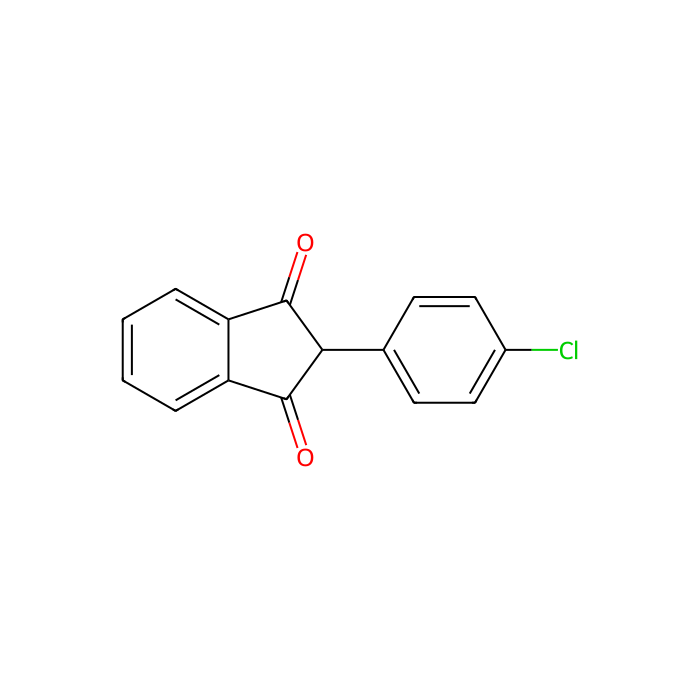
Brief description: Chlorindione is a 1,3‑indandione derivative bearing a para‑chlorophenyl substituent at the 2‑position; it belongs to the vitamin K antagonist chemotype (indanedione class) and is supplied for research use only.
Product identifiers (from Product Data)
SKU: C413309
Product name: Chlorindione
CAS: 1146-99-2
PubChem CID: 70846
InChIKey (as provided): 239914
SMILES: Not specified for this item; refer to CoA/Spec Sheet.
Molecular descriptors
Molecular formula: Not specified for this item; refer to CoA/Spec Sheet. (A literature description identifies chlorindione as a para‑chlorophenyl‑substituted 1,3‑indandione.)
Molecular weight: Not specified for this item; refer to CoA/Spec Sheet.
Structural features (general/literature description)
Core scaffold: bicyclic 1,3‑indandione (indane fused to a 1,3‑diketone) bearing two adjacent carbonyls at C‑1 and C‑3.
Substitution: a 4‑chlorophenyl group at C‑2 of the indandione ring system.
Functional groups: 1,3‑diketone capable of keto–enol tautomerism; aryl chloride (para‑chloro) on the pendant phenyl ring; polycyclic aromatic framework.
2D structure in words: a five‑membered ring with two carbonyls fused to a benzene ring (indandione), with the bridgehead carbon (C‑2) bonded to a para‑chlorophenyl ring. No stereocenters; planar/aromatic regions dominate.
Synthetic Utility
Chlorindione offers a 1,3‑indandione core appended with a para‑chlorophenyl group, providing a well‑defined chromophore and a platform for structure–activity or materials studies.
1,3‑Diketone functionality: Exhibits keto–enol tautomerism; under basic conditions the enolate can form and participate in O‑acylation/alkylation or coordinate to metals. The 2‑position is aryl‑substituted here, so classic Knoevenagel couplings at C‑2 are not applicable; however, O‑derivatization and metal complexation remain accessible.
Aryl chloride handle: Para‑chloro substituent can engage in metal‑catalyzed cross‑coupling (e.g., Buchwald–Hartwig amination, Suzuki–Miyaura) if oxidative addition to Ar–Cl is achieved with an appropriate catalyst system, enabling rapid access to 4‑substituted aryl variants tethered to the indandione.
Electrophilic aromatic substitution on the indandione ring: Halogenation and nitration of related indandione cores are reported; conditions must be tuned to avoid overreaction or decomposition.
Use cases
Preparation of libraries of VKOR‑pathway tool compounds via diversification of the para‑chloro aryl ring.
Generation of metal–ligand model complexes leveraging the 1,3‑diketone for spectroscopic benchmarking.
Purification/analysis tips
Strong UV absorption assists HPLC/UPLC monitoring. Silica gel chromatography with moderately polar eluents (DCM/EtOAc) generally provides good resolution.
Target Specificity
This section is typically applicable to biologics (e.g., antibodies) or target‑validated tool compounds with documented binding data provided by the supplier. For this listing, no target specificity, binding constants, or selectivity panels are provided in the Product Data.
General note (literature/context): Chlorindione is widely recognized in the literature as a vitamin K cycle antagonist scaffold used to probe VKOR activity in biochemical systems. However, this catalog entry does not include item‑specific affinity data, selectivity profiles, or validated targets. Please consult primary literature and perform in‑house assays to establish specificity in your system.
We use cookies to ensure the website functions properly and, where permitted, to improve your experience. You can manage your preferences at any time in Settings. Learn more in our Cookie Policy.
Shall we send you a message when we have discounts available?
Remind me later
Thank you! Please check your email inbox to confirm.
Products are supplied to verified businesses, institutions, and qualified professionals for research and development use only. Not for use in humans, animals, diagnosis, or therapy.

 G2303352