Determine the necessary mass, volume, or concentration for preparing a solution.
Taxonomy Tree
| Kingdom | Organic compounds |
|---|---|
| Superclass | Organoheterocyclic compounds |
| Class | Benzofurans |
| Subclass | Benzofuranones |
| Intermediate Tree Nodes | Not available |
| Direct Parent | Benzofuranones |
| Alternative Parents | Phthalides Benzoxathioles O-chlorophenols Chlorobenzenes 1-hydroxy-2-unsubstituted benzenoids Organosulfonic acid esters Aryl chlorides Oxacyclic compounds Organooxygen compounds Organochlorides Organic oxides Hydrocarbon derivatives |
| Molecular Framework | Aromatic heteropolycyclic compounds |
| Substituents | Benzofuranone - Phthalide - Benzoxathiole - 2-halophenol - 2-chlorophenol - 1-hydroxy-2-unsubstituted benzenoid - Chlorobenzene - Halobenzene - Phenol - Aryl chloride - Aryl halide - Monocyclic benzene moiety - Benzenoid - Organosulfonic acid ester - Organosulfonic acid or derivatives - Organic sulfonic acid or derivatives - Oxacycle - Organic oxygen compound - Hydrocarbon derivative - Organic oxide - Organohalogen compound - Organochloride - Organooxygen compound - Aromatic heteropolycyclic compound |
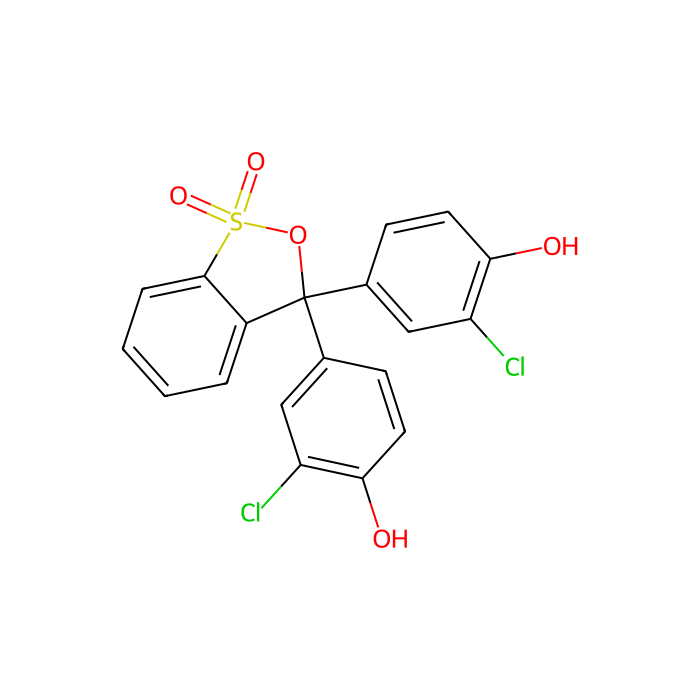
| Description | This compound belongs to the class of organic compounds known as benzofuranones. These are organic compounds containing a benzene ring fused to a furanone. |
| External Descriptors | Not available |
Find and download the COA for your product by matching the lot number on the packaging.
| Lot Number | Certificate Type | Date | Item |
|---|---|---|---|
| Certificate of Analysis | Mar 04, 2025 | C104980 | |
| Certificate of Analysis | Feb 28, 2025 | C104980 | |
| Certificate of Analysis | Feb 28, 2025 | C104980 | |
| Certificate of Analysis | Feb 28, 2025 | C104980 | |
| Certificate of Analysis | Feb 28, 2025 | C104980 | |
| Certificate of Analysis | Feb 28, 2025 | C104980 | |
| Certificate of Analysis | Feb 11, 2025 | C104980 | |
| Certificate of Analysis | Feb 11, 2025 | C104980 | |
| Certificate of Analysis | Aug 15, 2023 | C104980 | |
| Certificate of Analysis | Jul 18, 2023 | C104980 | |
| Certificate of Analysis | May 27, 2023 | C104980 | |
| Certificate of Analysis | May 27, 2023 | C104980 | |
| Certificate of Analysis | Feb 20, 2023 | C104980 | |
| Certificate of Analysis | Jun 21, 2022 | C104980 |
| Sensitivity | Moisture sensitive. |
|---|---|
| x_melt_point_char | 261-262°C |
| Molecular Weight | 423.300 g/mol |
| XLogP3 | 4.300 |
| Hydrogen Bond Donor Count | 2 |
| Hydrogen Bond Acceptor Count | 5 |
| Rotatable Bond Count | 2 |
| Exact Mass | 421.978 Da |
| Monoisotopic Mass | 421.978 Da |
| Topological Polar Surface Area | 92.200 Ų |
| Heavy Atom Count | 27 |
| Formal Charge | 0 |
| Complexity | 625.000 |
| Isotope Atom Count | 0 |
| Defined Atom Stereocenter Count | 0 |
| Undefined Atom Stereocenter Count | 0 |
| Defined Bond Stereocenter Count | 0 |
| Undefined Bond Stereocenter Count | 0 |
| The total count of all stereochemical bonds | 0 |
| Covalently-Bonded Unit Count | 1 |
No vendor-validated protocols were provided for this item. The following are general literature-style procedures for Chlorophenol red; optimize for your laboratory conditions.
Preparation of 0.04% indicator solution (literature example):
Spectrophotometric pH determination (ratiometric):
Immobilized pH sensor preparation (outline):
These are illustrative only; confirm compatibility with your assay components.
Chlorophenol red has no intrinsic biological role; it is a synthetic sulfonephthalein dye used as a pH indicator. The content below reflects research and analytical contexts (literature/general), not therapeutic use.
Note: No medical, diagnostic, or therapeutic claims are made. For cell culture media pH monitoring near neutrality, alternative indicators (e.g., Phenol Red, Bromothymol Blue) may be better matched to typical pH 7–7.5 conditions.
Chlorophenol red is widely used as a visual/spectrophotometric indicator in buffer systems spanning pH ~4.8–6.4 (literature). It is not a buffering agent itself but aids in pH adjustment and monitoring.
Practical guidance:
Note: Values here are literature guidance only and not specifications for this product.
For pH indication near weakly acidic to neutral conditions, Chlorophenol red is one option among several sulfonephthalein dyes. Greenness considerations revolve around solvent usage, dye loading, and persistence.
Comparison (general):
Waste minimization: Collect dye-containing aqueous waste separately for appropriate treatment to prevent coloration of effluents.
Chlorophenol red is not an excipient for therapeutic effect; in pharmaceutical and compendial contexts it serves as an analytical indicator.
Caveats:
No medical or clinical claims are made; usage is limited to research and analytical development settings.
Item-specific specs
Typical properties (literature, for context only; not product specifications)
Practical note: For analytical use, prepare fresh aqueous stocks by dissolving in a small volume of ethanol or by neutralizing with dilute NaOH, then diluting with water or buffer. Verify absorbance spectrum and apparent pKa under your exact conditions.
Item-specific grade
What “Indicator grade” implies (general guidance)
What is not specified for this item
Practical guidance
Primary role: Chlorophenol red is an acid–base indicator used for monitoring pH visually or spectrophotometrically in the mildly acidic to near-neutral region (literature transition range ~4.8–6.4, yellow → red).
Representative applications (literature/general):
Practical tips:
Note: No manufacturer application text was provided for this item; applications above are general literature use cases for this indicator class.
Because Chlorophenol red functions as an indicator, not a reactant, “reaction conditions” pertain to its analytical performance (literature/general):
Expected performance (general):
Note: No batch-specific performance data are provided for this item; consult the CoA for any available QC photometric criteria.
GHS status provided for this item
General laboratory safety (literature/good practice; defer to SDS for authority)
Always consult the product SDS for definitive hazard and handling information.
As a solid pH indicator dye, Chlorophenol red is not used as a reaction solvent. Solubility and vehicle choice matter for preparing indicator solutions.
Tip: Filter freshly prepared indicator solutions to remove undissolved particulates that can seed background turbidity and scattering in spectrophotometric measurements.
Item-specific storage
General guidance (literature/general)
Note: Specific shelf-life, stabilizers, water content, and exact solubility are not specified for this item; consult the CoA/Spec Sheet and SDS for authoritative information.
Item-specific identifiers (from Product Data)
Structural description (literature/general chemistry)
Note: SMILES and full InChIKey were not provided for this item; refer to the CoA/Spec Sheet for definitive structural strings.
Chlorophenol red is primarily a signaling molecule (pH indicator) rather than a synthetic building block. That said, several practical utilities in chemical workflows exist (literature/general):
Limitations:
Not applicable. Chlorophenol red is a small-molecule pH indicator and does not have biological targets, antigen specificity, clone, or isotype. For functional information, see the Reaction & Applications and Buffer Applications sections.
Our grade selection guide covers purity, stabilizer status, and application suitability for all variants in our catalog.
View Indicator grade guide →