GRADE & PURITYMoligand™?Moligand™ — Aladdin's line of ligands and bioactive small molecules. Use for receptor, pathway, and binding studies needing defined small-molecule tools.≥99%
Moligand™, ≥99% Moligand™ for sensitive chromatographic and analytical workflows requiring minimal baseline interference.
🌡
Storage & shipping
Store at 2-8°C Ships Wet ice Check lot-specific COA for exact specifications.
📋
Quality documents
SDS, COA, datasheet, and spec sheet available for download. Lot-specific COA accessible via lot number lookup.
📚
Literature proof
Cited in 0 peer-reviewed publications across chromatography, organic synthesis, and cross-coupling reactions.
Overview
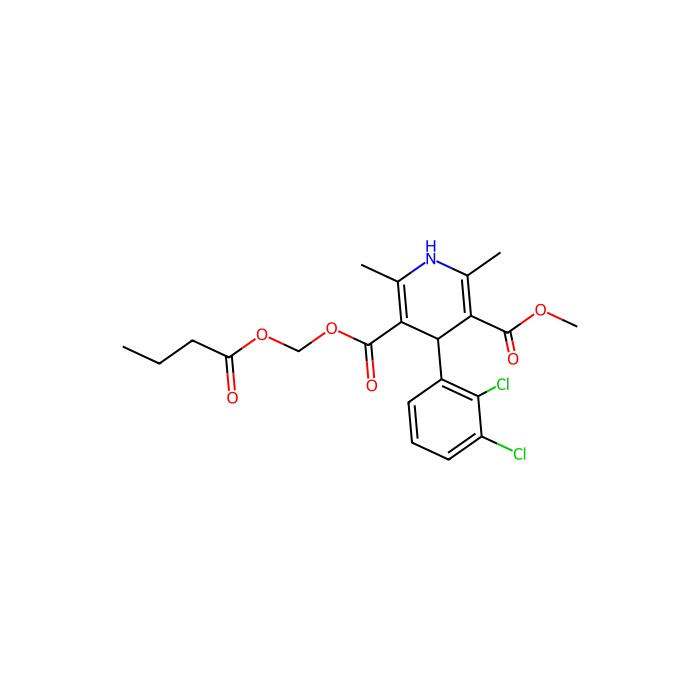
Clevidipine Butyrate is a dihydropyridine calcium channel blocker use as agent for the reduction of blood pressure. A calcium channel protein inhibitor and blocker
This compound belongs to the class of organic compounds known as dihydropyridinecarboxylic acids and derivatives. These are compounds containing a dihydropyridine moiety bearing a carboxylic acid group.
External Descriptors
Not available
1. Djoumbou Feunang Y, Eisner R, Knox C, Chepelev L, Hastings J, Owen G, Fahy E, Steinbeck C, Subramanian S, Bolton E, Greiner R, and Wishart DS. ClassyFire: Automated Chemical Classification With A Comprehensive, Computable Taxonomy. Journal of Cheminformatics, 2016, 8:61.
Determine the necessary mass, volume, or concentration for preparing a solution.
Dilution Calculator
Determine the dilution needed to prepare a stock solution.
Reconstitution Calculator
Reviews
Customer Reviews
Application Protocols
No tested application protocols, assay formats, or recommended dilutions are provided for this item. As general guidance for small, lipophilic, light-sensitive ligands:
Prepare concentrated stocks in a suitable organic solvent (see Solvent Selection) under low light; make single-use aliquots.
Immediately before experiments, dilute into assay medium with vigorous mixing to avoid precipitation; consider carrier systems (e.g., serum proteins, cyclodextrins, or emulsions) when compatible with your model.
Verify concentration and integrity by analytical HPLC before and after key experiments to account for hydrolysis/oxidation.
For detailed, protocol-specific parameters (concentrations, incubation times, controls), design and validate within your laboratory and consult peer-reviewed literature relevant to your biological system.
Biological Roles
Mechanistic class (literature/general): Cleviprex (clevidipine butyrate) is a 1,4-dihydropyridine that functions as a calcium channel ligand with high affinity for L-type channels. As with other DHPs, it binds to a transmembrane site within the channel’s alpha subunit.
Biophysical characteristics (literature/general)
High lipophilicity promotes membrane partitioning.
The diester DHP is susceptible to metabolic and chemical hydrolysis, yielding inactive acid/alcohol metabolites; this confers short-lived activity in biological systems.
Research utility
Probe for calcium-dependent signaling, excitation–contraction coupling in smooth muscle, and channel state-dependence studies in membranes or cells.
Useful in comparative SAR investigations across DHP analogs due to its distinctive ester substituents.
No biological role or activity specifications are provided for this specific item beyond “For research use only.” Users should design and validate assays appropriate for their biological system and follow institutional policies for handling bioactive small molecules.
Buffer Applications
This product is not a buffering reagent and is not typically used to prepare biochemical buffers. If used in biological experiments, it is generally dissolved in an organic co-solvent and then diluted into an assay buffer immediately before use. For applicable guidance, see the Solvent Selection and Reaction & Applications sections.
Green Alternatives
While Cleviprex itself is a target molecule rather than a solvent, greener choices can be made in its handling and synthesis (literature/general guidance).
Greener handling/formulation options
Prefer ethanol or 2-propanol over chlorinated solvents for intermediate concentrates when assay-compatible.
For aqueous delivery, consider cyclodextrin inclusion complexes or biogenic lipid emulsions prepared with ethanol-assisted methods to minimize aggressive solvents.
Hantzsch-type condensations can be run in ethanol/water or solvent-free under microwave heating with organocatalysts, reducing reliance on toluene/DMF and metal catalysts.
Photo-oxidation risks can be mitigated with LED lighting controls instead of mercury lamps during photochemical steps.
Comparative overview
Conventional approach: chlorinated or aromatic solvents; larger solvent volumes for workup.
Greener approach: aqueous ethanol systems, solvent recycling, and crystallization/anti-solvent precipitation to reduce chromatographic waste.
Trade-offs: greener solvents may affect yield, polymorph/form, or impurity profiles; perform risk–benefit assessments and pilot trials before scale-up.
Item-specific process details are not provided; consult your route’s development history and align with green chemistry metrics (E-factor, PMI).
Pharmaceutical Uses
No clinical or therapeutic claims are made for this research-grade material.
Research/formulation context (literature/general)
Employed as a reference standard or development API in formulation studies focusing on lipid emulsions and nanoemulsions for highly lipophilic, light-sensitive DHP compounds.
Used in method development and validation for stability-indicating assays (monitoring hydrolysis/oxidation pathways) in preformulation research.
Regulatory status (item-specific)
Grade/Purity: Moligand™; not a pharmacopeial, GMP, or clinical grade.
Practical notes
When exploring delivery systems (e.g., emulsions, cyclodextrin complexes), document excipients, droplet size, zeta potential, and photoprotection strategies.
Establish robust, stability-indicating analytical methods (e.g., RP-HPLC with photodiode array and MS, peroxide/UV stress studies) suitable for your development stage.
Any use in manufacturing or clinical settings requires separately sourced, appropriately qualified material. This catalog item is for research use only.
Physical Properties
Only limited item-specific properties are provided for this catalog entry.
Appearance: Not specified for this item; refer to CoA/Spec Sheet.
Molecular weight: Not specified for this item; refer to CoA/Spec Sheet.
Solubility (literature/general):
Expected to be practically insoluble in water due to high lipophilicity (DHP diesters).
Soluble in polar aprotic organic solvents (e.g., DMSO, DMF) and lower alcohols (ethanol) for stock solutions in bioassays.
Incorporation into lipid emulsions or cyclodextrin complexes is commonly used for aqueous delivery in research formulations.
Partitioning (literature/general): high logP typical for DHP diesters; promotes membrane affinity and poor aqueous solubility.
Stability considerations (literature/general):
Esterase-labile; base- and acid-catalyzed hydrolysis occurs in aqueous media—avoid prolonged exposure to water, high pH, or strong acids.
Light sensitive (DHP chromophore): protect from light; photo-oxidation can convert the DHP to the corresponding pyridine.
Air/oxidant sensitivity: DHPs can undergo oxidation; store under inert headspace when feasible.
No item-specific values for melting point, boiling point, density, refractive index, pKa, logP, or UV cutoff are provided. For method-specific or regulatory testing, refer to the item’s CoA/Spec Sheet.
Quality and Grades
Supplied grade: Moligand™ (from Product Data)
Description: Moligand™ denotes inclusion in a curated small-molecule/compound library suitable for ligand screening and discovery workflows in research laboratories. It is not a pharmacopeial, clinical, or GMP grade. No medical use is intended or implied. Specifications focus on identity and suitability for research assays rather than regulated manufacturing.
Purity: Not specified for this item; refer to CoA/Spec Sheet.
What this means for your work
Identity/traceability: Supported by catalog identifiers (CAS, CID) and lot-level CoA. Use CoA for exact analytical methods employed (e.g., HPLC area %, NMR confirmation) when provided.
UV background: Not specified for this item; if using in optical assays, empirically check baseline absorbance/fluorescence of your formulation.
Stabilizers/additives: Not specified for this item; refer to CoA/Spec Sheet. If none are present, users should protect from light/oxidants to preserve the DHP integrity.
Documentation
For regulated studies, obtain lot-specific CoA/SDS from Aladdin Scientific. If additional documentation (impurity profiles, residual solvents) is required, contact Technical Support prior to purchase to confirm availability.
Reaction and Applications
This compound is primarily a bioactive research ligand rather than a synthetic reagent. Typical research applications focus on its interaction with voltage-gated calcium channels and on formulation science.
Research use cases (literature/general)
Tool compound in studies of L-type Ca2+ channel pharmacology in membrane preparations, isolated tissues, and cell-based assays.
Model substrate for esterase-mediated hydrolysis kinetics due to its ester-labile DHP framework.
Formulation development studies, including lipid emulsion and nanoemulsion systems designed to solubilize highly lipophilic, light-sensitive actives.
Assay considerations
Light sensitivity: conduct potency/stability assays under reduced light; verify integrity by HPLC before/after experiments.
Hydrolysis: control pH and minimize aqueous exposure time; include quench steps for kinetic sampling.
Analytical support (literature/general)
Quantitation by reverse-phase HPLC/UPLC with UV detection near the DHP absorbance band; MS detection provides selectivity and enables monitoring of hydrolysis products (acid/alcohol) and oxidized pyridine.
No manufacturer-provided functional application notes are listed for this item; adapt general DHP-ligand handling to your specific protocol.
Reaction Conditions
No manufacturer-recommended reaction conditions are provided for this product as it is principally a research ligand, not a reagent. The following literature/general guidance addresses stability and common transformations for analytical control:
Hydrolysis (to generate degradation standards)
Base-catalyzed: dilute NaOH or carbonate in aqueous alcohol at ambient to mildly elevated temperature; monitor by RP-HPLC until desired conversion.
Acid-catalyzed: dilute HCl or acetate buffer (acidic) in aqueous alcohol; avoid strong mineral acids that may promote side reactions.
Enzymatic: porcine liver esterase or other carboxylesterases in buffered media for biologically relevant degradation.
Oxidation
Manganese dioxide or photochemical oxygenation to convert DHP to pyridine; perform under controlled, low-light conditions and quench appropriately.
Photostability testing
Expose solutions/solids to defined light doses; compare to dark controls using stability-indicating HPLC/UPLC with MS for impurity tracking.
Solvents
DMSO, ethanol, or acetonitrile are common vehicles for stock solutions; aqueous exposure minimized to limit hydrolysis.
Always validate and document conditions for your lab’s purpose; yields and rates vary with concentration, solvent, pH, and temperature.
Safety and Handling
GHS/SDS information (item-specific)
Signal Word: Not specified for this item; refer to SDS.
H-Statements: Not specified for this item; refer to SDS.
GHS Classification/Pictograms: Not specified for this item; refer to SDS.
General hazards and precautions (literature/general for DHP esters)
Avoid inhalation, ingestion, and skin/eye contact. Use in a chemical fume hood.
Protect from light and oxidants; DHPs can photo-oxidize to pyridines.
Hydrolysis can generate alcohols and acids; avoid strong acids/bases and prolonged contact with aqueous solutions.
PPE and engineering controls
Wear lab coat, safety glasses, and appropriate chemical-resistant gloves (e.g., nitrile). Handle powder/stock solutions with caution; minimize aerosol/splash risk.
Employ amber glassware/vials and minimize headspace oxygen where feasible.
First aid (overview; defer to SDS)
Skin/eye contact: Rinse with water for ≥15 min; remove contaminated clothing; seek medical attention if irritation persists.
Inhalation: Move to fresh air; seek medical attention if symptoms occur.
Ingestion: Rinse mouth; do not induce vomiting; seek medical attention.
Preferred stock solvents: DMSO, DMF, or ethanol, prepared under low-light conditions. Filter through PTFE if particulates remain.
Aqueous use: Avoid neat aqueous buffers. For biological assays, dilute organics into buffer immediately before use, or employ carriers (lipid emulsions, cyclodextrins, or micelles) formulated under controlled conditions.
Miscibility and polarity considerations
Water: negligible solubility expected.
Alcohols: good solubility; ethanol/isopropanol suitable for intermediate concentrates.
Nonpolar: soluble in chlorinated and aromatic solvents for synthetic/manufacturing research.
Comparison to alternatives (literature/general)
Versus less lipophilic DHPs: Clevidipine may require higher proportions of co-solvent or carrier systems.
Versus salts: No stable salt form is typical for neutral DHP diesters; solubilization relies on organic solvent or encapsulation strategies.
Handling tips
Prepare small, single-use aliquots to limit freeze–thaw and moisture uptake.
Use amber containers; minimize residence time in aqueous media to reduce hydrolysis.
Item-specific solvent specifications are not provided; confirm compatibility with your assay matrix experimentally.
Storage and Reconstitution
Storage (from Product Data)
Store at 2–8°C.
Shipped on wet ice.
Light and atmosphere
Protect from light (amber vials, foil wrap) to mitigate DHP photo-oxidation.
Keep containers tightly closed; consider inert gas headspace for long-term integrity.
Reconstitution/stock preparation
Item-specific reconstitution solvent, concentration, and stabilizers: Not specified for this item; refer to CoA/Spec Sheet.
General guidance (literature/general): dissolve in a dry, oxygen-reduced organic solvent (e.g., DMSO or ethanol) under low light; filter if needed through PTFE; prepare small aliquots to minimize freeze–thaw cycles.
Stability notes (literature/general)
Avoid prolonged exposure to aqueous environments or extreme pH to limit ester hydrolysis.
Monitor for discoloration or precipitation; confirm by HPLC if material has been stored for extended periods.
Follow the SDS and any lot-specific instructions on the CoA for definitive storage and handling directives.
Structure and Identity
Cleviprex (clevidipine butyrate; literature) is a 1,4-dihydropyridine (DHP) ester used as a small-molecule research ligand. This item is supplied for research use only.
Item identifiers (from Product Data)
SKU: C125754
CAS: 167221-71-8
PubChem CID: 153994
InChIKey: Not specified for this item; refer to CoA/Spec Sheet.
SMILES: Not specified for this item; refer to CoA/Spec Sheet.
Composition fields
Molecular formula: Not specified for this item; refer to CoA/Spec Sheet.
Molecular weight: Not specified for this item; refer to CoA/Spec Sheet.
Structural features (literature/general)
Core scaffold: 1,4-dihydropyridine ring bearing two ester substituents (including a butyrate ester) and lipophilic aryl substituent(s).
Functional groups: secondary amine-like N–H within the DHP ring (non-basic), two carboxylate esters, aryl chloride(s) may be present depending on substitution pattern (literature for clevidipine).
Stereochemistry: one stereogenic center at the 4-position of the DHP (typically supplied as racemate in research context; literature).
2D description in words: a six-membered 1,4-dihydropyridine with C3/C5 ester substituents and a C4 substituted benzylic-like center bearing an aryl group and an alkyl-oxycarbonyl; overall highly lipophilic and ester-labile.
Note: Exact structural string identifiers (SMILES/InChIKey) and elemental analysis are not specified for this catalog item; consult the CoA/SDS for definitive identity data.
Synthetic Utility
As supplied, this compound is typically a final bioactive target rather than a synthetic building block. However, understanding its functional groups aids in modification and analytical derivatization (literature/general):
Functional groups and reactivity
1,4-Dihydropyridine ring: prone to oxidation to the corresponding pyridine (e.g., MnO2 or photo-oxidation). UV-sensitive.
Diester motif: susceptible to base-/acid-catalyzed and enzymatic hydrolysis to acid/alcohol derivatives; enables prodrug-like behavior.
Benzylic-like stereocenter at C4: potential site for racemization under harsh conditions; typically handled under mild, non-basic conditions to preserve enantiomeric integrity when relevant.
Transformations useful in method development
Hydrolysis to generate reference degradation products for stability-indicating methods.
Oxidation to the pyridine analog as an impurity marker.
Derivatization of acid/alcohol metabolites for GC or LC–MS sensitivity (e.g., silylation or esterification of hydrolysis products).
Retrosynthetic note
DHP core accessible via Hantzsch condensation of a β-ketoester, an aldehyde, and an amine/ammonia equivalent; late-stage esterification introduces the butyrate ester (route-specific).
No item-specific synthetic route or impurity profile is provided; consult literature procedures and develop route controls as needed.
Target Specificity
No item-specific target, clone, isotype, or epitope data are provided for this product. This is a small-molecule research ligand rather than an antibody or protein. If target engagement studies are planned, determine specificity empirically (e.g., radioligand displacement, electrophysiology, or binding assays) and consult the literature for dihydropyridine-class ligand interactions with L-type calcium channels.
Frequently Asked Questions
What is the purity of this product?
This product is supplied at ≥99% purity (chemical assay). Lot-specific values are stated on the Certificate of Analysis.
What is Moligand??
Moligand? is one of Aladdin Scientific's premium product lines, formulated for high-purity applications across multiple workflows. Compared to standard grades in the same workflow, Moligand? products typically offer tighter specifications, more rigorous QC, and stronger lot-to-lot consistency.
How should this product be stored?
Store at 2–8 °C. Refrigerated storage is required to maintain the specified shelf life.
How is this product shipped?
This product ships chilled on wet ice. Unpack on arrival and transfer it to the storage condition stated above.
What are the CAS number, molecular formula and molecular weight?
The CAS Number is 167221-71-8, the molecular formula is C21H23Cl2NO6, and the molecular weight is 456.32 g/mol. InChIKey KPBZROQVTHLCDU-UHFFFAOYSA-N.
What documentation is provided?
Available product documentation, including Certificates of Analysis (COA), Safety Data Sheets (SDS), and specification sheets, is shown in the product document area. Document availability and access follow the current site policy.
Need help choosing the grade?
Our grade selection guide covers purity, stabilizer status, and application suitability for all variants in our catalog.
We use cookies to ensure the website functions properly and, where permitted, to improve your experience. You can manage your preferences at any time in Settings. Learn more in our Cookie Policy.
Shall we send you a message when we have discounts available?
Remind me later
Thank you! Please check your email inbox to confirm.
Products are supplied to verified businesses, institutions, and qualified professionals for research and development use only. Not for use in humans, animals, diagnosis, or therapy.

 B1525009