Concanavalin A lectin (Con A) - ≥90% , CAS No.11028-71-0

CAS: 11028-71-0 Cat. No.: C491285 EC Number: 234-258-2
AVAILABLE TO ORDER
GRADE & PURITY ≥90%
Synonyms
Concanavalin A
Storage
Store at -20°C
Shipped In
Ice chest + Ice pads
★
Size
Germany (EU)
USA*
Price
Qty
25mg
C491285-25mg
—
In stock ≥10
€60.65
100mg
C491285-100mg
—
3 In stock
€166.52
250mg
C491285-250mg
—
1 In stock
€312.30
1g
C491285-1g
—
1 In stock
€1,041.20
Enter a quantity for the sizes you want to add.

Overview

Concanavalin A (Con A) lectin is isolated from Jack beans (Canavalia ensiformis) and purified by affinity chromatography. The molecular weight of the lectin is 104 kDa. It has broad applicability and is the most widely used lectin within molecular biology research. Con A binds specifically to α-Mannose, α-Galactose structures found in sugars, glycoproteins and glycolipids . The lectin has been utilized in hormone receptor studies, mitogenic assays and for characterizing normal and malignant cells (cancer cells are readily aggregated by Con A while normal cells are not). Con A can also initiate cell division (mitogenesis) principally acting on T-lymphocytes . Immobilized Con A has been used in affinity chromatography purifications of a wide variety of glycoproteins and cellular structures. Polyacrylamide gel electrophoresis in SDS of Con A from Jack beans yields three major bands corresponding to molecular weights 27, 13 and 10 kDa. One minor band is visible at 18 kDa. Medicago’s Con A is supplied as a white lyophilized powder from a buffer containing 0.5 mM MnCl2, 0.5 mM CaCl2, no preservatives are added. The identity is determined by SDS-PAGE (Figure 1) and the protein content by spectrophotometry (Figure 2). The lectin is available in vials containing 250 mg or 100 mg lyophilized powder and the product is to be used for laboratory work only.

Specifications

Synonyms
Concanavalin A
Specifications & Purity
≥90%
Biochemical and Physiological Mechanisms
Con A is not blood group specific but has an affinity for terminal α-D-mannosyl and α-D-glucosyl residues. Ca2+ and Mn2+ ions are required for activity. Con A dissociates into dimers at pH 5.6 or below. Between pH 5.8 and pH 7.0, Con A exists as a tetramer; above pH 7.0 higher aggregates are formed. Con A exhibits mitogenic activity which is dependent on its degree of aggregation. Succinylation results in an active dimeric form which remains a dimer above pH 5.6.
Storage
Store at -20°C
Shipped In
Ice chest + Ice pads
This product requires cold chain shipping. Ground and other economy services are not available.
Purity
≥90%
Names and Identifiers
Pubchem Sid
SMILES
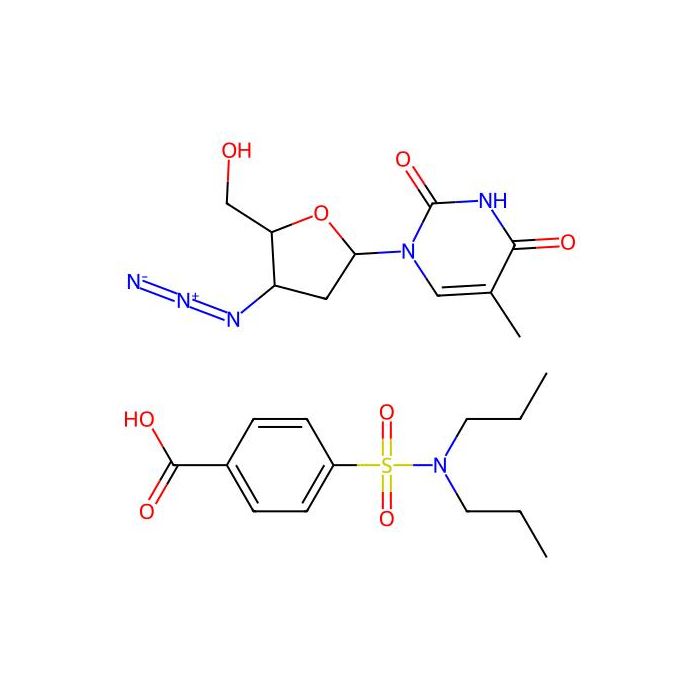
CCCN(CCC)S(=O)(=O)C1=CC=C(C=C1)C(=O)O.CC1=CN(C(=O)NC1=O)C2CC(C(O2)CO)N=[N+]=[N-]
IUPAC Name
1-[4-azido-5-(hydroxymethyl)oxolan-2-yl]-5-methylpyrimidine-2,4-dione;4-(dipropylsulfamoyl)benzoic acid
InChIKey
RVSZVJZFCQZYHQ-UHFFFAOYSA-N
InChI
1S/C13H19NO4S.C10H13N5O4/c1-3-9-14(10-4-2)19(17,18)12-7-5-11(6-8-12)13(15)16;1-5-3-15(10(18)12-9(5)17)8-2-6(13-14-11)7(4-16)19-8/h5-8H,3-4,9-10H2,1-2H3,(H,15,16);3,6-8,16H,2,4H2,1H3,(H,12,17,18)
Isomeric SMILES
CCCN(CCC)S(=O)(=O)C1=CC=C(C=C1)C(=O)O.CC1=CN(C(=O)NC1=O)C2CC(C(O2)CO)N=[N+]=[N-]
WGK Germany
3
RTECS
GK6890000
Reaxys
39344595
Reaxys-RN_link_address
https://www.reaxys.com/reaxys/secured/hopinto.do?context=S&query=IDE.XRN=39344595&ln=

Advanced Data

Taxonomic Classification

Taxonomy Tree

KingdomOrganic compounds
SuperclassNucleosides, nucleotides, and analogues
ClassPyrimidine nucleosides
SubclassPyrimidine 2',3'-dideoxyribonucleosides
Intermediate Tree Nodes Not available
Direct ParentPyrimidine 2',3'-dideoxyribonucleosides
Alternative Parents Benzenesulfonamides  Benzoic acids  Benzenesulfonyl compounds  Benzoyl derivatives  Pyrimidones  Organosulfonamides  Hydropyrimidines  Vinylogous amides  Tetrahydrofurans  Heteroaromatic compounds  Aminosulfonyl compounds  Ureas  Lactams  Azo imides  Azo compounds  Oxacyclic compounds  Monocarboxylic acids and derivatives  Carboxylic acids  Azacyclic compounds  Primary alcohols  Organopnictogen compounds  Organic oxides  Hydrocarbon derivatives  
Molecular FrameworkNot available
Substituents Pyrimidine 2',3'-dideoxyribonucleoside - Benzenesulfonamide - Benzenesulfonyl group - Benzoic acid - Benzoic acid or derivatives - Benzoyl - Pyrimidone - Benzenoid - Organosulfonic acid amide - Pyrimidine - Hydropyrimidine - Monocyclic benzene moiety - Heteroaromatic compound - Vinylogous amide - Aminosulfonyl compound - Tetrahydrofuran - Sulfonyl - Organosulfonic acid or derivatives - Organic sulfonic acid or derivatives - Urea - Lactam - Azo imide - Azo compound - Oxacycle - Azacycle - Organoheterocyclic compound - Monocarboxylic acid or derivatives - Carboxylic acid - Carboxylic acid derivative - Organic nitrogen compound - Organic oxygen compound - Organopnictogen compound - Organic oxide - Hydrocarbon derivative - Primary alcohol - Organosulfur compound - Organooxygen compound - Organonitrogen compound - Alcohol - Aromatic heteromonocyclic compound
DescriptionThis compound belongs to the class of organic compounds known as pyrimidine 2',3'-dideoxyribonucleosides. These are compounds consisting of a pyrimidine linked to a ribose which lacks a hydroxyl group at positions 2 and 3.
External Descriptors Not available
3D Structure
Interactive Chemical Structure Model


Certificates (CoA,COO,BSE/TSE and Analysis Chart)
C of A & Other Certificates(BSE/TSE, COO):
Analytical Chart:

Find and download the COA for your product by matching the lot number on the packaging.

28 results found

Lot NumberCertificate TypeDateItem
B2625485B2625485Certificate of AnalysisFeb 06, 2026 C491285
B2625486B2625486Certificate of AnalysisFeb 06, 2026 C491285
B2625487B2625487Certificate of AnalysisFeb 06, 2026 C491285
B2625488B2625488Certificate of AnalysisFeb 06, 2026 C491285
L2508112L2508112Certificate of AnalysisJul 02, 2025 C491285
G2507331G2507331Certificate of AnalysisJul 02, 2025 C491285
G2507330G2507330Certificate of AnalysisJul 02, 2025 C491285
G2507329G2507329Certificate of AnalysisJul 02, 2025 C491285
G2507328G2507328Certificate of AnalysisJul 02, 2025 C491285
H2405523H2405523Certificate of AnalysisJul 24, 2024 C491285
H2405518H2405518Certificate of AnalysisJul 24, 2024 C491285
H2405517H2405517Certificate of AnalysisJul 24, 2024 C491285
H2405516H2405516Certificate of AnalysisJul 24, 2024 C491285
D2425282D2425282Certificate of AnalysisApr 12, 2024 C491285
D2425283D2425283Certificate of AnalysisApr 12, 2024 C491285
D2425281D2425281Certificate of AnalysisApr 12, 2024 C491285
D2425159D2425159Certificate of AnalysisApr 12, 2024 C491285
D2425157D2425157Certificate of AnalysisApr 12, 2024 C491285
D2425155D2425155Certificate of AnalysisApr 12, 2024 C491285
D2425153D2425153Certificate of AnalysisApr 12, 2024 C491285
B2317545B2317545Certificate of AnalysisFeb 23, 2023 C491285
H2223243H2223243Certificate of AnalysisAug 31, 2022 C491285
H2223242H2223242Certificate of AnalysisAug 31, 2022 C491285
H2223241H2223241Certificate of AnalysisAug 31, 2022 C491285
H2223240H2223240Certificate of AnalysisAug 31, 2022 C491285
G2319036G2319036Certificate of AnalysisAug 31, 2022 C491285
J2326075J2326075Certificate of AnalysisAug 31, 2022 C491285
E2311180E2311180Certificate of AnalysisAug 31, 2022 C491285
Chemical and Physical Properties
SolubilitySoluble in water(slightly hazy), and PBS (5 mg/mL, slightly hazy).
SensitivityMoisture sensitive
Molecular Weight552.6
XLogP3
Hydrogen Bond Donor Count3
Hydrogen Bond Acceptor Count11
Rotatable Bond Count10
Exact Mass552.2 Da
Monoisotopic Mass552.2 Da
Topological Polar Surface Area176.000 Ų
Heavy Atom Count38
Formal Charge0
Complexity858.000
Isotope Atom Count0
Defined Atom Stereocenter Count0
Undefined Atom Stereocenter Count3
Defined Bond Stereocenter Count0
Undefined Bond Stereocenter Count0
The total count of all stereochemical bonds0
Covalently-Bonded Unit Count2
Safety and Hazards(GHS)
x_symbol
x_signal_word
Danger
x_hazard_statements

H317:May cause an allergic skin reaction

H334:May cause allergy or asthma symptoms or breathing difficulties if inhaled

H361:Suspected of damaging fertility or the unborn child

x_precautionary_statements

P261:Avoid breathing dust/fume/gas/mist/vapors/spray.

P272:Contaminated work clothing should not be allowed out of the workplace.

P280:Wear protective gloves/protective clothing/eye protection/face protection.

P284:[In case of inadequate ventilation] Wear respiratory protection.

P321:Specific treatment (see ... on this label).

P302+P352:IF ON SKIN: wash with plenty of water.

P304+P340:IF INHALED: Remove person to fresh air and keep comfortable for breathing.

P333+P313:IF SKIN irritation or rash occurs: Get medical advice/attention.

P362+P364:Take off contaminated clothing and wash it before reuse.

P405:Store locked up.

P501:Dispose of contents/container to an approved waste disposal plant.

P203:Obtain, read and follow all safety instructions before use.

P318:if exposed or concerned, get medical advice.

P342+P316:If experiencing respiratory symptoms: Get emergence medical help immediately.

x_wgk_germany
3
x_rtecs
GK6890000
x_reaxy_rn
39344595
x_reaxys_rn_link_address
https://www.reaxys.com/reaxys/secured/hopinto.do?context=S&query=IDE.XRN=39344595&ln=
FAQs and Articles
Cytokines and Inflammation
Autophagy Inducers
Lectins: A Bridge Between Glycobiology Research and Diagnostic Biomarkers
Methodological Applications of Lectins in Glycoprotein Detection: Histochemistry, ELISA, and Western Blot
Methods for Establishing and Evaluating Animal Models of Acute Liver Injury
Construction and Evaluation of Hepatic Fibrosis Animal Models: Toxic Injury, Cholestasis, Immune Inflammation, and Metabolism-Related Models
Induced Animal Models of Immune-Inflammatory Diseases: Pathogenesis, Modeling Systems, and Model Selection
Citations of This Product
Solution Calculators
Reviews

Customer Reviews

Shall we send you a message when we have discounts available?

Remind me later

Thank you! Please check your email inbox to confirm.

Oops! Notifications are disabled.