GRADE & PURITYAnhydrous Grade?Anhydrous grade — water removed and packaged dry for moisture-sensitive chemistry. Use in reactions where even trace water would interfere or quench.≥99%stabilized with 100 ppm BHT
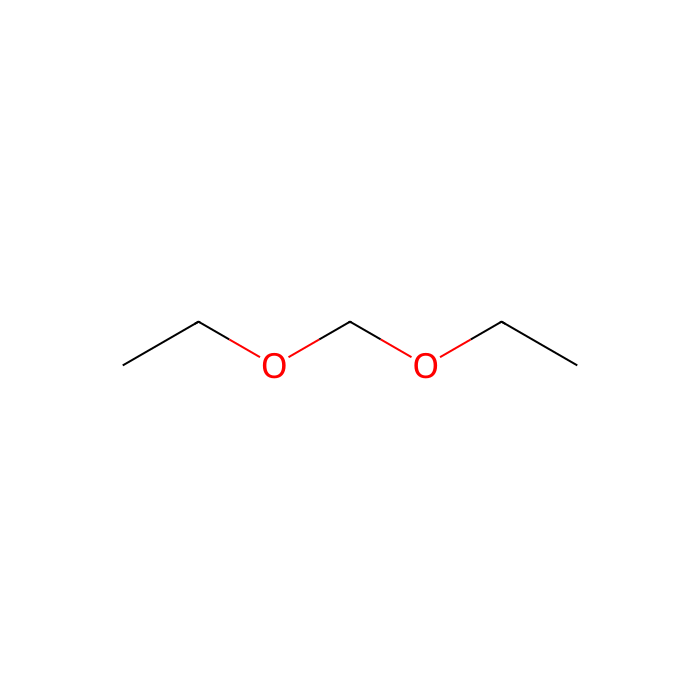
Formaldehyde diethyl acetal (FDEA, diethoxymethane, DEM) is a diethyl acetal. It has been synthesized from ethanol and aqueous formaldehyde. It is a low boiling solvent useful for sodium hydride reactions, organolithium chemistry, copper-catalyzed conjugate additions and phase-transfer reactions. It is a potential alternate for tetrahydrofuran, dichloromethane, glyme and methylal. DEM is an ethoxymethylating agent, a formaldehyde equivalent and a carbonylation substrate. Its condensation with 2-propylresorcinol to form resorcin[n]arenes (n=4–7) has been investigated. The IR and Raman spectra and conformations of DEM have been studied. NMR spectroscopy has been used to study the aggregation behavior of organolithium compounds in diethoxymethane. Unimolecular metastable decomposition of DEM upon electron impact has been studied. Solubility of non-polar gases in DEM has been evaluated.
This compound belongs to the class of organic compounds known as acetals. These are compounds having the structure R2C(OR')2 ( R' not Hydrogen) and thus diethers of geminal diols. Originally, the term was confined to derivatives of aldehydes (one R = H), but it now applies equally to derivatives of ketones (neither R = H ). Mixed acetals have different R' groups.
External Descriptors
Not available
1. Djoumbou Feunang Y, Eisner R, Knox C, Chepelev L, Hastings J, Owen G, Fahy E, Steinbeck C, Subramanian S, Bolton E, Greiner R, and Wishart DS. ClassyFire: Automated Chemical Classification With A Comprehensive, Computable Taxonomy. Journal of Cheminformatics, 2016, 8:61.
We use cookies to ensure the website functions properly and, where permitted, to improve your experience. You can manage your preferences at any time in Settings. Learn more in our Cookie Policy.
Shall we send you a message when we have discounts available?
Remind me later
Thank you! Please check your email inbox to confirm.
Products are supplied to verified businesses, institutions, and qualified professionals for research and development use only. Not for use in humans, animals, diagnosis, or therapy.

 L2525042