This compound belongs to the class of organic compounds known as fatty acid esters. These are carboxylic ester derivatives of a fatty acid.
External Descriptors
Not available
1. Djoumbou Feunang Y, Eisner R, Knox C, Chepelev L, Hastings J, Owen G, Fahy E, Steinbeck C, Subramanian S, Bolton E, Greiner R, and Wishart DS. ClassyFire: Automated Chemical Classification With A Comprehensive, Computable Taxonomy. Journal of Cheminformatics, 2016, 8:61.
Determine the necessary mass, volume, or concentration for preparing a solution.
Dilution Calculator
Determine the dilution needed to prepare a stock solution.
Reconstitution Calculator
Reviews
Customer Reviews
Application Protocols
No antibody/assay application protocols (WB, IHC, IF, FC) are applicable to this small-molecule reagent. For synthetic transformations, refer to the Reaction Conditions and Synthetic Utility sections for general literature guidance and develop process-specific SOPs as needed.
Biological Roles
This product is a synthetic fluorinated diester intended for laboratory research and materials synthesis. It does not have recognized endogenous biological roles.
No metabolic or biochemical pathway participation is expected for this non-natural structure (literature/general).
If used in biological assay development (e.g., as a hydrophobic modifier in materials), ensure that any observed effects are interpreted as material property consequences rather than intrinsic biochemical activity.
For any in vitro exposure work, treat as a non-biogenic organofluorine compound; avoid assumptions of biodegradability or metabolism without specific experimental evidence (literature/general).
Research Use Note: For research use only (product data).
Buffer Applications
Not typically applicable. Diethyl 2,2,3,3,4,4-hexafluoropentanedioate is a neutral, hydrophobic diester and is not used as a buffering agent or pH control component.
For any aqueous handling (e.g., hydrolysis), conventional buffer systems (phosphate, acetate, carbonate) may be used to control pH, while the substrate is handled in biphasic or co-solvent systems (THF, dioxane) (literature/general).
Green Alternatives
This item is a fluorinated diester building block. While indispensable in certain materials applications, organofluorine content poses persistence and environmental concerns. Consider the following strategies when feasible (literature/general):
Substrate alternatives:
Replace with non-fluorinated or partially fluorinated diesters/diacids when the application tolerates higher surface energy and reduced chemical resistance.
Explore short perfluoro segments or branched architectures that may reduce bioaccumulation potential compared to longer perfluoroalkyl chains (application-specific tradeoffs).
Process/solvent greening:
Prefer methyl tert-butyl ether (MTBE), 2-methyltetrahydrofuran (2-MeTHF), or cyclopentyl methyl ether (CPME) over chlorinated solvents where compatible.
Use catalytic transesterification (organocatalysts, enzymes) under milder conditions to reduce waste.
Comparison (general):
Diethyl 2,2,3,3,4,4-hexafluoropentanedioate vs non-fluorinated diethyl glutarate:
Performance: Fluorinated analogue offers lower surface energy and higher chemical/thermal resistance.
Environmental profile: Non-fluorinated analogue is typically more biodegradable and less persistent.
Cost/availability: Fluorinated reagents are usually costlier and may have longer lead times.
Practical note: If fluorinated performance is required, emphasize solvent recycling, rigorous containment, and waste minimization to mitigate environmental footprint.
Pharmaceutical Uses
No pharmacopeial status or excipient role is specified for this product; it is sold for research use only (product data).
Fluorinated diesters such as this are occasionally explored as synthetic intermediates in medicinal chemistry or materials used in drug delivery research; however, there are no item-specific claims or approvals.
For any use in pre-formulation research, thoroughly evaluate compatibility, hydrolytic stability, extractables/leachables, and residual solvent profiles; none are specified for this item and must be established experimentally or via the CoA/SDS.
Physical Properties
Appearance: Not specified for this item; refer to CoA/Spec Sheet.
Boiling point, melting point, density, refractive index, UV cutoff: Not specified for this item; refer to CoA/Spec Sheet.
Solubility: Not specified for this item; refer to CoA/Spec Sheet.
Literature/computed context (for planning only; not item specifications):
Fluorinated dialkyl esters of comparable chain length are typically low-volatility liquids with elevated density versus hydrocarbon analogs due to high fluorine content (literature/general).
Expected to be sparingly soluble in water and soluble in many organic solvents (e.g., chlorinated solvents, ethers, esters) owing to its neutral ester groups and perfluoroalkyl-like interior (literature/general).
Calculated MW for C9H10F6O4 ≈ 296.16 g/mol (computed).
Notes for use:
The combination of two ester groups and multiple CF2 units often yields a fluid, hydrophobic liquid at ambient temperature; however, users should rely on the COA for definitive handling parameters (item-specific).
Prior to process design (e.g., distillation, vacuum drying), obtain the exact thermal properties from the product specification or SDS.
Quality and Grades
Grade/Purity: Not specified for this item; refer to CoA/Spec Sheet.
Without a declared grade (e.g., AR, HPLC, anhydrous), users should consult the lot-specific CoA for purity, water, residual solvents, and any stabilizers. Do not assume analytical suitability (e.g., low UV background) unless explicitly stated on the CoA/spec.
For synthetic applications (ester hydrolysis, amidation, reductions), trace water and residual acidic/basic impurities can impact outcomes. If critical, consider in-house pretests (e.g., GC purity check, Karl Fischer) and purification (distillation under reduced pressure or column chromatography) as appropriate.
If employing this reagent as a monomer/intermediate for materials synthesis, verify residual metals/halides only when process dictates; otherwise, rely on the CoA.
Stabilizers: Not specified for this item; refer to CoA/Spec Sheet. If none are present, routine storage in an inert atmosphere may improve long-term stability by minimizing hydrolysis and oxidative degradation.
Reaction and Applications
As a perfluoroalkyl-substituted aliphatic diester, Diethyl 2,2,3,3,4,4-hexafluoropentanedioate serves as a versatile fluorinated building block for materials and fluorinated intermediates.
Hydrolysis to diacid (literature/general): Under acidic or basic conditions, the diethyl ester can be converted to the corresponding 2,2,3,3,4,4-hexafluoropentanedioic acid. The diacid is a gateway to amide, imide, and anhydride derivatives used in fluorinated materials chemistry.
Amidation/Imide formation: Conversion to acid chloride (e.g., with oxalyl chloride or SOCl2) followed by amine coupling provides diamide linkages incorporating a –CF2–CF2–CF2– spacer, useful for tuning hydrophobicity, dielectric properties, and chemical resistance (literature/general).
Transesterification: Exchange of ethyl for other alcohol residues (e.g., benzyl, neopentyl, perfluoroalkyl alcohols) enables property modulation (boiling point, glass transition) in specialty monomers and plasticizers (literature/general).
Reductions of ester groups: LiAlH4 or DIBAL-H affords the corresponding diol (or aldehydes under controlled conditions), providing access to fluorinated diols for polyurethane/polycarbonate research (literature/general).
Polymer/oligomer synthesis: The diacid/diester pair can be integrated in step-growth polymerizations (polyesters, polyamides, polyurethanes) to impart oleophobicity and chemical resistance (literature/general).
Surface science: The densely fluorinated backbone favors low surface energy motifs; derivatives can be explored for coatings, repellents, or compatibilizers in blends (literature/general).
Note: The strong –I effect of CF2 groups reduces α-CH acidity issues (none present) and generally suppresses side reactions that rely on enolization.
Reaction Conditions
General literature guidance for common transformations of dialkyl diesters; verify compatibility with fluorinated substrates and optimize per application:
Acidic hydrolysis:
Conditions: Aqueous HCl or H2SO4 (1–6 M), reflux to 100 °C.
Solvent: Water or water/co-solvent (THF, dioxane) to aid dispersion.
Workup: Extract diacid into suitable organic solvent after acidification.
Basic hydrolysis (saponification):
Conditions: NaOH/KOH (1–3 equiv/ester), 20–80 °C.
Solvent: MeOH/H2O, EtOH/H2O, or THF/H2O.
Acidify to precipitate or extract the diacid; salt removal by wash/filtration.
Transesterification:
Acid-catalyzed: Alcohol solvent (ROH), catalytic TsOH or H2SO4, reflux with Dean–Stark or continuous removal of EtOH.
Reagents: SOCl2 or (COCl)2 with catalytic DMF; 0–25 °C then reflux as needed.
Coupling: Amine (1.0–2.5 equiv), base (Et3N/DIPEA), DCM/THF/DMF, 0–25 °C.
Reductions:
LiAlH4 (THF/Et2O), 0 °C to reflux; quench carefully.
DIBAL-H (toluene/THF) at −78 to 0 °C for aldehydes; excess/elevated T for diols.
Notes: The –CF2–CF2–CF2– segment is generally inert under these conditions but avoid strongly reducing/defluorinating environments (e.g., active metals at high T). Always confirm by small-scale trials.
Safety and Handling
GHS classification, signal word, pictograms, H-statements: Not specified for this item; refer to SDS.
Primary hazards (general/literature):
Organic esters may cause eye/skin irritation; inhalation of vapors or aerosols can be irritating (literature/general).
Fluorinated organics may release toxic and corrosive fumes (e.g., HF, carbonyl fluorides) upon thermal decomposition or combustion; avoid overheating and open flames (literature/general).
PPE (typical laboratory): Lab coat, safety glasses or face shield, and chemically resistant gloves (e.g., nitrile). Use in a fume hood to control vapors and minimize inhalation exposure (literature/general).
Handling guidance:
Avoid moisture ingress if hydrolysis of esters is a concern; keep containers tightly closed.
Prevent contact with strong bases/acids if undesired transesterification or hydrolysis is possible; avoid strong oxidizers and reducing agents (general chemical incompatibility).
First-aid overview (refer to SDS for details):
Inhalation: Move to fresh air; seek medical attention if symptoms persist.
Skin/eyes: Rinse with water for several minutes; remove contaminated clothing; obtain medical advice for persistent irritation.
Ingestion: Rinse mouth; do not induce vomiting; seek medical advice.
Fire response: Use CO2, dry chemical, or foam; avoid water jets. Combustion may produce hazardous fluorinated gases—firefighters should wear self-contained breathing apparatus (literature/general).
Solvent Selection
This product is a fluorinated diester reagent, not typically used as a reaction solvent. Solvent selection pertains to its use in transformations (hydrolysis, transesterification, amidation, reduction):
Polarity/miscibility (literature/general):
Neutral, hydrophobic ester; expected to dissolve well in common organic media (e.g., dichloromethane, chloroform, ethyl acetate, THF, toluene).
Likely immiscible with water; biphasic conditions are typical for aqueous hydrolysis or wash steps.
Typical solvent choices by transformation (literature/general):
Acid/base-catalyzed transesterification: anhydrous alcohols (MeOH, EtOH, iPrOH) with catalytic acid (e.g., H2SO4, TsOH) or base (alkoxides); azeotropic removal of the leaving alcohol improves conversion.
Hydrolysis: aqueous MeOH/THF or dioxane; base (NaOH, KOH) or acid (HCl, H2SO4) catalysis.
Amidation via acid chloride (after hydrolysis): DCM, THF, DMF, or toluene with base scavengers (Et3N, DIPEA).
Ester reductions: Ether solvents (Et2O, THF) for LiAlH4; toluene/THF for DIBAL-H.
When to choose alternatives: For highly moisture-sensitive sequences, switch to rigorously anhydrous ethers/aromatics and maintain inert gas blanketing; for scale-up hydrolysis, aqueous-organic biphasic systems with phase-transfer catalysts can be advantageous.
Storage and Reconstitution
Storage Conditions: Room temperature (product data). Maintain in a tightly sealed container, protected from moisture and strong acids/bases to minimize hydrolysis and undesired transesterification. Inert gas blanketing is recommended for long-term storage (good laboratory practice).
Shipped In: Normal (product data).
Reconstitution: Not applicable; supplied neat (appearance not specified). If solidification occurs at low temperature, gently warm to ambient and homogenize before use.
Freeze–thaw guidance: Not typically required; avoid repeated heating–cooling cycles that may introduce condensate.
Shelf-life: Not specified for this item; refer to CoA/Spec Sheet. Monitor for signs of hydrolysis (acid content increase) by simple titration or GC if critical to your application.
Structure and Identity
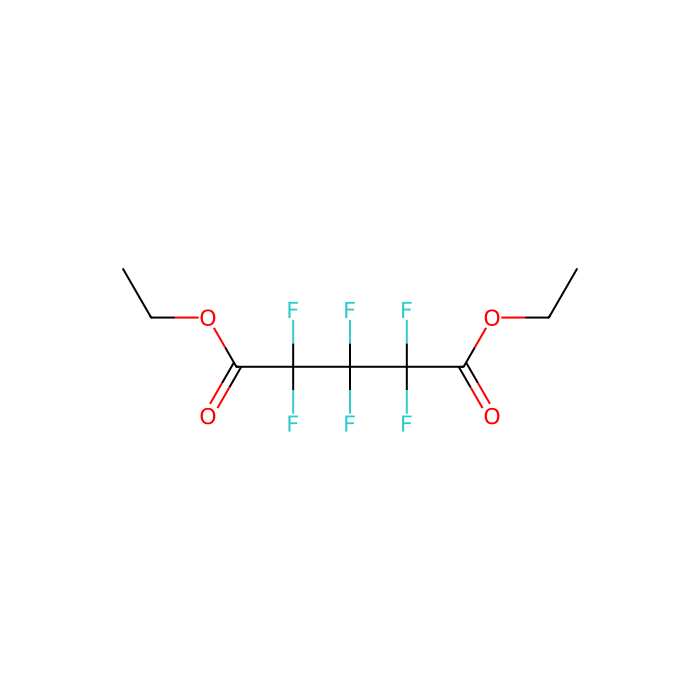
A fluorinated aliphatic diester featuring three geminal difluoromethylene units in a five-carbon backbone, esterified as the diethyl ester at both termini.
Product Name (SKU): Diethyl 2,2,3,3,4,4-Hexafluoropentanedioate (D154392)
CAS: 424-40-8 (product data)
CID: 9874 (product data)
InChIKey: 227107 (product data as provided)
Molecular Formula: Not specified for this item; refer to CoA/Spec Sheet.
Literature/computed formula for the described structure: C9H10F6O4 (literature/computed)
Molecular Weight: Not specified for this item; refer to CoA/Spec Sheet.
Literature/computed MW: ~296.16 g/mol (calculated from C9H10F6O4) (literature/computed)
SMILES: Not specified for this item; refer to CoA/Spec Sheet.
Literature representation: CCOC(=O)C(F)(F)C(F)(F)C(F)(F)C(=O)OCC (literature)
Key structural features:
Linear C5 aliphatic chain bearing three consecutive CF2 groups at C2, C3, and C4 (gem-difluoro substitution).
Terminal diethyl ester functionalities (–CO2Et) at C1 and C5.
No stereogenic centers (all-carbon backbone, geminal difluoro groups).
Two electron-withdrawing ester carbonyls plus strongly inductive –CF2– units render the backbone highly deactivated toward typical carbocation/anion formation.
2D description in words: Ethyl ester of a pentanedioic acid where the three internal methylene carbons are each replaced by difluoromethylene (–CF2–) units: EtO–C(=O)–CF2–CF2–CF2–C(=O)–OEt.
Synthetic Utility
Functional group set and reactivity make this compound a concise entry to a family of fluorinated intermediates:
Transformable handles: Two ethyl ester groups provide classic disconnections to carboxylic acids (hydrolysis), acid chlorides (SOCl2/oxalyl chloride), amides/imides (via coupling), and alcohols/aldehydes (via reductions) (literature/general).
Electronic effects: Three consecutive CF2 units strongly withdraw electron density through induction, attenuating nucleophilicity of the backbone and improving oxidative/thermal stability of derived materials (literature/general).
Retrosynthetic value:
Access to the diacid enables bifunctional coupling to diamines/diols for step-growth polymers (polyamides, polyesters, polyurethanes).
Transesterification allows rapid variation of terminal alcohol identity, tuning solubility and processability.
Reduction to fluorinated diols provides monomers for low surface energy elastomers and coatings.
Derivatization repertoire:
Anhydride formation for further acylation chemistry.
Selective mono-hydrolysis/mono-activation to prepare asymmetric mixed esters/amides.
Because α-CH sites are absent between the CF2 centers and the carbonyls, enolate chemistry is not operative, simplifying reaction planning compared with non-fluorinated malonate/glutarate analogues.
Target Specificity
Not applicable. This product is a small-molecule fluorinated diester and does not have biological target specificity (no antigen, epitope, clone, or isotype). No item-specific targeting information is provided.
Frequently Asked Questions
How is this product shipped?
This product ships under standard ambient conditions. No temperature-controlled packaging is required.
We use cookies to ensure the website functions properly and, where permitted, to improve your experience. You can manage your preferences at any time in Settings. Learn more in our Cookie Policy.
Shall we send you a message when we have discounts available?
Remind me later
Thank you! Please check your email inbox to confirm.
Products are supplied to verified businesses, institutions, and qualified professionals for research and development use only. Not for use in humans, animals, diagnosis, or therapy.

 H2412552