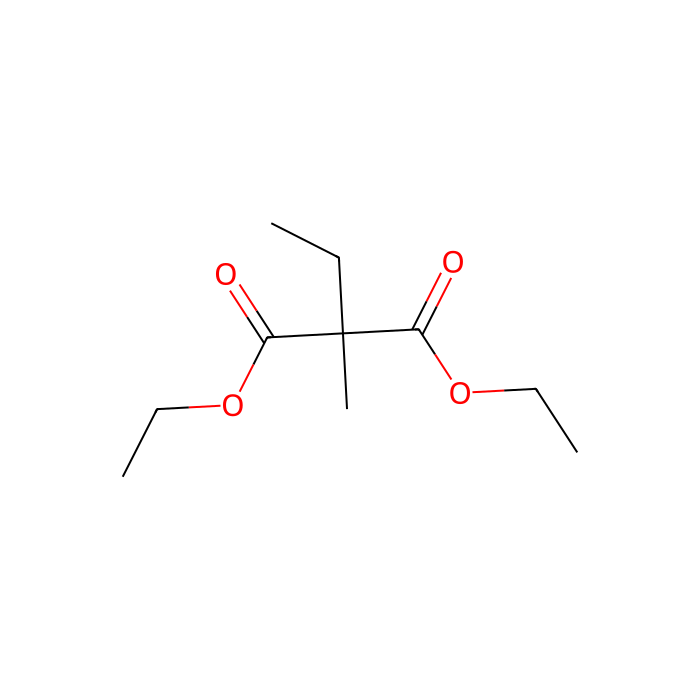
This compound belongs to the class of organic compounds known as fatty acid esters. These are carboxylic ester derivatives of a fatty acid.
External Descriptors
Not available
1. Djoumbou Feunang Y, Eisner R, Knox C, Chepelev L, Hastings J, Owen G, Fahy E, Steinbeck C, Subramanian S, Bolton E, Greiner R, and Wishart DS. ClassyFire: Automated Chemical Classification With A Comprehensive, Computable Taxonomy. Journal of Cheminformatics, 2016, 8:61.
Determine the necessary mass, volume, or concentration for preparing a solution.
Dilution Calculator
Determine the dilution needed to prepare a stock solution.
Reconstitution Calculator
Reviews
Customer Reviews
Application Protocols
No assay/application protocols (e.g., WB, IHC, IF, FC) apply to this small-molecule reagent. For synthetic use, see the Reaction Conditions and Synthetic Utility sections for general procedural guidance.
Biological Roles
Not a biological metabolite. As a synthetic dialkyl malonate, Diethyl 2-ethyl-2-methylmalonate has no known endogenous role in cells or organisms.
General biochemistry context (literature/class):
Malonate itself is a competitive inhibitor of succinate dehydrogenase, but dialkyl malonates are far less polar and primarily function as synthetic reagents rather than biochemical probes.
The fully substituted (2,2-disubstituted) malonate lacks an active methylene and is not a common prodrug motif.
Given its role as a fine-chemical intermediate, any biological interactions would be incidental and are not the basis of use. For research use only.
Buffer Applications
This compound is not a buffering agent and is not typically used to prepare laboratory buffers. It lacks acid/base functionality in a pH range suitable for buffering (the esterified diacid is non-ionizable under physiological pH). For solution preparation needs, refer instead to appropriate buffering systems (e.g., phosphate, acetate, Tris) unrelated to this product.
Green Alternatives
Green chemistry context: This compound is a dialkyl malonate building block for constructing quaternary centers/tertiary carboxylic acids. Greener choices relate to solvent selection, carbonyl chemistry alternatives, and minimizing hazardous reagents.
Greener approaches and comparisons (literature-class guidance):
Solvent choices:
Prefer bio-based or safer solvents where feasible (e.g., 2-MeTHF over THF; EtOAc over DCM; propylene carbonate for certain polar processes). Choice must balance solubility and reaction kinetics.
Carbonyl transformations:
Transesterifications using catalytic organic bases (DBU, organocatalysts) and low-toxicity alcohols can replace stoichiometric reagents.
For reductions, consider catalytic hydrogenation or transfer hydrogenation where compatible, instead of stoichiometric hydrides (which generate inorganic waste).
Decarboxylation strategies:
Employ catalytic decarboxylative couplings (e.g., Ni/Cu catalysis under milder conditions) to reduce thermal input vs. classical high-temperature decarboxylation.
Comparison snapshots (general):
DCM vs EtOAc: EtOAc is less toxic and more environmentally preferred; often equivalent for extractions and many reactions.
THF vs 2-MeTHF: 2-MeTHF is bio-based, forms fewer peroxides and has higher boiling point; ensure compatibility with bases/acids used.
LAH/DIBAL vs catalytic hydrogenation: Catalysis reduces waste but may require specific equipment and careful substrate compatibility.
Tradeoffs should be evaluated experimentally; maintain product performance while reducing solvent/reagent hazards where possible.
Pharmaceutical Uses
Item-specific pharmacopeial status or excipient role: Not specified for this item; refer to CoA/Spec Sheet.
General context (no therapeutic claims):
As a versatile intermediate, 2,2-disubstituted malonates can serve in process chemistry to access tertiary carboxylic acids and quaternary carbon frameworks that appear in APIs or advanced intermediates.
Potential roles include: building blocks for side chains, precursors to acid chlorides and amides after hydrolysis, and handles for decarboxylative couplings to elaborate sterically congested motifs.
Selection is driven by desired substitution pattern at a quaternary center; the 2-ethyl/2-methyl substitution pattern can be leveraged when a tertiary acid of that topology is needed.
Any pharmaceutical manufacturing use requires appropriate qualification, impurity control, and regulatory assessment.
Physical Properties
Item-specific specifications: Not specified for this item; refer to CoA/Spec Sheet.
Computed/Literature (for reference only; not product specifications):
Molecular formula: C10H18O4 (computed from structure)
Molecular weight: ~202.25 g/mol (computed)
Expected physical state: Liquid at ambient temperature (literature expectation for diethyl malonate derivatives with C10 backbone); appearance for this specific item is not specified.
Volatility/boiling behavior: Diethyl malonate itself boils ~198–200 °C (literature). Alkyl substitution at C-2 typically raises boiling point; exact BP for this compound not located here — consult primary literature or CoA.
Density/refractive index: Not located in provided data; typical malonate diesters have nD ~1.41–1.43 and densities ~1.00–1.05 g/mL (literature ranges for class). Exact values for this item are not specified.
Solubility: Expected to be miscible with common organic solvents (e.g., dichloromethane, ethyl acetate, toluene, THF) and poorly soluble in water (literature expectation for dialkyl malonates). Quantitative solubilities are not specified for this item.
Note: Use these literature expectations only as planning guidance. For method-critical work, obtain item-specific values from CoA/Spec Sheet.
Quality and Grades
Item-specific quality information (grade, purity, stabilizers, appearance): Not specified for this item; refer to CoA/Spec Sheet.
General guidance on grades relevant to this compound class (for context only):
Research/technical grade: Suitable for most synthetic applications; impurity profiles (e.g., residual alcohols, monoesters, acids) vary by supplier.
High-purity or GC/HPLC grade: Tighter control of volatile/non-volatile residues and UV-absorbing impurities; beneficial for analytical method development or photoactive reactions.
Water content: Moisture can promote hydrolysis; Karl Fischer specifications, if provided on CoA, guide drying needs. Not specified for this item.
Stabilizers: None are indicated in Product Data. Many dialkyl malonates are supplied neat without stabilizers; verify on CoA if any antioxidant or acid scavenger is used.
What to check on receipt:
Identity by 1H/13C NMR (diagnostic quaternary carbon at ~45–55 ppm; ester carbonyls ~165–175 ppm), GC-MS or LC-MS for MW ~202.
Purity and residual solvents by GC; acid number to assess hydrolysis.
Water by KF if moisture sensitivity is critical.
Use item-specific CoA/Spec Sheet for definitive grade and quality attributes.
Reaction and Applications
Diethyl 2-ethyl-2-methylmalonate is a fully substituted (2,2-disubstituted) malonate diester. Unlike diethyl malonate, it lacks an acidic methylene and thus behaves primarily as an electrophile or masked tertiary carboxylic acid precursor rather than a nucleophilic methylene donor.
Representative uses (literature/general):
Hydrolysis/decarboxylation sequence to tertiary carboxylic acids: Base hydrolysis to the diacid (or monoacid–monoester), followed by thermal decarboxylation affords 2-ethyl-2-methylacetic acid (a tertiary carboxylic acid) — a useful intermediate in fragrance, materials, and fine-chemical synthesis.
Lewis acid activation: The geminal diester can be activated (e.g., with TiCl4, BF3·OEt2, or other strong Lewis acids) for reactions where the quaternary center can participate in acylation/transacetalization-like pathways or to form mixed anhydrides/enol derivatives under specific conditions.
Transformations of the ester groups: Reduction (DIBAL-H for aldehyde equivalents; LiAlH4/borohydrides for diols), transesterification to tailor leaving groups, or conversion to acid chlorides via hydrolysis then SOCl2/oxalyl chloride.
Decarboxylative couplings: After hydrolysis to the half-ester/acid, decarboxylation can be leveraged in radical or transition-metal-catalyzed manifolds to build quaternary carbon frameworks.
Notable constraints:
No active methylene; alkylation via classical malonic ester synthesis is not applicable.
Under strong basic conditions, competitive saponification dominates; avoid if retention of diester is required.
Practical tips:
Maintain anhydrous conditions during manipulations intended to preserve the diester.
Use buffered or neutral silica during chromatography to minimize hydrolysis.
Reaction Conditions
General, literature-based guidance for 2,2-disubstituted malonates (adjust per substrate and scale):
Saponification/Hydrolysis:
Typical: 2–4 equiv NaOH or KOH in EtOH/H2O (1:1 to 4:1 v/v), 0–25 °C to start, then warm to 50–80 °C until completion (2–16 h). Workup by solvent removal, aqueous acidification (1–2 M HCl) to pH ~1–2 to precipitate/partition acids. Expected high conversion; yields depend on workup and avoidance of over-hydrolysis.
Decarboxylation (after diacid formation):
Heat the diacid (or β-ketoacid-like intermediate) at 140–200 °C (neat or in high-boiling solvent like toluene/xylene) to effect CO2 loss, typically 0.5–3 h. Catalysis by Cu salts or microwaves can reduce temperature/time (literature).
Reductions:
LAH: Anhydrous Et2O or THF, 0 °C to reflux, 1–4 h, quench carefully; delivers diol from diester (over-reduction common).
DIBAL-H: Toluene or CH2Cl2, −78 to −20 °C, 1–3 equiv, may stop at aldehyde equivalents when applied to monoester/acid derivatives.
Transesterification:
Acidic (cat. H2SO4, TsOH) or basic (cat. NaOMe/NaOEt), alcohol as solvent, reflux 2–12 h. Remove alcoholate by-product or water continuously (Dean–Stark) as appropriate.
Lewis-acid-promoted reactions:
BF3·OEt2, TiCl4, or AlCl3 in DCM/toluene at −20 to rt can activate the carbonyls; conditions are substrate- and goal-dependent.
Note: Numerical values are representative literature ranges for this class and not specifications. Optimize on small scale.
Safety and Handling
Product Data (item-specific):
Storage Conditions: Room temperature
Shipped In: Normal
GHS/SDS fields (Signal Word, H-Statements, Classification, Pictograms): Not specified for this item; refer to SDS.
General safety considerations for dialkyl malonates (literature/class guidance; not a substitute for SDS):
Hazards: Combustible liquid; may cause skin/eye irritation. Avoid inhalation of vapors or mists and prolonged skin contact.
Incompatibilities: Strong bases and strong acids can cause saponification or hydrolysis. Avoid moisture if hydrolytic stability is a concern. Oxidizing agents may react with organic esters.
PPE: Use lab coat, safety glasses or goggles, and appropriate chemical-resistant gloves (e.g., nitrile). Employ local exhaust/hood when handling.
First aid (general):
Inhalation: Move to fresh air; seek medical attention if symptoms persist.
Skin contact: Wash with soap and water; remove contaminated clothing.
Eye contact: Rinse cautiously with water for several minutes; seek medical attention if irritation persists.
Ingestion: Rinse mouth; do not induce vomiting; seek medical advice.
Spills: Absorb with inert material (vermiculite, sand), collect for disposal. Prevent entry into drains.
Waste: Dispose in accordance with institutional, local, and national regulations.
Always consult the item-specific SDS for authoritative hazard classification and response measures.
Solvent Selection
This product is a substrate/reagent (a malonate diester), not typically used as a solvent.
Practical handling solvents (general guidance):
Polar aprotic: THF, MeCN, DMF, DMSO — useful for base-mediated saponification (DMF less preferred for hydrolysis) and for Lewis-acid-promoted reactions.
Moderately polar: EtOAc, DCM — good for reaction media and workups; compound is expected to be highly soluble.
Nonpolar: Toluene, hexanes — solubility likely good to moderate; often suitable for high-temperature steps (e.g., thermal decarboxylation after hydrolysis to acid, when used as solvent for azeotropic drying of intermediates).
Polarity/partitioning (class expectations):
Dialkyl malonates exhibit intermediate polarity (two esters) with logP typically ~1.0–1.7 depending on substitution (literature class range). Specific logP for this item is not specified.
When to choose which solvent:
Hydrolysis/saponification: EtOH/H2O with NaOH or KOH is classic; MeOH/H2O also common.
Lewis-acid activation or acylations: DCM or toluene under anhydrous conditions.
Purification: Normal-phase silica with hexanes/EtOAc gradients is standard; monitor for ester hydrolysis on acidic silica — pre-neutralize if necessary.
Item-specific solubility parameters are not provided; verify empirically or consult CoA.
Storage and Reconstitution
Item-specific storage: Room temperature (per Product Data). Ship under normal conditions.
General handling:
Keep container tightly closed in a dry, well-ventilated place. Protect from moisture to minimize hydrolysis.
If prolonged storage after opening is expected, consider blanketing with inert gas and storing in amber glass away from heat.
Stability notes (class guidance):
Dialkyl malonates are generally stable at ambient conditions but can slowly hydrolyze in the presence of moisture, acids, or bases.
Reconstitution/Preparation:
Provided neat; no reconstitution required. For solution preparation, use anhydrous solvents as needed (e.g., EtOAc, DCM, toluene, THF). Filter through a PTFE syringe filter if particulate contamination is observed.
For any item-specific shelf life, water content, or inhibitor/stabilizer information, refer to the CoA/Spec Sheet.
Structure and Identity
A fully substituted malonate diester featuring a quaternary carbon bearing methyl and ethyl substituents, flanked by two ethyl ester groups.
Product Data (item-specific):
CAS: 2049-70-9
CID: 16293
InChIKey: 255186 (as provided; appears truncated — full key not specified in Product Data)
SMILES: Not specified for this item; refer to CoA/Spec Sheet.
Molecular formula (computed from structure/name): C10H18O4
Molecular weight (computed): ~202.25 g/mol
Structural features (general chemistry description):
Central quaternary carbon (sp3) attached to: one methyl (–CH3), one ethyl (–CH2CH3), and two carbonyl carbons of ester groups (geminal diester).
Two ethyl ester moieties [–C(=O)OCH2CH3] symmetrically disposed about the quaternary center.
No stereocenters; overall achiral. No aromatic rings or heteroatoms beyond carbonyl oxygens.
2D depiction in words: An isobutyl-like quaternary center substituted by two carbonyl groups, each bearing an ethoxy substituent; alkyl substituents are Me and Et on the same central carbon.
Synonymy (literature): Often referred to as a 2,2-disubstituted diethyl malonate (specifically, 2-ethyl-2-methyl).
Synthetic Utility
Key features relevant to synthesis:
Functional group set: Two ethyl esters (–CO2Et) geminal to a quaternary carbon bearing Me and Et substituents; no acidic methylene. The diester serves as a masked tertiary carboxylic acid framework.
Transformations (literature/general):
Hydrolysis → Decarboxylation: Base hydrolysis to diacid (or monoacid/monoester), followed by thermal decarboxylation to 2-ethyl-2-methylacetic acid. Subsequent derivatization: acid chlorides (SOCl2), amides (amine coupling), esters (Fischer/Steglich), or reductions (to tertiary alcohols via addition–reduction sequences after activation).
Reductive routes: LAH can reduce esters to diols; DIBAL-H at low temperature can deliver aldehyde-equivalent intermediates from mono-hydrolyzed derivatives. Chemoselectivity control is crucial.
Cross-coupling via decarboxylation: After conversion to carboxylate or redox-active ester, Ni/Cu-catalyzed decarboxylative couplings can install new C–C bonds at quaternary centers.
Transesterification/exchange: Changing the alkoxy groups (to Me, iPr, benzyl) can tune reactivity and downstream deprotection strategies (e.g., hydrogenolysis of benzyl esters).
Retrosynthetic value:
Serves as a convergent way to introduce a predefined quaternary center adjacent to carbonyl equivalents. Useful when direct alkylation strategies are hampered by sterics.
Limitations:
Basic enolate chemistry of malonates is not applicable (no α-H). Conditions must avoid unnecessary saponification unless intended.
Target Specificity
Not applicable. This product is a small-molecule chemical reagent, not a biologic or affinity reagent. No antigen/epitope or species specificity applies.
Frequently Asked Questions
What is the purity of this product, and how is it determined?
This product is supplied at ≥97% purity, determined by gas chromatography (GC). Lot-specific values are stated on the Certificate of Analysis.
How should this product be stored?
Store at room temperature.
How is this product shipped?
This product ships under standard ambient conditions. No temperature-controlled packaging is required.
What are the CAS number, molecular formula and molecular weight?
The CAS Number is 2049-70-9, the molecular formula is C10H18O4, and the molecular weight is 202.25 g/mol. InChIKey ODRGILDUWDVBJX-UHFFFAOYSA-N.
What documentation is provided?
Available product documentation, including Certificates of Analysis (COA), Safety Data Sheets (SDS), and specification sheets, is shown in the product document area. Document availability and access follow the current site policy.
We use cookies to ensure the website functions properly and, where permitted, to improve your experience. You can manage your preferences at any time in Settings. Learn more in our Cookie Policy.
Shall we send you a message when we have discounts available?
Remind me later
Thank you! Please check your email inbox to confirm.
Products are supplied to verified businesses, institutions, and qualified professionals for research and development use only. Not for use in humans, animals, diagnosis, or therapy.