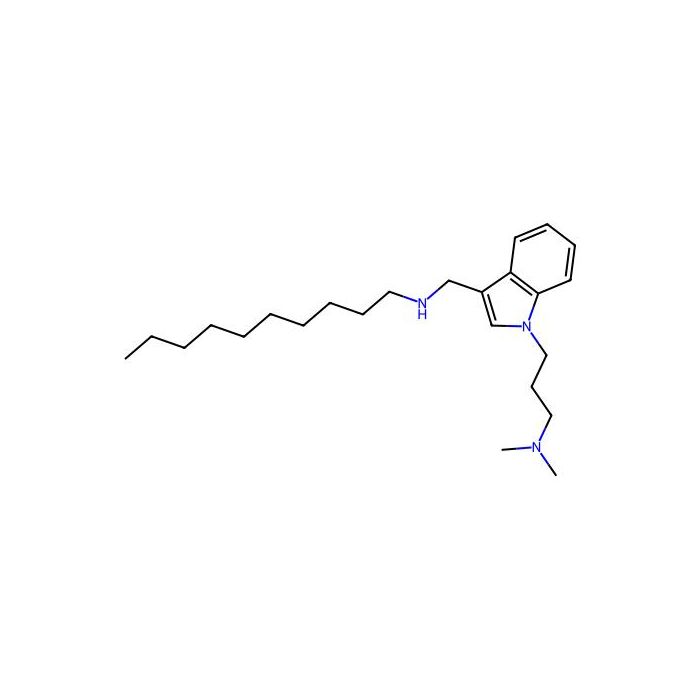
Dynole 2−24 is an indole-based dynamin GTPase inhibitor ( IC 50 =0.56 μM for dynamin I). Dynole 2−24 is nontoxic and shows increased potency against dynamin I and II in vitro and in cells (IC ₅₀(CME) =1.9 μM). Dynole 2−24 also shows 4.4-fold selectivity for dynamin I. Dynole 2−24 is active in-cell inhibitor of clathrin-mediated endocytosis. CME: Clathrin mediated endocytosis
Specifications
Biochemical and Physiological Mechanisms
Dynole 2−24 is an indole-based dynamin GTPase inhibitor ( IC 50 =0.56 μM for dynamin I). Dynole 2−24 is nontoxic and shows increased potency against dynamin I and II in vitro and in cells (IC ₅₀(CME) =1.9 μM). Dynole 2−24 also shows 4.4-fold selectivity f
Storage
Store at -20°C
Shipped In
Ice chest + Ice pads
This product requires cold chain shipping. Ground and other economy services are not available.
Action Type
INHIBITOR
Names and Identifiers
Molecular Weight
371.60
Advanced Data
Certificates (CoA,COO,BSE/TSE and Analysis Chart)
C of A & Other Certificates(BSE/TSE, COO):
Analytical Chart:
Solution Calculators
Molarity Calculator
Determine the necessary mass, volume, or concentration for preparing a solution.
Dilution Calculator
Determine the dilution needed to prepare a stock solution.
Reconstitution Calculator
Reviews
Customer Reviews
Application Protocols
No tested application protocols are provided for this specific catalog item.
Validated applications (WB, IHC, IF, FC, etc.): Not applicable to this small-molecule probe.
For general experimental guidance on using endocytosis inhibitors, consult peer-reviewed literature and adapt to your system. Always perform a concentration and time-course titration with appropriate vehicle controls.
Item-specific, validated protocols—if available—will appear in the CoA/Spec Sheet or on the product page as updates.
Biological Roles
Item is supplied for research use only.
General literature context (non-item-specific):
Target/process: Dynole-class molecules are used as small-molecule inhibitors of dynamin GTPases (e.g., dynamin-1/2/3), key mechanoenzymes driving vesicle scission during clathrin-mediated endocytosis and other trafficking events.
Functional consequence: Acute application in cells typically reduces receptor–ligand internalization (e.g., transferrin uptake as a benchmark assay) and can modulate synaptic vesicle recycling and trafficking-dependent signaling cascades.
Selectivity considerations: Reported selectivity can vary with concentration, exposure time, and cell type. Off-target effects are a known consideration for several endocytosis inhibitors; experimental designs should include genetic and orthogonal chemical controls.
Reversibility: Many studies employ washout protocols to assess recovery of endocytic function, indicating reversible target engagement on experimental timescales.
Important notes:
No medical, diagnostic, or therapeutic uses are intended or endorsed.
For definitive target identity, potency (IC50/Ki), and selectivity for a given lot, consult primary peer-reviewed sources and the item’s CoA/Spec Sheet.
Cellular responses may depend strongly on vehicle percentage, serum conditions, temperature, and exposure duration; pre-validate in your exact biological system.
Buffer Applications
This compound is not a buffering agent and is not used to prepare classical buffer systems.
For assay use, it is typically diluted from an organic stock (e.g., DMSO) into biological buffers or media (HBSS, PBS, culture media) at low vehicle percentages. Validate solubility and clarity upon dilution.
If precipitation occurs, adjust the vehicle percentage slightly (within biological tolerance), warm to 37 °C, and gently mix; avoid strong bases/acids unless compatibility is proven for your system.
For buffer recipes and pH control, refer instead to dedicated buffering reagents (HEPES, PBS, MOPS, etc.).
Green Alternatives
As a targeted bioactive probe, Dynole 2−24 does not have a direct “green alternative” in the sense of a drop-in replacement reagent for a synthetic transformation. However, the environmental footprint of its use can be reduced through solvent and process choices.
Greener handling strategies (general):
Prefer aqueous-compatible assay formats and keep the final DMSO concentration at the minimum validated for your system.
Use microscale formats (96/384-well plates) to reduce solvent consumption.
When possible, substitute DMSO with ethanol for short-term stock use if fully compatible with the assay and compound solubility (validate first). Ethanol is generally considered a greener solvent than DMSO, DMF, or NMP.
Comparison (general solvent perspective):
DMSO: excellent solvency and low volatility; disposal load can be higher; not readily biodegradable.
Ethanol: renewable feedstock, biodegradable; may limit solubility and can affect membranes/proteins.
PBS/Buffer with minimal co-solvent: greener vehicle but risks precipitation; confirm stability.
Waste minimization:
Aliquot stocks to avoid repeated thaw/freeze and discard; this reduces degraded, unusable material.
Consolidate waste streams and follow institutional guidelines to minimize incineration volumes.
There is no established “green” chemical substitute that replicates the same biological target engagement of Dynole 2−24; optimization should focus on solvent systems and scale.
Pharmaceutical Uses
Dynole 2−24 is supplied strictly for research use and is not intended for human or veterinary administration.
Excipient/formulation role: None; not used as a pharmacopeial excipient.
Manufacturing role: Not a process reagent in pharmaceutical unit operations.
Regulatory status: No pharmacopeial monograph known for this research probe.
If using as a reference material in analytical method development (e.g., for transporter/endocytosis assay benchmarking), ensure appropriate internal qualification (purity, identity, stability) and document handling in accordance with your quality system.
Physical Properties
Only item-verified specifications belong in method-critical work. Values below are either item-specific (none provided) or general literature guidance clearly labeled.
Item-specific (this listing):
Appearance: Not specified for this item; refer to CoA/Spec Sheet.
Molecular Weight (MW): Not specified for this item; refer to CoA/Spec Sheet.
Melting/Boiling Point, Density, Refractive Index, UV cutoff: Not specified for this item; refer to CoA/Spec Sheet.
Solubility (spec): Not specified for this item; refer to CoA/Spec Sheet.
General handling properties (literature/general practice; non-spec):
Physical form & solubility: Supplied commonly as a solid, readily soluble in polar aprotic organics (e.g., DMSO) to prepare concentrated stocks; limited aqueous solubility without cosolvent.
Working solutions: Often prepared as 10–50 mM stocks in anhydrous DMSO, then diluted to low micromolar concentrations in aqueous buffers or media containing ≤0.1% DMSO (literature practice).
pKa/logP: Not consolidated; values vary by reported structure/source. Determine experimentally for your lot if these parameters are method-critical.
Stability: Stock solutions are typically stable short-term at room temperature during handling; for storage, aliquot and freeze to minimize freeze–thaw (see Storage tab). Avoid prolonged light and moisture exposure.
Always verify exact values for your lot from the CoA/Spec Sheet or generate in-house QC data before quantitative PK/PD, modeling, or reference-standard applications.
Quality and Grades
Assurance of suitability for research use depends on documented specifications for the supplied lot.
Item-specific information (this listing):
Grade/Purity: Not specified for this item; refer to CoA/Spec Sheet.
Stabilizers/Inhibitors: Not specified for this item; refer to CoA/Spec Sheet.
Context and expectations (general, literature/industry practice):
Bioactive probe materials are typically offered at ≥95% purity by HPLC with orthogonal identity confirmation (NMR/MS). However, do not assume this for a given lot—use the CoA.
Low residual solvents/metals: Often relevant for biological assays and mechanistic studies; if not listed, consider in-house verification (GC for residuals; ICP for metals) when sensitivity demands.
Chromatographic performance: For applications involving LC/LC–MS quantitation, low non-volatile residues and defined UV spectra are desirable. Verify with the CoA or qualify in-house.
Recommendations:
Request or download the CoA/Spec Sheet for your lot to confirm identity (NMR/HRMS), purity (HPLC/UPLC), and any stabilizers. If your application is highly sensitive (e.g., chemoproteomics, live-cell imaging), perform fit-for-purpose requalification (HPLC assay, MS homogeneity, water content) prior to use.
Reaction and Applications
This product is a bioactive small molecule primarily used as a research probe rather than a synthetic reagent.
Research applications (literature/general):
Endocytosis modulation: Dynole 2−24 is widely used to inhibit dynamin GTPase activity in vitro and in cells, thereby modulating clathrin-mediated and other dynamin-dependent endocytic pathways.
Mechanistic studies: Enables temporal interrogation of receptor internalization, synaptic vesicle recycling, and cargo uptake by applying the inhibitor acutely and monitoring trafficking readouts.
Comparative pharmacology: Often evaluated alongside related tools (e.g., dynasore, other dynoles) to contrast potency, selectivity, and off-target profiles in cellular systems.
Practical tips (general, non-item-specific):
Prepare concentrated DMSO stocks (e.g., 10–50 mM), aliquot, and store frozen. Thaw immediately before use and minimize exposure to ambient moisture.
When dosing cells, add stock to pre-warmed media to achieve the desired final concentration while keeping DMSO ≤0.1–0.2% v/v to maintain cell compatibility.
Include vehicle controls (matching DMSO %) and, where possible, orthogonal genetic controls (e.g., dominant-negative or knockdown of dynamin) to validate on-target effects.
Note: This section reflects general literature use-cases for the compound class. For item-specific performance characteristics, kinetics, or selectivity data, consult primary literature or the item’s CoA/Spec Sheet.
Reaction Conditions
No chemical reaction conditions (e.g., for synthesis) are applicable, as Dynole 2−24 is supplied as a finished probe compound. The following guidance relates to its experimental use in biological/biochemical assays and is based on general literature practice (non-item-specific):
Stock preparation: 10–50 mM in anhydrous DMSO. Vortex to dissolve completely. Filter sterilize (0.22 µm PTFE/RC) if sterility is required and the solvent system is compatible.
Working concentrations: Commonly low micromolar (e.g., 0.5–30 µM) depending on cell type, assay, and desired extent of endocytosis modulation. Titrate empirically.
Exposure time: Minutes to short hours (e.g., 10–60 min) for acute inhibition; longer exposures may increase off-target effects—validate.
Temperature/atmosphere: Standard cell culture conditions (e.g., 37 °C, 5% CO2) unless the assay requires hypothermia or temperature shifts.
Controls: Vehicle-only (DMSO) and orthogonal controls (genetic or unrelated chemical inhibitors) to confirm on-target effects.
These parameters are generalized from literature use of endocytosis inhibitors and should be optimized for each experimental system. For item-specific potency or kinetics, consult primary publications and the item’s CoA/Spec Sheet.
Safety and Handling
Safety information specific to this catalog entry is limited; exercise prudent laboratory precautions.
Item-specific hazard data (this listing):
GHS Classification / Pictograms / Signal Word / H-Statements: Not specified for this item; refer to SDS.
General laboratory guidance (not a substitute for SDS):
PPE: Wear lab coat, safety glasses, and appropriate chemically resistant gloves. Use a fume hood when weighing or preparing solutions.
Handling: Avoid inhalation of dust/aerosols. Prevent skin/eye contact. Prepare DMSO stocks with clean, dry tools; cap immediately to reduce moisture uptake.
First aid (overview): In case of contact, rinse affected area with water for 15 minutes; remove contaminated clothing. If inhaled, move to fresh air. Seek medical attention if symptoms persist. Refer to the SDS for detailed instructions.
Incompatibilities: Strong oxidizers and strong acids/bases may degrade many organic small molecules; segregate accordingly. Avoid prolonged light exposure if the compound is light-sensitive (verify with SDS/CoA).
Spill/cleanup: Avoid spreading dust. Absorb solutions with inert material, collect in suitable waste.
Waste: Dispose of according to institutional and local regulations for organic chemical waste.
Always consult the product-specific SDS before use; SDS supersedes any general guidance.
Solvent Selection
Selecting an appropriate solvent system is critical for stock preparation and biological assay compatibility.
Primary stock solvent (common practice):
DMSO (anhydrous): High solvating power for many heteroatom-bearing, aromatic small molecules. Facilitates 10–50 mM stock solutions; miscible with aqueous buffers upon dilution.
Alternative organic solvents (as needed):
DMF or NMP: Similar solvency to DMSO; consider only if assay tolerates these vehicles.
Ethanol (absolute): Useful for lower-concentration stocks; check assay tolerance and potential precipitation upon aqueous dilution.
Aqueous systems: Direct aqueous solubility is typically limited; co-solvent or surfactant (e.g., 0.05–0.1% DMSO, 0.01% Tween-20—if biologically acceptable) can help maintain clarity. Validate compatibility with your biological system.
Materials considerations: Adsorptive losses to some plastics may occur for hydrophobic/aromatic probes. Prefer glass vials/syringes for concentrated stocks; use low-bind plastics for diluted working solutions.
pH effects: While not a buffer, ionizable functional groups (if present) can alter solubility across pH. Perform a small-scale solubility screen (pH 6.5–8.0) if precipitation is observed post-dilution.
Filtration: If sterile solutions are required, filter through 0.22 µm PTFE/RC membranes. Avoid nylon if compound–nylon interactions are suspected.
Always confirm final vehicle percentage (e.g., ≤0.1–0.2% DMSO) is tolerated by your cells/assay system.
Storage and Reconstitution
Follow item-specific storage instructions for maximum stability.
Item-specific (this listing):
Storage Conditions: Store at −20 °C.
Shipping: Shipped in ice chest with ice pads.
General guidance (literature/practice; confirm with CoA/SDS for your lot):
Reconstitution solvent: Dissolve in anhydrous DMSO to prepare concentrated stocks (e.g., 10–50 mM). If an alternative solvent is required (ethanol, DMF), verify solubility and assay compatibility.
Aliquoting: Dispense single-use aliquots in amber glass or low-bind polypropylene to avoid repeated freeze–thaw. Target aliquot sizes that match one experimental day’s use.
Storage of solutions: Keep frozen at −20 to −80 °C, protected from light and moisture. Record preparation date; evaluate for precipitation, discoloration, or LC/MS changes before critical experiments.
Freeze–thaw: Minimize cycles; thaw on ice and promptly return unused stock to freezer. Avoid frost/moisture ingress by purging headspace with inert gas if feasible.
Aqueous working solutions: Prepare fresh immediately before use; maintain minimal organic vehicle percentage compatible with your system. Discard after the experiment—do not refreeze diluted solutions.
Always defer to the product’s CoA/SDS for definitive stability and compatibility information.
Structure and Identity
Concise identification and structural context for Dynole 2−24.
Product Name (SKU): Dynole 2−24 (D648932)
CAS: 1416313-72-8
Category: Small molecules and compound libraries (研究/库用)
Item-specific identifiers:
Molecular Formula: Not specified for this item; refer to CoA/Spec Sheet.
Molecular Weight: Not specified for this item; refer to CoA/Spec Sheet.
SMILES: Not specified for this item; refer to CoA/Spec Sheet.
InChIKey: Not specified for this item; refer to CoA/Spec Sheet.
Structural features (general literature context):
Dynole 2−24 is widely cited in the literature as a small-molecule, cell-permeable probe that inhibits dynamin GTPases, used to modulate endocytic processes in biochemical and cell studies. Exact atom connectivity, ring systems, and stereochemical descriptors should be taken from a primary reference or the item’s CoA/Spec Sheet for this lot.
2D structural description (literature-level, non-item-specific): typically an aromatic-rich organic scaffold bearing polar functionalities suitable for DMSO dissolution and cellular uptake. Do not treat this as an item-specific specification—consult primary structural data before quantitative modeling or analytical method development.
Synthetic Utility
This product is primarily a functional biological probe and is not typically employed as a building block or reagent in multistep chemical synthesis.
Functional groups/derivatization: Without item-specific structure disclosure in this listing, no derivatization guidance can be provided. If analog development or SAR studies are planned, obtain the verified structure and consider late-stage diversification strategies accordingly.
Reference standard use: Can serve as a comparator compound in SAR campaigns targeting dynamin or endocytosis, supporting assay validation and benchmarking.
Analytical utility: Useful as a positive control in uptake/internalization assays to validate endocytosis readouts.
For users seeking synthetic transformations, consult alternative catalog entries that are designed as building blocks (acids, amines, halides, boronates) or reagents (coupling agents, catalysts).
Target Specificity
Item-specific target details are not provided in this listing.
Target, epitope, isotype/clone, species reactivity: Not applicable; this is a small-molecule probe, not an antibody or protein reagent.
For any validated biochemical target engagement data (e.g., enzyme class, isoforms, IC50), please refer to the product’s CoA/Spec Sheet or primary literature.
Frequently Asked Questions
How should this product be stored?
Store at ?20 °C. Freezer storage is required to maintain the specified shelf life.
How is this product shipped?
This product ships in an insulated container with ice pads. Unpack on arrival and transfer it to the storage condition stated above.
What are the CAS number, molecular formula and molecular weight?
The CAS Number is 1416313-72-8, the molecular formula is C24H41N3, and the molecular weight is 371.60 g/mol.
What documentation is provided?
Available product documentation, including Certificates of Analysis (COA), Safety Data Sheets (SDS), and specification sheets, is shown in the product document area. Document availability and access follow the current site policy.
We use cookies to ensure the website functions properly and, where permitted, to improve your experience. You can manage your preferences at any time in Settings. Learn more in our Cookie Policy.
Shall we send you a message when we have discounts available?
Remind me later
Thank you! Please check your email inbox to confirm.
Products are supplied to verified businesses, institutions, and qualified professionals for research and development use only. Not for use in humans, animals, diagnosis, or therapy.