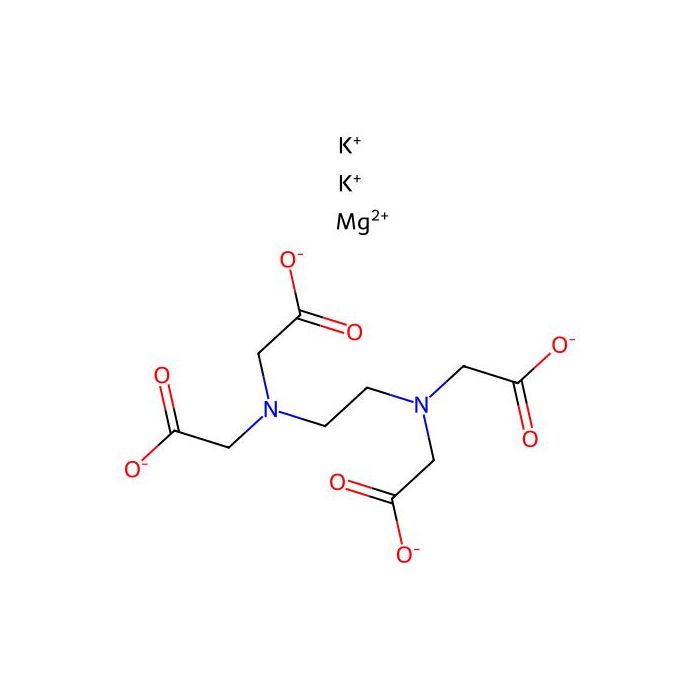
Ethylenediaminetetraacetic acid dipotassium magnesium salt is a biochemical reagent that can be used as a biological material or organic compound for life science related research.
Specifications
Storage
Store at -20°C
Shipped In
Ice chest + Ice pads
This product requires cold chain shipping. Ground and other economy services are not available.
Tetracarboxylic acid or derivatives - Alpha-amino acid - Alpha-amino acid or derivatives - Amino acid or derivatives - Carboxylic acid salt - Amino acid - Tertiary amine - Tertiary aliphatic amine - Carboxylic acid - Organic alkali metal salt - Organic potassium salt - Organic nitrogen compound - Hydrocarbon derivative - Organooxygen compound - Organonitrogen compound - Organic oxide - Carbonyl group - Organopnictogen compound - Amine - Organic oxygen compound - Organic zwitterion - Organic salt - Aliphatic acyclic compound
Description
This compound belongs to the class of organic compounds known as tetracarboxylic acids and derivatives. These are carboxylic acids containing exactly four carboxyl groups.
External Descriptors
Not available
1. Djoumbou Feunang Y, Eisner R, Knox C, Chepelev L, Hastings J, Owen G, Fahy E, Steinbeck C, Subramanian S, Bolton E, Greiner R, and Wishart DS. ClassyFire: Automated Chemical Classification With A Comprehensive, Computable Taxonomy. Journal of Cheminformatics, 2016, 8:61.
P305+P351+P338:IF IN EYES: Rinse cautiously with water for several minutes. Remove contact lenses if present and easy to do - continue rinsing.
x_wgk_germany
3
Solution Calculators
Molarity Calculator
Determine the necessary mass, volume, or concentration for preparing a solution.
Dilution Calculator
Determine the dilution needed to prepare a stock solution.
Reconstitution Calculator
Reviews
Customer Reviews
Application Protocols
No vendor-validated application protocols are provided for this SKU.
Not specified for this item
Tested applications, recommended dilutions, and positive controls: Not specified for this item; refer to CoA/Spec Sheet.
General guidance (literature/general) for preparing Mg–EDTA buffers
Determine desired free [Mg2+] using a speciation calculator (e.g., MaxChelator). Choose total concentrations of Mg–EDTA salt, supplemental MgCl2, and/or EDTA to hit the target at the working pH/ionic strength.
Dissolve EDTA dipotassium magnesium in ultrapure water; adjust pH to 7.4 (or target) with KOH/HCl. Bring to volume and filter sterilize if required (0.22 µm).
Validate free [Mg2+] experimentally using an Mg2+-selective electrode or by fitting to an indicator dye/assay calibrated for Mg2+.
These steps are illustrative and should be adapted to your specific assay or process. Always verify compatibility with other buffer components.
Biological Roles
General context (literature)
EDTA itself has no native biological role; it is a synthetic chelator. However, it profoundly affects biological systems by binding divalent/trivalent cations, notably Ca2+ and Mg2+.
Magnesium is an essential cofactor in ATP-dependent enzymes, nucleic acid processing, ribosome function, and membrane stability. The balance of free vs. bound Mg2+ is critical in enzymology and cell physiology.
Use of Mg–EDTA complexes in biology (literature/general)
Metal-ion buffering: Pre-formed Mg–EDTA is used to set reproducible free Mg2+ levels in vitro without precipitation in phosphate-containing buffers, enabling controlled studies of Mg2+-dependent processes.
Nuclease control: While free EDTA is classically used to inhibit nucleases by sequestering Mg2+, Mg–EDTA provides a defined reservoir and can be combined with other ligands (e.g., ATP, citrate) to tune free Mg2+.
Protein stability: Chelation suppresses trace metal-catalyzed oxidation (e.g., Fenton chemistry) in protein and peptide formulations.
Speciation considerations (literature)
pH, ionic strength, temperature, and competing ligands (phosphate, citrate, carboxylates, histidines) govern the free Mg2+ fraction. Representative formation constant for MgEDTA2− at 25 °C: log Kf ≈ 8.6–8.8.
In mixed-ion systems, metals with higher EDTA affinity (e.g., Zn2+, Cu2+, Fe3+) can displace Mg2+, altering bioavailability.
Note: The above describes general biochemical roles. No claims are made for clinical/therapeutic use; this product is for research use only, as noted.
Buffer Applications
EDTA dipotassium magnesium is well-suited for aqueous buffers where controlled Mg2+ speciation is required.
Typical buffer systems (literature/general)
Phosphate-buffered saline (PBS) with Mg–EDTA: Maintains soluble magnesium without precipitation; verify free Mg2+ using speciation tools.
HEPES/Tris/MOPS buffers (pH 7.0–8.2): Provide near-physiological pH while supporting stable Mg–EDTA complexes.
Metal-ion buffered systems: Combine Mg–EDTA with defined amounts of EDTA or MgCl2 to establish target free [Mg2+] across 0.01–5 mM (as required by enzyme assays); calculate using MaxChelator or equivalent software.
Practical formulation advice (general)
Dissolve Mg–EDTA salt completely in ultrapure, metal-depleted water before pH adjustment. Adjust pH with KOH/HCl to match counterions and minimize ionic drift.
Filter (0.22 µm) to remove particulates for sensitive biophysical assays; store aliquots at 2–8 °C for short term or frozen for long term to limit microbial growth.
Avoid strong acidification (pH < 4), which protonates EDTA and weakens Mg binding; avoid high concentrations of competitive chelators (citrate, tartrate) unless explicitly modeled.
Not specified for this item
Exact pKa values, buffer capacity, and stock concentration recommendations: Not specified for this item; refer to CoA/Spec Sheet and validate empirically for your system.
Green Alternatives
From a green chemistry perspective, legacy aminopolycarboxylates like EDTA are persistent in the environment and exhibit limited biodegradability. Where functionally acceptable, newer chelating agents with improved environmental fate may be considered.
Alternative chelators (literature/general)
GLDA (tetrasodium L-glutamate N,N-diacetate): Readily biodegradable, broad metal-binding spectrum; may require higher doses than EDTA for the same complexation strength.
MGDA (trisodium methylglycinediacetate): Good biodegradability, strong binding to alkaline earths; often a practical substitute for Ca2+/Mg2+ control.
IDS (iminodisuccinate): Biodegradable; moderate stability constants; useful in cleaning and metal control applications.
Citrate: Benign and biodegradable; weaker binding than EDTA; suitable where only mild chelation is needed.
Comparison highlights (qualitative)
Binding strength: EDTA > MGDA ≳ GLDA > IDS ≳ citrate (varies by metal and conditions; literature trend).
Ionic compatibility: All are water-soluble; pH operating windows differ (EDTA and GLDA tolerate wider pH).
Tradeoffs
For precise Mg2+ buffering in biochemical assays, EDTA’s well-characterized stability constants and extensive speciation data are advantageous. Substitution may require re-optimization of pH/ionic strength and verification of free-ion concentrations.
Note: This SKU’s composition is specific to EDTA; the above are conceptual alternatives for method development with sustainability in mind.
Pharmaceutical Uses
No therapeutic claims are made. The following describes general formulation roles of EDTA-type salts (literature/general), not specifications for this SKU.
Typical roles in formulations (general)
Chelating/excipient function: EDTA salts can reduce trace metal-catalyzed oxidation in parenteral, ophthalmic, and topical products by binding Fe/Cu ions.
Preservative potentiation: Chelation of divalent cations can enhance the efficacy of certain antimicrobial preservatives in aqueous products.
Solubility/compatibility: Pre-formed Mg–EDTA can maintain Mg2+ in solution in phosphate- or carbonate-containing vehicles where inorganic salts might precipitate.
Regulatory context (general)
Disodium EDTA and calcium disodium EDTA have pharmacopeial monographs (USP/EP/JP). Specific monographs for magnesium–potassium EDTA salts are less common; suitability must be determined case-by-case.
Development considerations
Verify compatibility with actives and excipients that bind metals (e.g., polysorbates, proteins, citrate) to avoid unintended shifts in metal speciation.
Control total and free Mg2+ analytically (e.g., ICP-OES for total; ISE/complexometric titration/speciation modeling for free).
Note: Use in pharmaceutical development must comply with regional regulations and internal quality requirements. This product is sold for research use only per Product Data.
Physical Properties
Item-specific values (from Product Data)
Appearance: Not specified for this item; refer to CoA/Spec Sheet.
Molecular Formula: Not specified for this item; refer to CoA/Spec Sheet.
Molecular Weight: Not specified for this item; refer to CoA/Spec Sheet.
Literature/general properties of Mg–EDTA potassium salts (non-specification)
Physical state: Typically a free-flowing, water-soluble solid; often hygroscopic (literature).
Solubility: Generally highly soluble in water; limited solubility in most organic solvents due to ionic character (literature).
pH behavior: Aqueous solutions are mildly basic to neutral depending on concentration and counterion composition; metal–EDTA speciation is strongly pH-dependent (literature).
Partitioning: Effectively non-volatile; extremely low logP due to ionic, polydentate nature (literature).
Thermal behavior: Decomposes rather than distills; no meaningful boiling point (literature).
Complex stability: The overall formation constant for MgEDTA2− is strong but lower than for Ca2+ transition metals; at 25 °C and I ≈ 0.1 M, log Kf(MgEDTA) ≈ 8.6–8.8 (literature, representative values).
Refractive index, density, mp/bp: Not specified for this item; refer to CoA/Spec Sheet.
Important: The above literature information aids method development but does not constitute specifications for SKU E1440728. For batch-specific numerical data (e.g., assay, water content), consult the CoA.
Quality and Grades
Item-specific quality information (from Product Data)
Grade/Purity: Not specified for this item; refer to CoA/Spec Sheet.
Interpretation and guidance (general)
Without an explicit grade (e.g., BioXtra, Molecular Biology, Cell Culture, Analytical Reagent), assume only that this material is for research use (as noted) and verify suitability by reviewing the lot-specific CoA.
For biochemical applications, desirable attributes often include low heavy-metal background, defined stoichiometry of the Mg–EDTA complex, and low bioburden/low endotoxin if used near biological systems; confirm on the CoA when critical.
For chromatographic or spectroscopic contexts, low UV absorbance impurities and defined water content can be important; obtain UV cutoffs and Karl Fischer results from the CoA where provided.
Stabilizers/antioxidants
No stabilizers are listed for this item. If your method is sensitive to trace metals or oxidants, consider pre-rinsing with chelator-compatible water and filtering solutions through 0.2 µm to remove particulates.
Recommendation: Qualify a lot for critical work by small-scale pilot tests and retain CoA/SDS with your records. If a specific grade is required (e.g., cell culture-tested), contact us for availability.
Reaction and Applications
This material functions primarily as a pre-formed metal chelate and is used to control speciation of divalent cations in aqueous systems.
Metal-ion buffering: Establishes a controlled, reproducible low free Mg2+ concentration for studies of Mg2+-dependent enzymes or ion channels by leveraging the Mg–EDTA equilibrium.
Precipitation control: Prevents formation of insoluble Mg salts (e.g., Mg3(PO4)2) in phosphate-containing buffers by maintaining Mg2+ in a soluble chelated form.
Trace-metal management: Suppresses interference from adventitious metals in reactions or assays while providing a reservoir of Mg2+ that can be titrated by pH/ionic strength.
Analytical chemistry: Calibration of Mg2+ selective electrodes and complexometric titration method development.
Practical tips (general)
pH dependence: EDTA binding increases with pH as carboxylates deprotonate; for Mg2+, pH 7.0–8.5 is commonly used to balance chelation and biological compatibility.
Competing ligands: Phosphate, citrate, ATP, and proteins can compete for Mg2+; model speciation using tools such as MaxChelator or MINEQL+.
Order of addition: Dissolve the salt completely in water/buffer before adjusting pH; avoid strong acids that can partially decompose or protonate EDTA.
Metals with higher affinity (e.g., Cu2+, Zn2+, Fe3+) can displace Mg2+ from EDTA; minimize contamination by using high-purity waterware and plasticware where appropriate.
Notable reaction families
While not a reagent for organic synthesis per se, chelators are used to quench metal-catalyzed reactions, capture trace metal contaminants, and condition surfaces/instruments prior to trace analysis.
Reaction Conditions
General operating conditions for Mg–EDTA applications (literature/general)
Solvent: Water or aqueous buffers (HEPES, Tris, MOPS, PBS). Organic cosolvents may decrease complex stability; verify empirically.
pH: Typically 7.0–8.5 for biochemical systems. Mg–EDTA stability increases with pH; below pH ~5, complexation weakens substantially.
Temperature: 4–37 °C common in bioassays; stability constants decrease modestly with increasing temperature.
Concentrations: Stock solutions 10–500 mM are typical for chelators; select based on desired free [Mg2+] and ionic strength.
Equilibration: Allow sufficient time (minutes to hours) for metal–ligand equilibration, especially in viscous or highly buffered systems.
Stability constants (representative literature)
log Kf(MgEDTA2−) ≈ 8.6–8.8 at 25 °C, I ≈ 0.1 M (varies with medium).
Competing ions: Higher-affinity metals for EDTA (Cu2+, Zn2+, Fe3+) can displace Mg2+; minimize contamination and consider pre-treatment with selective scavengers.
Expected outcomes
In phosphate buffers, pre-formed Mg–EDTA maintains clear solutions at Mg levels that would otherwise precipitate as phosphates.
In enzymology, combining Mg–EDTA with MgCl2 or EDTA allows fine-tuning of free Mg2+ across physiologically relevant ranges; verify with speciation models or ion-selective electrodes.
Non-applicable metrics
Typical organic reaction yields, catalysts, and solvent screens do not apply directly to this chelator salt. For quench protocols, introduce EDTA salts post-reaction in aqueous workup.
Safety and Handling
Item-specific hazard data (from Product Data)
Signal Word: Not specified for this item; refer to SDS.
H-Statements: Not specified for this item; refer to SDS.
GHS Classification: Not specified for this item; refer to SDS.
Pictograms: Not specified for this item; refer to SDS.
General safety profile (literature/general)
EDTA salts are generally classified as low acute toxicity but may cause eye/skin irritation and gastrointestinal upset if ingested. Avoid inhalation of dusts and contact with eyes/skin. Always consult the SDS for authoritative guidance.
PPE: Laboratory coat, safety glasses, and suitable gloves (e.g., nitrile). Use a dust mask/respirator if airborne particulates may form.
Handling: Minimize dust generation. Use in a chemical fume hood if powders are handled extensively. Because chelators can bind metal ions, avoid prolonged skin contact to prevent defatting/irritation.
Incompatibilities and reactivity (literature/general)
Strong oxidizers may degrade aminopolycarboxylates. Avoid contact with reactive acids/bases that may alter speciation/pH abruptly.
Metal complexation: Can sequester divalent/trivalent cations; avoid unintended removal of essential metal ions from buffers, media, or catalysts unless intended.
First-aid overview (general)
Skin/eye contact: Rinse with water for ≥15 minutes; remove contaminated clothing; seek medical advice if irritation persists.
Inhalation: Move to fresh air; seek medical attention if symptoms occur.
Ingestion: Rinse mouth; do not induce vomiting; obtain medical advice.
Always defer to the product-specific SDS for detailed hazard classification, exposure limits, and spill/accidental release procedures.
Solvent Selection
As an ionic aminopolycarboxylate complex salt, EDTA dipotassium magnesium is designed for use in aqueous systems.
Polarity and miscibility (literature/general)
Polarity class: Highly polar, ionic.
Miscibility: Freely soluble in water; generally insoluble in nonpolar organic solvents. Partial solubility may be observed in polar protic solvents (e.g., methanol) depending on hydration/counterions.
Dielectric considerations: Chelation equilibria and activity coefficients are best behaved in high-dielectric media like water.
Practical selection guidance
Choose deionized or metal-depleted water to avoid unintended displacement of Mg2+ from the complex by higher-affinity metals.
For buffer systems, common compatible bases/acids include KOH/Tris/HEPES/MOPS/citrate; avoid strong acids which can protonate EDTA and weaken complexation.
In mixed aqueous–organic systems (e.g., 10–30% organic), verify stability constants, as organic cosolvents can reduce effective stability of Mg–EDTA.
Comparison to alternatives (literature/general)
Free EDTA or K2EDTA provides stronger net chelation capacity (no pre-bound Mg2+) and is preferred when removing Mg2+/Ca2+ is the goal.
Pre-formed Mg–EDTA is preferred for metal-ion buffering where a defined, low free Mg2+ is required without fully depleting Mg2+ from solution, or where precipitation with anions (e.g., phosphate) must be avoided.
Note: Solubility and pH ranges for this SKU are not specified; verify by small-scale dissolution trials in your intended buffer.
General handling and reconstitution (literature/general)
Hygroscopicity: Chelator salts are often hygroscopic. Open containers briefly in low-humidity conditions; promptly reseal. If needed, equilibrate to room temperature in a desiccator before opening to minimize condensation.
Solid handling: Use clean, dry spatulas. Record mass quickly to limit moisture uptake that can skew molarity calculations.
Reconstitution: Dissolve in ultrapure, metal-depleted water to prepare a concentrated stock (e.g., 100–500 mM, as compatible with your application). Adjust pH after dissolution to the working range (typically 7.0–8.5 for biochemical systems).
Filtration: For sterile or particulate-sensitive applications, filter through a 0.22 µm membrane. Store solutions in polypropylene or borosilicate containers known to be low in extractable metals.
Storage of solutions (general)
Short term: 2–8 °C for days to weeks, protected from microbial contamination.
Long term: Aliquot and freeze at −20 °C to limit bioburden and maintain composition; avoid repeated freeze–thaw cycles.
Specifications
Assay, water content, metal limits, and related specifications: Not specified for this item; refer to CoA/Spec Sheet.
Always refer to the SDS and CoA for authoritative, lot-specific instructions.
Structure and Identity
EDTA dipotassium magnesium is a coordination complex salt composed of ethylenediaminetetraacetate (EDTA) chelating a Mg2+ center, with potassium cations balancing the net charge.
Item-specific identifiers (from Product Data)
SKU: E1440728
Product Name: EDTA dipotassium magnesium
CAS: 15708-48-2
CID: 85061
InChIKey: 228583
SMILES: Not specified for this item; refer to CoA/Spec Sheet.
Core chelator: EDTA (a hexadentate aminopolycarboxylate ligand) coordinates Mg2+ typically via two tertiary amines and up to four carboxylate oxygens, forming an octahedral chelate complex.
Counterions: Potassium ions (K+) are present to neutralize the residual anionic charge of the EDTA–Mg complex; exact stoichiometry may vary across named salts in the EDTA–Mg–K family.
Functional groups: Tertiary amines (–N–) and carboxylates (–COO−) act as donors; the complex is polyanionic and highly polar in water.
2D structure (verbal): An ethylenediamine backbone bearing four acetate arms (–CH2–COO−) wraps around a central Mg2+; K+ ions are not coordinated tightly to EDTA but balance charge in the lattice/solution.
Molecular formula and molecular weight: Not specified for this item; refer to CoA/Spec Sheet.
Note: Because the precise stoichiometry of potassium counterions relative to the Mg–EDTA core can differ by supplier and grade, consult the CoA for exact compositional details for this SKU.
Synthetic Utility
While not a classical building block, EDTA dipotassium magnesium offers utility as a process aid and conditioning reagent in aqueous and hybrid workflows.
Roles in synthesis and analysis (literature/general)
Metal scavenging: Quenches residual metal catalysts (e.g., Fe, Cu, Ni) after aqueous workups; reduces background metal content in downstream steps.
Speciation control: Maintains soluble Mg2+ for enzyme-catalyzed transformations requiring Mg as a cofactor while suppressing precipitation in phosphate buffers.
Surface conditioning: Passivates glassware/instrument lines by complexing trace metals prior to trace analysis (ICP, electrochemistry).
Redox suppression: Minimizes Fenton-type oxidation by sequestering Fe/Cu impurities in water-rich media.
Complementary reagents
Free EDTA (K2EDTA, Na2EDTA) when stronger chelation is required; EGTA for Ca2+-selective chelation; citrate for greener but weaker chelation tasks.
Practical notes
Verify that desired catalysts/biocatalysts are not inhibited by chelation. For metal-catalyzed organic reactions, EDTA is typically introduced during quench/workup rather than in the catalytic stage.
Adjust pH to 7–9 to favor anionic EDTA forms and robust complexation. In high ionic strength brines, re-check stability constants and solubility.
These general utilities should be tailored to the specific process. Batch-specific attributes for this SKU (assay, water, metals) are Not specified for this item; refer to CoA/Spec Sheet.
Target Specificity
This product is not an antibody, probe, or biological ligand with defined biomolecular target specificity.
Item-specific note: No antigen/epitope/clone/isotype data are applicable or provided.
Guidance: For experiments requiring biochemical selectivity, consider the relative stability constants of EDTA toward various metal ions; EDTA exhibits higher affinity to many transition metals than to Mg2+ (literature), which may influence metal availability in complex matrices.
Frequently Asked Questions
How should this product be stored?
Store at ?20 °C. Freezer storage is required to maintain the specified shelf life.
How is this product shipped?
This product ships in an insulated container with ice pads. Unpack on arrival and transfer it to the storage condition stated above.
What are the CAS number, molecular formula and molecular weight?
The CAS Number is 15708-48-2, the molecular formula is C10H12K2MgN2O8 · 2H2O, and the molecular weight is 426.74 g/mol. InChIKey MUEOBEUHFKBRJH-UHFFFAOYSA-J.
What documentation is provided?
Available product documentation, including Certificates of Analysis (COA), Safety Data Sheets (SDS), and specification sheets, is shown in the product document area. Document availability and access follow the current site policy.
We use cookies to ensure the website functions properly and, where permitted, to improve your experience. You can manage your preferences at any time in Settings. Learn more in our Cookie Policy.
Shall we send you a message when we have discounts available?
Remind me later
Thank you! Please check your email inbox to confirm.
Products are supplied to verified businesses, institutions, and qualified professionals for research and development use only. Not for use in humans, animals, diagnosis, or therapy.