GRADE & PURITYMoligand™?Moligand™ — Aladdin's line of ligands and bioactive small molecules. Use for receptor, pathway, and binding studies needing defined small-molecule tools.≥95%
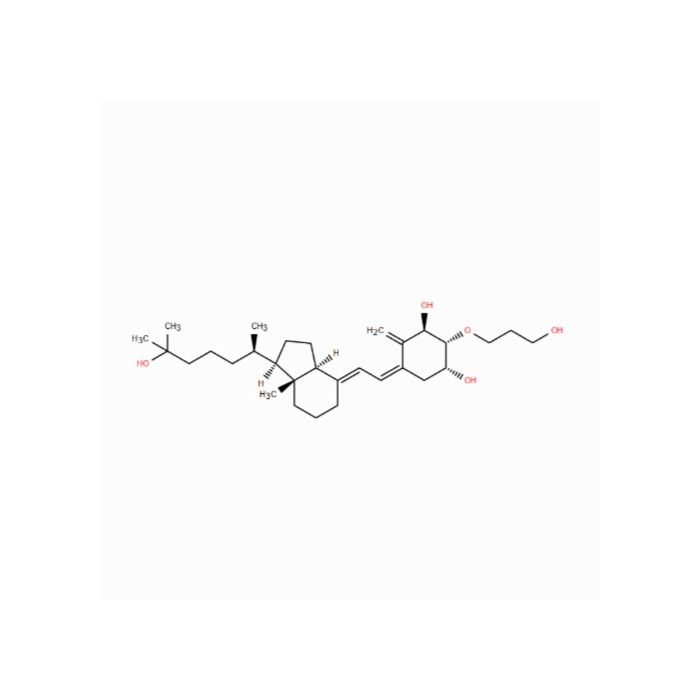
Eldecalcitol (ED-71) is a vitamin D3 analogue, inhibits bone resorption and increases bone mineral density. Eldecalcitol (ED-71) displays anti-tumor effect and inhibits cell proliferation, migration and induces apoptosis by suppressing GPx-1.
Storage
Protected from light,Store at -20°C,Argon charged
Shipped In
Ice chest + Ice pads
This product requires cold chain shipping. Ground and other economy services are not available.
This compound belongs to the class of organic compounds known as vitamin d and derivatives. These are compounds containing a secosteroid backbone, usually secoergostane or secocholestane.
External Descriptors
Vitamin D3 and derivatives
1. Djoumbou Feunang Y, Eisner R, Knox C, Chepelev L, Hastings J, Owen G, Fahy E, Steinbeck C, Subramanian S, Bolton E, Greiner R, and Wishart DS. ClassyFire: Automated Chemical Classification With A Comprehensive, Computable Taxonomy. Journal of Cheminformatics, 2016, 8:61.
Determine the necessary mass, volume, or concentration for preparing a solution.
Dilution Calculator
Determine the dilution needed to prepare a stock solution.
Reconstitution Calculator
Reviews
Customer Reviews
Application Protocols
No tested applications or protocols were provided for this catalog item.
General research-use guidance (non-validated; for planning only):
Stock preparation: Dissolve in anhydrous DMSO or ethanol to 1–10 mM under low light; aliquot into amber, argon-flushed vials; store at −20°C.
Cell-based assays: Dilute stock into pre-warmed media to desired final concentration, keeping vehicle ≤0.1–0.2% v/v; include carrier protein (e.g., 0.1% fatty-acid–free BSA) to reduce adsorption; protect plates from light during incubation.
Biochemical assays: Prepare serial dilutions in assay buffer containing a small percentage of solvent and/or BSA; perform quickly to minimize degradation.
LC–MS calibration: Prepare multi-level standards in ACN/MeOH with 0.1% formic acid; store working standards at 4°C in amber vials for short term and at −20°C for longer term, minimizing freeze–thaw.
Users should validate conditions for their specific models and endpoints and consult peer-reviewed literature for assay-specific parameters.
Biological Roles
General literature context (for research use only; not a therapeutic claim):
Target class: Eldecalcitol is a synthetic analog of vitamin D3 that functions as a high-affinity agonist of the nuclear vitamin D receptor (VDR). Upon binding, the VDR–RXR heterodimer regulates transcription of genes involved in calcium/phosphate handling, differentiation, and other metabolic pathways.
Structural pharmacology highlights:
The 2β-(3‑hydroxypropoxy) substitution alters conformational dynamics and metabolic stability relative to calcitriol, often improving ligand residence time and modifying coactivator recruitment profiles (literature).
Retains the 1α,25-dihydroxyl motif required for canonical hydrogen-bonding to the VDR ligand-binding domain.
Biochemical behavior in vitro:
Strongly lipophilic; tends to partition into membranes and bind to serum proteins. In cell culture, the presence of carrier proteins (e.g., BSA) influences free concentration.
Light/oxygen sensitivity mandates careful dosing and rapid mixing to maintain active ligand concentration during assays.
Research applications:
Probe of VDR-dependent gene networks (reporter assays, ChIP-qPCR/ChIP-seq, RNA-seq).
Comparative SAR studies across vitamin D analogs to dissect the role of A-ring and side-chain modifications on receptor activation and catabolism.
Note: No target specificity data unique to this catalog item were provided; the above reflects general vitamin D receptor biology to aid experimental design.
Buffer Applications
This compound is not a buffering agent and is not used to maintain solution pH.
Practical handling in buffered systems (general guidance):
Prepare concentrated stocks in DMSO or ethanol, then dilute into physiological buffers (e.g., HBSS, PBS, cell culture media) to the desired final concentration, keeping vehicle ≤0.1–0.2% v/v where possible.
To reduce adsorption and precipitation in aqueous buffers, include carrier protein (e.g., 0.1–0.5% BSA or fatty-acid–free BSA) or cyclodextrin formulations when compatible with your assay.
Add the ligand last, with rapid vortexing or pipette mixing; avoid prolonged exposure to ambient light during preparation and incubation.
Buffer compatibility notes:
Avoid strongly basic buffers and oxidizing additives that may degrade the conjugated triene.
For LC–MS sample prep, volatile buffers (ammonium formate/acetate, 2–10 mM) in MeOH/ACN–water are preferred; filter through low-binding PTFE or PVDF.
Green Alternatives
As Eldecalcitol is a specific bioactive small molecule (not a commodity solvent or reagent), “green replacement” typically refers to greener solvent and handling choices during its use and analysis.
Greener handling strategies (general guidance):
Prefer biofriendly stock solvents: Ethanol over chlorinated solvents when feasible; limit DMSO concentration in final biological media.
Avoid chlorinated solvents for routine prep/dilutions; reserve DCM/CHCl3 for necessary analytical extractions only.
Use minimal volumes and high-concentration stocks to reduce waste.
Employ amber glass microscale vials to reduce evaporation waste and photolysis.
Comparison of common choices (general):
Ethanol vs DCM for transfers: Ethanol is less hazardous and compatible with aqueous systems; DCM offers rapid drying but is volatile/toxic.
2‑MeTHF vs THF for synthesis: If protection/derivatization steps are performed, 2‑MeTHF offers a better environmental profile and often improved stability toward peroxide formation compared with THF.
Supercritical CO2 (analytical): For some clean-up steps, SFC can reduce organic solvent consumption relative to HPLC, if method development resources permit.
Trade-offs:
Eldecalcitol’s lipophilicity may necessitate potent solvents (DMSO/MeOH/ACN) for analytical accuracy; balance green goals with data quality.
Light and oxygen sensitivity require inert and amber packaging, which may increase materials use but significantly improves product longevity and reduces repeat syntheses/purchases.
Pharmaceutical Uses
No clinical or therapeutic claims are made for this catalog item. The following refers to non-clinical laboratory and quality control contexts.
Typical research/formulation roles (general):
Analytical reference standard for method development and validation in pharmaceutical or academic labs studying vitamin D analogs.
Tool compound in preformulation studies assessing solubilization strategies for hydrophobic secosteroids (cosolvents, lipid vehicles, cyclodextrins) in in vitro systems.
Spike/recovery control for extraction efficiency in bioanalytical assays (serum, plasma, tissue homogenates) under research-use conditions.
Pharmacopeial status: Not specified for this item; refer to CoA/Spec Sheet and relevant compendia.
Packaging and stability considerations relevant to formulation work:
Supplied argon charged and light-protected; maintain these conditions during aliquoting and storage to preserve integrity of the conjugated triene system.
Employ amber glass vials with PTFE-lined caps; avoid repeated freeze–thaw.
Regulatory note:
Labeled for research use only. Not for human or veterinary use, not for diagnostic or therapeutic applications.
Physical Properties
Item-specific specifications (this lot):
Molecular formula: Not specified for this item; refer to CoA/Spec Sheet.
Molecular weight: Not specified for this item; refer to CoA/Spec Sheet.
Appearance: Not specified for this item; refer to CoA/Spec Sheet.
Literature/general properties (for reference; not item specifications):
Physical state: Typically an off-white to pale solid or viscous resin at ambient temperature; strongly light- and oxygen-sensitive (vitamin D triene).
Solubility: Practically insoluble in water; soluble in organic solvents such as ethanol, methanol, isopropanol, acetonitrile (moderate), dichloromethane, ethyl acetate; highly soluble in DMSO and DMF. Stock solutions commonly prepared at 1–10 mM in anhydrous DMSO or ethanol.
Partitioning: Highly lipophilic (vitamin D analog; high logP, literature) and prone to non-specific adsorption to plastics—prefer glass vials and amber syringes.
UV/Vis: Conjugated triene exhibits strong absorbance in the UV-B region with characteristic bands for vitamin D analogs (literature); rapid photodegradation under UV exposure.
Stability: Sensitive to light, oxygen, and heat; stabilizes under inert gas (argon) at low temperature and in the dark.
Practical tips:
Prepare solutions and manipulations under dim or red light when possible.
Use amber glassware; sparge solutions with inert gas and cap headspace with argon or nitrogen.
Minimize exposure above ambient temperature and avoid repeated thaw/warm cycles.
Quality and Grades
Catalog grade: Moligand™.
Description (program-level, general): Moligand™ denotes Aladdin Scientific’s portfolio focus on high-integrity, research-grade small-molecule ligands suitable for biochemical, molecular pharmacology, and chemical biology workflows where target engagement and structural fidelity are critical. Lots are selected for identity and purity appropriate to research applications; UV/photo-stability considerations are emphasized for light-sensitive ligands.
What this means in practice:
Prioritization of accurate structure/identity for ligand-target studies (e.g., NMR, HPLC/LC–MS verification per internal QA policies).
Packaging tailored to stability (amber vials, inert gas backfill as applicable).
Item-specific notes from Product Data:
Storage: Protected from light; Store at −20°C; Argon charged.
Shipping: Ice chest + ice pads to preserve stability in transit.
Unspecified attributes for this item:
Trace metals, residual solvents, water content, stabilizers, UV cutoffs: Not specified for this item; refer to CoA/Spec Sheet.
Exact purity assay and method: Not specified for this item; refer to CoA/Spec Sheet.
Practical QA recommendations to users:
Upon receipt, verify identity by LC–MS and purity by HPLC if your application is highly sensitivity-dependent (e.g., binding affinity quantitation, cell transcription assays).
Record light exposure and number of freeze–thaw cycles to maintain data integrity across experiments.
Reaction and Applications
Scope for Eldecalcitol in bench chemistry is primarily as a bioactive ligand standard rather than as a general reagent.
Research applications (general, literature-based):
Ligand studies: Agonist for the vitamin D receptor (VDR); used in biochemical binding assays, reporter gene transcription assays, chromatin/transcriptomics studies of VDR signaling, and receptor–ligand structural investigations.
Analytical reference: Employed as a reference standard for LC–MS/MS method development and quality control in the analysis of vitamin D analogs.
Formulation/excipient studies: Solubilization and vehicle evaluation for hydrophobic secosteroids in in vitro systems.
Chemical manipulation (if derivatization is desired):
Protection strategies: Silyl (TBS/TIPS) protection of allylic/secondary alcohols (1α-/3β-/25‑OH) under mild conditions; ensure light exclusion and low temperature.
Ester/ether formation: Selective acylation or carbonate formation at secondary alcohols; Mitsunobu or Williamson-type etherifications on the 3‑OH if protected/unprotected strategy permits.
Oxidation sensitivity: Conjugated triene is susceptible to electrophilic addition/oxidation; avoid strong oxidants, radical initiators, or prolonged exposure to peroxides.
Practical handling tips:
Conduct reactions under inert gas and in the dark (amber glass, foil-wrapped apparatus).
Use mild bases (e.g., pyridine, DIPEA) and room temperature to preserve the triene.
Note: No manufacturer-specific application claims were provided beyond research-use; the above reflects general literature practices for vitamin D analogs.
Reaction Conditions
General conditions for typical transformations of vitamin D analogs like Eldecalcitol (literature guidance; not item specifications):
Esterification of hydroxyl groups:
Reagents: Acyl chlorides or anhydrides with pyridine, DMAP catalysts; or carbodiimide coupling (EDC/DMAP) at 0–25°C.
Solvents: DCM, DMF, or 2‑MeTHF; strictly anhydrous and oxygen-free; amber glassware.
Notes: Protect sensitive alcohols selectively to control regioselectivity.
Reagents: p‑Nitrophenyl chloroformate or CDI-derived carbonates; amine partners for carbamates.
Conditions: 0–20°C, DIPEA/Et3N; monitor closely to avoid overreaction.
Etherification at terminal primary alcohol on the 2β‑substituent:
Mitsunobu (DIAD/PPh3) or Williamson ether synthesis (NaH/alkyl halide) under subdued light; low temperatures to minimize triene isomerization.
Silyl protection/deprotection:
Protection: TBSCl or TIPSCl, imidazole, DMF, 0–25°C.
Deprotection: TBAF in THF at 0–10°C, short times.
Purification and analysis:
Flash chromatography: Hexane/EtOAc or toluene/EtOAc under amber conditions; avoid silica overexposure.
LC–MS: ACN/H2O with ammonium formate or formic acid, low lamp intensity in detectors where applicable.
Expected outcomes: Yields and selectivities vary with protection strategies; plan for small-scale scouting due to sensitivity of the triene and multiple hydroxyls.
Safety and Handling
Authoritative safety information resides in the SDS; always consult the SDS prior to use.
GHS classification, signal word, pictograms, and H-statements: Not specified for this item; refer to SDS.
General hazards (literature/chemical class guidance):
Vitamin D analogs are biologically potent; avoid inhalation, ingestion, and skin exposure. Handle as a potent bioactive research chemical in a fume hood with appropriate containment.
Photosensitivity: Rapid photodegradation; protect from light during handling to avoid formation of unknown photo-products.
Recommended PPE: Lab coat, safety glasses, and chemical-resistant gloves (e.g., nitrile). For weighing or large-scale solution prep, consider double-gloving and using a disposable bench pad.
Handling practices:
Work under inert atmosphere (argon or nitrogen) when possible.
Use amber vials/syringes; minimize headspace oxygen.
Avoid contact with oxidizers and strong acids/bases that may promote decomposition.
First-aid overview (general):
Skin/eye contact: Rinse with water for several minutes; remove contaminated clothing; seek medical advice.
Inhalation: Move to fresh air; seek medical attention if symptoms occur.
Ingestion: Rinse mouth; do not induce vomiting; seek medical attention.
Waste disposal: Collect solutions/solids as halogen-free organic waste unless contaminated otherwise; follow institutional and local regulations.
Transport/receiving: Product is shipped cold with ice packs; inspect for container integrity and maintain cold chain to the freezer. Maintain argon blanket when possible after opening.
Solvent Selection
Solvent strategy is driven by Eldecalcitol’s high lipophilicity and photosensitivity.
Polarity/miscibility (general, literature-based):
Poorly soluble in water; readily soluble in polar aprotic (DMSO, DMF, acetonitrile to a degree) and many organic solvents (ethanol, methanol, 2‑propanol, chloroform, ethyl acetate, toluene).
For biological assays, DMSO or ethanol stocks are most common due to compatibility with aqueous media upon dilution.
Recommended stock solution choices:
DMSO (anhydrous): Excellent solvency; minimize final DMSO concentration in assays (e.g., ≤0.1–0.2% v/v) to limit vehicle effects.
Ethanol (absolute, anhydrous): Good solvency and favorable biocompatibility; consider co-solvent strategies for high concentrations.
Handling considerations:
Use amber, gas-tight glass vials; avoid adsorption to plastics by pre-rinsing with solvent and keeping concentrations ≥10 µM in working solutions.
Degas and inert: Sparge stock solutions lightly with argon and cap headspace to prolong stability.
When to choose alternatives:
For chromatographic purification or analytical methods, MeOH/ACN with 0.1% formic acid or ammonium formate (LC–MS) or hexane/ethyl acetate (normal-phase) are typical; choose based on method validation.
Small comparison (general):
DMSO: Highest solvency/stability; may affect cells above 0.2–0.5%.
DMF: Strong solvent but less biocompatible; reserve for synthesis/stock then dilute/replace if needed.
Storage and Reconstitution
Item-specific storage/shipping from Product Data:
Storage conditions: Protected from light; Store at −20°C; Argon charged.
Shipped in: Ice chest + Ice pads to maintain a cold chain during transit.
Reconstitution and handling (general guidance; not item specifications):
Reconstitution solvents: Use anhydrous DMSO or ethanol to prepare concentrated stocks (e.g., 1–10 mM). Mix gently under dim light until fully dissolved.
Aliquoting: Split into small, single-use amber glass vials or low-bind amber screw-cap vials. Backfill headspace with argon and cap tightly.
Light/oxygen control: Perform all steps quickly under subdued light; wrap vials in foil. Maintain an inert atmosphere where feasible.
Freeze–thaw: Avoid repeated freeze–thaw. Thaw on ice or at room temperature briefly, use immediately, and refreeze unused aliquots only once if necessary.
Short-term stability: Working solutions in DMSO/ethanol are generally stable for the course of an experiment when protected from light and air; aqueous dilutions should be prepared fresh.
Unspecified parameters for this item:
Exact shelf life, acceptable number of freeze–thaw cycles, and stabilizer content: Not specified for this item; refer to CoA/Spec Sheet and SDS.
Always dispose of expired or degraded material following institutional chemical waste procedures.
Structure and Identity
Brief overview: Eldecalcitol (ED-71) is a synthetic vitamin D3 analog (secosteroid) bearing a 1α,25-dihydroxylated A-ring and an additional 2β-(3‑hydroxypropoxy) substituent that modulates VDR binding and metabolic stability.
Item-specific registry data:
CAS: 104121-92-8
SKU: E127221
InChIKey: Not specified for this item; refer to CoA/Spec Sheet.
SMILES: Not specified for this item; refer to CoA/Spec Sheet.
Literature identity (for reference only; not a specification):
Common names: Eldecalcitol; ED-71; 1α,25-dihydroxy-2β-(3-hydroxypropoxy)-vitamin D3
Structural class: Secosteroid (opened B-ring) with the vitamin D3 trans-fused CD-ring system and an isoprenoid side chain at C17.
Functional groups: Two secondary alcohols at C1 and C25, one tertiary alcohol at C3 (vitamin D motif), and a 3-hydroxypropoxy ether at C2β.
Stereochemistry: Multiple defined stereocenters concordant with the vitamin D3 scaffold (A/B cis, C/D trans; 1α- and 25-hydroxyls in native configurations; 2β-alkoxy).
2D structural description (verbal):
A triene secosteroid backbone (conjugated triene across C5–C7/C10) with a cleaved 9,10-bond typical of vitamin D, bearing an A-ring with 1α,3β-diols and an ether substituent at C2β extending as –O–CH2–CH2–CH2–OH; the side chain at C17 terminates in a secondary alcohol at C25.
Synthetic Utility
While Eldecalcitol is generally used as a finished, bioactive ligand rather than a building block, chemists may derivatize it for probe development or SAR studies. General synthetic considerations (literature-based):
Reactive handles:
Secondary alcohols at C1 and C25 and a tertiary/secondary alcohol environment at C3 offer points for esterification, carbonate/urethane formation, and etherification.
The 2β-(3‑hydroxypropoxy) ether contains a terminal primary alcohol suitable for conjugation (e.g., coupling to fluorophores, affinity tags) after appropriate protection of the core diols.
Protection strategy:
Silyl protection (TBS, TIPS) of allylic alcohols under mild conditions is favored; avoid acidic deprotections that might isomerize the triene.
Carbonate protection (e.g., p‑nitrophenyl carbonate) can be used for temporary masking with orthogonal removal.
Key cautions:
Conjugated triene is sensitive to acids, light, radicals, and ozone; keep reactions cool, dark, and oxygen-free.
Strong bases can induce double-bond isomerization—use hindered, non-nucleophilic bases and short contact times.
Analytical support:
Monitor by LC–MS with soft ionization and minimal light exposure; use chilled, amber autosampler vials.
NMR in CDCl3 or CD3OD with subdued lighting; add antioxidants (e.g., BHT at trace levels) only if compatible with downstream use.
Target Specificity
No target specificity, clone, isotype, or species reactivity data were provided for this catalog item. This section typically applies to biologicals (e.g., antibodies, proteins). For Eldecalcitol, please refer to the Biological Roles tab for general, literature-based context on vitamin D receptor engagement in research settings.
Need help choosing the grade?
Our grade selection guide covers purity, stabilizer status, and application suitability for all variants in our catalog.
We use cookies to ensure the website functions properly and, where permitted, to improve your experience. You can manage your preferences at any time in Settings. Learn more in our Cookie Policy.
Shall we send you a message when we have discounts available?
Remind me later
Thank you! Please check your email inbox to confirm.
Products are supplied to verified businesses, institutions, and qualified professionals for research and development use only. Not for use in humans, animals, diagnosis, or therapy.

 G2613509