GRADE & PURITYMoligand™?Moligand™ — Aladdin's line of ligands and bioactive small molecules. Use for receptor, pathway, and binding studies needing defined small-molecule tools.≥98%
This compound belongs to the class of organic compounds known as phenylpyridines. These are polycyclic aromatic compounds containing a benzene ring linked to a pyridine ring through a CC or CN bond.
External Descriptors
Not available
1. Djoumbou Feunang Y, Eisner R, Knox C, Chepelev L, Hastings J, Owen G, Fahy E, Steinbeck C, Subramanian S, Bolton E, Greiner R, and Wishart DS. ClassyFire: Automated Chemical Classification With A Comprehensive, Computable Taxonomy. Journal of Cheminformatics, 2016, 8:61.
Determine the necessary mass, volume, or concentration for preparing a solution.
Dilution Calculator
Determine the dilution needed to prepare a stock solution.
Reconstitution Calculator
Reviews
Customer Reviews
Application Protocols
Only product-validated application protocols from item data may be listed. None are provided for this product.
Tested applications: Not specified for this item; refer to CoA/Spec Sheet.
Recommended concentrations/dilutions: Not specified for this item; refer to CoA/Spec Sheet.
General guidance (non-item-specific): Prepare DMSO stock solutions, include vehicle controls, and perform concentration–response and time-course studies with appropriate biomarker readouts. Validate with orthogonal assays where possible.
Biological Roles
Contextual information (literature-level, not item-specific claims):
Small-molecule modulators targeting protein kinase signaling pathways are widely used to probe translational control, stress responses, and growth signaling cascades in cells.
The mitogen-activated protein kinase interacting kinases (MNK1/2) and the eIF4F complex are common areas of investigation for understanding regulation of mRNA translation initiation and downstream phenotypes such as cell growth and stress adaptation.
Chemical probes that influence these nodes enable elucidation of pathway wiring, phosphorylation-dependent regulation of translational machinery, and crosstalk with MAPK pathways.
Validate specificity by comparing responses in genetic perturbation models (e.g., knockdown/CRISPR) where feasible.
Time- and concentration-response studies help distinguish primary target effects from secondary adaptations.
Note: This section provides general biological context for pathway-modulating small molecules. No target specificity or potency parameters for this product are provided in the item data; consult primary literature or the CoA/Spec Sheet for any available details.
Buffer Applications
This product is not a buffering reagent and does not define solution pH. Accordingly, buffer-system selection (PBS, HEPES, Tris, etc.) is application-dependent.
Practical notes for assay buffers (general guidance):
When diluting DMSO stocks into aqueous buffers, maintain consistent final DMSO across controls and treatments (commonly ≤0.1–0.5% v/v) to avoid solvent artifacts.
Include carrier proteins (e.g., 0.1–0.5% BSA) or non-ionic surfactants (e.g., 0.01% Tween-20) if precipitation or adsorption to plastics is observed.
Filter-sterilize buffers (0.22 µm) for cell-based assays and equilibrate temperature and CO2 conditions as required by the cell line.
No item-specific buffer recommendations are provided; optimize for your assay system.
Green Alternatives
While bioactive small molecules are typically handled at milligram scales, solvent choices can still impact environmental footprint. Consider the following greener practices and alternatives for solution handling and assay preparation (general guidance):
Prefer DMSO over halogenated solvents for stock solutions; DMSO has favorable environmental and safety profiles compared with DMF or NMP, though assay tolerance must be verified.
Explore aqueous vehicles with solubilization aids to reduce organic solvent use:
Hydroxypropyl-β-cyclodextrin (HP-β-CD) complexes
Small percentages of ethanol or propylene glycol with polysorbates
Buffered saline with minimal DMSO (<0.1% v/v) when solubility permits
Comparison (general):
DMSO: High solvency, low volatility; widely accepted in bioassays; waste benign relative to chlorinated solvents.
PEG 400/propylene glycol: Useful for higher loadings in formulation studies; viscosity may complicate liquid handling.
Operational tips:
Use miniaturized assay formats (384–1536 wells) to reduce solvent consumption.
Consolidate solvent waste streams and avoid chlorinated solvents unless required.
Always confirm that alternative vehicles do not affect assay readouts or compound integrity.
Pharmaceutical Uses
This product is supplied strictly for research use only and is not intended for human or veterinary use, diagnostic procedures, or as a drug substance/excipient.
Formulation context (general, non-clinical R&D):
In preclinical research, small molecules are often formulated for in vitro and ex vivo studies using DMSO-based stocks and aqueous dilutions. For non-clinical in vivo method development, co-solvent systems (e.g., PEG 400, ethanol, surfactants) may be explored to assess exposure; such work requires institution-specific approvals and is outside the scope of this catalog entry.
Pharmacopeial status:
No pharmacopeial monograph or excipient status is indicated for this item.
Any clinical or therapeutic claims are explicitly excluded. For all handling and use, follow institutional guidelines and the product’s SDS.
Physical Properties
Item-specific physico-chemical specifications are not provided in this listing.
Appearance: Not specified for this item; refer to CoA/Spec Sheet.
Melting point: Not specified for this item; refer to CoA/Spec Sheet.
Boiling point: Not applicable/Not typically reported for complex organic solids; refer to CoA if available.
Density: Not specified for this item; refer to CoA/Spec Sheet.
Solubility: Not specified for this item; refer to CoA/Spec Sheet. Practical note (general): bioactive small molecules are commonly prepared as concentrated DMSO stocks (e.g., 10–50 mM) and diluted into assay media.
LogP, pKa, refractive index: Not specified for this item; refer to CoA/Spec Sheet.
General handling implications:
If provided as a solid, it is typically reconstituted in anhydrous DMSO, with subsequent dilution into aqueous buffers containing carrier proteins or solvents to minimize precipitation. Confirm compatibility with your assay matrix.
Quality and Grades
Grade/Purity: Moligand™ (item-specific).
What Moligand™ indicates (general description):
A discovery- and screening-oriented small-molecule grade intended for research use in target validation, biochemical/cellular assays, and library applications. Emphasis is on identity and suitability for in vitro research rather than compliance with pharmacopeial monographs.
Key points for this item:
Purity level, residual solvent content, and analytical limits: Not specified for this item; refer to CoA/Spec Sheet.
Stabilizers or form: Not specified for this item; refer to CoA/Spec Sheet.
Recommended verification for critical applications:
Confirm identity by LC–MS and, where appropriate, 1H NMR against literature/control.
Check purity by HPLC/UPLC prior to quantitative assays.
If using for SAR or screening, maintain a documented chain of custody, storage history, and thaw/freeze cycles.
Note: This product is supplied strictly for research use only and is not intended for human or veterinary use, diagnostics, or as an active pharmaceutical ingredient.
Reaction and Applications
This product is supplied as a bioactive small molecule for research use, rather than as a synthetic reagent. Consequently, classical synthetic reaction applications (e.g., coupling, reductions, Grignard) are not typically relevant.
Research applications (general, non-clinical):
Tool compound applications in biochemical assays to modulate signaling pathways and assess downstream biomarkers.
Cell-based studies for pathway engagement, potency ranking, and preliminary SAR comparisons alongside related ligands.
Target engagement methods such as CETSA, NanoBRET, or biochemical kinetics where appropriate controls and orthogonal readouts are used.
ADME/DMPK characterization: solubility, stability, microsomal clearance, and permeability screening for medicinal chemistry workflows.
Practical guidance:
Prepare fresh DMSO stocks and minimize freeze–thaw cycles to maintain integrity.
Include vehicle controls and, if possible, orthogonal reference compounds to contextualize responses.
Confirm identity and purity prior to quantitative experiments (LC–MS, HPLC).
Note: No specific manufacturer application examples are provided for this item; tailor experimental designs to your target biology and consult primary literature for pathway-relevant assay conditions.
Reaction Conditions
Not typically applicable. This product is supplied as a bioactive research compound rather than a reagent for performing chemical reactions.
If using in biological/biochemical assays (general guidance):
Stock solutions: Prepare in anhydrous DMSO under inert atmosphere if moisture-sensitive; typical working concentrations span nM–µM in assays, depending on biology and assay sensitivity.
Incubation: Time courses from 15 min to several hours are common for pathway modulation studies; verify kinetics in your system.
Temperature: Standard cell culture conditions (e.g., 37 °C) or biochemical assay temperatures (25–37 °C) as appropriate.
No item-specific reaction or assay conditions are provided in the product data; consult the literature for pathway-relevant protocols.
Safety and Handling
Hazard classification details are not provided in this listing and may vary with jurisdiction and batch.
Signal word: Not specified for this item; refer to SDS.
GHS pictograms/classification: Not specified for this item; refer to SDS.
H-statements: Not specified for this item; refer to SDS.
Handle powders in a fume hood to avoid inhalation; avoid skin/eye contact.
Avoid ingestion and inhalation; do not pipette by mouth.
Prevent environmental release; dispose of waste via approved chemical-waste streams.
Incompatibilities and stability (general):
Avoid strong oxidizers and strong acids/bases unless compatibility is known.
Protect from prolonged exposure to light and moisture; many bioactives are light- and hydrolysis-sensitive.
First aid (overview; defer to SDS):
Skin/eye contact: Rinse with water for at least 15 minutes; remove contaminated clothing.
Inhalation: Move to fresh air; seek medical advice if symptoms persist.
Ingestion: Rinse mouth; seek medical attention. Provide the SDS to responders.
Always consult the product’s Safety Data Sheet (SDS) for authoritative, lot-specific safety information.
Solvent Selection
Given its classification as a small-molecule bioactive, the following practical solvent guidance applies (general best practices; not item-specific specs):
Primary stock solvent: Anhydrous DMSO is commonly used to prepare concentrated stocks (e.g., 10–50 mM) due to broad solubilizing power and assay compatibility at low final percentages.
Aqueous compatibility: Dilute DMSO stocks into assay buffers or media, keeping final DMSO typically ≤0.1–0.5% v/v for sensitive cell systems (optimize per assay).
Alternative cosolvents: Ethanol or DMF can sometimes be used for intermediate stocks; test for assay tolerance. For in vitro biochemical assays, addition of 0.01–0.1% non-ionic surfactant (e.g., Tween-20) may improve dispersion if precipitation is observed.
Solubility screening tips:
Sonication and gentle warming (≤40 °C) can help dissolution, followed by return to ambient temperature before use.
Verify clarity after dilution; if turbidity forms, increase dilution factor or adjust solvent composition.
Polarity and miscibility (general):
DMSO is fully miscible with water and most organics; ethanol is miscible with water up to high percentages; DMF is fully miscible with water.
Always validate solvent choice against your biological readout to rule out solvent-induced artifacts.
Storage and Reconstitution
Item-specific conditions:
Storage: Store at -20°C (as provided in product data). Protect from light and moisture.
Shipped in: Ice chest + ice pads (as provided).
Reconstitution (general guidance; confirm with CoA):
If supplied as a solid: Allow vial to equilibrate to room temperature in a desiccator before opening to prevent condensation. Dissolve in anhydrous DMSO to prepare a concentrated stock (e.g., 10–50 mM), then aliquot.
If supplied as a solution: Mix thoroughly after thaw; avoid prolonged exposure at room temperature.
Aliquoting and stability:
Store aliquots at -20°C to minimize freeze–thaw cycles. Record the number of thaws per aliquot.
Working solutions in aqueous buffers are typically prepared fresh and used the same day; stability is matrix- and temperature-dependent.
Specifications such as exact solubility, extinction coefficient, and long-term stability are not specified for this item; refer to the CoA/Spec Sheet and SDS for authoritative guidance.
Research use only.
Structure and Identity
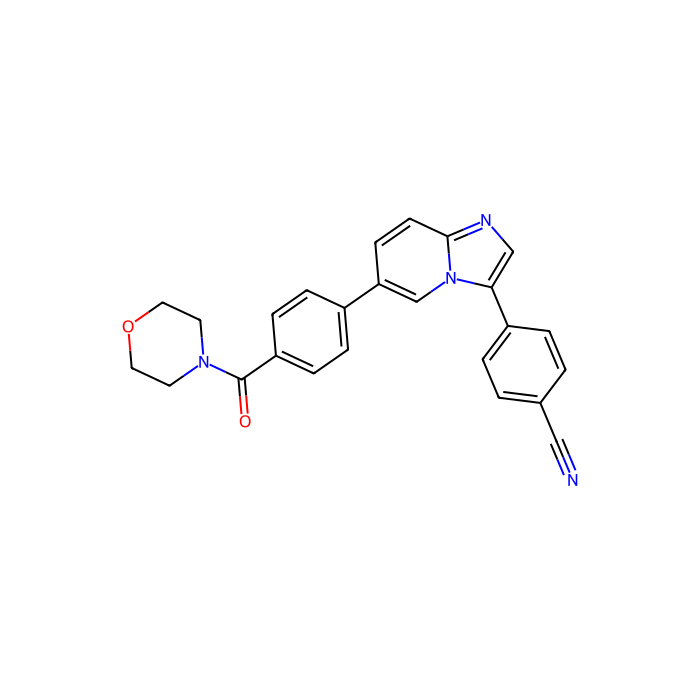
Product name: ETC-206 (AUM 001)
CAS: 1464151-33-4
PubChem CID: 71766360
InChIKey: 94188 (as provided; note that this appears truncated. Not specified for this item; refer to CoA/Spec Sheet for full InChIKey.)
SMILES: Not specified for this item; refer to CoA/Spec Sheet.
Molecular formula: Not specified for this item; refer to CoA/Spec Sheet.
Molecular weight: Not specified for this item; refer to CoA/Spec Sheet.
Structural features (general, literature-level, not item-specific):
Reported in the literature as a small-molecule heteroaromatic kinase-pathway modulator. Specific ring systems and substituents are not provided in this listing; consult primary literature or the CoA for exact structural details.
2D description (generic):
Expected to contain multiple aromatic/heteroaromatic rings and H-bond acceptors/donors typical of ATP-competitive or allosteric modulators; exact functional groups are not specified here.
Synthetic Utility
This material is offered as a defined bioactive small molecule rather than a building block or reagent. It is not typically used as a starting material or intermediate in routine synthetic chemistry.
If derivatization is desired (general considerations):
Without an item-specific structure, potential points for modification (e.g., heteroaromatic substitution, amide/urea handles) cannot be identified here. Consult primary literature and structural data to plan any analog synthesis.
Protect the integrity of the parent scaffold if using it as a reference standard in SAR; maintain strict analytical characterization (LC–MS, NMR, HRMS) after any transformations.
For synthetic method development, consider obtaining dedicated building blocks or purchasing the appropriate precursors rather than modifying this research tool compound.
Target Specificity
Only item-specific data may be listed here. No target, potency, or selectivity information is provided in the product data for ETC-206 (AUM 001).
Target(s): Not specified for this item; refer to CoA/Spec Sheet.
Species selectivity: Not specified for this item; refer to CoA/Spec Sheet.
Mechanism of action: Not specified for this item; refer to CoA/Spec Sheet.
For experimental planning, consult primary literature and independently verify target engagement in your assay system.
Frequently Asked Questions
What is the purity of this product?
This product is supplied at ≥98% purity (chemical assay). Lot-specific values are stated on the Certificate of Analysis.
What is Moligand??
Moligand? is one of Aladdin Scientific's premium product lines, formulated for high-purity applications across multiple workflows. Compared to standard grades in the same workflow, Moligand? products typically offer tighter specifications, more rigorous QC, and stronger lot-to-lot consistency.
How should this product be stored?
Store at ?20 °C. Freezer storage is required to maintain the specified shelf life.
How is this product shipped?
This product ships in an insulated container with ice pads. Unpack on arrival and transfer it to the storage condition stated above.
What are the CAS number, molecular formula and molecular weight?
The CAS Number is 1464151-33-4, the molecular formula is C25H20N4O2, and the molecular weight is 408.45 g/mol. InChIKey FWRFPHJSGLYXTD-UHFFFAOYSA-N.
What documentation is provided?
Available product documentation, including Certificates of Analysis (COA), Safety Data Sheets (SDS), and specification sheets, is shown in the product document area. Document availability and access follow the current site policy.
Need help choosing the grade?
Our grade selection guide covers purity, stabilizer status, and application suitability for all variants in our catalog.
We use cookies to ensure the website functions properly and, where permitted, to improve your experience. You can manage your preferences at any time in Settings. Learn more in our Cookie Policy.
Shall we send you a message when we have discounts available?
Remind me later
Thank you! Please check your email inbox to confirm.
Products are supplied to verified businesses, institutions, and qualified professionals for research and development use only. Not for use in humans, animals, diagnosis, or therapy.

 K2229046