
Structural Features, Property Modulation, and Typical Applications of Triazole Compounds
Structural Features, Property Modulation, and Typical Applications of Triazole Compounds
1 Introduction
Triazole compounds are widely encountered in research fields such as pharmaceuticals, agrochemicals, click chemistry, corrosion protection, proton-conducting materials, coordination materials, and energetic materials. At first glance, these applications appear to differ substantially from one another: antifungal drugs are used to inhibit fungal growth; agricultural fungicides are used to control crop diseases; click chemistry is used for molecular ligation; benzotriazole is used for corrosion inhibition of copper and copper alloys; triazole polymers are used for proton conduction; and nitro- or amino-substituted triazoles are used in the design of energetic materials.
The reason triazoles repeatedly appear across these diverse fields lies fundamentally in their highly concentrated structural features: a five-membered aromatic ring containing three nitrogen atoms. This structure not only maintains relatively good aromatic stability, but also provides strong polarity, hydrogen-bonding capability, metal-coordination ability, and tunable substitution patterns.
To understand triazole compounds, one should start from their structure and address three key questions:
① Why does the position of nitrogen atoms in the triazole ring matter?
② Why can triazoles simultaneously exhibit stable linking, target recognition, metal coordination, and material functions?
③ How do different substitution patterns alter the properties of triazole compounds?
This article follows the main thread of “structure–property–application” and focuses on explaining the underlying structural logic of triazole compounds.
2 Definition of Triazole Compounds
2.1 Basic Concept of Triazoles
Triazole is a five-membered aromatic heterocycle containing three nitrogen atoms and two carbon atoms, with the parent molecular formula C₂H₃N₃. According to the arrangement of the three nitrogen atoms in the five-membered ring, triazoles are mainly divided into two types:
Type | Positions of Nitrogen Atoms in the Ring | Basic Structural Features |
1,2,3-Triazole | Nitrogen atoms at positions 1, 2, and 3 | Three nitrogen atoms are arranged consecutively; commonly found in products of azide–alkyne cycloaddition reactions |
1,2,4-Triazole | Nitrogen atoms at positions 1, 2, and 4 | Nitrogen atoms are distributed relatively more separately; commonly found in pharmaceuticals, agrochemicals, and functional materials |
2.2 Differences Between Triazoles and Common Nitrogen-Containing Heterocycles
A triazole is not merely a simple “nitrogen-containing five-membered ring.” Its distinctive feature lies in the high concentration of three nitrogen atoms within a small aromatic ring. This structure brings about three major effects:
Structural Factor | Direct Effect |
Five-membered aromatic ring | Provides stability and conformational restriction |
Three nitrogen atoms | Increases polarity, hydrogen-bonding ability, and molecular-recognition capability |
Lone pairs on nitrogen atoms | Provide metal-coordination and interfacial-interaction capabilities |
3 Structure–Property Relationships of Triazoles
3.1 Structural Schematic of Two Triazole Parent Scaffolds
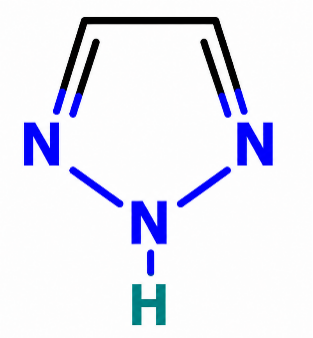
The properties of triazoles are first determined by the arrangement of nitrogen atoms. 1,2,3-Triazole and 1,2,4-triazole have the same molecular formula, but different nitrogen positions. This leads to differences in electron distribution, dipole orientation, substitution patterns, and coordination behavior.
Structural schematic of the 1,2,3-triazole parent scaffold
Structural schematic of the 1,2,4-triazole parent scaffold
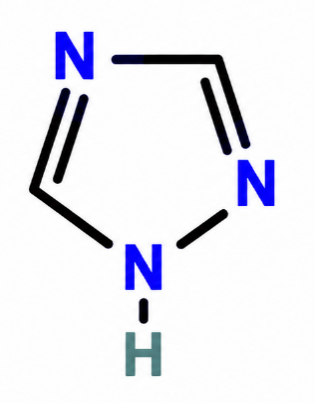
Triazoles are aromatic heterocycles. Their actual electronic structures exhibit delocalization and should not be simply understood as fixed combinations of single and double bonds.
3.2 Nitrogen Atom Arrangement Determines Major Functional Tendencies
The differences between 1,2,3-triazole and 1,2,4-triazole directly influence their application directions.
Comparison Dimension | 1,2,3-Triazole | 1,2,4-Triazole |
Arrangement of nitrogen atoms | Three nitrogen atoms arranged consecutively | Nitrogen atoms distributed relatively more separately |
Common formation methods | Azide–alkyne cycloaddition | Condensation, cyclization, and various heterocycle-synthesis routes |
Main structural roles | Stable linking, spatial orientation, bioisosterism | Enzyme inhibition, coordination recognition, modulation of material functions |
Typical applications | Click chemistry, biolabeling, drug-structure modification | Antifungal drugs, agrochemicals, proton-conducting materials, energetic materials |
Structural advantages | Easily constructed through click reactions; controllable regioselectivity | Commonly involved in coordination recognition and functional modulation; rich substitution patterns |
From the perspective of application distribution, 1,2,3-triazoles are more often used as stable linking and conformational-restriction units, while 1,2,4-triazoles are more commonly found in enzyme inhibition, coordination recognition, and the modulation of functional materials. Both types of triazoles can participate in hydrogen bonding, coordination, and structural modification. Their specific functions depend on the substitution pattern and the overall molecular structure.
3.3 Aromatic Stability Makes Triazoles Suitable as Stable Linking Structures
The triazole ring is aromatic, and electron delocalization within the ring gives it relatively good chemical stability. Compared with flexible aliphatic chains, the triazole ring is more rigid. Compared with certain readily hydrolyzable linker structures, triazoles are more stable under many reaction conditions and in many biological environments.
This feature is particularly representative in click chemistry. Copper-catalyzed azide–alkyne cycloaddition, known as CuAAC, can connect azide and alkyne groups to form 1,4-disubstituted 1,2,3-triazoles. Ruthenium-catalyzed azide–alkyne cycloaddition, known as RuAAC, can be used to obtain 1,5-disubstituted 1,2,3-triazoles. In these reactions, the triazole ring serves as the core structure that stably links two molecular fragments. It addresses key issues in complex molecular ligation, including efficiency, selectivity, and stability.
3.4 The Polynitrogen Structure Provides Hydrogen-Bonding, Dipole, and Target-Recognition Capabilities
The triazole ring contains three nitrogen atoms, which significantly increases molecular polarity and local differences in electron density. Nitrogen atoms can act as hydrogen-bond acceptors. In unsubstituted or specific tautomeric forms, triazoles may also exhibit hydrogen-bond donor characteristics.
In medicinal chemistry, this structure can help molecules interact with proteins, enzymes, nucleic acids, or the active centers of metalloenzymes. 1,2,3-Triazoles are also frequently used as bioisosteres and can replace certain metabolically unstable linker structures, such as some amide bonds, ester bonds, or other linking units. Whether such replacement is effective must be assessed by considering the target-binding mode, conformation, and hydrogen-bond distribution.
The recognition capability of triazoles originates from two aspects:
① Multiple nitrogen atoms provide sites for hydrogen-bonding and dipole interactions.
② The five-membered aromatic ring restricts rotation of substituents, allowing substituents to maintain relatively defined spatial orientations.
3.5 Lone Pairs on Nitrogen Atoms Provide Metal-Coordination Ability
The available pyridine-like nitrogen atoms in the triazole ring can act as hydrogen-bond acceptors or metal-coordination sites, and they can interact with metal ions, metalloenzyme active centers, or metal surfaces. This feature is an important basis for triazole antifungal drugs, aromatase inhibitors, benzotriazole corrosion inhibitors, and triazole-based coordination materials.
Interaction Target | Mode of Triazole Action | Resulting Property |
Metalloenzyme active center | Nitrogen atoms interact with heme iron or a metal center | Enzyme activity is inhibited |
Copper and copper-alloy surfaces | Adsorption, coordination, or formation of a complex protective film | Corrosion rate is reduced |
Metal-ion nodes | Polynitrogen coordination | Construction of coordination polymers or metal–organic frameworks |
Ion-conduction systems | Nitrogen atoms participate in hydrogen bonding and proton migration | Proton conductivity is improved |
3.6 Substitution Position Determines the Direction of Property Modulation
Triazoles can undergo N-substitution or C-substitution. Different substitution positions alter molecular spatial orientation, electronic effects, hydrogen-bonding ability, hydrophobicity, and coordination modes.
Structural Modulation Method | Main Effect | Main Result |
N-substitution | Changes hydrogen-bond donor ability, basicity, hydrophobicity, and ionic characteristics | Affects pharmacokinetic properties, ion conduction, and polymer performance |
C-substitution | Changes substituent spatial orientation and electron distribution | Affects target binding, crystal packing, and material assembly |
Substitution with electron-withdrawing groups | Changes ring electron density, acid–base properties, and thermal stability | Affects energetic-material properties, coordination strength, and reactivity |
Substitution with electron-donating groups | Changes solubility, lipophilicity, and intermolecular interactions | Affects drug activity, systemic properties of agrochemicals, and material processability |
Taking 1,2,3-triazole as an example, 1,4-disubstituted and 1,5-disubstituted structures have the same composition, but the two substituents are oriented differently in space. This difference may alter the binding mode between a drug and its target, and may also change polymer-chain conformation, crystal packing, and the mechanical properties of materials.
4 Comparison with Structurally Related Compounds
4.1 Comparison with Imidazole, Pyrazole, Tetrazole, and Benzotriazole
Triazoles, imidazoles, pyrazoles, and tetrazoles are all nitrogen-containing heterocycles. The properties of different heterocycles depend on the number and positions of nitrogen atoms, acid–base properties, tautomerism, substitution patterns, and the overall molecular structure.
Compound Type | Structural Features | Main Differences from Triazoles | Common Application Features |
Imidazole | Five-membered diazole heterocycle | Stronger basicity; related to the histidine side chain | Biocatalysis, coordination chemistry, drug structures |
Pyrazole | Five-membered diazole heterocycle with two adjacent nitrogen atoms | Different substitution direction and polarity distribution | Agrochemicals, pharmaceuticals, ligand design |
Triazole | Five-membered triazine-like nitrogen heterocycle containing three nitrogen atoms | Combines stability, polarity, coordination ability, and substitution tunability | Pharmaceuticals, agrochemicals, click chemistry, materials, and corrosion protection |
Tetrazole | Five-membered tetrazole heterocycle containing four nitrogen atoms | Stronger acidity; often used as a carboxylic-acid bioisostere | Replacement of acidic fragments in drug molecules |
Benzotriazole | Triazole fused with a benzene ring | Enhanced planarity and hydrophobicity; stronger surface-adsorption ability | Corrosion inhibition of copper and copper alloys; material additives |
4.2 Structural Advantages of Triazoles
The advantage of triazoles does not lie in any single property being extremely prominent, but rather in the balance among multiple properties:
① Compared with imidazole and pyrazole, triazoles have higher nitrogen content and stronger polarity.
② Compared with tetrazole, triazoles are less limited to the simulation of acidic structures.
③ Compared with ordinary aromatic rings, triazoles have stronger hydrogen-bonding and coordination capabilities.
④ Compared with flexible linker chains, triazoles provide stronger conformational restriction.
⑤ Compared with a single coordination group, triazoles offer richer possibilities for substitution-based modulation.
5 Classification and Representative Compounds of Triazole Compounds
5.1 Classification by Parent Scaffold Structure
Classification | Structural Features | Representative Compounds or Structures | Main Uses |
1,2,3-Triazole compounds | Three nitrogen atoms arranged consecutively | 1,4- or 1,5-disubstituted triazoles generated by click reactions | Click chemistry, biolabeling, drug modification |
1,2,4-Triazole compounds | Nitrogen atoms arranged at positions 1, 2, and 4 | Fluconazole, voriconazole, letrozole, ribavirin | Antifungal drugs, enzyme inhibitors, antiviral drugs |
Benzotriazole compounds | Triazole fused with a benzene ring | Benzotriazole, methylbenzotriazole | Corrosion protection of copper and copper alloys |
Triazole salts | Triazoles forming ionic structures | Triazolium salts, energetic triazole salts | Ionic liquids, electrolytes, energetic materials |
Multitriazole structures | Molecules containing multiple triazole rings | Multidentate triazole ligands, bis-triazole energetic compounds | Coordination materials, energetic materials, multivalent recognition |
5.2 Classification by Functional Role
Functional Type | Role Played by Triazoles | Representative Compounds or Structures |
Pharmacophore type | Directly participates in target binding or enzyme inhibition | Fluconazole, itraconazole, voriconazole, letrozole, anastrozole |
Linker type | Links two molecular fragments and provides a stable, rigid connection | 1,2,3-Triazoles generated by CuAAC or RuAAC |
Agrochemical active-structure type | Participates in inhibition of fungal sterol biosynthesis or regulation of plant growth | Tebuconazole, propiconazole, difenoconazole, triadimefon, paclobutrazol |
Surface-protection type | Adsorbs or complexes on metal surfaces | Benzotriazole, methylbenzotriazole |
Coordination-material type | Serves as a polynitrogen ligand for assembly with metal ions | Triazole coordination polymers, metal–organic framework materials |
Ion-conduction type | Participates in hydrogen-bond networks and proton migration | Poly(1-vinyl-1,2,4-triazole) |
Energetic-structure type | Uses a high-nitrogen skeleton and energetic substituents to improve energetic performance | Nitro-, amino-, and nitramino-substituted triazoles |
6 Applications, Problems Addressed, and Research Focuses of Triazole Compounds
6.1 Antifungal Drugs: Inhibition of Ergosterol Biosynthesis
Ergosterol plays an important structural and functional role in fungal cell membranes. Triazole antifungal drugs inhibit cytochrome P450-dependent sterol 14α-demethylase, commonly known as CYP51, thereby blocking ergosterol biosynthesis and impairing the structure and function of fungal cell membranes.
Key Issue | Content |
Problem addressed | Selectively interfering with the ergosterol biosynthesis process on which fungi depend, despite both fungi and human cells being eukaryotic |
Role of triazoles | Triazole nitrogen atoms participate in interactions with the enzyme active center, enhancing inhibition of CYP51 |
Representative compounds | Fluconazole, itraconazole, voriconazole, posaconazole, isavuconazole |
Research focuses | Resistance mutations, drug efflux, structural changes in the target enzyme, combination therapy, and development of new triazole derivatives |
The triazole ring is responsible for key interactions with the enzyme active center, while other aromatic or hydrophobic structures in the molecule help the drug enter and stably occupy the target-enzyme binding site.
6.2 Agricultural Fungicides: Control of Fungal Crop Diseases
Many triazole agricultural fungicides belong to demethylation inhibitors, abbreviated as DMIs. DMI fungicides inhibit the C14 demethylation step in fungal sterol biosynthesis, thereby affecting cell-membrane formation and function.
Key Issue | Content |
Problem addressed | Systemic control of fungal crop diseases such as powdery mildew, rust, and leaf spot |
Role of triazoles | Participation in inhibition of enzymes related to sterol biosynthesis |
Representative compounds | Tebuconazole, propiconazole, difenoconazole, triadimefon |
Research focuses | Resistance management, cross-resistance, risks associated with long-term low-dose use, environmental residues, and ecological impact |
The advantages of triazole agrochemicals include systemic activity, a broad control spectrum, and relatively high control efficiency. However, because many DMI fungicides share the same target site, long-term use of a single mode of action can increase the risk of resistance. Research on triazole agrochemicals should therefore focus not only on improving activity, but also on rotation of modes of action, combination strategies, and environmental safety.
6.3 Click Chemistry: Efficient Ligation of Complex Molecules
CuAAC is one of the most representative reactions in click chemistry. This reaction connects azide and alkyne groups to form stable 1,4-disubstituted 1,2,3-triazoles. RuAAC can be used to construct 1,5-disubstituted 1,2,3-triazoles.
Key Issue | Content |
Problem addressed | Difficulty in achieving efficient and selective ligation among complex molecules, material surfaces, or biomolecules |
Role of triazoles | Acting as a stable and rigid linker structure that connects two molecular fragments |
Representative applications | Drug discovery, fluorescent probes, biolabeling, polymer modification, surface functionalization |
Research focuses | Low copper residues, aqueous-phase reactions, metal-free click reactions, biocompatibility, and regioselectivity control |
6.4 Corrosion Inhibition: Protection of Copper and Copper-Alloy Surfaces
Benzotriazole is a representative corrosion inhibitor for copper and copper alloys. Its triazole moiety can interact with copper surfaces or copper ions through nitrogen atoms, forming adsorbed layers, Cu-BTA coordination species, or polymeric protective films under certain conditions. Here, BTA refers to benzotriazole.
Key Issue | Content |
Problem addressed | Copper and copper alloys are prone to corrosion in the presence of oxygen, water, and corrosive ions |
Role of triazoles | Formation of protective films through adsorption, coordination, or complexation |
Representative compounds | Benzotriazole, methylbenzotriazole |
Research focuses | Film-formation mechanisms, alternative inhibitors with lower environmental risk, long-term protection, and compatibility in microelectronics |
6.5 Proton-Conducting Materials: Improving Ion Conduction under High-Temperature and Low-Humidity Conditions
Proton exchange membrane fuel cells, abbreviated as PEMFCs, have high requirements for proton-conducting materials. Conventional proton exchange membranes often rely on water to maintain proton migration, and their performance can decline under high-temperature or low-humidity conditions.
1,2,4-Triazole and its polymers can participate in proton conduction through nitrogen atoms and hydrogen-bond networks. Materials such as poly(1-vinyl-1,2,4-triazole) have therefore been investigated as proton-conducting materials under high-temperature, low-humidity, or anhydrous conditions.
Key Issue | Content |
Problem addressed | Decreased proton-conduction efficiency under high-temperature and low-humidity conditions |
Role of triazoles | Nitrogen atoms participate in proton acceptance, transfer, and construction of hydrogen-bond networks |
Representative structures | 1-Vinyl-1,2,4-triazole polymers, triazole composite membranes |
Research focuses | Anhydrous proton conduction, mechanical strength, electrochemical stability, and long-term durability of membrane materials |
6.6 Coordination Materials: Construction of Metal–Organic Structures
The polynitrogen structure of triazoles allows them to act as ligands and form coordination polymers, metal–organic frameworks, or MOFs, as well as other metal–organic structures with metal ions.
Key Issue | Content |
Problem addressed | Need for controllable construction of metal–organic structures with pores, magnetism, catalytic properties, or adsorption performance |
Role of triazoles | Acting as polynitrogen ligands to connect metal nodes |
Representative structures | Triazole coordination polymers, triazole-based MOFs |
Research focuses | Regulation of coordination modes, pore-structure design, catalytic activity, gas adsorption, and stability |
6.7 Energetic Materials: Balancing Energy Density and Safety
Energetic materials, or high-energy materials (HEMs), require high energy-release capability while maintaining acceptable thermal stability and mechanical safety. Triazoles are high-nitrogen aromatic heterocycles. They have relatively high nitrogen content, potential for high positive enthalpy of formation, and good structural stability, and are therefore commonly used in the design of energetic materials.
Key Issue | Content |
Problem addressed | Improving energetic performance while controlling thermal stability and mechanical sensitivity |
Role of triazoles | A high-nitrogen aromatic skeleton provides the basis for both energy and stability |
Representative structures | Nitro-, amino-, and nitramino-substituted triazoles; energetic triazole salts |
Research focuses | Low-sensitivity design, salt formation, cocrystal design, thermal-decomposition mechanisms, and environmentally friendly energetic materials |
7 Overall Structural Logic of Triazole Compounds
Structural Origin | Chemical Property | Property Manifestation | Typical Applications |
Five-membered aromatic ring | Aromatic stability and relatively strong rigidity | Stable linking and conformational restriction | Click chemistry, drug modification |
Three nitrogen atoms | Strong polarity and ability to form hydrogen bonds | Molecular recognition and proton conduction | Pharmaceuticals, proton-conducting materials |
Lone pairs on nitrogen atoms | Ability to participate in metal coordination | Enzyme inhibition, metal-surface protection, coordination assembly | Antifungal drugs, corrosion inhibitors, MOFs |
Controllable substitution positions | Tunable spatial orientation and electronic effects | Tunable selectivity, solubility, activity, and stability | Pharmaceuticals, agrochemicals, materials |
High-nitrogen skeleton | High nitrogen content and relatively high enthalpy of formation | Tunable energetic performance and thermal stability | Energetic materials |
The applications of triazoles are not isolated from one another. Antifungal drugs rely on metalloenzyme recognition and inhibition of the sterol pathway. Agrochemicals make use of interference with fungal sterol biosynthesis. Click chemistry relies on the stable linking ability of the triazole ring. Corrosion inhibition uses metal-surface adsorption and complexation. Proton-conducting materials rely on polynitrogen hydrogen-bond networks. Energetic materials take advantage of the high-nitrogen aromatic skeleton. The important capability of triazoles is that they combine structural stability, polar recognition, coordination ability, and substitution tunability within a single small molecular ring.
8 Product Classification Tables Related to the Structural Logic, Property Characteristics, and Application Value of Triazole Compounds
Table 1 Triazole Parent Scaffolds, Substituted Derivatives, and Structurally Related Heterocyclic Reference Compounds
Classification | CAS No. | Aladdin Cat. No. | Name | Specification or Purity | Product Features and Applications |
Structurally related heterocyclic reference compound | 288-32-4 | Imidazole | Anhydrous, ACS, ≥99% | A five-membered diazole heterocyclic reference compound, used for comparing differences in nitrogen atom number, basicity, hydrogen-bonding behavior, and metal-coordination properties | |
Triazole parent scaffold | 288-88-0 | 1,2,4-Triazole | ≥99% | A basic 1,2,4-triazole parent scaffold, used in the synthesis of pharmaceuticals, agrochemicals, coordination materials, and high-nitrogen heterocyclic derivatives | |
Triazole parent scaffold | 288-36-8 | 1H-1,2,3-Triazole | ≥98% | A basic 1,2,3-triazole parent scaffold, used in studies of linker structures, click-reaction product structures, and substituent effects | |
1,2,4-Triazole substituted derivative | 6086-21-1 | 1-Methyl-1,2,4-triazole | ≥99% | An N-methyl-substituted triazole, used to study the effects of N-substitution on polarity, basicity, coordination behavior, and material properties | |
1,2,4-Triazole substituted derivative | 61-82-5 | 3-Amino-1,2,4-triazole | Analytical standard | An aminotriazole analytical standard, used in high-nitrogen heterocycle analysis, herbicidal-activity research, and substituted-structure comparison | |
1,2,4-Triazole substituted derivative | 584-13-4 | 4-Amino-4H-1,2,4-triazole | ≥98% (HPLC) | An amino-substituted triazole, used in high-nitrogen heterocycle derivatization and studies of hydrogen bonding, coordination behavior, and material structures | |
1,2,4-Triazole substituted derivative | 1455-77-2 | 3,5-Diamino-1,2,4-triazole | ≥98% | A diamino high-nitrogen heterocycle, used in studies of multi-site hydrogen bonding, metal coordination, nitrogen-containing functional materials, and high-nitrogen structures | |
1,2,4-Triazole substituted derivative | 16691-43-3 | 3-Amino-5-mercapto-1,2,4-triazole | ≥98% | A nitrogen–sulfur multi-site triazole derivative, used in metal coordination, surface adsorption, and heterocycle functionalization studies | |
1,2,4-Triazole substituted derivative | 3179-31-5 | 3-Mercapto-1,2,4-triazole | ≥97% | A mercapto-substituted triazole, used in studies of metal-surface adsorption, metal coordination, corrosion-inhibition mechanisms, and sulfur-containing heterocycles | |
1,2,4-Triazole substituted derivative | 24807-55-4 | 3-Nitro-1,2,4-triazole | ≥98% (HPLC) | A nitro-substituted high-nitrogen triazole, used in studies of high-nitrogen heterocycles, thermal stability, structure–energy relationships, and energetic structures | |
1,2,4-Triazole substituted derivative | 7343-34-2 | 3,5-Dimethyl-1,2,4-triazole | ≥95% (GC) | An alkyl-substituted triazole, used to study steric hindrance, lipophilicity, substitution position, and structure–property relationships | |
Structurally related heterocyclic reference compound | 288-13-1 | Pyrazole | ≥98% (GC) | A five-membered diazole heterocyclic reference compound, used for comparing nitrogen atom arrangement, tautomerism, and structural differences from triazoles | |
Structurally related high-nitrogen heterocyclic reference compound | 288-94-8 | Tetrazole | ≥98% | A five-membered tetrazole heterocyclic reference compound, used for comparing the structure and acid–base properties of high-nitrogen acidic heterocycles with those of triazoles | |
Structurally related high-nitrogen heterocyclic reference compound | 4418-61-5 | 5-Amino-1H-tetrazole | ≥98% | An amino-substituted tetrazole high-nitrogen heterocycle, used for comparison with aminotriazoles in terms of nitrogen content, acid–base properties, and material performance |
Table 2 Benzotriazole Corrosion-Inhibiting Compounds and Benzotriazole-Based Coupling Reagents
Classification | CAS No. | Aladdin Cat. No. | Name | Specification or Purity | Product Features and Applications |
Benzotriazole corrosion-inhibiting compound | 95-14-7 | Benzotriazole | ≥99% | A representative corrosion inhibitor for copper and copper alloys, used in studies of metal-surface adsorption, complex protective films, and corrosion-inhibition mechanisms | |
Benzotriazole corrosion-inhibiting compound | 136-85-6 | 5-Methyl-1H-benzotriazole | ≥99% | A methyl-substituted benzotriazole, used in copper corrosion protection and studies of substituent effects and metal-surface adsorption performance | |
Benzotriazole corrosion-inhibiting compound | 29385-43-1 | Methyl-1H-benzotriazole, mixture (TTA) | ≥98% (GC) | A mixture of methylbenzotriazole isomers, used in corrosion inhibition of copper and copper alloys, anticorrosion additives, and surface-protection studies | |
Benzotriazole structural derivative | 13351-73-0 | 1-Methyl-1H-benzotriazole | ≥98% | An N-methyl-substituted benzotriazole, used to compare the effects of N-substitution on adsorption, coordination, and anticorrosion performance | |
Benzotriazole structural derivative | 94-97-3 | 5-Chlorobenzotriazole | ≥98% | A halogenated benzotriazole, used to study the effects of electron-withdrawing substitution on metal-surface interactions and anticorrosion performance | |
Benzotriazole structural derivative | 28539-02-8 | 1H-Benzotriazole-1-methanol | ≥96% | A hydroxymethylated benzotriazole derivative, used in functional modification, resin additives, and surface-interaction studies | |
Benzotriazole-based carboxylic acid activation reagent | 2592-95-2 | H684271 | 1-Hydroxybenzotriazole (HOBt) | ≥99% | A carboxylic acid activation auxiliary reagent, used in amide coupling, peptide synthesis, and studies of benzotriazole active esters |
Benzotriazole-based carboxylic acid activation reagent | 123333-53-9 | 1-Hydroxybenzotriazole hydrate | ≥97% | A hydrated hydroxybenzotriazole reagent, used in amide coupling, carboxylic acid activation, and peptide synthesis studies | |
Azabenzotriazole-based carboxylic acid activation reagent | 39968-33-7 | 1-Hydroxy-7-azabenzotriazole (HOAt) | ≥99% | An azabenzotriazole hydroxy reagent, used in amide coupling, carboxylic acid activation, and racemization control studies | |
Azabenzotriazole-based uronium coupling reagent | 148893-10-1 | O-(7-Azabenzotriazol-1-yl)-N,N,N′,N′-tetramethyluronium hexafluorophosphate (HATU) | ≥99% | An azabenzotriazole-based uronium coupling reagent, used in peptide synthesis, amide-bond formation, and coupling of pharmaceutical intermediates | |
Benzotriazole-based uronium coupling reagent | 94790-37-1 | Benzotriazol-N,N,N′,N′-tetramethyluronium hexafluorophosphate (HBTU) | ≥99% | A benzotriazole-based uronium coupling reagent, used in carboxylic acid activation, amide-bond formation, and peptide synthesis | |
Benzotriazole-based uronium coupling reagent | 125700-67-6 | O-Benzotriazol-N,N,N′,N′-tetramethyluronium tetrafluoroborate | ≥98% | A benzotriazole-based uronium coupling reagent, used in amide coupling, peptide synthesis, and preparation of heterocyclic pharmaceutical intermediates | |
Benzotriazole-based phosphonium coupling reagent | 56602-33-6 | Castro’s reagent (BOP) | ≥98% | A benzotriazole-based phosphonium coupling reagent, used in carboxylic acid activation, peptide condensation, and amide-bond formation |
Table 3 Click Chemistry Reagents and Reagents for Constructing 1,2,3-Triazoles
Classification | CAS No. | Aladdin Cat. No. | Name | Specification or Purity | Product Features and Applications |
Monovalent copper catalyst for click chemistry | 7681-65-4 | Copper(I) iodide | Anhydrous, ≥99.995% metals basis | A monovalent copper catalyst, used in azide–alkyne cycloaddition reactions and the construction of 1,4-disubstituted 1,2,3-triazoles | |
Divalent copper salt source for click chemistry | 7758-99-8 | Copper(II) sulfate pentahydrate | European Pharmacopoeia (Ph. Eur.), suitable for analysis, ACS, premium grade | A divalent copper salt source that works with a reducing agent to generate active monovalent copper species, used in azide–alkyne cycloaddition systems | |
Monovalent copper catalyst for click chemistry | 7787-70-4 | Copper(I) bromide | PrimorTrace™, ≥99.99% metals basis | A monovalent copper catalyst, used for cycloaddition between terminal alkynes and azide compounds to generate 1,2,3-triazoles | |
Reducing agent for click chemistry | 134-03-2 | Sodium ascorbate | Analytical standard | A reducing agent that works with divalent copper salts to generate monovalent copper catalytic active species, used in azide–alkyne cycloaddition reactions | |
Alkynylation reagent for click chemistry | 106-96-7 | Propargyl bromide | 80 wt% solution in toluene, containing 0.3% MgO stabilizer | A propargylation reagent, used to introduce terminal alkyne structures and participate in triazole click ligation | |
Electron-withdrawing alkyne substrate for click chemistry | 623-47-2 | Ethyl propiolate | ≥98% (GC) | An electron-withdrawing alkynyl ester substrate, used to construct triazole carboxylate derivatives and study substituent effects | |
Protected alkyne reagent for click chemistry | 1066-54-2 | Trimethylsilylacetylene | ≥98% | A protected acetylene reagent, used in the preparation of terminal alkyne precursors and construction of triazole linker structures | |
Amino alkyne substrate for click chemistry | 2450-71-7 | Propargylamine | ≥98% | An amino-containing terminal alkyne reagent, used to introduce modifiable alkynyl fragments and triazole linker structures | |
Electron-withdrawing alkyne substrate for click chemistry | 922-67-8 | Methyl propiolate | ≥97% | An electron-withdrawing alkynyl ester substrate, used in the synthesis of triazole carboxylate structures and studies of electronic effects | |
Aryl alkyne substrate for click chemistry | 536-74-3 | Phenylacetylene | ≥97% | An aryl terminal alkyne substrate, used in the synthesis of aryl-substituted 1,2,3-triazoles and studies of conformational restriction | |
Azide substrate for click chemistry | 72320-38-8 | 3-Azido-1-propanol | ≥96% | An azide-terminated alcohol, used to introduce azide functional groups and in click ligation and bioorthogonal reaction substrate design | |
Copper ligand for click chemistry | 510758-28-8 | Tris[(1-benzyl-1H-1,2,3-triazol-4-yl)methyl]amine (TBTA) | ≥95% | A triazole-based copper ligand, used to stabilize active monovalent copper species and in azide–alkyne cycloaddition research |
Table 4 Triazole Bioactive Pharmaceutical Compounds
Classification | CAS No. | Aladdin Cat. No. | Name | Specification or Purity | Product Features and Applications |
Triazole antifungal bioactive compound | 171228-49-2 | Posaconazole | Moligand™, ≥99% | A triazole antifungal drug, used in studies of ergosterol biosynthesis inhibition, resistance mechanisms, and drug activity | |
Triazole aromatase inhibitor | 120511-73-1 | Anastrozole | Moligand™, ≥99% | A triazole aromatase inhibitor, used in studies of metalloenzyme inhibition, structure–activity relationships, and drug activity | |
Triazole antifungal bioactive compound | 84625-61-6 | Itraconazole | Moligand™, ≥98% (HPLC) | A triazole antifungal drug, used in studies of sterol biosynthesis pathway inhibition, fungal resistance, and drug metabolism | |
Triazole antifungal bioactive compound | 137234-62-9 | Voriconazole | Moligand™, ≥98% | A triazole antifungal drug, used in studies of invasive fungal infections, target-enzyme inhibition, and drug susceptibility | |
Triazole nucleoside analogue | 36791-04-5 | Ribavirin | Moligand™, ≥98% | A 1,2,4-triazole carboxamide nucleoside analogue, used in studies of antiviral activity, nucleoside metabolism, and drug activity | |
Triazole aromatase inhibitor | 112809-51-5 | Letrozole (CGS 20267) | Moligand™, ≥98% | A triazole aromatase inhibitor, used in studies of heme metal-center binding, endocrine pharmacology, and pharmacological activity | |
Triazole antifungal bioactive compound | 86386-73-4 | Fluconazole | Moligand™, ≥98% | A triazole antifungal drug, used in studies of sterol demethylase inhibition, drug susceptibility, and fungal resistance | |
Triazole antifungal bioactive compound | 241479-67-4 | Isavuconazole | ≥98% | A triazole antifungal drug, used in studies of sterol biosynthesis inhibition, resistant strains, and drug activity |
Table 5 Triazole Agrochemical Analytical Standards, Agrochemical Bioactive Compounds, and Mechanistic Reference Compounds
Classification | CAS No. | Aladdin Cat. No. | Name | Specification or Purity | Product Features and Applications |
Triazole agrochemical analytical standard | 60207-90-1 | Propiconazole | Analytical standard, mixture of isomers | A triazole sterol demethylation inhibitor analytical standard, used in pesticide residue testing, crop disease-control research, and resistance monitoring | |
Triazole agrochemical standard solution | 43121-43-3 | Triadimefon standard solution | Analytical standard, 10 µg/mL in petroleum ether | A triazole fungicide standard solution, used in pesticide residue analysis, method validation, and detection of sterol biosynthesis inhibitors | |
Triazole plant growth regulator standard solution | 76738-62-0 | Paclobutrazol standard solution | Analytical standard, 10 µg/mL in methanol | A triazole plant growth regulator standard solution, used in crop growth regulation, residue analysis, and quality control | |
Triazole agrochemical standard solution | 85509-19-9 | Flusilazole standard solution | Analytical standard, 1.00 mg/mL in methanol | A triazole fungicide standard solution, used in pesticide residue testing, instrument calibration, and resistance monitoring | |
Triazole agrochemical analytical standard | 131983-72-7 | Triticonazole | Analytical standard, ≥99.2% | A triazole fungicide analytical standard, used in seed-treatment agent analysis, crop disease-control research, and residue testing | |
Triazole agrochemical analytical standard | 107534-96-3 | Tebuconazole | Analytical standard, ≥99% | A triazole fungicide analytical standard, used in pesticide residue testing, fungal sterol biosynthesis inhibition studies, and resistance-risk research | |
Triazole agrochemical analytical standard | 88671-89-0 | Myclobutanil | Analytical standard, ≥98.5% | A triazole fungicide analytical standard, used in crop disease-control research, residue analysis, and target-action studies | |
Triazole agrochemical analytical standard | 79983-71-4 | Hexaconazole | Analytical standard, ≥98% | A triazole fungicide analytical standard, used in pesticide residue testing, quality control, and pathogenic fungal inhibition studies | |
Triazole agrochemical analytical standard | 119446-68-3 | Difenoconazole | Analytical standard, ≥98% | A triazole fungicide analytical standard, used in pesticide residue testing, sterol demethylation inhibition studies, and resistance monitoring | |
Triazole plant growth regulator analytical standard | 83657-22-1 | Uniconazole | Analytical standard, ≥97.5% | A triazole plant growth regulator analytical standard, used in gibberellin biosynthesis-related studies and residue analysis | |
Triazole agrochemical bioactive compound | 66246-88-6 | Penconazole | Moligand™, ≥98% | A triazole fungicidal bioactive compound, used in studies of sterol demethylation inhibition, agrochemical activity evaluation, and resistance mechanisms | |
Triazole agrochemical analytical standard | 133855-98-8 | Epoxiconazole | Analytical standard | A triazole fungicide analytical standard, used in cereal disease-control research, residue testing, and analytical method development | |
Triazole agrochemical bioactive compound | 76674-21-0 | Flutriafol | ≥98% | A triazole fungicidal bioactive compound, used in studies of sterol demethylation inhibition, crop disease control, and structure–activity relationships | |
Structurally related imidazole fungicide reference compound | 68694-11-1 | Triflumizole (Standard) | — | An imidazole sterol demethylation inhibitor reference compound, used for comparison with triazole fungicides in mechanism-of-action studies and residue analysis |
Note: The above products are representative Aladdin products related to scientific research and formulation research. For additional product specifications, grades, and COA information, please search by product name, CAS No., or catalog number on the Aladdin website.
For more related articles, please see below:
Reactions of strained alkenes in click chemistry