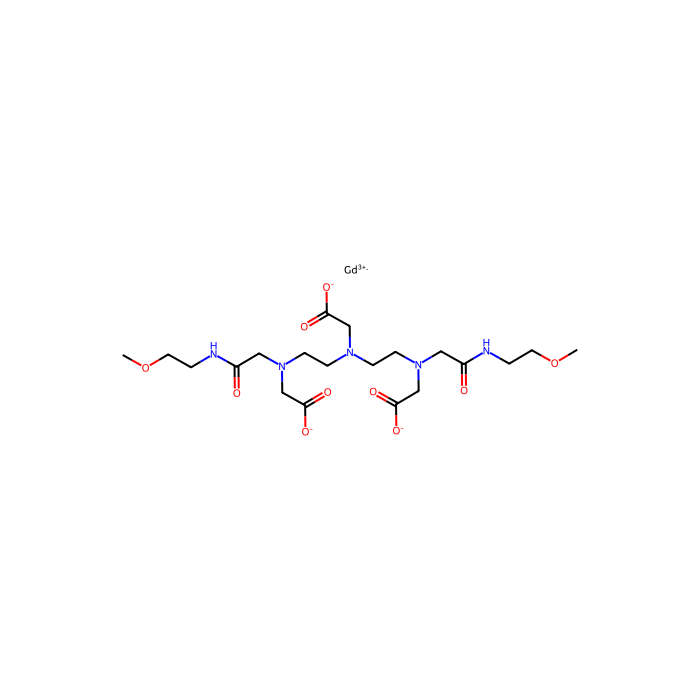
This compound belongs to the class of organic compounds known as alpha amino acid amides. These are amide derivatives of alpha amino acids.
External Descriptors
gadolinium coordination entity
1. Djoumbou Feunang Y, Eisner R, Knox C, Chepelev L, Hastings J, Owen G, Fahy E, Steinbeck C, Subramanian S, Bolton E, Greiner R, and Wishart DS. ClassyFire: Automated Chemical Classification With A Comprehensive, Computable Taxonomy. Journal of Cheminformatics, 2016, 8:61.
Determine the necessary mass, volume, or concentration for preparing a solution.
Dilution Calculator
Determine the dilution needed to prepare a stock solution.
Reconstitution Calculator
Reviews
Customer Reviews
Application Protocols
Item-specific validated applications are not provided for this listing.
General research protocols (literature; for guidance only)
T1 phantom preparation:
Prepare a stock solution gravimetrically in DI water (e.g., 10–100 mM based on intended use). Optionally include 0.9% NaCl to match physiological ionic strength.
Dilute to target concentrations (e.g., 0.05–2.0 mM) in agarose or gelatin solutions for solid phantoms; degas to reduce bubbles; cast into molds.
Record temperature, pH, and ionic strength; measure T1/T2 with inversion‑recovery and multi‑echo sequences.
Relaxivity determination (r1, r2):
Prepare a concentration series (n≥6) in a fixed buffer at controlled temperature.
Measure 1/T1 and 1/T2; plot vs [Gd] to obtain slopes r1 and r2. Verify linearity at low concentrations.
NMR recycle‑delay reduction (aqueous samples):
Spike trace amounts (µM) to shorten water T1 and reduce experiment time. Validate that analyte lineshape/signal is acceptable at the chosen concentration.
Note: These are general methods; adjust to instrumentation, field strength, and quality requirements. For application‑specific validation, consult your internal SOPs.
Biological Roles
General knowledge (biochemistry/materials; not clinical)
Gadolinium is not a biological element and has no known physiological role. As a free ion, Gd3+ can mimic Ca2+ in some systems and block calcium channels, but in well‑designed chelates such as gadoversetamide, the metal is tightly bound and largely prevented from interacting with biomolecules (literature).
In vitro research: Gadoversetamide is used to study water‑exchange kinetics, macromolecular interactions (e.g., with proteins or polysaccharides), and the influence of microenvironmental factors (viscosity, temperature) on longitudinal and transverse relaxation rates in aqueous media.
Cell and tissue phantoms: Incorporated into agarose, gelatin, PVA cryogels, or tissue‑mimicking materials to generate biologically relevant relaxation times for MRI method development. Concentrations are tuned to reproduce T1/T2 values observed in biological tissues for purely methodological work.
Stability considerations: The chelate’s behavior is pH‑dependent. Near‑neutral pH and moderate ionic strength help maintain complex integrity during biological model studies. Competitive chelators (e.g., EDTA, DTPA) in samples can alter the speciation and apparent relaxivity if present at high levels.
Caveat
All uses are for research and laboratory purposes only. No medical or clinical claims are made or implied.
Buffer Applications
Not typically applicable.
Gadoversetamide is not a buffer component and does not establish a defined pH range. It is, however, commonly dissolved in preselected buffers (e.g., phosphate, HEPES, TRIS) to prepare MRI/NMR phantoms or relaxometry solutions.
Practical notes (general)
Choose buffers with minimal metal‑binding capacity at the working pH to avoid perturbing chelate speciation (HEPES and phosphate are common choices; avoid strong chelators like EDTA unless specifically studying competitive binding).
Maintain ionic strength to match intended application (e.g., 0.9% NaCl for physiologically inspired phantoms). Document buffer composition because relaxivity can vary modestly with ionic strength and pH.
Green Alternatives
Context
Gadoversetamide is a specialized paramagnetic Gd(III) chelate used for imaging research; “green chemistry” considerations focus on lifecycle impacts (rare‑earth mining, ligand synthesis, aqueous waste) rather than solvent replacement.
Alternatives and trade‑offs (literature/general)
Macrocyclic Gd(III) chelates (e.g., DOTA‑based) vs linear bis‑amide chelates:
Pros (macrocyclic): Higher kinetic and thermodynamic stability, generally lower propensity for Gd release under harsh conditions; potentially reduced risk under extreme processing.
Cons (macrocyclic): Often more complex synthesis, different relaxivity and water‑exchange characteristics; may alter phantom calibration curves.
Manganese‑based or iron‑based complexes:
Pros: Avoid rare‑earth sourcing; Mn(II)/Fe(III) are more earth‑abundant.
Cons: Different magnetic properties, redox activity, and potentially greater interaction with biomolecules; relaxivity and stability profiles differ, affecting comparability.
Greener practice tips
Use aqueous media exclusively; avoid organic co‑solvents when possible.
Minimize concentrations to what is required for target T1/T2 values; document and reuse phantoms to reduce waste.
Segregate and properly dispose of gadolinium‑containing waste; consider chelation of waste streams to limit free metal release.
Source electricity‑efficient lyophilization/incubation where relevant and maintain cold‑chain efficiency to minimize dry‑ice usage.
Note
Selection of an alternative should be driven by required relaxivity, stability, and matrix compatibility for your specific research use.
Pharmaceutical Uses
Scope of this section
Provided for formulation and process research context only; no therapeutic or clinical claims are made.
Formulation research roles (general literature)
Reference material: Employed as a model nonionic Gd(III) chelate in preformulation studies exploring osmolality, viscosity, stability vs pH/temperature, and interactions with excipients.
Processing studies: Useful for evaluating sterilizing filtration, thermal stress, and lyophilization protocols for paramagnetic aqueous formulations.
Analytical method development: Serves as a standard for ICP‑MS quantitation of gadolinium, HPLC methods for chelate/ligand profiling, and relaxivity‑based potency assays.
Device/material compatibility: Investigations of adsorption to polymeric surfaces, extractables/leachables impact on chelate integrity, and container closure interactions.
Regulatory notes
Pharmacopeial monographs and compendial specifications, if any, vary by region and product presentation. For this catalog item, compendial status and grades are not specified; consult the CoA/Spec Sheet if required for your workflow.
Physical Properties
Item-specific (Product Data)
Appearance: Not specified for this item; refer to CoA/Spec Sheet.
Molecular weight: Not specified for this item; refer to CoA/Spec Sheet.
Literature/general properties (for context; not item specifications)
Physical state: Typically obtained as a highly water‑soluble solid or as an aqueous solution of the Gd(III) chelate (literature).
Solubility: High aqueous solubility expected for the formulated complex; organic solvent solubility is limited to highly polar media (e.g., water, some polyols) due to the polyaminocarboxylate framework (literature).
LogP: Effectively very low; overall neutral yet strongly hydrophilic due to multiple donor atoms and hydration (literature).
Acid/base behavior: The ligand contains tertiary/secondary amines and carboxamide/carboxylate functionalities; protonation state and conditional stability constants are pH‑dependent (literature). Chelate stability is maximized in mildly acidic to neutral aqueous conditions commonly used for imaging phantoms.
Paramagnetism: Strongly paramagnetic due to Gd3+ (seven unpaired electrons), yielding pronounced T1 (and some T2) effects in NMR/MRI phantoms; magnetic susceptibility enhancements scale with concentration and temperature (literature).
Notes
Exact numeric values for mp/bp/density/refractive index are not generally assigned to such metal chelate formulations and are formulation‑dependent. For experiment‑critical parameters, consult the item’s CoA/Spec Sheet.
Quality and Grades
Item-specific (Product Data)
Grade/Purity: Not specified for this item; refer to CoA/Spec Sheet.
Guidance for this class of material (general; not item specifications)
Typical quality attributes for Gd(III) chelates used in research include: identity confirmation of the ligand and metal complex (NMR of ligand, MS/ICP‑MS for Gd), assay of gadolinium content, residual free Gd3+ (ICP‑MS/complexometric titration), pH of supplied solution (if applicable), osmolality and conductivity (for phantom/formulation use), and level of competing metals (Zn, Cu, Fe).
Low‑metal background: For relaxation studies, low levels of adventitious paramagnetic impurities (Fe, Mn) are important; vendors may report metal limits. If not listed, verify by ICP‑MS if your application is sensitive.
Stabilizer/buffer: Complexes may be supplied in water or buffered aqueous media. Buffer identity and concentration influence relaxivity and stability. If unstated, treat as unspecified and verify prior to critical measurements.
Documentation: For chromatography, phantom preparation, or relaxivity benchmarking, request a CoA including method of gadolinium assay, free ligand/metal tests, and microbial limits if sterility/endotoxin are relevant to your workflow.
Bottom line
In the absence of a stated grade, treat this as a research‑grade chemical. For regulated or quantitative applications, qualify the lot internally or contact us for detailed specifications.
Reaction and Applications
Research applications (literature; non-clinical)
MRI/NMR phantoms: Widely used to prepare T1‑weighted calibration phantoms and to benchmark relaxivity (r1, r2) as a function of concentration, temperature, pH, and field strength.
Relaxometry standards: Serves as a convenient paramagnetic standard for inversion‑recovery and CPMG measurements in benchtop and high‑field NMR relaxometers.
Contrast mechanism studies: Model compound for investigating inner‑sphere vs outer‑sphere contributions, water exchange kinetics, and rotational correlation times in Gd(III) chelates.
Materials and polymer research: Doping hydrogels, microbeads, and polymer matrices with gadoversetamide imparts controlled paramagnetism for MRI‑visible materials and agent‑release studies.
Method development: Useful for testing pulse sequences, quantification pipelines (T1 mapping, MOLLI, VFA), and scanner QA/QC when clinical agents are not being used.
Practical notes
Concentration control: Prepare gravimetrically in high‑purity water; verify Gd concentration by ICP‑MS or complexometric titration if quantitative relaxivity is required.
pH and buffer: Maintain near‑neutral pH to avoid chelate degradation; phosphate or HEPES buffers are commonly used when ionic strength control is desired.
Temperature: Relaxivity decreases with increasing temperature; document and control temperature during measurements.
Materials compatibility: Use plastic or glassware with low metal leaching; avoid prolonged contact with reactive metals that could promote transmetallation under extreme conditions.
Reaction Conditions
Not a conventional reagent for chemical transformations.
Experimental handling conditions for research use (general)
Solvent: Water (DI) or defined aqueous buffers at pH ~6–8.
Concentration ranges: For relaxometry, typical working concentrations span low µM to low mM, depending on field strength and target T1/T2 values (literature). Always calibrate with known standards.
Temperature: Control between 15–37 °C; report temperature alongside relaxation data due to temperature dependence of relaxivity.
Filtration: 0.22–0.45 µm membrane filtration recommended for phantom clarity; avoid metal‑containing housings when trace metals are critical.
Containers: Use plastic (PP, HDPE) or borosilicate glass. Avoid reactive metals that could, under extreme conditions, promote metal exchange.
Do not treat these parameters as product specifications; they are general literature guidelines for using Gd(III) chelates in NMR/MRI research workflows.
Safety and Handling
Item-specific (Product Data)
GHS signal word: Not specified for this item; refer to SDS.
H‑statements/GHS classification/pictograms: Not specified for this item; refer to SDS.
General safety considerations (literature/standard practice; defer to SDS for authoritative guidance)
Hazard overview: Gadolinium(III) chelates are generally handled as laboratory chemicals. Avoid inhalation of powders/aerosols and contact with skin/eyes. Use in a chemical fume hood when handling dry material or concentrated solutions.
PPE: Lab coat, safety goggles, appropriate chemical‑resistant gloves (e.g., nitrile), and closed‑toe shoes. For solution handling, splash protection as needed.
Incompatibilities: Strong oxidants and strong acids/bases can compromise ligand integrity and chelate stability; avoid extreme pH and prolonged heating that may promote transmetallation or demetallation (literature).
Special risks: Free Gd3+ salts are toxic; although chelation greatly reduces bioavailability, prevent conditions that could release Gd3+ (e.g., strong mineral acids, competitive chelants, or metal exchange with high concentrations of Zn2+/Cu2+ under forcing conditions).
First aid (overview): In case of skin/eye contact, rinse with water for several minutes; remove contaminated clothing. If inhaled, move to fresh air. If swallowed, rinse mouth. Seek medical advice and provide the SDS.
Waste: Collect aqueous solutions and solids as hazardous inorganic/chelate waste according to institutional and local regulations.
Solvent Selection
Applicability
Gadoversetamide is predominantly used in aqueous systems. Solvent selection is therefore focused on water and highly polar media.
General guidance (literature)
Primary solvent: Water (DI or buffered). High aqueous compatibility and strong hydration are intrinsic to polyaminocarboxylate Gd(III) chelates.
pH considerations: Maintain near‑neutral pH (≈6–8) to preserve chelate integrity and minimize risk of demetallation. Avoid strong acids/bases for prolonged periods.
Co‑solvents: If needed for co‑formulation or lyophilization studies, small fractions of polar organics (e.g., glycerol, propylene glycol) can be used; verify effects on relaxivity and viscosity.
Ionic strength: Background electrolytes (NaCl, phosphate) can influence solution properties (conductivity, osmolality) and, modestly, relaxivity via outer‑sphere effects.
Comparison (qualitative, literature)
Water vs saline: Isotonic saline is often preferred for phantoms simulating physiological conductivity; deionized water is suitable for basic relaxivity measurements.
Water vs organic polar solvents: DMSO/DMF are generally avoided due to coordination/competition with the metal center and poor relevance to MRI applications.
Practical tips
Degassing is generally unnecessary for stability but may be useful for NMR relaxometry to minimize O2‑related T1/T2 effects.
Filter solutions (0.22–0.45 µm) for optical clarity in phantom construction. Use non‑metallic filtration hardware when trace metals are critical.
Storage and Reconstitution
Item-specific (Product Data)
Storage: Store at −80 °C.
Shipping: Dry ice packs + cold packs.
General guidance (not item specifications; adapt to actual form on receipt)
Upon receipt: If supplied as a solid, allow container to equilibrate to room temperature in a desiccator before opening to avoid condensation. If supplied as a frozen solution, keep at −80 °C until use; thaw on ice.
Reconstitution (solid): Dissolve the measured amount in high‑purity water or desired buffer (near‑neutral pH). Mix gently until fully dissolved. Filter (0.22–0.45 µm) if optical clarity is required.
Working solutions: Prepare fresh or store aliquots at 2–8 °C for short term (≤1 week) and at −20 to −80 °C for longer term. Avoid repeated freeze–thaw; aliquot into single‑use vials.
Stability considerations: Maintain pH ~6–8; avoid strong acids/bases and chelating agents that could compromise complex integrity. Record concentration, pH, and preparation date on each aliquot.
Container compatibility: Use plastic or glass containers with low metal leaching. Rinseware with chelate solution can be saved and combined to minimize Gd waste.
Always defer to the product’s CoA and SDS for item‑specific instructions on storage, stability, and handling.
Structure and Identity
Item-specific (Product Data)
SKU: G421205
Product name: Gadoversetamide
CAS: 131069-91-5
PubChem CID: 444013
InChIKey (as provided): 116899
SMILES: Not specified for this item; refer to CoA/Spec Sheet.
General structural description (literature)
Chemical class: Gadolinium(III) chelate of a diethylenetriaminepentaacetic acid bis-amide (DTPA-bisamide; “versetamide”) ligand; nonionic, linear polyaminopolycarboxylate complex.
Coordination sphere: Gd3+ is coordinated by the polyaminopolycarboxylate donor set (predominantly N and O donors). In water, the complex typically contains one inner‑sphere coordinated water molecule, which dominates T1 relaxivity behavior (literature).
Functional groups: Multiple tertiary/secondary amines and carboxylate/carboxamide oxygens; overall complex is neutral (bis-amide substitution reduces net charge compared with DTPA).
2D structural features in words: A central Gd3+ ion bound by a pentadentate/hexadentate amine–carboxylate backbone derived from diethylenetriamine, with pendant acetate arms of which two are amidated (–CONHMe). The chelate wraps around Gd3+ in a cage-like, pseudo-octa-/nonacoordinate environment, leaving one coordinated water in aqueous media (literature).
Molecular formula and molecular weight
Not specified for this item; refer to CoA/Spec Sheet.
Synthetic Utility
Applicability
As an already formed gadolinium(III) chelate, gadoversetamide is not a general synthetic building block for organic synthesis. Its utility is primarily in materials/imaging science rather than as a reagent.
Relevant synthetic contexts (general)
Paramagnetic dopant: Introduced into polymers, hydrogels, or inorganic matrices to impart MRI/NMR visibility or tune relaxation properties of composite materials.
Probe precursor work: The underlying ligand class (DTPA‑bisamides) illustrates strategies to tune water exchange and relaxivity via amide substitution; chemists may use related ligands to synthesize customized Gd(III) probes.
NMR tool: Paramagnetic broadening can be exploited to accelerate relaxation in NMR sample preparation for certain kinetic studies (e.g., reducing T1 of solvent water to shorten recycle delays), with careful control of concentration to avoid line broadening of analytes.
Notes
If ligand modification or alternative metal loading is desired, work should start from the corresponding ligand (versetamide derivative) rather than the Gd‑loaded complex, as transmetallation/demetallation steps can complicate purification.
Target Specificity
Not applicable.
Gadoversetamide is a small‑molecule metal chelate and does not possess biological target specificity, epitopes, or immunochemical properties. No antibody/antigen attributes apply.
Frequently Asked Questions
How should this product be stored?
Store at ?80 °C. Ultra-low temperature storage is required to maintain the specified shelf life.
How is this product shipped?
This product ships frozen with dry ice and cold packs. Unpack on arrival and transfer it to the storage condition stated above; handle dry ice with insulated gloves in a ventilated area.
What are the CAS number, molecular formula and molecular weight?
The CAS Number is 131069-91-5, the molecular formula is C20H34GdN5O10, and the molecular weight is 661.76 g/mol. InChIKey HBEAOBRDTOXWRZ-UHFFFAOYSA-K.
What documentation is provided?
Available product documentation, including Certificates of Analysis (COA), Safety Data Sheets (SDS), and specification sheets, is shown in the product document area. Document availability and access follow the current site policy.
We use cookies to ensure the website functions properly and, where permitted, to improve your experience. You can manage your preferences at any time in Settings. Learn more in our Cookie Policy.
Shall we send you a message when we have discounts available?
Remind me later
Thank you! Please check your email inbox to confirm.
Products are supplied to verified businesses, institutions, and qualified professionals for research and development use only. Not for use in humans, animals, diagnosis, or therapy.