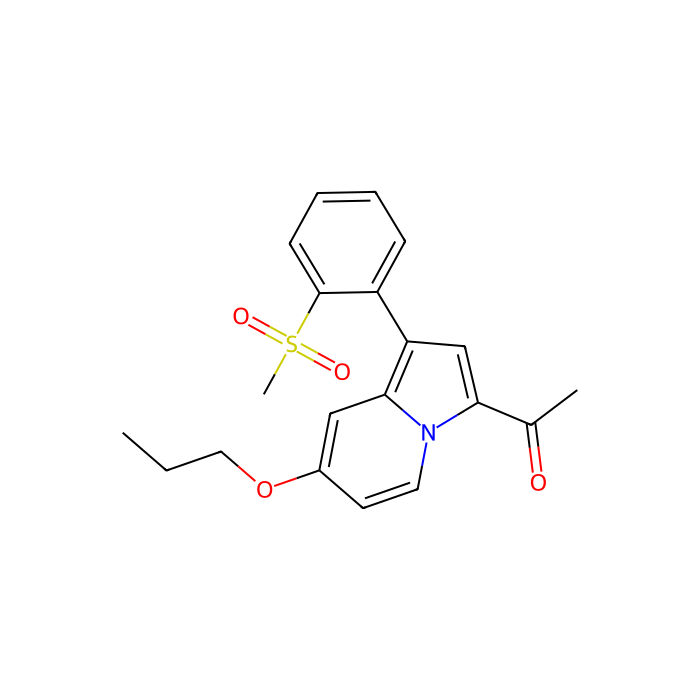
GSK 2801 - Moligand™, ≥98%(HPLC) , Inhibitor of bromodomain adjacent to zinc finger domain 2A;Inhibitor of bromodomain adjacent to zinc finger domain 2B, CAS No.1619994-68-1, Inhibitor of bromodomain adjacent to zinc finger domain 2A;Inhibitor of bromodomain adjacent to zinc finger domain 2B

CAS: 1619994-68-1 Cat. No.: G288683 Formula: C20H21NO4S Molecular Weight: 371.45 EC Number: 106-614-6
AVAILABLE TO ORDER
GRADE & PURITY Moligand™ ? Moligand™ — Aladdin's line of ligands and bioactive small molecules. Use for receptor, pathway, and binding studies needing defined small-molecule tools. ≥98%(HPLC)
Synonyms
1-(1-(2-(methylsulfonyl)phenyl)-7-propoxyindolizin-3-yl)ethanone | 1-[1-[2-(Methylsulfonyl)phenyl]-7-propoxy-3-indolizinyl]ethanone
Storage
Store at -20°C
Shipped In
Ice chest + Ice pads
★
Size
Germany (EU)
USA*
Price
Qty
5mg
G288683-5mg
—
2 In stock
€34.62
10mg
G288683-10mg
—
2 In stock
€54.58
25mg
G288683-25mg
—
2 In stock
€104.04
50mg
G288683-50mg
—
2 In stock
€154.37
100mg
G288683-100mg
—
2 In stock
€235.94
Enter a quantity for the sizes you want to add.
🧪
Why this grade

Moligand™, ≥98%(HPLC) Moligand™ for sensitive chromatographic and analytical workflows requiring minimal baseline interference.

🌡

Storage & shipping

Store at -20°C Ships Ice chest + Ice pads Check lot-specific COA for exact specifications.

📋

Quality documents

SDS, COA, datasheet, and spec sheet available for download. Lot-specific COA accessible via lot number lookup.

📚

Literature proof

Cited in 0 peer-reviewed publications across chromatography, organic synthesis, and cross-coupling reactions.

Specifications

Synonyms
1-(1-(2-(methylsulfonyl)phenyl)-7-propoxyindolizin-3-yl)ethanone | 1-[1-[2-(Methylsulfonyl)phenyl]-7-propoxy-3-indolizinyl]ethanone
Specifications & Purity
Moligand™, ≥98%(HPLC)
Biochemical and Physiological Mechanisms
Selective BAZ2A and BAZ2B inhibitor (IC50values are 0.40 and 0.43μM, respectively). Selective for BAZ2A/B over TAF1L and BRD9. Cell permeable and orally available.
Storage
Store at -20°C
Shipped In
Ice chest + Ice pads
This product requires cold chain shipping. Ground and other economy services are not available.
Grade
Moligand™
Action Type
INHIBITOR
Mechanism of action
Inhibitor of bromodomain adjacent to zinc finger domain 2A;Inhibitor of bromodomain adjacent to zinc finger domain 2B
Purity
≥98%(HPLC)
Names and Identifiers
Pubchem Sid
Pubchem Sid Url
https://pubchem.ncbi.nlm.nih.gov/substance/504772311
Canonical Smiles
CCCOC1=CC2=C(C=C(N2C=C1)C(=O)C)C3=CC=CC=C3S(=O)(=O)C
IUPAC Name
1-[1-(2-methylsulfonylphenyl)-7-propoxyindolizin-3-yl]ethanone
InChIKey
KHWCPNJRJCNVRI-UHFFFAOYSA-N
INCHI
1S/C20H21NO4S/c1-4-11-25-15-9-10-21-18(14(2)22)13-17(19(21)12-15)16-7-5-6-8-20(16)26(3,23)24/h5-10,12-13H,4,11H2,1-3H3
Isomeric SMILES
CCCOC1=CC2=C(C=C(N2C=C1)C(=O)C)C3=CC=CC=C3S(=O)(=O)C
MeSH Entry Terms
1-(1-(3-(methylsulfonyl)phenyl)-7-propoxyindolizin-3-yl)ethanone;GSK2801
Molecular Weight
371.45
Reaxy-Rn
29186066
Reaxys-RN_link_address
https://www.reaxys.com/reaxys/secured/hopinto.do?context=S&query=IDE.XRN=29186066&ln=

Documentation

📋 Safety Data Sheet (SDS)

Comprehensive hazard, handling, storage, and regulatory compliance document.

<<<<<<< HEAD Download SDS → ======= Download SDS → >>>>>>> release248-p3

✅ Certificate of Analysis (COA)

Lot-specific quality data. Enter your lot number to retrieve the exact COA.

Look up COA →

📊 Datasheet

Quick-reference summary of product specifications and applications.

View datasheet →

🔬 Specification Sheet

Full quality attributes and acceptance criteria for this grade.

View spec sheet →

Advanced Data

Taxonomic Classification

Taxonomy Tree

KingdomOrganic compounds
SuperclassOrganoheterocyclic compounds
ClassPyrroles
SubclassSubstituted pyrroles
Intermediate Tree Nodes Not available
Direct ParentPhenylpyrroles
Alternative Parents Indolizines  Benzenesulfonyl compounds  Aryl alkyl ketones  Alkyl aryl ethers  Pyridines and derivatives  Sulfones  Heteroaromatic compounds  Azacyclic compounds  Organonitrogen compounds  Organic oxides  Hydrocarbon derivatives  
Molecular FrameworkAromatic heteropolycyclic compounds
Substituents 3-phenylpyrrole - Indolizine - Benzenesulfonyl group - Pyrrolopyridine - Aryl alkyl ketone - Aryl ketone - Alkyl aryl ether - Monocyclic benzene moiety - Pyridine - Benzenoid - Heteroaromatic compound - Sulfone - Sulfonyl - Ketone - Ether - Azacycle - Organic nitrogen compound - Hydrocarbon derivative - Organosulfur compound - Organooxygen compound - Organonitrogen compound - Organic oxide - Organic oxygen compound - Aromatic heteropolycyclic compound
DescriptionThis compound belongs to the class of organic compounds known as phenylpyrroles. These are polycyclic aromatic compounds containing a benzene ring linked to a pyrrole ring through a CC or CN bond.
External Descriptors Not available
3D Structure
Interactive Chemical Structure Model


Associated Targets(Human)
BAZ2A Tchem Bromodomain adjacent to zinc finger domain protein 2A (4 Activities)
Activity TypeActivity Value -log(M)Mechanism of ActionActivity ReferencePublications (PubMed IDs)
BAZ2B Tchem Bromodomain adjacent to zinc finger domain protein 2B (6 Activities)
Activity TypeActivity Value -log(M)Mechanism of ActionActivity ReferencePublications (PubMed IDs)
ABL1 Tclin Tyrosine-protein kinase ABL (18331 Activities)
Activity TypeRelationActivity valueUnitsAction TypeJournalPubMed IddoiAssay Aladdin ID
GSK3B Tclin Glycogen synthase kinase-3 beta (11785 Activities)
Activity TypeRelationActivity valueUnitsAction TypeJournalPubMed IddoiAssay Aladdin ID
CSNK1D Tchem Casein kinase I delta (4546 Activities)
Activity TypeRelationActivity valueUnitsAction TypeJournalPubMed IddoiAssay Aladdin ID
MTNR1A Tclin Melatonin receptor 1A (2519 Activities)
Activity TypeRelationActivity valueUnitsAction TypeJournalPubMed IddoiAssay Aladdin ID
CDK2 Tchem Cyclin-dependent kinase 2 (9050 Activities)
Activity TypeRelationActivity valueUnitsAction TypeJournalPubMed IddoiAssay Aladdin ID
AURKA Tchem Serine/threonine-protein kinase Aurora-A (10240 Activities)
Activity TypeRelationActivity valueUnitsAction TypeJournalPubMed IddoiAssay Aladdin ID
EP300 Tchem Histone acetyltransferase p300 (1259 Activities)
Activity TypeRelationActivity valueUnitsAction TypeJournalPubMed IddoiAssay Aladdin ID
KAT2B Tchem Histone acetyltransferase PCAF (884 Activities)
Activity TypeRelationActivity valueUnitsAction TypeJournalPubMed IddoiAssay Aladdin ID
CREBBP Tchem CREB-binding protein (1602 Activities)
Activity TypeRelationActivity valueUnitsAction TypeJournalPubMed IddoiAssay Aladdin ID
BRD4 Tchem Bromodomain-containing protein 4 (13122 Activities)
Activity TypeRelationActivity valueUnitsAction TypeJournalPubMed IddoiAssay Aladdin ID
BRD2 Tchem Bromodomain-containing protein 2 (1296 Activities)
Activity TypeRelationActivity valueUnitsAction TypeJournalPubMed IddoiAssay Aladdin ID
BAZ2B Tchem Bromodomain adjacent to zinc finger domain protein 2B (56204 Activities)
Activity TypeRelationActivity valueUnitsAction TypeJournalPubMed IddoiAssay Aladdin ID
PBRM1 Tchem Protein polybromo-1 (712 Activities)
Activity TypeRelationActivity valueUnitsAction TypeJournalPubMed IddoiAssay Aladdin ID
BRDT Tchem Bromodomain testis-specific protein (576 Activities)
Activity TypeRelationActivity valueUnitsAction TypeJournalPubMed IddoiAssay Aladdin ID
BRD3 Tchem Bromodomain-containing protein 3 (1086 Activities)
Activity TypeRelationActivity valueUnitsAction TypeJournalPubMed IddoiAssay Aladdin ID
ATAD2 Tchem ATPase family AAA domain-containing protein 2 (598 Activities)
Activity TypeRelationActivity valueUnitsAction TypeJournalPubMed IddoiAssay Aladdin ID
TRIM33 Tchem E3 ubiquitin-protein ligase TRIM33 (162 Activities)
Activity TypeRelationActivity valueUnitsAction TypeJournalPubMed IddoiAssay Aladdin ID
PHIP Tbio PH-interacting protein (91 Activities)
Activity TypeRelationActivity valueUnitsAction TypeJournalPubMed IddoiAssay Aladdin ID
BRD1 Tchem Bromodomain-containing protein 1 (256 Activities)
Activity TypeRelationActivity valueUnitsAction TypeJournalPubMed IddoiAssay Aladdin ID
ATAD2B Tchem ATPase family AAA domain-containing protein 2B (90 Activities)
Activity TypeRelationActivity valueUnitsAction TypeJournalPubMed IddoiAssay Aladdin ID
SMARCA2 Tchem Probable global transcription activator SNF2L2 (466 Activities)
Activity TypeRelationActivity valueUnitsAction TypeJournalPubMed IddoiAssay Aladdin ID
SMARCA4 Tchem Transcription activator BRG1 (263 Activities)
Activity TypeRelationActivity valueUnitsAction TypeJournalPubMed IddoiAssay Aladdin ID
BPTF Tchem Nucleosome-remodeling factor subunit BPTF (194 Activities)
Activity TypeRelationActivity valueUnitsAction TypeJournalPubMed IddoiAssay Aladdin ID
BRD7 Tchem Bromodomain-containing protein 7 (146 Activities)
Activity TypeRelationActivity valueUnitsAction TypeJournalPubMed IddoiAssay Aladdin ID
TRIM24 Tchem Transcription intermediary factor 1-alpha (2087 Activities)
Activity TypeRelationActivity valueUnitsAction TypeJournalPubMed IddoiAssay Aladdin ID
CECR2 Tchem Cat eye syndrome critical region protein 2 (340 Activities)
Activity TypeRelationActivity valueUnitsAction TypeJournalPubMed IddoiAssay Aladdin ID
BRD9 Tchem Bromodomain-containing protein 9 (684 Activities)
Activity TypeRelationActivity valueUnitsAction TypeJournalPubMed IddoiAssay Aladdin ID
TAF1L Tchem Transcription initiation factor TFIID subunit 1-like (141 Activities)
Activity TypeRelationActivity valueUnitsAction TypeJournalPubMed IddoiAssay Aladdin ID
BAZ2A Tchem Bromodomain adjacent to zinc finger domain protein 2A (266 Activities)
Activity TypeRelationActivity valueUnitsAction TypeJournalPubMed IddoiAssay Aladdin ID
SP140 Tbio Nuclear body protein SP140 (54 Activities)
Activity TypeRelationActivity valueUnitsAction TypeJournalPubMed IddoiAssay Aladdin ID
BRPF1 Tchem Peregrin (2217 Activities)
Activity TypeRelationActivity valueUnitsAction TypeJournalPubMed IddoiAssay Aladdin ID
TAF1 Tchem Transcription initiation factor TFIID subunit 1 (441 Activities)
Activity TypeRelationActivity valueUnitsAction TypeJournalPubMed IddoiAssay Aladdin ID
BRWD1 Tbio Bromodomain and WD repeat-containing protein 1 (55 Activities)
Activity TypeRelationActivity valueUnitsAction TypeJournalPubMed IddoiAssay Aladdin ID
BAZ1B Tbio Tyrosine-protein kinase BAZ1B (16 Activities)
Activity TypeRelationActivity valueUnitsAction TypeJournalPubMed IddoiAssay Aladdin ID
ASH1L Tbio Histone-lysine N-methyltransferase ASH1L (468 Activities)
Activity TypeRelationActivity valueUnitsAction TypeJournalPubMed IddoiAssay Aladdin ID
BRWD3 Tbio Bromodomain and WD repeat-containing protein 3 (17 Activities)
Activity TypeRelationActivity valueUnitsAction TypeJournalPubMed IddoiAssay Aladdin ID
TRIM28 Tbio Transcription intermediary factor 1-beta (21 Activities)
Activity TypeRelationActivity valueUnitsAction TypeJournalPubMed IddoiAssay Aladdin ID
Associated Targets(non-human)
Mapk1 MAP kinase ERK2 (650 Activities)
Activity TypeRelationActivity valueUnitsAction TypeJournalPubMed IddoiAssay Aladdin ID
Hdac6 Histone deacetylase 6 (222 Activities)
Activity TypeRelationActivity valueUnitsAction TypeJournalPubMed IddoiAssay Aladdin ID
Fgfr3 Fibroblast growth factor receptor 3 (21 Activities)
Activity TypeRelationActivity valueUnitsAction TypeJournalPubMed IddoiAssay Aladdin ID
Mus musculus (284745 Activities)
Activity TypeRelationActivity valueUnitsAction TypeJournalPubMed IddoiAssay Aladdin ID
GCN5 Histone acetyltransferase GCN5 (89 Activities)
Activity TypeRelationActivity valueUnitsAction TypeJournalPubMed IddoiAssay Aladdin ID
rep Replicase polyprotein 1ab (378 Activities)
Activity TypeRelationActivity valueUnitsAction TypeJournalPubMed IddoiAssay Aladdin ID
Mechanisms of Action
Certificates (CoA,COO,BSE/TSE and Analysis Chart)
C of A & Other Certificates(BSE/TSE, COO):
Analytical Chart:

Find and download the COA for your product by matching the lot number on the packaging.

6 results found

Lot NumberCertificate TypeDateItem
I2523097I2523097Certificate of AnalysisOct 13, 2025 G288683
I2201471I2201471Certificate of AnalysisJun 10, 2025 G288683
I2201480I2201480Certificate of AnalysisJun 10, 2025 G288683
I2201481I2201481Certificate of AnalysisJun 10, 2025 G288683
I2201507I2201507Certificate of AnalysisJun 10, 2025 G288683
I2201509I2201509Certificate of AnalysisJun 10, 2025 G288683
Chemical and Physical Properties
SolubilitySolvent:DMSO, Max Conc. mg/mL: 18.57, Max Conc. mM: 50
Molecular Weight371.500 g/mol
XLogP34.200
Hydrogen Bond Donor Count0
Hydrogen Bond Acceptor Count4
Rotatable Bond Count6
Exact Mass371.119 Da
Monoisotopic Mass371.119 Da
Topological Polar Surface Area73.200 Ų
Heavy Atom Count26
Formal Charge0
Complexity599.000
Isotope Atom Count0
Defined Atom Stereocenter Count0
Undefined Atom Stereocenter Count0
Defined Bond Stereocenter Count0
Undefined Bond Stereocenter Count0
The total count of all stereochemical bonds0
Covalently-Bonded Unit Count1
FAQs and Articles
Solution Calculators
Reviews

Customer Reviews

Application Protocols

Validated, item-specific protocols are not provided in the listing. The following are general best practices for small-molecule probe handling and assay setup.

  • DMSO stock preparation:
    • Calculate required mass for desired stock (e.g., 10 mM). Dissolve in anhydrous DMSO; vortex to clarity. Prepare single-use aliquots (e.g., 10–50 μL) to avoid freeze–thaw.
  • Biochemical binding assay (generic outline):
    • Prepare serial dilutions (e.g., 10-point, 1:3) in assay buffer maintaining constant DMSO across wells (commonly 0.1–1% v/v).
    • Incubate with target protein and detection reagent per platform (FP/HTRF/Alpha); read after equilibrium.
    • Fit data to appropriate binding/inhibition model (e.g., 4PL) accounting for substrate/ligand depletion.
  • Cellular assay seeding and dosing (generic outline):
    • Seed cells to desired density; allow attachment/overnight equilibration.
    • Dose with compound dilutions maintaining constant DMSO (≤0.1–0.5% v/v typical). Include vehicle controls and positive controls if available.
    • Assess readouts (e.g., target engagement, reporter activity) at optimized timepoints.

Note: These are general frameworks and not validated for this specific item. Optimize conditions for your system. For any item-specific recommendations, refer to the CoA/Spec Sheet.

Biological Roles

Context for researchers (literature/general knowledge):

  • GSK 2801 is widely referenced as a selective ligand for certain bromodomains within the BET-like/BAZ families and has been used as a chemical probe in epigenetics research. Public reports describe its capacity to occupy the acetyl-lysine (Kac) recognition pocket of target bromodomains, thereby modulating chromatin reader interactions with acetylated histones.
  • Functional consequences explored in literature include modulation of transcriptional programs and chromatin accessibility in systems where the targeted bromodomain(s) play a scaffolding/reader role.
  • Typical experimental modalities: biophysical binding assays (ITC, SPR), biochemical inhibition of bromodomain–peptide interactions (Alpha/HTRF/FP), and cellular target engagement assays.

Important caveats:

  • Item-specific target selectivity, Kd/IC50 values, and off-target profiles are Not specified for this item; consult the primary literature and verify with your in-house assays.
  • Biological effects are context-dependent and may vary by cell type, expression level, and assay format.

This product is for research use only and is not intended for diagnostic or therapeutic use.

Buffer Applications

This product is a small-molecule ligand rather than a buffering agent. Direct use as a pH buffer is not applicable.

Practical notes for buffer use with small-molecule stocks (general guidance):

  • Prepare DMSO stock and dilute into assay buffer (e.g., PBS, HEPES, Tris) immediately before use.
  • Maintain buffer ionic strength and pH appropriate for your assay (commonly pH 7.2–7.5 for cellular and many biochemical assays).
  • Avoid high concentrations of detergents or serum proteins that may nonspecifically bind the ligand; optimize using control titrations.

Item-specific buffer compatibility or precipitation thresholds are Not specified for this item; refer to CoA/Spec Sheet and validate in your system.

Green Alternatives

As GSK 2801 is a discrete bioactive molecule (not a process solvent), “green alternative” considerations focus on solvent usage and assay design rather than replacing the compound itself.

Greener handling strategies (general):

  • Minimize DMSO volume: Use the lowest feasible final DMSO percentage that maintains solubility and assay performance (often ≤0.1–0.5% v/v in cellular assays).
  • Microscale assays: Employ miniaturized formats (e.g., 384/1536-well) to reduce solvent and compound consumption.
  • Aqueous-first dilution: Pre-dilute DMSO stocks into buffer with vigorous mixing to limit local supersaturation and precipitation, avoiding the need for repeat preparations.
  • Waste management: Segregate halogenated and non-halogenated organic waste; keep DMSO-containing waste separate as per institutional guidance.

Illustrative comparison (general solvent considerations):

  • DMSO vs ethanol as delivery solvent
    • Solubility: DMSO typically superior for heteroaromatic ligands.
    • Biological tolerance: Ethanol may perturb membranes at lower % v/v than DMSO; DMSO often preferable ≤0.5% v/v.
    • Safety: Both require PPE; DMSO can enhance dermal absorption of solutes—take extra care.

Note: There is no “greener substitute” for the compound itself when it serves as a specific chemical probe; suitability is target- and study-dependent.

Pharmaceutical Uses

This product is supplied strictly for research use and is not approved for human or veterinary applications.

Formulation/manufacturing context (general, non-clinical):

  • Role: Chemical probe/lead-like small molecule for discovery research, target validation, and assay development.
  • Typical laboratory formulation: DMSO stock solutions for in vitro/in-cell assays; occasional use of co-solvent/polymeric carriers for in vivo research formulations in preclinical settings (outside the scope of this listing).
  • Pharmacopeial status: Not compendial; no pharmacopeial monograph.

No claims are made regarding therapeutic efficacy, safety, or clinical suitability. Any preclinical formulation or in vivo use requires institution-specific approvals and is outside the intended scope of this catalog item.

Physical Properties

Item-specific specifications are not provided in the current listing. Where applicable, consult the product’s CoA/SDS.

  • Physical state/appearance: Not specified for this item; refer to CoA/Spec Sheet.
  • Melting point: Not specified for this item; refer to CoA/Spec Sheet.
  • Boiling point: Not applicable/Not specified for this solid probe; refer to CoA/Spec Sheet.
  • Density: Not specified for this item; refer to CoA/Spec Sheet.
  • Solubility (item-specific): Not specified for this item; refer to CoA/Spec Sheet.
  • LogP, pKa, refractive index: Not specified for this item; refer to CoA/Spec Sheet.

Practical handling guidance (general for small-molecule probes; literature/common practice):

  • Stock solutions are commonly prepared in anhydrous DMSO (e.g., 10–50 mM) due to typical limited aqueous solubility of bromodomain ligands.
  • For biological assays, dilute DMSO stocks into aqueous buffers or media immediately before use, keeping final DMSO ≤0.1–0.5% v/v when possible to minimize solvent effects.
  • If aqueous solubility is limited, consider using minimal co-solvent (DMSO) plus surfactant-free buffer and brief sonication. Filter through 0.22 μm if particulates persist.

Note: Any numerical thermophysical values not explicitly provided above should be sourced from the product CoA or primary literature for GSK 2801 (PubChem CID 73010930).

Quality and Grades
  • Grade/Purity: Moligand™
    • Moligand™ indicates a research-grade small-molecule ligand suitable for screening, target validation, and mechanistic studies. It emphasizes identity and usability as a chemical probe rather than chromatographic solvent grade.

What this means in practice:

  • Identity/Integrity: Supplied to support reproducible bioassay performance. Verify lot-specific identity (e.g., NMR/HRMS/HPLC) on the CoA accompanying the shipment.
  • Purity reporting: Numeric purity, residual solvents, or related-substance profiles are Not specified for this item; refer to CoA/Spec Sheet.
  • Stabilizers/Inhibitors: Not specified for this item; refer to CoA/Spec Sheet.
  • UV/fluorescence background: For assay development (e.g., FP/HTRF), consult spectral properties if relevant; Not specified for this item; refer to CoA/Spec Sheet.

Recommended QC upon receipt (general best practice for probe compounds):

  • Record lot number and verify labeling; inspect for physical changes (clumping, discoloration, moisture ingress).
  • If critical, perform a quick check (e.g., LC–MS purity/identity) before committing to long campaigns.

Regulatory/Use domain:

  • Research-use only; not intended for diagnostic, therapeutic, or GMP manufacturing use.
Reaction and Applications

This product is a research-use small-molecule ligand and is not typically employed as a reagent or solvent for synthetic transformations.

Applicable laboratory uses (general for GSK 2801-type probes; literature context):

  • Chemical biology/epigenetics: Used as a reference ligand/chemical probe in studies interrogating bromodomain function, chromatin reader biology, and transcriptional regulation.
  • Biophysical assays: Suitable for use in binding assays such as ITC, SPR, BLI, thermal shift (DSF/TTM), fluorescence polarization (FP), and Alpha/HTRF assays to assess bromodomain engagement.
  • Cellular assays: Employed to evaluate target engagement and downstream transcriptional effects; careful controls with matched inactive analogs are recommended.

Not typical applications:

  • Not intended for Grignard/coupling/oxidation type chemistry; see Synthetic Utility for notes.

Practical tips (general):

  • Prepare concentrated DMSO stocks (e.g., 10–50 mM) and store aliquots at −20°C protected from light. Thaw on ice before use; avoid repeated freeze–thaw cycles.
  • Include DMSO vehicle controls at identical final % v/v.
  • Verify assay window and dynamic range using positive/negative controls per assay platform.
Reaction Conditions

Not typically applicable: GSK 2801 is a bioactive ligand rather than a reagent used in chemical transformations.

Assay/handling conditions (general guidance for small-molecule probes):

  • Stock preparation: 10–50 mM in anhydrous DMSO; vortex and, if needed, briefly sonicate. Filter (0.22 μm PTFE) if particles persist.
  • Working concentrations: Determined empirically by assay; literature for bromodomain probes often spans low nanomolar to low micromolar in biochemical assays and sub-micromolar to a few micromolar in cellular assays, depending on target and permeability. Item-specific potencies are Not specified for this item.
  • Temperature/light: Handle at room temperature during assay setup; protect from prolonged light exposure if chromophoric. Store aliquots at −20°C as specified for this item.
  • Controls: Include DMSO vehicle and, when available, an orthogonal or inactive analog control.

Note: The above are general practices. For validated numerical conditions, consult primary literature for GSK 2801 and optimize within your assay platform.

Safety and Handling

Safety information specific to this item is not provided in the listing. Always consult the SDS for authoritative guidance.

  • GHS classification, signal word, pictograms, H-statements: Not specified for this item; refer to SDS.
  • General precautions (good laboratory practice):
    • Handle in a fume hood. Avoid inhalation of dust or aerosols and contact with skin/eyes.
    • Wear appropriate PPE: lab coat, safety glasses, and chemical-resistant gloves (e.g., nitrile). Consider double-gloving when working with DMSO stocks as DMSO can facilitate dermal transport of solutes.
    • Avoid repeated freeze–thaw of stock vials; dispense single-use aliquots.
  • Storage incompatibilities: Keep away from strong oxidizers and acids/bases unless compatibility is verified. Protect from light and moisture if the compound is photosensitive or hygroscopic (check SDS/CoA).
  • First-aid overview (general):
    • Skin/eye contact: Rinse with plenty of water for ≥15 minutes; remove contaminated clothing; seek medical attention.
    • Inhalation: Move to fresh air; obtain medical advice if symptoms occur.
    • Ingestion: Rinse mouth; seek medical attention; do not induce vomiting unless directed by medical personnel.
  • Spill response: Avoid dust generation; collect with inert absorbent; dispose of according to institutional and local regulations.

Note: This material is for research use only and not for human or veterinary use.

Solvent Selection

Given this is a bioactive small molecule (not a bulk solvent), solvent selection guidance focuses on stock preparation and assay compatibility.

  • Primary stock solvent (typical practice):
    • DMSO is generally preferred for small-molecule probe stocks owing to broad solvating power and assay compatibility at low v/v.
  • Secondary solvents/co-solvents:
    • DMF or ethanol can sometimes be used, but DMSO typically provides superior stability/solubility for bromodomain ligands. Always confirm biological compatibility with your assay system.
  • Aqueous compatibility:
    • Dilute DMSO stocks into buffered aqueous media (e.g., PBS, HEPES, cell culture medium) immediately before use. Maintain final DMSO typically ≤0.1–0.5% v/v for cellular assays; enzyme/biophysical assays may tolerate up to ~1–2% v/v depending on system.
  • pH considerations:
    • Adjust buffer pH to physiological or assay-optimal ranges. Avoid extreme pH that may induce decomposition or ionization changes impacting binding.

Small comparison (general):

  • DMSO: highest solvency; widely assay-compatible at low %; can carry compounds across skin—use PPE.
  • Ethanol: acceptable in some biochemical assays but may perturb membranes/cells at modest % levels.
  • Aqueous-only: rarely sufficient for hydrophobic ligands; may precipitate upon dilution without co-solvent.

Item-specific solubility limits and stability are Not specified for this item; refer to CoA/Spec Sheet.

Storage and Reconstitution
  • Storage conditions (as provided): Store at −20°C.
  • Shipping conditions (as provided): Shipped in ice chest with ice pads to maintain cold chain.
  • Appearance: Not specified for this item; refer to CoA/Spec Sheet.

Reconstitution (general guidance for small-molecule ligands):

  • Solvent: Prepare concentrated stock in anhydrous DMSO unless otherwise specified. Item-specific solubility is Not specified for this item; verify experimentally.
  • Aliquoting: Prepare single-use aliquots to minimize freeze–thaw cycles. Clearly label with concentration, solvent, lot, and date.
  • Thawing: Thaw aliquots on ice or at room temperature immediately before use. Mix thoroughly; inspect for precipitation/crystallization.
  • Short-term stability: Keep on ice during assay setup; return unused aliquots to −20°C promptly. Avoid multiple freeze–thaw cycles.
  • Light/moisture: Protect from light and moisture as a precaution unless otherwise indicated by the CoA/SDS.

Retention of records:

  • Record lot numbers and storage history. For critical studies, confirm integrity by LC–MS/HPLC at defined intervals.

For any numeric solubility, stability, or degradation parameters not listed above: Not specified for this item; refer to CoA/Spec Sheet.

Structure and Identity

Brief overview: This listing is for GSK 2801, a research-use small-molecule ligand (Moligand grade) commonly employed as a chemical probe in epigenetics and bromodomain research.

  • SKU: G288683
  • Product Name: GSK 2801
  • CAS: 1619994-68-1
  • PubChem CID: 73010930
  • InChIKey (as provided): 180501 (note: format appears non-standard; consult CoA/SDS for confirmation)
  • SMILES: Not specified for this item; refer to CoA/Spec Sheet.
  • Molecular formula: Not specified for this item; refer to CoA/Spec Sheet.
  • Molecular weight: Not specified for this item; refer to CoA/Spec Sheet.

Structural features (general, literature context):

  • GSK 2801 is widely cited as a bromodomain-directed ligand used to interrogate epigenetic reader domains. Public literature describes it as a heteroaromatic small molecule bearing hydrogen-bond acceptors/donors positioned for acetyl-lysine pocket engagement. Exact atom-by-atom structure should be verified against primary references and the CoA.

2D structure description (literature-level, not item-specific):

  • Typical bromodomain ligands feature a central heteroaryl core with appended polar substituents that engage the conserved Asn and water network in the Kac-binding site, alongside hydrophobic flanking groups occupying WPF-shelf/ZA channel. For GSK 2801 specifically, consult peer-reviewed references or PubChem CID 73010930 for a definitive depiction.
Synthetic Utility

GSK 2801 is a finished bioactive small molecule and is not typically used as a synthetic building block or reagent.

Context (general):

  • Functional group participation in synthesis: Not applicable; the compound is generally used as supplied for biological assays rather than transformed chemically.
  • Derivatization: Researchers may occasionally derivatize probe molecules (e.g., affinity tags, photo-crosslinkers, biotin) for chemoproteomic studies; such efforts require bespoke synthetic routes and protection strategies tailored to the specific scaffold of GSK 2801. Item-specific reactive handles are Not specified for this item; consult the literature and structure on PubChem CID 73010930.

If your intent is to modify the scaffold:

  • Map SAR-critical features (e.g., Kac-pocket H-bond donors/acceptors) and retain pharmacophores essential for bromodomain engagement when appending tags/linkers.
  • Validate binding post-modification via biophysical assays.

For general reagents and building blocks, see other catalog sections.

Target Specificity

Item-specific target details are not provided in this listing.

  • Target/epitope, species reactivity, clone/isotype (if antibody): Not applicable.
  • For small molecules such as GSK 2801, detailed target specificity (e.g., bromodomain family member selectivity, Kd/IC50 values, off-target panel results) is Not specified for this item; refer to CoA/Spec Sheet and primary literature.

Researchers should verify target engagement and selectivity in their system using appropriate orthogonal assays (e.g., biophysical binding, competition assays, chemoproteomics).

Frequently Asked Questions

What are the CAS number, molecular formula and molecular weight?
The CAS Number is 1619994-68-1, the molecular formula is C20H21NO4S, and the molecular weight is 371.45 g/mol. InChIKey KHWCPNJRJCNVRI-UHFFFAOYSA-N.
What is the purity of this product, and how is it determined?
This product is supplied at ≥98% purity, determined by HPLC. Lot-specific values are stated on the Certificate of Analysis.
What is Moligand??
Moligand? is one of Aladdin Scientific's premium product lines, formulated for high-purity applications across multiple workflows. Compared to standard grades in the same workflow, Moligand? products typically offer tighter specifications, more rigorous QC, and stronger lot-to-lot consistency.
How should this product be stored?
Store at ?20 °C. Freezer storage is required to maintain the specified shelf life.
How is this product shipped?
This product ships in an insulated container with ice pads. Unpack on arrival and transfer it to the storage condition stated above.
What documentation is provided?
Available product documentation, including Certificates of Analysis (COA), Safety Data Sheets (SDS), and specification sheets, is shown in the product document area. Document availability and access follow the current site policy.

Shall we send you a message when we have discounts available?

Remind me later

Thank you! Please check your email inbox to confirm.

Oops! Notifications are disabled.