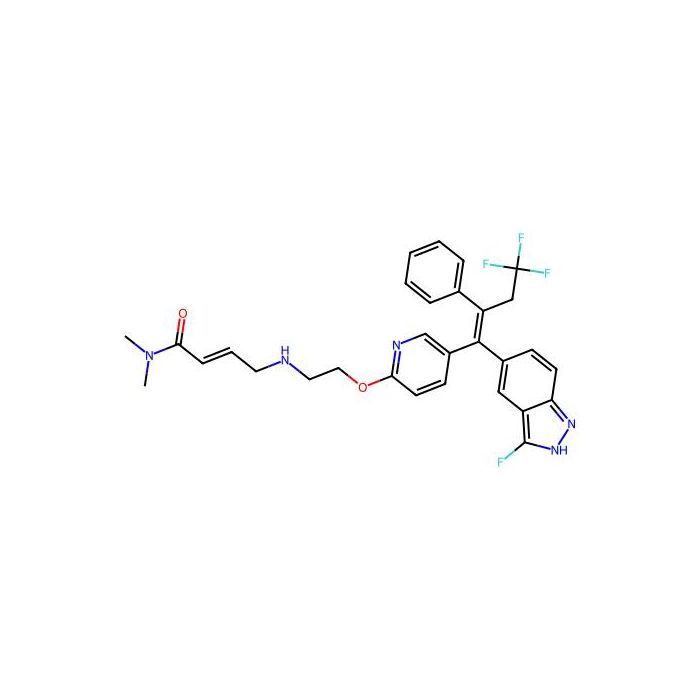
10mM in DMSO for sensitive chromatographic and analytical workflows requiring minimal baseline interference.
🌡
Storage & shipping
Store at -80°C Ships Dry ice packs + Cold packs Check lot-specific COA for exact specifications.
📋
Quality documents
SDS, COA, datasheet, and spec sheet available for download. Lot-specific COA accessible via lot number lookup.
📚
Literature proof
Cited in 0 peer-reviewed publications across chromatography, organic synthesis, and cross-coupling reactions.
Overview
H3B-6545 is an oral, selective estrogen receptor covalent antagonist ( SERCA ) for the research of metastatic ER-positive, HER2-negative breast cancer
In Vitro
H3B-6545 is a highly selective small molecule that potently antagonizes wild-type and mutant ERα in biochemical and cell based assays. In vitro comparisons with standard of care and other experimental agents confirm increased cell potency of H3B-6545 under continuous as well as washout treatment conditions. H3B-6545, a member of a novel class of ERα antagonists refer to as selective ER covalent antagonist (SERCA), which inactivates both wild-type and mutant ERα by targeting C530 and enforcing a unique antagonist conformation. H3B-6545 is a first-in-class selective ER covalent antagonist (SERCA). H3B-6545 inhibits ERα WT activity and growth of ERα WT -positive breast cancer lines. H3B-6545 potently inhibits ERα WT activity and suppresses proliferation of ERα WT -positive breast cancer lines. With GI 50 s of 0.3-0.4, 1.0, 0.5, 5.2, and 0.2 nM for MCF7, HCC1428, BT483, T47D and CAMA-1 cell lines. MCE has not independently confirmed the accuracy of these methods. They are for reference only.
In Vivo
In vivo, once daily oral dosing of H3B-6545 shows potent activity and superior efficacy to fulvestrant in the MCF-7 xenograft model with maximal antitumor activity at doses >10x below the maximum tolerated dose in mice. In addition, H3B-6545 shows superior antitumor activity to Tamoxifen and Fulvestrant in patient derived xenograft models of estrogen receptor positive breast cancer including models carrying ERα mutations in rat and monkeys, H3B-6545 is well tolerated across a broad dose range and at exposures that significantly exceed those required for efficacy in mouse xenograft models . MCE has not independently confirmed the accuracy of these methods. They are for reference only.
IC50& Target:Estrogen receptor
Specifications
Specifications & Purity
10mM in DMSO
Biochemical and Physiological Mechanisms
H3B-6545 is an oral, selective estrogen receptor covalent antagonist ( SERCA ) for the research of metastatic ER-positive, HER2-negative breast cancer.
Storage
Store at -80°C
Shipped In
Dry ice packs + Cold packs
This product requires cold chain shipping. Ground and other economy services are not available.
Determine the necessary mass, volume, or concentration for preparing a solution.
Dilution Calculator
Determine the dilution needed to prepare a stock solution.
Reconstitution Calculator
Reviews
Customer Reviews
Application Protocols
Only item-specific, validated protocols can be listed here. The Product Data provided do not include tested applications or recommended conditions specific to H3B-6545.
Item-specific protocols
Not specified for this item.
General guidance (non-item-specific)
Small-molecule testing typically involves preparation of a concentrated DMSO stock, serial dilutions, and treatment of the biological system (cells, lysates, biochemical assays) with appropriate vehicle controls. Readouts may include enzymatic activity, reporter expression, target engagement (e.g., CETSA), or phenotypic changes. These are general practices and not validated for this specific product.
Consult the product page or CoA for any future updates on validated applications.
Biological Roles
Scope note: The following provides general, literature-based context for small-molecule modulators used in receptor or enzyme pathway research. It is not item-specific and does not make clinical claims. For H3B-6545, consult primary literature and the CoA/SDS for definitive details.
General roles of targeted small molecules in research
Serve as chemical probes to modulate protein function (agonism, antagonism, inhibition, degradation) enabling dissection of signaling pathways, feedback regulation, and compensatory mechanisms in cells.
Facilitate validation of target dependency by phenotypic rescue, knockdown/knockout comparison, and orthogonal probe use.
Support chemoproteomic profiling for on-/off-target engagement (e.g., thermal shift, DARTS, CETSA, photoaffinity analogs), helping map interactomes and binding sites.
Practical considerations in biological studies (general)
Establish compound stability in assay buffers and cell culture media (serum binding, adsorption to plastics, hydrolysis, or oxidation).
Determine free vs total concentration in protein-rich media; highly protein-bound compounds may require higher nominal dosing to achieve effective free concentrations.
Evaluate permeability and efflux effects using model systems (e.g., Caco-2, MDCK) when relevant; verify intracellular target engagement rather than relying solely on extracellular potency metrics.
Safety and compliance
For research use only. Not for diagnostics, therapeutic use, or human/animal administration. Ensure biosafety review when combining with engineered cell lines or primary tissues.
Buffer Applications
Not typically applicable. H3B-6545 is a discrete bioactive small molecule and not a buffering agent or pH control component.
Practical note (general)
When preparing assay solutions, dissolve in an appropriate organic co-solvent (commonly DMSO) and dilute into the desired biological buffer (e.g., PBS, HBSS, cell culture media) while keeping the final organic content within assay-tolerated limits (often ≤0.1–1% v/v). Validate compound stability in the chosen buffer over the assay timescale.
If precipitation occurs upon dilution, add slowly with vigorous mixing, warm gently to ambient temperature, or adjust co-solvent fraction within assay tolerances.
Green Alternatives
Applicability note: H3B-6545 is a discrete bioactive small molecule, not a process solvent or reagent with readily substitutable “green” alternatives. As such, green chemistry considerations primarily concern how it is handled and formulated rather than replacing the compound itself.
Greener handling and formulation (general guidance)
Use minimal DMSO volumes and prepare concentrated stocks to reduce solvent waste; aliquot to avoid repeated freeze–thaw and disposal of partially used vials.
Consider ethanol or aqueous-compatible formulations when assay constraints allow, to reduce DMSO usage. Balance against solubility and stability needs.
Adopt microscale screening formats (e.g., 384- or 1536-well plates) to reduce material and solvent consumption.
Waste management
Segregate halogenated vs non-halogenated organic waste as per institutional guidelines. Many bioactive molecules are persistent; avoid drain disposal.
Comparison table (general considerations)
| Aspect | Conventional practice | Greener practice |
| --- | --- | --- |
| Stock solvent | DMSO at large volumes | Concentrated DMSO stocks; minimize volume; consider ethanol if compatible |
| Assay scale | 96-well | 384+/miniaturization to cut waste |
| Storage | Multiple thaw cycles | Single-use aliquots to reduce spoilage and waste |
Note: There is no direct “green substitute” for this specific bioactive molecule; methodological optimizations are the appropriate sustainability focus.
Pharmaceutical Uses
This product is supplied strictly for research use only. No medical, diagnostic, or therapeutic use is intended or permitted.
Formulation context in research (general, non-clinical)
For in vitro work, concentrated DMSO stocks are commonly diluted into aqueous assay media. Record final DMSO percentage and maintain consistent vehicle controls across conditions.
For preclinical exploratory studies (non-human, institutional approval required), vehicles may include DMSO/PEG/saline mixtures, Captisol, or lipid-based carriers. Selection depends on compound solubility and stability; follow institutional animal care and use policies. This is general information, not a recommendation for this specific item.
Pharmacopeial status
Not specified for this item; refer to CoA/Spec Sheet. Bioactive screening compounds typically do not have pharmacopeial monographs.
Compliance reminder
Any formulation or in vivo use must comply with local regulations and institutional oversight. This product is not an API, excipient, or GMP-grade material.
Physical Properties
Item-specific specifications are not included in the current Product Data.
Item-specific data (from Product Data)
Appearance: Not specified for this item; refer to CoA/Spec Sheet.
Molecular Weight: Not specified for this item; refer to CoA/Spec Sheet.
Typical properties for small-molecule screening compounds (literature/general context; not item-specific)
Many bioactive screening compounds are solids at ambient conditions and are sparingly soluble in water but soluble in polar aprotic solvents (e.g., DMSO) at millimolar concentrations for stock solutions.
For assay preparation, 10 mM DMSO stock solutions are commonly used (general practice). Actual solubility for this item must be verified empirically.
Properties not specified for this item (consult CoA/Spec Sheet or SDS)
Melting point (MP)
Boiling point (BP)
Density
LogP/logD
pKa(s)
Refractive index
UV–Vis absorption maxima / cutoff
Water content or residual solvent data
HPLC purity and chromatographic conditions
Guidance
Determine solubility experimentally in intended assay media (buffered aqueous systems with co-solvent such as DMSO or ethanol). Filter sterilize if required for cell-based assays, mindful that adsorption to filters can occur with hydrophobic compounds.
If crystallinity or polymorphism affects dissolution, brief sonication or gentle warming (≤40 °C) of DMSO stock may help; avoid prolonged heating or light exposure unless stability data support it.
Quality and Grades
Item-specific grade/purity (from Product Data)
Grade/Purity: Not specified for this item; refer to CoA/Spec Sheet.
How to interpret quality for screening compounds (general guidance)
For biochemical/cell-based assays, a typical benchmark is ≥95% HPLC purity. Impurities can confound potency, selectivity, and cytotoxicity readouts.
Identity confirmation by LC–MS (or HRMS), and structural verification by NMR are recommended. Residual solvents and counter-ions (if a salt form) should be reported.
If a specific salt/hydrate form exists, ensure consistency between CoA and your experimental records; differing forms can alter solubility and potency.
UV/LC considerations (general)
If the compound is used in LC-based quantification, low baseline absorbance and a clean chromatogram under the selected method are important. Request the HPLC method used on the CoA for comparability.
Stabilizers and additives
Not specified for this item; refer to CoA/Spec Sheet. If none are used, confirm stability under your storage and assay conditions. If an antioxidant or acid/base modifier is present, consider its potential impact on assays.
Lot-to-lot reproducibility
Retain aliquots for cross-comparison. Record lot numbers in screening databases. If biological data shift between lots, re-verify purity/identity and check for polymorph or solvate differences.
Reaction and Applications
Applicability note: H3B-6545 is supplied as a bioactive research compound in a screening/compound library context, not as a synthetic reagent or solvent. Therefore, classical synthetic reaction applications are not typically relevant.
Research usage (general, non-clinical)
Tool compound in target validation, pathway interrogation, and phenotypic screening studies in vitro. Suitable for biochemical binding/engagement assays and cell-based functional assays when appropriate controls are applied.
Can be profiled across dose–response curves to determine EC50/IC50 values in the chosen assay system (general practice). Ensure calibration of compound concentration by UV or LC–MS where applicable.
Assay design considerations (general)
Include vehicle controls (e.g., 0.1% DMSO), positive controls (reference modulators), and evaluate potential off-target cytotoxicity via orthogonal assays (e.g., CellTiter-Blue, ATP luminescence).
Confirm on-target mechanism with complementary readouts (e.g., reporter assays, CETSA/thermal shift, or target occupancy assays) when feasible.
Not applicable items for this product
Named organic reactions (e.g., Grignard, cross-coupling) are not relevant here since the compound is used as a finished bioactive molecule rather than a building block or reagent.
Reaction Conditions
Not applicable for this product in the conventional synthetic chemistry sense. H3B-6545 is supplied as a ready-to-use bioactive compound, not as a reagent for carrying out chemical transformations.
Assay preparation conditions (general guidance)
Stock solutions: Commonly prepared at 5–20 mM in anhydrous DMSO; actual solubility for this item is unknown and must be verified.
Working concentrations: Determined empirically by the assay (e.g., nM–µM range). Include vehicle controls matching the highest solvent percentage.
Stability checks: Assess by LC–MS or HPLC after typical assay exposure (e.g., 4–48 h at 37 °C) to rule out degradation.
Environmental sensitivities (general)
Light and oxidation may affect some heteroaromatic or conjugated systems; use amber vials and inert gas headspace if degradation is suspected.
For chemical reaction parameters (solvent, catalyst, time, yield), there is no relevant content because this is not a synthetic reagent.
Safety and Handling
Safety overview for research use only; consult the official SDS for authoritative guidance.
Item-specific hazard data (from Product Data)
Signal Word: Not specified for this item; refer to SDS.
H-Statements: Not specified for this item; refer to SDS.
GHS Classification: Not specified for this item; refer to SDS.
Pictograms: Not specified for this item; refer to SDS.
General caution for bioactive small molecules (literature/general guidance)
Handle in a chemical fume hood; avoid inhalation of dust or aerosols and prevent skin/eye contact.
Use appropriate PPE: lab coat, safety glasses, and disposable nitrile gloves (double-glove for weighed solids). Change gloves frequently to prevent permeation from DMSO solutions.
Avoid exposure to light and heat if stability data are limited; many bioactives undergo slow degradation under UV/visible light.
Storage and stability
Store at −80 °C (per Product Data). Keep container tightly closed under inert, dry conditions if possible. Minimize freeze–thaw cycles by aliquoting.
Shipped on dry ice + cold packs; inspect upon receipt and return promptly to −80 °C.
Incompatibilities and handling tips (general)
Avoid strong oxidizers and strong acids/bases unless compatibility is known.
When preparing concentrated DMSO stocks, confirm container compatibility and label with preparation date and concentration. Use amber vials for light-sensitive compounds.
First-aid overview (general)
Skin/eye contact: Rinse with water for ≥15 minutes; remove contaminated clothing.
Inhalation: Move to fresh air; seek medical attention if symptoms persist.
Ingestion: Rinse mouth; seek medical attention. Provide SDS to responders.
Solvent Selection
Applicability note: H3B-6545 is a bioactive small molecule rather than a bulk reaction solvent. Solvent discussion below focuses on dissolving the compound for analytical or biological assays.
Item-specific solubility data
Not specified for this item; refer to CoA/Spec Sheet. Empirical solubility testing is recommended.
General recommendations (literature/practice; not item-specific specs)
Primary solvent: DMSO is commonly used to prepare 5–20 mM frozen stocks; actual achievable concentration depends on the compound’s polarity and crystallinity.
Secondary co-solvents: Ethanol or DMF can be used when DMSO is insufficient, followed by dilution into aqueous buffers containing ≤0.1–1% organic co-solvent as assay-compatible.
Aqueous systems: Many hydrophobic small molecules exhibit low aqueous solubility; consider carriers (e.g., 0.5–1% v/v DMSO) or surfactants (e.g., 0.01–0.05% Tween-80) only if compatible with the assay.
Practical tips
Warm (room temperature) and vortex/sonicate to accelerate dissolution; avoid heating above ~40 °C without stability data.
Filter through low-protein-binding, low-adsorption membranes (PTFE or PVDF) if particulate persists. Pre-rinse filters with solvent to reduce adsorption losses.
Comparison (general)
DMSO vs ethanol: DMSO typically provides higher solubility and lower volatility; ethanol may be preferable for certain biological systems with strict DMSO limits.
DMF is an effective solvent but is less favored in biological assays due to toxicity; use sparingly and dilute thoroughly if used.
Storage and Reconstitution
Item-specific storage and shipping (from Product Data)
Storage Conditions: Store at −80 °C.
Shipped In: Dry ice packs + Cold packs.
Reconstitution and handling (general guidance; not item-specific specifications)
Allow the container to equilibrate to room temperature in a desiccated environment before opening to prevent moisture condensation.
Prepare concentrated stock solutions in anhydrous DMSO (commonly 5–20 mM); the actual solubility of this item is unknown and must be verified empirically. Vortex/sonicate briefly to aid dissolution. If insoluble, consider alternative solvents (e.g., ethanol) within assay compatibility.
Sterile work: For cell-based assays requiring sterility, pass solutions through a 0.22 µm low-adsorption filter (PTFE/PVDF) into sterile, labeled aliquot vials.
Aliquoting and stability (general)
Dispense single-use aliquots to minimize freeze–thaw cycles. Store aliquots at −80 °C in amber vials if light sensitivity is suspected.
Record preparation date, solvent, and concentration on each aliquot. Periodically assess integrity by HPLC/LC–MS if stocks are stored >3 months.
Additional item-specific details
Appearance, exact solubility, and stability data: Not specified for this item; refer to CoA/Spec Sheet.
For research use only. Follow your institution’s SOPs for storage, handling, and disposal.
Structure and Identity
Brief overview: H3B-6545 is listed as a research small molecule in our small-molecule/compound library category. Item-specific identifiers below are provided; structural descriptors are not specified in the product data provided here.
Item-specific data (from Product Data)
SKU: H654751
Product Name: H3B-6545
CAS: 2052130-80-8
PubChem CID: 124091040
Molecular Formula: Not specified for this item; refer to CoA/Spec Sheet.
Molecular Weight: Not specified for this item; refer to CoA/Spec Sheet.
InChIKey: Not specified for this item; refer to CoA/Spec Sheet.
SMILES: Not specified for this item; refer to CoA/Spec Sheet.
Structural features (general context)
Not specified for this item; refer to CoA/Spec Sheet. Without a provided structure, functional groups, ring systems, and stereochemistry cannot be summarized.
Descriptive 2D structure (general context)
Not specified for this item; refer to CoA/Spec Sheet.
Notes
For definitive identity confirmation (NMR, LC–MS, HRMS, HPLC purity, and structure), consult the item’s Certificate of Analysis (CoA) and Spectral Data Sheet once supplied with the specific lot.
Synthetic Utility
Not typically applicable. H3B-6545 is offered as a finished bioactive screening compound rather than a synthetic building block or reagent.
General notes (for chemists considering derivatization)
If structural information is obtained from literature or CoA, analog synthesis or tagging (e.g., biotin, photoaffinity, fluorophores) may be pursued to create probes for target engagement or imaging. Such work requires access to the full structure, functional group tolerance, and stability data.
Maintain the core pharmacophore and physicochemical profile when designing derivatives to preserve activity; use matched molecular pair analysis and in silico ADME predictions as guides.
Quality control if derivatization is attempted (general)
Confirm identity/purity by LC–MS and NMR; evaluate stability under storage and assay conditions. Ensure removal of metal catalysts and residual reagents to levels compatible with biological testing.
Given the absence of structural details in the Product Data, no further reagent-like synthetic roles can be responsibly described for this item.
Target Specificity
Only item-specific information is permitted in this section. The Product Data provided do not include target, selectivity, or mechanistic annotations for H3B-6545.
Item-specific details
Target/Pathway: Not specified for this item.
Reported selectivity panel: Not specified for this item.
Binding/functional parameters (Kd, IC50, EC50): Not specified for this item.
Species cross-reactivity: Not specified for this item.
Please refer to the CoA, product webpage, or primary literature for target annotations if and when available. All use is for research purposes only.
Frequently Asked Questions
How should this product be stored?
Store at ?80 °C. Ultra-low temperature storage is required to maintain the specified shelf life.
How is this product shipped?
This product ships frozen with dry ice and cold packs. Unpack on arrival and transfer it to the storage condition stated above; handle dry ice with insulated gloves in a ventilated area.
What are the CAS number, molecular formula and molecular weight?
The CAS Number is 2052130-80-8, the molecular formula is C30H29F4N5O2, and the molecular weight is 567.58 g/mol.
What documentation is provided?
Available product documentation, including Certificates of Analysis (COA), Safety Data Sheets (SDS), and specification sheets, is shown in the product document area. Document availability and access follow the current site policy.
We use cookies to ensure the website functions properly and, where permitted, to improve your experience. You can manage your preferences at any time in Settings. Learn more in our Cookie Policy.
Shall we send you a message when we have discounts available?
Remind me later
Thank you! Please check your email inbox to confirm.
Products are supplied to verified businesses, institutions, and qualified professionals for research and development use only. Not for use in humans, animals, diagnosis, or therapy.