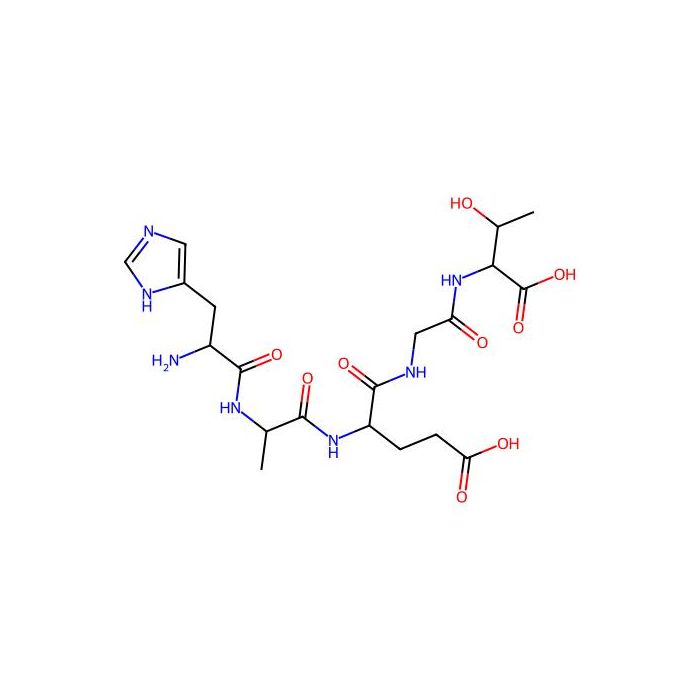
HAEGT is the first N-terminal 1-5 residues of Glukagon like peptide-1 (GLP-1) peptide, and the sequence is His-Ala-Glu-Gly-Thr . HAEGT acts as a competitive substrate for probing prime substrate binding sites of human dipeptidyl peptidase-IV (DPP-IV) 1 , in which the N-terminal His-Ala is catalyzed cleavage by DPP-IV. HAEGT can be used in the research of diabetes, obesity
In Vitro
HAEGT (0-500 μM) is a competitive substrate for probing prime substrate binding sites of human dipeptidyl peptidase-IV (DPP-IV). HAEGT can be catalyzed cleavage by DPP-IV with a k m value of 38 μM, K cat value of 3.1 S -1. MCE has not independently confirmed the accuracy of these methods. They are for reference only.
Form:Solid
IC50& Target:DPP-4
Specifications
Specifications & Purity
≥99%
Biochemical and Physiological Mechanisms
HAEGT is the first N-terminal 1-5 residues of Glukagon like peptide-1 (GLP-1) peptide, and the sequence is His-Ala-Glu-Gly-Thr . HAEGT acts as a competitive substrate for probing prime substrate binding sites of human dipeptidyl peptidase-IV (DPP-IV) 1 ,
Storage
Protected from light,Desiccated,Store at -80°C
Shipped In
Dry ice packs + Cold packs
This product requires cold chain shipping. Ground and other economy services are not available.
H2O Peptide Solubility and Storage Guidelines: 1. Calculate the length of the peptide. 2. Calculate the overall charge of the entire peptide according to the following table: Contents Assign value Acidic amino acid Asp (D), Glu (E), a
Solution Calculators
Molarity Calculator
Determine the necessary mass, volume, or concentration for preparing a solution.
Dilution Calculator
Determine the dilution needed to prepare a stock solution.
Reconstitution Calculator
Reviews
Customer Reviews
Application Protocols
Validated, item‑specific protocols are not provided in the current listing. The following are general best practices for small‑molecule library compounds.
Stock preparation (general)
Prepare a 10–50 mM DMSO stock. Vortex and sonicate briefly to aid dissolution. Aliquot into low‑bind tubes or 96/384‑well plates to avoid freeze–thaw.
Assay dilution
Dilute into assay buffer to the desired working concentration, keeping final DMSO ≤0.1–1% v/v to minimize assay interference. Include vehicle controls matched to the highest DMSO percentage.
Storage/handling
Store master plates at −80 °C, desiccated, protected from light. Use cold chains during transfers and minimize bench time.
Analytical QC (recommended)
Verify identity/purity by LC‑MS prior to critical studies. Recheck stability after several freeze–thaw cycles or >6 months storage.
Item‑specific recommended dilutions, positive controls, or tested applications: Not specified for this item; refer to CoA/Spec Sheet.
Biological Roles
Item‑specific biological roles, targets, and pathway annotations are not provided in the current listing.
General considerations for library compounds (literature/general)
Serve as chemical probes or starting points (“hits”) in phenotypic or target‑based screening. Biological role is empirical and context‑dependent until validated.
If the compound is peptide‑like, potential roles could include transient binding to protein surfaces or modulation of PPIs, often with limited membrane permeability; however, this is speculative absent structural confirmation.
ADME/PK behaviors (permeability, stability, efflux) can vary widely; characterize experimentally (e.g., PAMPA/Caco‑2, microsomal stability) before drawing conclusions.
No clinical or therapeutic claims are made or implied. For definitive biological role or target annotations, refer to the product’s CoA/Spec Sheet or associated database entry once the structure is confirmed.
Buffer Applications
Not typically applicable without confirmed structure and ionization properties.
Item‑specific buffering capacity or recommended buffer systems: Not specified for this item; refer to CoA/Spec Sheet.
Practical note (general)
For assay dilution of small‑molecule stocks, common buffers include PBS, HEPES, or Tris at pH 7.2–7.5 with 0.1–1% DMSO. If the compound is peptide‑like, maintain near‑neutral pH to minimize hydrolysis and racemization; add carrier protein (e.g., 0.1% BSA) only if assay‑compatible.
Please confirm compatibility with your biological system experimentally.
Green Alternatives
Without confirmed structure or solvent requirements for this item, green chemistry considerations are best focused on solvent choice and waste minimization in screening workflows.
Solvent substitution (literature/general)
Prefer water or aqueous buffers where solubility allows.
If organic cosolvent is needed, consider ethanol or isopropanol as greener alternatives to acetonitrile or DMF; validate assay compatibility.
For chromatographic analyses, explore water‑rich gradients and shorter columns to reduce solvent use.
Comparison (general guidance)
DMSO vs EtOH/IPA vs ACN
DMSO: broad solubilizing power; higher boiling point, challenging to remove; moderate EHS profile.
EtOH/IPA: greener, lower toxicity; may have limited solubility for highly lipophilic compounds.
ACN: excellent for LC; higher environmental and safety concerns; aim to minimize.
Operational practices
Prepare small, single‑use aliquots to minimize freeze–thaw and waste.
Use 384/1536‑well formats to reduce reagent volumes.
Segregate halogenated vs non‑halogenated waste.
Item‑specific greener alternatives are Not specified for this item; consult the CoA/Spec Sheet once structure and solvent needs are known.
Pharmaceutical Uses
No pharmacopeial status, excipient role, or manufacturing application is provided for this catalog item.
Item‑specific pharmaceutical uses: Not specified for this item; refer to CoA/Spec Sheet.
General note (literature/general)
Library compounds are commonly intended as research tools or early discovery starting points and are not formulated for human or veterinary use.
If a compound advances toward developability studies, additional quality attributes (stability indicating methods, polymorph assessment, residual solvents, elemental impurities) must be established under appropriate quality systems.
This product is for research use only and is not intended for clinical or diagnostic applications.
Physical Properties
Item‑specific physico‑chemical specifications are not included in the current listing. Use the CoA/Spec Sheet for authoritative values.
Appearance: Not specified for this item; refer to CoA/Spec Sheet.
Molecular weight: Not specified for this item; refer to CoA/Spec Sheet.
Molecular formula: Not specified for this item; refer to CoA/Spec Sheet.
Melting point: Not specified for this item; refer to CoA/Spec Sheet.
Boiling point: Not applicable for many nonvolatile solids; if needed, consult literature once structure is confirmed.
Density: Not specified for this item; refer to CoA/Spec Sheet.
Refractive index: Not applicable/typically for liquids; not specified here.
pKa/logP/logD: Not specified for this item; refer to CoA/Spec Sheet.
Solubility profile:
Item-specific solubility: Not specified for this item; refer to CoA/Spec Sheet.
General guidance (literature/general): For library compounds with uncertain polarity, initial stock preparation is commonly attempted in anhydrous DMSO (10–50 mM), followed by aqueous dilution into assay buffer containing 0.1–1% DMSO. If the compound is peptidic, water or aqueous buffers (pH ~6.5–8.0) may be suitable; salt form and isoelectric point will strongly influence solubility.
UV/Vis characteristics: Not specified for this item; refer to CoA/Spec Sheet.
Important: Do not treat any computed or literature values as specifications. For regulatory or quantitative work, rely solely on the lot-specific CoA.
Quality and Grades
Grade/purity (item‑specific): Not specified for this item; refer to CoA/Spec Sheet.
What to expect in the CoA (general guidance)
Identity confirmation: NMR/LC‑MS/HRMS as applicable; peak purity by HPLC/UPLC.
Content/assay: % purity by area normalization or qNMR; residual solvent(s); water content (e.g., KF) when relevant.
Counterion/salt form: If applicable (e.g., TFA/acetate/Cl−), will be listed.
Interpreting grades (general)
“Screening” or “library” grade typically emphasizes chemical identity and chromatographic purity fit for discovery assays, with less emphasis on trace metal/UV cutoff specifications compared to “HPLC” or “LC–MS” grades for solvents/reagents.
If peptide‑like, annotations may include sequence confirmation, average/monoisotopic mass, and purity by RP‑HPLC.
Stabilizers/additives
Presence or absence of stabilizers is Not specified for this item; refer to CoA/Spec Sheet.
Practical tips (general)
Verify salt/hydrate state; convert to a standard form if your application requires precise molarity.
For quantitative biology or SAR, confirm purity on your in‑house LC‑MS and consider desalting if counterions interfere with detection.
Record lot number and CoA in ELN to ensure traceability across screens.
Reaction and Applications
This product is listed within a “small molecules and compound library” category and is intended primarily for screening/discovery workflows rather than use as a synthetic reagent.
Discovery applications (general)
Biochemical or cell‑based screening to probe pathway modulation, phenotypic changes, or as part of fragment/peptidomimetic libraries.
Physicochemical profiling: solubility, stability, permeability (PAMPA), and microsomal stability as part of triage.
Analytical method development: LC‑MS retention behavior and ionization profiling for library registration.
If the molecule is peptide‑like (literature/general)
Could be used in binding assays (SPR, ITC, FP) against protein targets to identify sequence/affinity trends.
Enzymatic stability studies in serum or specific protease panels to guide optimization.
Not typically used as a classical reagent in named reactions (e.g., Grignard, cross‑coupling) unless structure dictates; no such use is specified for this item.
Item‑specific applications: Not specified for this item; refer to CoA/Spec Sheet. When planning experiments, confirm structure, salt form, and purity to ensure that observed bioactivity is attributable to the intended compound and not counterions or impurities.
Reaction Conditions
Not applicable in the absence of a defined role as a synthetic reagent.
Item‑specific reaction conditions, catalysts, or yields: Not specified for this item; refer to CoA/Spec Sheet.
General laboratory handling for solution preparation (literature/general)
For screening stocks, dissolve in anhydrous DMSO to 10–50 mM, vortex, and sonicate gently. Filter through 0.22 µm if needed. Store aliquots at −80 °C, protected from light.
For peptide‑like materials, consider aqueous buffers (pH ~7–8) and avoid strong base/acid and elevated temperatures that may induce hydrolysis or epimerization.
If you intend to use this compound in a chemical reaction, confirm structural identity and consult reaction‑specific literature.
Safety and Handling
Research Use Note: For research use only.
GHS/SDS information (item‑specific)
Signal word: Not specified for this item; refer to SDS.
Hazard statements (H‑codes): Not specified for this item; refer to SDS.
Pictograms and GHS classification: Not specified for this item; refer to SDS.
Storage conditions (from Product Data)
Store at −80 °C, protected from light, desiccated.
Shipping: Dry ice packs + cold packs.
General laboratory precautions (literature/general)
Handle in a fume hood or well‑ventilated area. Avoid inhalation of dust/aerosols and skin/eye contact.
Recommended PPE: lab coat, safety glasses, and suitable chemical‑resistant gloves (e.g., nitrile). For solid powders, consider dust mask/respirator per institutional risk assessment.
Avoid repeated freeze–thaw cycles; aliquot upon receipt.
Incompatibilities (general)
Unknown for this specific item. Until structure is confirmed, avoid strong oxidizers/reductants, strong acids/bases, and reactive acylating/alkylating agents. Keep dry to prevent hydrolysis if the compound contains labile functions (e.g., esters/anhydrides/activated amides).
First‑aid overview (general)
Skin/eye contact: Rinse with water for at least 15 minutes; remove contaminated clothing; seek medical attention as needed.
Inhalation: Move to fresh air; seek medical advice if symptoms persist.
Ingestion: Rinse mouth; do not induce vomiting; seek medical attention.
Always consult the item’s SDS for definitive hazard, handling, and disposal guidance.
Solvent Selection
Given the absence of structure/solubility data, begin with a tiered solvent strategy commonly used for small‑molecule libraries.
Primary solvent (general practice)
Anhydrous DMSO for master stocks (e.g., 10–50 mM). It maximizes solubility across diverse chemotypes and is compatible with most biochemical/cell assays at 0.1–1% v/v final.
Secondary options (screen if DMSO fails)
Water or aqueous buffers (pH 6.5–8.0) if the compound is peptide‑like or highly polar.
Mixed solvents: DMSO:water (1:1), MeOH:water, or DMF:water for difficult cases.
For hydrophobic entities: ACN, MeOH, or IPA as cosolvents; small amounts of Tween‑20 or Pluronic F‑127 can aid dispersion (assay‑dependent; validate controls).
Polarity/miscibility (literature/general)
DMSO, MeOH, ACN are fully miscible with water and are common in screening workflows.
Practical tips
Warm gently (25–37 °C) and sonicate to assist dissolution; avoid prolonged heating or high pH without structural knowledge.
Filter (0.22 µm PTFE/nylon) if particulate persists.
Document exact solvent composition to ensure reproducibility across replicate assays.
Note: Item‑specific solubility and solvent restrictions are Not specified for this item; refer to CoA/Spec Sheet before finalizing protocols.
Storage and Reconstitution
Storage (from Product Data)
Store at −80 °C, protected from light, desiccated.
Shipped on dry ice packs + cold packs to maintain frozen/cold chain.
Stability notes (general)
Avoid moisture exposure and repeated freeze–thaw cycles. Use desiccants and light‑protective packaging.
Track cumulative time at room temperature; limit to the minimum necessary for weighing/aliquoting.
Reconstitution (item‑specific details are not provided)
Solvent: Not specified for this item; refer to CoA/Spec Sheet.
General practice for library compounds: Start with anhydrous DMSO to prepare a concentrated master stock (e.g., 10–50 mM). If peptide‑like and water‑soluble, consider sterile water or buffer (pH ~7–8). Filter sterilize if required by your assay.
Aliquoting: Prepare single‑use aliquots in low‑bind tubes/plates; flush headspace with inert gas if oxidation is a concern.
Handling after reconstitution (general)
Store aliquots at −80 °C; protect from light. Document lot, concentration, solvent, and date in ELN.
Item‑specific concentration limits, solubility ceilings, and stability in chosen solvent are Not specified for this item; consult the CoA/Spec Sheet for definitive guidance.
Structure and Identity
Brief overview: This catalog entry is part of a small‑molecule/compound library. The vendor record does not include full structure descriptors. Where necessary below, general/literature guidance is provided and clearly labeled.
Item identifiers (from Product Data)
SKU: H646322
Product Name: HAEGT
CAS: 852155-81-8
PubChem CID: 134691699
InChIKey: 209810 (as provided; note that typical InChIKeys are 27 characters — verify on CoA/SDS)
SMILES: Not specified for this item; refer to CoA/Spec Sheet.
Composition
Molecular formula: Not specified for this item; refer to CoA/Spec Sheet.
Molecular weight: Not specified for this item; refer to CoA/Spec Sheet.
Structural features
Functional groups, ring systems, stereochemistry: Not specified for this item; refer to CoA/Spec Sheet.
Notes on name interpretation (literature/general)
The string “HAEGT” is commonly used in peptide notation to denote the pentapeptide sequence His–Ala–Glu–Gly–Thr. However, the present record does not confirm sequence, configuration, salt form, or whether the product is a peptide versus another small molecule. Verify structure on the item’s CoA or technical data sheet before experimental use.
2D structure description
Not available in the present listing. Please consult the CoA/Spec Sheet or request structural data (SMILES/SDF) for cheminformatics workflows (e.g., registration, property predictions, and safety assessments).
Synthetic Utility
This item is offered as part of a small‑molecule/compound library for screening; it is not positioned as a general synthetic reagent in the present listing.
Item‑specific reactivity or use in named reactions: Not specified for this item; refer to CoA/Spec Sheet.
General considerations (literature/general)
If confirmed to be a peptide or peptidomimetic, it may serve as a reference standard, analytical control, or building block in SPPS/fragment stitching; however, such use should be validated against purity, sequence, and protecting group status.
For non‑peptidic small molecules, synthetic utility depends on functional group content (unknown here). Avoid assuming reactivity without structural data.
Users seeking a reagent for a specific transformation should verify structure and functionality via the CoA and, if needed, request an SDF/SMILES and spectral data before planning synthetic routes.
Target Specificity
This section is typically applicable to biologics (e.g., antibodies) or annotated chemical probes. The current product listing provides no target, epitope, or selectivity information.
Item‑specific targets/affinity data: Not specified for this item; refer to CoA/Spec Sheet.
For screening use, determine apparent target engagement empirically (e.g., enzymatic IC50, SPR/ITC KD) once structure and assay conditions are defined.
Frequently Asked Questions
What is the purity of this product?
This product is supplied at ≥99% purity (chemical assay). Lot-specific values are stated on the Certificate of Analysis.
How should this product be stored?
Store at ?80 °C, protected from light, desiccated. Keep the container tightly closed with desiccant — the material is moisture-sensitive.
How is this product shipped?
This product ships frozen with dry ice and cold packs. Unpack on arrival and transfer it to the storage condition stated above; handle dry ice with insulated gloves in a ventilated area.
What are the CAS number, molecular formula and molecular weight?
The CAS Number is 852155-81-8, the molecular formula is C20H31N7O9, and the molecular weight is 513.50 g/mol. InChIKey LUWRDKLVTXFZFK-AWCHJOLGSA-N.
What documentation is provided?
Available product documentation, including Certificates of Analysis (COA), Safety Data Sheets (SDS), and specification sheets, is shown in the product document area. Document availability and access follow the current site policy.
We use cookies to ensure the website functions properly and, where permitted, to improve your experience. You can manage your preferences at any time in Settings. Learn more in our Cookie Policy.
Shall we send you a message when we have discounts available?
Remind me later
Thank you! Please check your email inbox to confirm.
Products are supplied to verified businesses, institutions, and qualified professionals for research and development use only. Not for use in humans, animals, diagnosis, or therapy.