
Determine the necessary mass, volume, or concentration for preparing a solution.
| Activity Type | Relation | Activity value | Units | Action Type | Journal | PubMed Id | doi | Assay Aladdin ID |
|---|
Taxonomy Tree
| Kingdom | Organic compounds |
|---|---|
| Superclass | Organic nitrogen compounds |
| Class | Organonitrogen compounds |
| Subclass | Quaternary ammonium salts |
| Intermediate Tree Nodes | Not available |
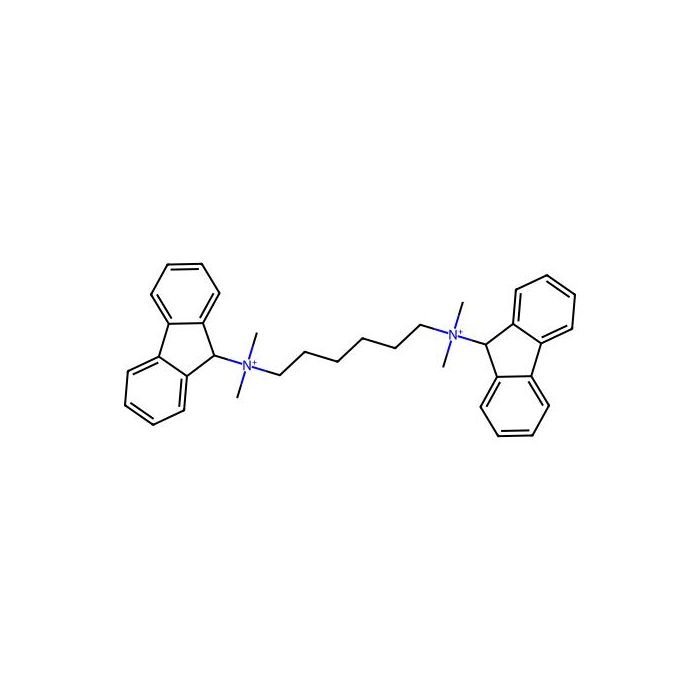
| Direct Parent | Hexamethonium compounds |
| Alternative Parents | Fluorenes Aralkylamines Tetraalkylammonium salts Organopnictogen compounds Organic salts Hydrocarbon derivatives Organic cations |
| Molecular Framework | Aromatic homopolycyclic compounds |
| Substituents | Hexamethonium - Fluorene - Aralkylamine - Benzenoid - Tetraalkylammonium salt - Organopnictogen compound - Hydrocarbon derivative - Organic salt - Amine - Organic cation - Aromatic homopolycyclic compound |
| Description | This compound belongs to the class of organic compounds known as hexamethonium compounds. These are organic compounds containing a N,N,N,N',N',N'-hexamethylhexane-1,6-diaminium moiety. |
| External Descriptors | Not available |
| Activity Type | Relation | Activity value | Units | Action Type | Journal | PubMed Id | doi | Assay Aladdin ID |
|---|
| Activity Type | Relation | Activity value | Units | Action Type | Journal | PubMed Id | doi | Assay Aladdin ID |
|---|
| Activity Type | Relation | Activity value | Units | Action Type | Journal | PubMed Id | doi | Assay Aladdin ID |
|---|
| Activity Type | Relation | Activity value | Units | Action Type | Journal | PubMed Id | doi | Assay Aladdin ID |
|---|
| Activity Type | Relation | Activity value | Units | Action Type | Journal | PubMed Id | doi | Assay Aladdin ID |
|---|
| Activity Type | Relation | Activity value | Units | Action Type | Journal | PubMed Id | doi | Assay Aladdin ID |
|---|
| Activity Type | Relation | Activity value | Units | Action Type | Journal | PubMed Id | doi | Assay Aladdin ID |
|---|
| Activity Type | Relation | Activity value | Units | Action Type | Journal | PubMed Id | doi | Assay Aladdin ID |
|---|
| Activity Type | Relation | Activity value | Units | Action Type | Journal | PubMed Id | doi | Assay Aladdin ID |
|---|
| Activity Type | Relation | Activity value | Units | Action Type | Journal | PubMed Id | doi | Assay Aladdin ID |
|---|
| Activity Type | Relation | Activity value | Units | Action Type | Journal | PubMed Id | doi | Assay Aladdin ID |
|---|
| Activity Type | Relation | Activity value | Units | Action Type | Journal | PubMed Id | doi | Assay Aladdin ID |
|---|
| Activity Type | Relation | Activity value | Units | Action Type | Journal | PubMed Id | doi | Assay Aladdin ID |
|---|
| Activity Type | Relation | Activity value | Units | Action Type | Journal | PubMed Id | doi | Assay Aladdin ID |
|---|
| Activity Type | Relation | Activity value | Units | Action Type | Journal | PubMed Id | doi | Assay Aladdin ID |
|---|
| Activity Type | Relation | Activity value | Units | Action Type | Journal | PubMed Id | doi | Assay Aladdin ID |
|---|
| Activity Type | Relation | Activity value | Units | Action Type | Journal | PubMed Id | doi | Assay Aladdin ID |
|---|
| Activity Type | Relation | Activity value | Units | Action Type | Journal | PubMed Id | doi | Assay Aladdin ID |
|---|
| Activity Type | Relation | Activity value | Units | Action Type | Journal | PubMed Id | doi | Assay Aladdin ID |
|---|
| Activity Type | Relation | Activity value | Units | Action Type | Journal | PubMed Id | doi | Assay Aladdin ID |
|---|
| Activity Type | Relation | Activity value | Units | Action Type | Journal | PubMed Id | doi | Assay Aladdin ID |
|---|
| Activity Type | Relation | Activity value | Units | Action Type | Journal | PubMed Id | doi | Assay Aladdin ID |
|---|
| Activity Type | Relation | Activity value | Units | Action Type | Journal | PubMed Id | doi | Assay Aladdin ID |
|---|
| Activity Type | Relation | Activity value | Units | Action Type | Journal | PubMed Id | doi | Assay Aladdin ID |
|---|
| Activity Type | Relation | Activity value | Units | Action Type | Journal | PubMed Id | doi | Assay Aladdin ID |
|---|
| Activity Type | Relation | Activity value | Units | Action Type | Journal | PubMed Id | doi | Assay Aladdin ID |
|---|
| Molecular Weight | 502.700 g/mol |
|---|---|
| XLogP3 | 7.600 |
| Hydrogen Bond Donor Count | 0 |
| Hydrogen Bond Acceptor Count | 0 |
| Rotatable Bond Count | 9 |
| Exact Mass | 502.335 Da |
| Monoisotopic Mass | 502.335 Da |
| Topological Polar Surface Area | 0.000 Ų |
| Heavy Atom Count | 38 |
| Formal Charge | 2 |
| Complexity | 663.000 |
| Isotope Atom Count | 0 |
| Defined Atom Stereocenter Count | 0 |
| Undefined Atom Stereocenter Count | 0 |
| Defined Bond Stereocenter Count | 0 |
| Undefined Bond Stereocenter Count | 0 |
| The total count of all stereochemical bonds | 0 |
| Covalently-Bonded Unit Count | 1 |
No tested applications or recommended dilutions are provided for this item.
General laboratory guidance (tool compound context):
For analytical use:
Please contact technical support with your intended application to receive tailored protocol suggestions.
Item-specific biological details are not provided in the Product Data. The following reflects general, literature-level context for quaternary ammonium tool compounds such as hexafluronium, for research use only.
Important notes:
This product is not a buffering agent and is not typically used to prepare buffer systems.
Practical guidance (general):
Item-specific buffer recipes, pKa data, and buffering ranges do not apply to this compound.
Green chemistry considerations for quaternary ammonium salts focus on solvent selection, process mass intensity, and aquatic toxicity.
Comparison (general guidance):
Operational tips:
No excipient or pharmacopeial status is provided for this item, and it is offered strictly for research use only.
General formulation context (not specific to this SKU):
Compliance notes:
If you require a certified reference material (CRM) or pharmacopeial-grade standard, please contact us with your regulatory requirements.
Item-specific specifications have not been provided in the Product Data. Use the CoA/Spec Sheet for definitive values measured for this lot.
Important: For use-planning and safety, rely on the item’s CoA/Spec Sheet and SDS rather than literature generalizations.
Item-specific quality attributes have not been provided in the Product Data.
Guidance (general chemistry knowledge):
Best practices:
Hexafluronium is most commonly used as a research tool compound rather than as a synthetic intermediate. Item-specific application notes are not provided; the following are general considerations for quaternary ammonium salts.
Applications (general chemistry knowledge):
Analytical/assay tips:
Not typical uses:
Manufacturer applications: Not specified for this item; if you require application verification (bioassay type, reference protocols), contact technical support with your intended use.
No item-specific reaction conditions are provided for this SKU. Hexafluronium is typically a target compound/tool rather than a reagent.
General handling and solution preparation (good laboratory practice):
If employing quaternary ammonium salts in catalysis or ion-pair applications (literature guidance):
Always validate any new protocol with a pilot experiment and refer to the SDS and CoA for compatibility limits.
Follow institutional chemical hygiene practices when handling quaternary ammonium salts and consult the SDS for authoritative guidance.
General precautions for cationic surfactant-like, quaternary ammonium compounds (general chemistry knowledge):
Note: Ethers’ peroxide risk, pyrophoricity, etc., do not apply here; the compound class is ionic/quaternary ammonium.
Hexafluronium, as a bis-quaternary ammonium salt, is expected to be highly polar and generally water/aqueous-buffer compatible (general chemistry knowledge). Item-specific solubility for this SKU is not provided—confirm with small-scale tests.
Solubility/miscibility tendencies (general):
Selection tips:
Quick comparison (general):
Always confirm solubility and stability by a small test, UV, or LC before scaling.
Storage conditions for this SKU per Product Data:
General guidance for quaternary ammonium salts:
Reconstitution (general):
Note: Any item-specific attributes such as hydrate form, counterion identity, and water content are not specified here; consult the CoA/Spec Sheet for precise handling directions.
Hexafluronium is a synthetic small-molecule, quaternary ammonium-type compound commonly encountered as a halide salt in research settings.
Structural features (general chemistry knowledge):
Notes:
Hexafluronium is not commonly used as a building block for multistep synthesis because its nitrogen centers are fully quaternized and therefore inert to typical nucleophilic/electrophilic transformations.
General roles for quaternary ammonium salts in synthesis (literature):
Limitations:
If your intent is synthetic manipulation, consider using a tertiary amine precursor or structurally related neutral analogs amenable to quaternization in a later step.
Target/epitope specificity, clone/isotype, and species reactivity are applicable to biological macromolecules (e.g., antibodies), not small molecules. For this product (a small-molecule quaternary ammonium compound), no target specificity data are provided in the Product Data.