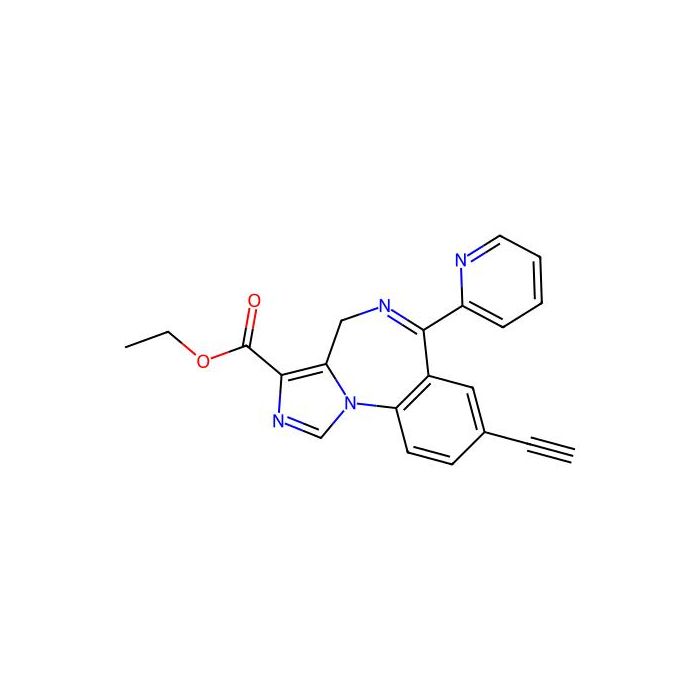
This compound belongs to the class of organic compounds known as imidazo[1,5-a][1,4]benzodiazepines. These are compounds containing an imidazole ring and a 1,4-benzodiazepine ring system, both sharing one nitrogen atom.
External Descriptors
Not available
1. Djoumbou Feunang Y, Eisner R, Knox C, Chepelev L, Hastings J, Owen G, Fahy E, Steinbeck C, Subramanian S, Bolton E, Greiner R, and Wishart DS. ClassyFire: Automated Chemical Classification With A Comprehensive, Computable Taxonomy. Journal of Cheminformatics, 2016, 8:61.
Determine the necessary mass, volume, or concentration for preparing a solution.
Dilution Calculator
Determine the dilution needed to prepare a stock solution.
Reconstitution Calculator
Reviews
Customer Reviews
Application Protocols
Item-specific
No tested applications, assay types, or recommended dilutions are provided for this product.
General guidance (for small-molecule research standards)
Stock preparation: Accurately weigh under low humidity if hygroscopicity is suspected. Dissolve in DMSO to a convenient concentration (e.g., 10–50 mM; establish empirically). Vortex and, if necessary, brief sonication. Filter through 0.22 µm for sterile applications.
Working solutions: Dilute into assay buffer or media, maintaining vehicle percentages compatible with the system (commonly ≤0.1–1% DMSO). Prepare fresh daily unless stability is verified.
Storage of aliquots: Keep frozen at −20 °C or below; avoid repeated freeze–thaw cycles by aliquoting single-use volumes.
Documentation: Record lot number, exact concentrations, vehicle composition, and preparation date on each aliquot and in your ELN.
Validation steps
Verify identity/purity by LC–MS and HPLC prior to critical experiments.
If quantitative readouts are required, consider qNMR or extinction-coefficient determination for accurate concentration assignment.
Reminder
All procedures should be validated within your laboratory context; this product is for research use only.
Biological Roles
Scope note: This listing does not include biological target or pathway information for HZ-166. The following guidance is general and intended for planning laboratory research with small-molecule probes.
Item-specific
No target, pathway, or mode-of-action details are specified. For research use only.
General considerations when using small-molecule ligands in biology
Confirm the compound’s identity, form (free base/salt), and purity prior to biological testing to ensure accurate dosing (µM or ng/mL).
Establish a working concentration range via preliminary cytotoxicity/viability screens in the specific cell system to define solvent tolerance and exposure windows.
Assess compound stability in relevant media (pH, serum content) and adsorption to plastics; consider glassware or carrier proteins if nonspecific binding is high.
Evaluate metabolic stability in microsomes/S9 or plasma if pharmacokinetic profiling is intended in preclinical models.
Documentation and reproducibility
Record lot numbers, exact solvent and dilution schemes, and final vehicle percentages in all assays.
Where literature reports exist for CAS 612527-56-7, cite them distinctly as literature references and do not treat them as catalog specifications.
Compliance
This product is not for human or veterinary use. Follow institutional biosafety and chemical hygiene plans when incorporating small molecules into biological experiments.
Buffer Applications
Relevance: HZ-166 is a small organic compound and not a classical buffering agent. Nevertheless, preparation of assay solutions often involves buffers.
Item-specific
No buffer-related specifications are provided.
Practical guidance (general)
Prepare a concentrated stock in DMSO (e.g., 10–50 mM as appropriate for your assay; set empirically) and dilute into the assay buffer, keeping final DMSO ≤0.1–1% v/v to maintain cell/tissue compatibility.
Common biological buffers: PBS (pH 7.2–7.4), HBSS, HEPES-buffered saline (pH 7.2–7.6). Verify compound stability across the intended pH range.
For low-solubility compounds, consider co-solvent systems (DMSO + PEG400 + water) or cyclodextrin carriers; validate that the vehicle does not perturb the readout.
Filter sterilize diluted working solutions using 0.22 µm PVDF/nylon filters if sterility is required; verify no significant adsorption losses.
Analytical buffers (LC)
Start with water/ACN or water/MeOH with 0.1% formic acid (for positive-ion LC–MS) or 5–10 mM ammonium acetate (neutral/negative mode). Confirm retention, peak shape, and ionization.
Note
Report buffer compositions and vehicle percentages explicitly in methods to ensure reproducibility. Do not treat any of the above as item specifications; these are general best practices.
Green Alternatives
Green chemistry considerations focus primarily on solvent and process choices, as the active compound identity is fixed by research needs.
Item-specific
No green-specific information or stabilizers are indicated for this item.
Greener solvent choices (general guidance)
For stock solutions and analytics, consider:
Ethanol over methanol when feasible (lower toxicity, bio-based supply routes available).
2-Methyltetrahydrofuran (2-MeTHF) or ethyl acetate instead of dichloromethane for extractions/preparative steps.
Water–ACN gradients in LC rather than water–MeOH when ACN recovery/reuse is established at your site—or vice versa if methanol’s lower environmental footprint at your facility is validated.
For lyophilization or film formation, use minimal solvent volumes and recover solvents via established recycling streams.
Comparison (illustrative; general)
Parameter | Traditional choice | Greener alternative | Trade-offs
Scale reactions and purifications appropriately to reduce waste.
Use microscale solubility and stability screens to avoid unnecessary solvent consumption.
Caveat
Ensure the compound’s stability and assay performance are preserved when substituting solvents; verify analytically.
Pharmaceutical Uses
Scope note: No pharmacopeial status or formulation role is provided for HZ-166 in this listing. The product is for research use only and is not intended for human or veterinary applications.
Item-specific
Regulatory/compendial status: Not specified for this item; refer to CoA/Spec Sheet.
Formulation/excipient role: Not specified for this item.
General research/manufacturing context (non-clinical)
In preclinical or discovery settings, small molecules like HZ-166 may be employed as reference standards, tool compounds, or analytical calibrators in method development and QC for in vitro studies.
For solid-dosage prototype research (non-clinical), consider basic preformulation tests: solubility in biorelevant media (FaSSIF/FeSSIF), pH–solubility profile, and stability screening to inform salt/solid-form selection—only if such work is within institutional non-clinical scope.
For PK studies in animals (institutional approval required), vehicle systems may include PEG400/saline, Captisol, or CMC suspensions; ensure ethical approval and adhere strictly to local regulations. Document that compound use is research-only.
Documentation
Maintain full traceability (lot/CoA/SDS) and do not use this material for GMP manufacturing or any clinical application.
Caveat
Avoid implying therapeutic claims in publications or reports based on this catalog entry; reference primary literature where appropriate and label as such.
Physical Properties
Practical note: This listing does not include item-specific physicochemical data. Use the CoA/SDS or verified literature for method development and handling limits.
Item-specific (from Product Data)
Appearance: Not specified for this item; refer to CoA/Spec Sheet.
Molecular weight: Not specified for this item; refer to CoA/Spec Sheet.
Literature/computed properties (do not treat as specifications)
Melting point (literature): Not specified here; consult primary references for CAS 612527-56-7.
Boiling point (literature): Not typically applicable for complex research ligands; consult references if needed.
LogP/logD (literature): Often required for assay planning; derive from curated databases or compute (e.g., ALOGPS) and document as “predicted.”
pKa (literature/computed): If ionizable centers are present, estimate via software and confirm experimentally for buffer selection.
Aqueous solubility (literature): Frequently low for hydrophobic ligands; measure empirically for your lot if critical.
UV–Vis λmax/ε (literature): If quantitative UV assay is planned, acquire a spectrum in the intended solvent and report extinction coefficients as method-specific.
Practical considerations (general)
Begin with a small-scale solubility screen in DMSO, DMF, MeOH, and acetonitrile; verify clarity and stability at experimental temperatures.
If hygroscopicity or solvates are suspected, perform Karl Fischer and TGA on receipt (as needed for quantitative work).
Always distinguish your measured values from catalog specifications in documentation.
Quality and Grades
Quality notes for HZ-166 (research chemical):
Item-specific (from Product Data)
Grade/Purity: Not specified for this item; refer to CoA/Spec Sheet.
How to interpret unspecified grade
When grade is not listed, treat the material as a research-grade small molecule suitable for discovery workflows and non-clinical experiments. Do not use for clinical, diagnostic, or GMP manufacturing applications.
What to check on the CoA/Spec Sheet (recommendations)
Identity confirmation: Typically by NMR and/or LC–MS; review acceptance criteria for retention time and mass accuracy.
Assay/purity method: HPLC/UPLC area% or qNMR; note any stated thresholds and method conditions (column, gradient, detection wavelength).
Residual solvents / volatiles: GC or KF moisture if provided; if not, evaluate in-house when critical for quantitative studies.
Counter-ions / form: Free base vs. salt, solvate/hydrate content; this impacts molecular weight and dosing calculations.
Stabilizers: If any stabilizer or antioxidant is present, it should be declared on the CoA; none are specified in this listing.
Practical implications
For bioassays or analytical standards, consider an independent identity/purity check (LC–MS and 1H NMR) upon receipt.
If UV-based quantification is planned, verify low background at relevant wavelengths and confirm extinction coefficients experimentally.
Document any in-house specifications distinctly from catalog data to maintain clear traceability.
Reaction and Applications
Scope note: HZ-166 is typically utilized as a research small molecule/analytical standard rather than as a synthetic reagent or building block. Reaction-driven applications are generally limited.
Item-specific (from Product Data)
Manufacturer application text is not provided; no specific transformations are claimed.
When reactions may be relevant (general)
If HZ-166 is to be derivatized for probe development (e.g., biotinylation, fluorophore conjugation), reaction planning must be guided by the confirmed functional groups after reviewing the structure from CoA/literature.
Stability screens: Before attempting coupling or protection reactions, assess chemical stability toward acids/bases, nucleophiles, and oxidants to avoid degradation of the core scaffold.
Non-reaction applications (typical for such items)
Use as a reference compound in binding or functional assays, or as a calibrator in LC–MS analytics, after verifying identity and purity.
Method-development control for chromatography or spectrophotometry to bracket retention times and detector responses.
Practical tips (general)
For analytical use, prepare gravimetrically quantified stock solutions using Class A glassware; verify concentration by LC–UV or qNMR where appropriate.
If synthetic modification is intended, obtain a full analytical package (1H/13C NMR, HRMS, HPLC) and document any changes to counter-ions or solvation state during workup and purification.
Note
In the absence of declared functional groups, avoid presuming compatibility with specific named reactions.
Reaction Conditions
Scope note: No reaction conditions are specified for HZ-166 in this listing. The compound is generally used as a research standard or tool molecule rather than a reagent.
Item-specific
No named reactions, catalysts, or transformation conditions are claimed.
General guidance (only if derivatization is planned after confirming structure from CoA/literature)
Solvents: Start with anhydrous DCM, DMF, DMSO, MeCN, 2-MeTHF as compatible media depending on solubility.
Temperatures: Screen 0–25 °C for sensitive transformations; elevate (50–100 °C) cautiously if stability allows, with LC–MS monitoring.
Atmosphere: Use N2/Ar for air- or moisture-sensitive motifs; dry glassware and reagents.
Times: Begin with short trials (0.5–2 h) and expand as guided by analytics; quench carefully and work up with minimal aqueous exposure if hydrolysis is observed.
Yields: Establish expectations empirically; literature yields for CAS 612527-56-7 (if available) should be cited explicitly as literature and not as item specs.
Stability checks
Perform stress testing (acid/base, oxidation, light) to define handling windows for any chemical modification.
Documentation
Record all derivatization steps distinctly from the supplied material to preserve traceability and avoid conflating modified analogs with the catalog item.
Safety and Handling
Safety overview: Definitive hazard classification for HZ-166 is not provided in this listing. Handle as a potentially hazardous laboratory chemical under a conservative risk posture.
Item-specific (from Product Data)
GHS signal word: Not specified for this item; refer to SDS.
H-statements: Not specified for this item; refer to SDS.
GHS classification/pictograms: Not specified for this item; refer to SDS.
Research Use Note: For research use only.
General laboratory precautions (not a substitute for SDS)
Wear appropriate PPE: lab coat, safety glasses, and chemically resistant gloves (e.g., nitrile). Use in a chemical fume hood to avoid inhalation exposure.
Avoid skin/eye contact and ingestion; prevent aerosol or dust formation during weighing or transfers.
Incompatibilities are unknown from this listing; segregate from strong oxidizers, strong acids/bases, and ignition sources until SDS guidance is reviewed.
First-aid overview: In case of skin/eye contact, rinse with water for ≥15 minutes; if inhaled, move to fresh air; if swallowed, seek medical attention. Provide SDS to responders.
Spill and waste
For small spills, absorb with inert material, collect in appropriate waste container, and ventilate area. Dispose of as organic laboratory waste following local regulations.
Transport/storage integrity
Shipped cold; maintain cold chain. Avoid repeated freeze–thaw of solutions. Always defer to the official SDS for authoritative hazard and response information.
Solvent Selection
Solvent strategy when structural/solubility data are not specified:
Item-specific (from Product Data)
No solvent recommendations provided; select empirically based on your application.
General solvent selection workflow (for small-molecule research ligands)
Prepare screening aliquots (1–2 mg) and test dissolution at room temperature in:
DMSO (first choice for bioassays; excellent solvency, miscible with water upon dilution)
DMF (high solvency; use for stock solutions not directly added to cells without dilution)
Acetonitrile, methanol, ethanol (HPLC-compatible; moderate to good solvency)
Ethyl acetate, THF/2-MeTHF (for synthetic or preparative work)
For aqueous systems, dissolve in DMSO (e.g., 10–50 mM) and dilute into buffer keeping final DMSO ≤0.1–1% v/v as assay-compatible.
Miscibility and polarity considerations (general)
If the compound is hydrophobic (common for receptor ligands), anticipate negligible direct aqueous solubility and rely on co-solvents or cyclodextrin complexation.
For chromatographic method development, start with MeOH/H2O or ACN/H2O mobile phases with 0.1% formic acid or ammonium buffers as appropriate; confirm analyte stability.
Comparative notes
Prefer DMSO for long-term concentrated stocks; choose MeOH/ACN for LC compatibility and rapid drying; use 2-MeTHF/EtOAc when prioritizing greener profiles in non-aqueous workflows.
Verification
Always inspect solutions for clarity/precipitation over 24 h and across intended temperature ranges; record empirical solubility data in ELN.
Reconstitution guidance (general; not item-specific specifications)
Allow container to equilibrate to room temperature in a desiccator before opening to minimize moisture condensation.
Prepare concentrated stocks in anhydrous DMSO or another suitable solvent after confirming solubility. Aim for convenient multiples (e.g., 10, 25, or 50 mM) for assay dilutions.
Filter sterilize through 0.22 µm if aseptic use is required. Dispense into single-use aliquots in inert, solvent-resistant vials or microtubes.
Solution storage (general)
Store aliquots at −20 °C or below, protected from light if the compound is chromophoric (verify experimentally). Label with concentration, solvent, date, and lot number.
Avoid repeated freeze–thaw; thaw once, keep on ice during use, and discard leftovers if stability is unverified.
Solid stability considerations
If hygroscopicity or oxidation sensitivity is suspected, handle under dry inert atmosphere and include desiccant/oxygen scavenger in secondary containment.
Documentation
Record all reconstitution details in your ELN and retain the CoA/SDS with the received lot. Where exact solubility or stability values are required, determine them experimentally for your application.
Structure and Identity
Brief overview: HZ-166 is supplied for research use only; detailed structural identifiers are limited in this listing. Key registry numbers are provided to enable unambiguous lookup in external databases and CoA/SDS.
Item-specific (from Product Data)
SKU: H978244
Product Name: HZ-166
CAS: 612527-56-7
PubChem CID: 10309028
InChIKey: 465168 (as provided)
SMILES: Not specified for this item; refer to CoA/Spec Sheet.
Molecular formula: Not specified for this item; refer to CoA/Spec Sheet.
Molecular weight: Not specified for this item; refer to CoA/Spec Sheet.
Literature/registry context (for CAS 612527-56-7)
Additional identifiers (full InChIKey, canonical SMILES, formula, and exact mass) are typically available in public databases (e.g., PubChem; CID 10309028). Consult those sources or the Aladdin CoA for definitive values. Label such values as “literature” in reports, distinct from item-specific specifications.
Structural features (general guidance)
Without an item-specific structure depiction in this listing, describe the molecule in reports using its CAS and CID. If needed, retrieve a 2D structure from a curated database and confirm consistency with the supplied CAS number before use in cheminformatics or inventory systems.
Stereochemistry/tautomerism
Not specified for this item; verify any reported stereocenters or tautomeric preferences via primary literature or CoA/SDS before quantitative work or docking studies.
Synthetic Utility
Relevance: HZ-166 is offered as a finished research chemical; no functional-group information is provided in this listing. As such, it is generally not positioned as a synthetic building block.
Item-specific
No reactive-handle details, protecting-group schemes, or derivatization notes are provided.
General guidance if derivatization is contemplated
Obtain the definitive structure (from CoA/literature) and map potential handles (e.g., amines, phenols, halides) before planning cross-couplings, acylations, or linker installations.
Evaluate chemical stability under common conditions: acids/bases, nucleophiles/electrophiles, oxidants/reductants, and heat. Run micro-scale trials with LC–MS monitoring.
If the target contains multiple heteroatoms, anticipate site-selectivity challenges; consider protective strategies and orthogonal activation where necessary.
Purification/analytics (general)
Use reverse-phase preparative HPLC or normal-phase chromatography depending on polarity; confirm identity by HRMS and purity by HPLC (≥95% area% typically targeted for probes; set your own spec as needed).
Track potential tautomerism or salt/solvate formation across steps, as these affect dosing accuracy and spectral interpretation.
Retrosynthetic value
Without declared functional groups, no specific named-reaction guidance can be provided for this compound. Treat any literature synthesis routes for CAS 612527-56-7 as references and not as catalog specifications.
Target Specificity
Item-specific
No antigen/epitope, enzyme/receptor, clone, isotype, or species reactivity information is provided for this product.
Note
This section typically applies to biological macromolecules (e.g., antibodies) or well-annotated tool compounds with declared targets. As no target data are provided here, consult primary literature for CAS 612527-56-7 if mechanistic context is required, and clearly cite such information as literature rather than catalog specification.
We use cookies to ensure the website functions properly and, where permitted, to improve your experience. You can manage your preferences at any time in Settings. Learn more in our Cookie Policy.
Shall we send you a message when we have discounts available?
Remind me later
Thank you! Please check your email inbox to confirm.
Products are supplied to verified businesses, institutions, and qualified professionals for research and development use only. Not for use in humans, animals, diagnosis, or therapy.