Determine the necessary mass, volume, or concentration for preparing a solution.
≥98%(HPLC) for sensitive chromatographic and analytical workflows requiring minimal baseline interference.
Store at -20°C Ships Ice chest + Ice pads Check lot-specific COA for exact specifications.
SDS, COA, datasheet, and spec sheet available for download. Lot-specific COA accessible via lot number lookup.
Cited in 0 peer-reviewed publications across chromatography, organic synthesis, and cross-coupling reactions.
Comprehensive hazard, handling, storage, and regulatory compliance document.
Download SDS →Lot-specific quality data. Enter your lot number to retrieve the exact COA.
Look up COA →Full quality attributes and acceptance criteria for this grade.
View spec sheet →Taxonomy Tree
| Kingdom | Organic compounds |
|---|---|
| Superclass | Benzenoids |
| Class | Benzene and substituted derivatives |
| Subclass | Benzenesulfonamides |
| Intermediate Tree Nodes | Not available |
| Direct Parent | Benzenesulfonamides |
| Alternative Parents | Benzenesulfonyl compounds Dichlorobenzenes Organosulfonamides Aryl chlorides Aminosulfonyl compounds Dialkyldisulfides Sulfenyl compounds Organonitrogen compounds Organochlorides Organic oxides Hydrocarbon derivatives |
| Molecular Framework | Aromatic homomonocyclic compounds |
| Substituents | Benzenesulfonamide - Benzenesulfonyl group - 1,4-dichlorobenzene - Chlorobenzene - Halobenzene - Aryl chloride - Aryl halide - Organosulfonic acid amide - Organic sulfonic acid or derivatives - Organosulfonic acid or derivatives - Aminosulfonyl compound - Sulfonyl - Organic disulfide - Dialkyldisulfide - Sulfenyl compound - Organosulfur compound - Organonitrogen compound - Organochloride - Organohalogen compound - Hydrocarbon derivative - Organic nitrogen compound - Organic oxygen compound - Organic oxide - Aromatic homomonocyclic compound |
| Description | This compound belongs to the class of organic compounds known as benzenesulfonamides. These are organic compounds containing a sulfonamide group that is S-linked to a benzene ring. |
| External Descriptors | Not available |
Find and download the COA for your product by matching the lot number on the packaging.
| Lot Number | Certificate Type | Date | Item |
|---|---|---|---|
| Certificate of Analysis | Dec 16, 2024 | K286569 | |
| Certificate of Analysis | Dec 16, 2024 | K286569 | |
| Certificate of Analysis | Dec 16, 2024 | K286569 | |
| Certificate of Analysis | Oct 10, 2024 | K286569 | |
| Certificate of Analysis | Oct 10, 2024 | K286569 | |
| Certificate of Analysis | Feb 12, 2022 | K286569 | |
| Certificate of Analysis | Feb 12, 2022 | K286569 |
| Solubility | Solvent:DMSO, Max Conc. mg/mL: 57.04, Max Conc. mM: 100 |
|---|---|
| Sensitivity | Air sensitive |
| Molecular Weight | 570.400 g/mol |
| XLogP3 | 4.700 |
| Hydrogen Bond Donor Count | 2 |
| Hydrogen Bond Acceptor Count | 8 |
| Rotatable Bond Count | 11 |
| Exact Mass | 569.872 Da |
| Monoisotopic Mass | 567.875 Da |
| Topological Polar Surface Area | 160.000 Ų |
| Heavy Atom Count | 30 |
| Formal Charge | 0 |
| Complexity | 671.000 |
| Isotope Atom Count | 0 |
| Defined Atom Stereocenter Count | 0 |
| Undefined Atom Stereocenter Count | 0 |
| Defined Bond Stereocenter Count | 0 |
| Undefined Bond Stereocenter Count | 0 |
| The total count of all stereochemical bonds | 0 |
| Covalently-Bonded Unit Count | 1 |
No vendor-validated application protocols are provided for this item. The following is general, target-agnostic guidance for handling small-molecule library members in research settings. Adjust to your assay and compound behavior.
Stock solution preparation (general):
Assay use (general):
Stability checks:
Note: For any protocol claims specific to KC7F2, consult the CoA/Spec Sheet or peer-reviewed literature tied to this CAS/CID.
Item-specific biological targets, pathways, or modes of action for KC7F2 are not provided in the product data. No claims are made here regarding biological activity or therapeutic relevance.
General considerations for small-molecule library members:
Note: All uses are for research only. Any biological role or mechanism should be supported by primary literature and/or vendor documentation specific to KC7F2 (CAS 927822-86-4; CID 16047442). Absent such data, do not infer function.
KC7F2 is a discrete small molecule, not a buffering reagent. As such, it does not form part of a conventional buffer system.
For preparation of standard biological buffers or electrophoresis systems, refer to established recipes; KC7F2 does not substitute for buffer components.
Because KC7F2 is a discrete small-molecule library member rather than a process solvent or commodity reagent, the concept of a “green alternative” is generally not applicable to the compound itself. However, greener choices can be made in how the compound is handled and formulated.
Greener handling considerations (general):
Comparison of common stock solvents (general):
Conclusion: Optimize solvent systems and dispensing technologies to lower environmental impact without altering the identity of KC7F2.
No pharmacopeial status, excipient role, or manufacturing application is provided for KC7F2 in the product data. This product is supplied strictly for research use only.
General guidance (non-clinical, non-therapeutic):
Important: Do not use this product as a drug substance, excipient, or for any clinical application. No GMP status is implied or claimed. For any movement toward regulated development, new sourcing, full CMC characterization, and quality system controls would be required.
The product data does not supply item-specific physicochemical parameters.
Item-specific values:
General guidance (literature/practice for screening compounds):
Note: For definitive physical property values for KC7F2, consult the CoA/Spec Sheet or the SDS. Do not assume values from unrelated compounds.
Interpretation and context:
Recommendations:
This product is cataloged as a small-molecule library component for research use. No item-specific reactivity profile or synthetic application notes are provided.
Applications (general for small-molecule probes/collection members):
Not provided for this item:
Practical tips (general):
Always tailor application development to verified structural and purity information from the CoA.
No reaction condition guidance is applicable to KC7F2 as a reagent, because it is offered as a discrete library compound with no specified role in chemical transformations.
General notes (if using in assay solution preparation):
For any use in synthetic chemistry, first obtain structure-specific data and consult primary literature or conduct small-scale feasibility tests.
Safety overview for KC7F2 is constrained by limited hazard data in the product listing. Treat as a research chemical of unknown hazards and follow prudent laboratory practices.
GHS/Classification (item-specific):
General laboratory precautions (good practice):
Always consult the product-specific SDS for authoritative guidance before use.
Item-specific solubility data are not provided for KC7F2. The following is general guidance for small-molecule screening compounds and should be verified experimentally.
General approach:
Comparison (typical considerations):
Note: Confirm solution stability (e.g., by UPLC at t0/t24 at room temperature and 4 °C) to ensure no precipitation or degradation.
Item-specific guidance from Product Data:
Additional best practices (general for small molecules):
Reconstitution (general guidance):
Disposal: Dispose of unused solutions and solids as organic chemical waste per institutional and local regulations.
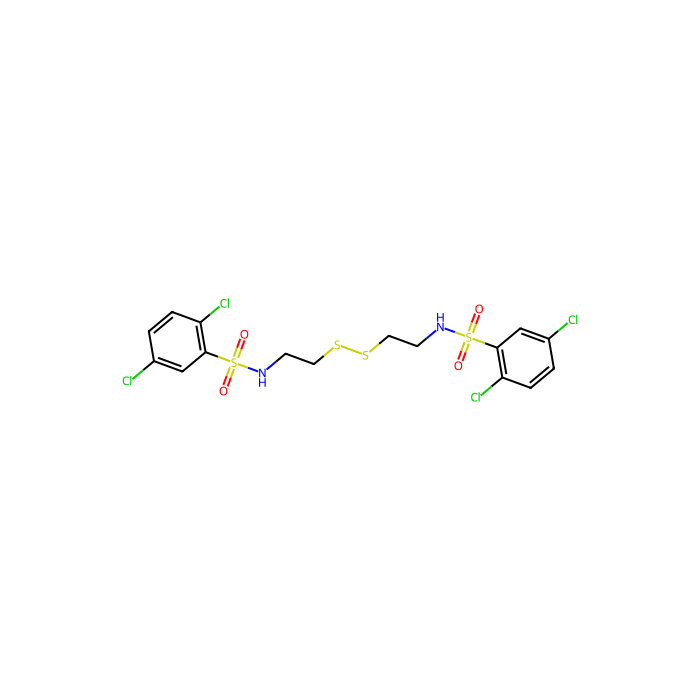
Brief overview: KC7F2 is listed as a small-molecule library component. The supplied product data does not include a chemical name, structure, or elemental composition.
Structural features (general note):
2D structure description:
KC7F2 is listed as a small-molecule library member rather than a synthetic reagent or building block. Without structural information, it is not appropriate to ascribe functional-group reactivity or named-reaction participation.
If a synthetic application is intended, obtain the full structure (e.g., from PubChem CID 16047442) and evaluate compatibility with your planned transformations. Confirm stability in proposed reaction media before scale-up.
Item-specific biological target(s), selectivity profile, and mechanism of action for KC7F2 are not provided in the product data.
Recommendation: If using KC7F2 in mechanistic studies, run orthogonal assays and include target engagement experiments (e.g., CETSA, DARTS, biochemical kinetics) to support any specificity claims.