
Determine the necessary mass, volume, or concentration for preparing a solution.
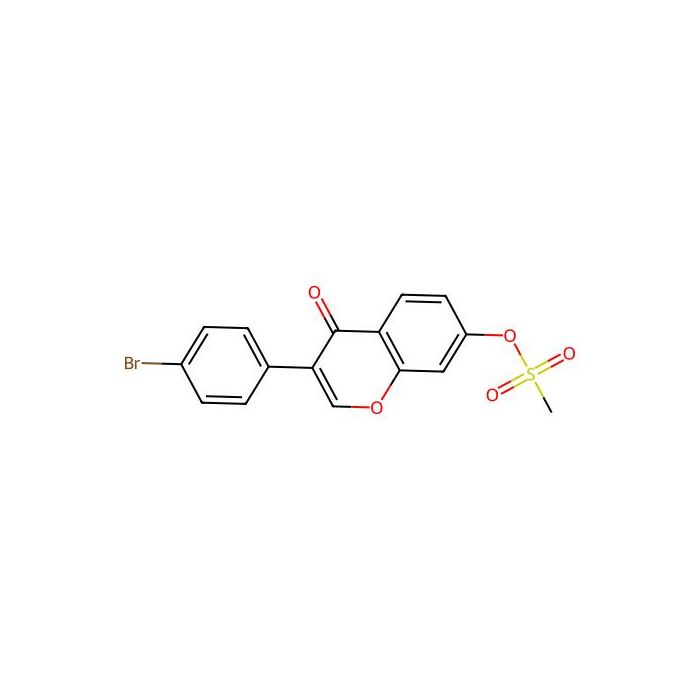
KIN101 - ≥99% , CAS No.610753-87-2
AVAILABLE TO ORDER
GRADE & PURITY ≥99%
Storage
Store at -20°C
Shipped In
Ice chest + Ice pads
KIN101 is a potent RNA viral inhibitor with IC 50 s of 2 μM, >5 μM for influenza virus and Dengue virus (DNV), respectively. KIN101, an isoflavone agonist of IRF-3 dependent signaling, induces IRF-3 nuclear translocation. KIN101 has broad-spectrum activity against RNA viruses
In Vitro
KIN 101 (10 μM; 24 hours) causes a significant decrease in the NP protein abundance. KIN 101 (10 μM; 18 hours) shows a >1 log decrease in HCV RNA levels. KIN 101 (0.01, 0.1, 1, 10, 100 μM) has a significant and dose-dependent effect on the formation of foci and has an IC 50 of 0.2 μM. KIN 101 (5, 10, 20, 50 μM; 4 hours) causes a dose-dependent decrease in influenza virus infection in MRC5 cells. KIN 101 results in a significant increase in the levels of ISGs as well as other proteins downstream of IRF activation such as RIG-I and MDA5. KIN101 (0.1-100 μM; 18 hours) shows the antiviral activity against hepatitis C virus (HCV). MCE has not independently confirmed the accuracy of these methods. They are for reference only. Western Blot AnalysisCell Line: MRC5 cells Concentration: 10 μM Incubation Time: 24 hours Result: Caused a significant decrease in the NP protein abundance. RT-PCRCell Line: Huh7 cells Concentration: 10 μM Incubation Time: 18 hours Result: Showed a >1 log decrease in HCV RNA levels.
Form:Solid
IC50& Target:IC50: 2 μM (influenza virus) and >5 μM (DNV)
Taxonomy Tree
| Kingdom | Organic compounds |
|---|---|
| Superclass | Phenylpropanoids and polyketides |
| Class | Isoflavonoids |
| Subclass | Isoflav-2-enes |
| Intermediate Tree Nodes | Not available |
| Direct Parent | Isoflavones |
| Alternative Parents | Chromones Pyranones and derivatives Bromobenzenes Sulfonic acid esters Organosulfonic acid esters Aryl bromides Sulfonyls Methanesulfonates Heteroaromatic compounds Oxacyclic compounds Organooxygen compounds Organobromides Organic oxides Hydrocarbon derivatives |
| Molecular Framework | Aromatic heteropolycyclic compounds |
| Substituents | Isoflavone - Chromone - Benzopyran - 1-benzopyran - Bromobenzene - Halobenzene - Pyranone - Organosulfonic acid ester - Sulfonic acid ester - Pyran - Aryl halide - Benzenoid - Monocyclic benzene moiety - Aryl bromide - Heteroaromatic compound - Sulfonyl - Organosulfonic acid or derivatives - Organic sulfonic acid or derivatives - Methanesulfonate - Oxacycle - Organoheterocyclic compound - Organosulfur compound - Hydrocarbon derivative - Organic oxide - Organic oxygen compound - Organohalogen compound - Organobromide - Organooxygen compound - Aromatic heteropolycyclic compound |
| Description | This compound belongs to the class of organic compounds known as isoflavones. These are polycyclic compounds containing a 2-isoflavene skeleton which bears a ketone group at the C4 carbon atom. |
| External Descriptors | Not available |
| Solubility | DMSO : 41.67 mg/mL (105.43 mM; ultrasonic and warming and heat to 60°C) |
|---|---|
| Molecular Weight | 395.2 |
| XLogP3 | 3.400 |
| Hydrogen Bond Donor Count | 0 |
| Hydrogen Bond Acceptor Count | 5 |
| Rotatable Bond Count | 3 |
| Exact Mass | 393.951 Da |
| Monoisotopic Mass | 393.951 Da |
| Topological Polar Surface Area | 78.100 Ų |
| Heavy Atom Count | 23 |
| Formal Charge | 0 |
| Complexity | 586.000 |
| Isotope Atom Count | 0 |
| Defined Atom Stereocenter Count | 0 |
| Undefined Atom Stereocenter Count | 0 |
| Defined Bond Stereocenter Count | 0 |
| Undefined Bond Stereocenter Count | 0 |
| The total count of all stereochemical bonds | 0 |
| Covalently-Bonded Unit Count | 1 |