GRADE & PURITYAnimal Free?Animal-free — produced without animal-derived components to reduce contamination risk. Use in biomanufacturing and culture avoiding animal-origin material.Carrier Free?Carrier-free — supplied without added carrier protein/stabilizer. Use when carriers (e.g. BSA) would interfere with conjugation or sensitive assays.ExactAb™?ExactAb™ — Aladdin's antibody line emphasizing precision and validated quality. Use for reliable, specificity-validated antibody applications.Azide Free?Azide-free — without sodium azide preservative. Use in conjugations, cell work, or assays where azide is toxic or inhibitory.Validated?Validated grade — performance confirmed in defined applications before release. Use when you want documented assurance the reagent works as stated.High Performance?High-performance grade with optimized purity and performance characteristics. Use for sensitive analyses where ordinary grades fall short.PBS Only?PBS-only formulation — supplied in phosphate-buffered saline with no other additives. Use when you need a clean PBS buffer free of stabilizers/carriers.≥95%(SDS-PAGE)1.0 mg/mL
Single-stranded DNA-dependent ATP-dependent helicase that plays a key role in DNA non-homologous end joining (NHEJ) by recruiting DNA-PK to DNA.Required for double-strand break repair and V(D)J recombination.Also has a role in chromosome translocation.Has
Any detailed WB, IF, IHC, IP protocols and dilution ranges must be taken from the official datasheet for SKU Ab302043.
Biological Roles
Target context (general biology of Ku70/XRCC6; not product performance claims):
Ku70 (XRCC6) is a nuclear DNA-end-binding protein that heterodimerizes with Ku80 (XRCC5) to form the Ku complex, a core component of the non-homologous end joining (NHEJ) DNA double-strand break repair pathway (literature).
Functions (literature/general):
Binds to DNA double-strand break ends, recruiting and stabilizing DNA-PKcs, facilitating synapsis and end processing.
Participates in V(D)J recombination by supporting end-joining machinery.
Interacts with proteins involved in apoptosis regulation and telomere maintenance; can modulate response to genotoxic stress.
Cellular localization: Predominantly nuclear; can associate with chromatin and DNA damage foci. Upon damage, Ku70 rapidly accumulates at breaks (observed in numerous cell systems; literature).
Expression: Broadly expressed in mammalian cells; levels may vary with cell cycle and DNA damage conditions.
Experimental implications (general):
Antibodies against Ku70 are commonly used as nuclear markers and as tools to monitor DNA damage response pathways.
Co-detection with Ku80 and DNA-PKcs can map NHEJ complex assembly dynamics.
Buffer Applications
From Product Data: PBS Only formulation. Exact pH/ionic strength not specified for this item; refer to CoA/Spec Sheet.
Practical guidance (general):
Working buffer: Phosphate-buffered saline (PBS), pH ~7.2–7.6 (literature typical). Use low endotoxin, sterile-filtered solutions for cell-associated assays.
Additives: Because this product is Carrier Free and Azide Free, maintain sterility and consider single-use aliquots. If adsorption losses are problematic in high-dilution assays, low-bind plastics or minimal inert protein additives may help, but adding carriers changes the formulation.
Detergents: For cell/nuclear extraction, nonionic detergents (e.g., 0.1–0.5% Triton X-100) are often used in sample prep, not in the antibody vial; confirm compatibility with your assay.
Buffer exchange (general):
For conjugation or specialized assays, buffer exchange into amine-free or metal-chelator-free buffers may be required. Use spin desalting, dialysis, or diafiltration. Validate recovery to avoid loss with carrier-free proteins.
Storage buffers: See Storage & Reconstitution for guidance. Do not add azide unless your assay and safety policies permit and you accept the change from the supplied “Azide Free” grade.
Green Alternatives
While green chemistry typically targets solvent/process choices, considerations for antibody reagents focus on safety, sustainability, and waste minimization.
Azide-free benefit:
Removing sodium azide reduces acute aquatic toxicity and hazards in HRP-based assays and tissue culture environments. Tradeoff: Requires strict aseptic handling to prevent microbial growth.
Animal-free production:
Animal-free workflows can reduce environmental and ethical impacts associated with animal-derived supplements and may improve lot-to-lot consistency.
Cold-chain optimization:
Shipments on ice (per Product Data) minimize dry ice use. Consolidate orders and use right-sized secondary packaging to reduce waste.
Ready-to-use buffer versus rebuffering:
“PBS Only” lessens the need for buffer exchange, cutting plastic consumables and buffer waste. If buffer exchange is required (e.g., for conjugation), consider reusable dialysis cassettes or diafiltration setups.
Comparison (general):
Preservatives: Sodium azide vs. azide-free
Pros (azide): Robust microbial suppression; Cons: Toxicity, incompatibility with HRP and metal piping.
Pros (azide-free): Safer for HRP/live cells; Cons: Demands aseptic technique and aliquoting.
This product is supplied strictly for research use only (per Product Data). It is not intended for diagnostic, therapeutic, or clinical manufacturing use.
Monoclonal antibodies in PBS are commonly used as analytical reagents in bioprocess development and quality control assays, not as excipients.
“Carrier Free” and “Azide Free” formats are preferred when chemical conjugation (e.g., to enzymes or fluorophores) is required for analytical assays.
Pharmacopeial/compendial status: Not specified for this item; refer to CoA/Spec Sheet if applicable.
GMP/clinical suitability: Not specified and not implied. This SKU is intended for laboratory research workflows only.
Physical Properties
As a protein reagent, classical small-molecule physical constants are not directly applicable. Item-specific numeric properties have not been provided.
Appearance: Not specified for this item; refer to CoA/Spec Sheet.
Formulation: Grade indicates “PBS Only; Azide Free; Carrier Free” (see Quality & Grades). Exact buffer composition, pH, and protein concentration: Not specified for this item; refer to CoA/Spec Sheet.
Molecular weight: Not specified for this item; refer to CoA/Spec Sheet. (Literature: typical mouse IgG ~150 kDa; exact mass depends on isotype and glycosylation.)
Solubility (general): Readily soluble in aqueous buffers (PBS, TBS) at working concentrations (literature/general). Avoid organic solvents and extremes of pH to maintain activity.
Isoelectric point (pI): Isotype- and sequence-dependent (literature range ~6–9 for IgG); item-specific pI not specified.
Stability (general): Antibodies are temperature- and freeze–thaw–sensitive; stability enhanced by storage at recommended temperatures, minimizing protease and microbial contamination (literature/general).
UV characteristics (general): Protein A280 absorbance with ε dependent on sequence; item-specific extinction coefficient not specified.
Quality and Grades
This antibody is supplied with multiple grade/designation attributes. The following explains their practical implications for advanced users:
What these mean (general definitions; consult CoA for item-specific test values):
Animal Free: Produced without animal-derived supplements during manufacturing; helps reduce variability and animal-origin contaminants.
Carrier Free: No proteins such as BSA, gelatin, or other stabilizing carriers are added. Advantages: clean backgrounds in WB/IF, compatibility with conjugation. Tradeoff: may require careful handling to avoid adsorption losses.
Azide Free: No sodium azide preservative. Safer for HRP-based assays and live-cell applications sensitive to azide. Requires sterile technique and cold-chain integrity to mitigate bioburden.
ExactAb™: Branded performance designation; typically denotes lot-to-lot reproducibility and stringent characterization. Exact acceptance criteria are not specified for this item; refer to CoA/Spec Sheet.
Validated, High Performance: Indicates internal verification against defined applications/controls. Specific assays, species reactivity, and performance metrics are not specified for this item.
PBS Only: Supplied in phosphate-buffered saline. Precise pH, ionic strength, and excipients are not specified.
Purity/Grade percent values, residuals, and UV cutoffs: Not specified for this item; refer to CoA/Spec Sheet.
Reaction and Applications
For antibodies, “applications” refer to immunoassays and protein-detection workflows rather than chemical reactions.
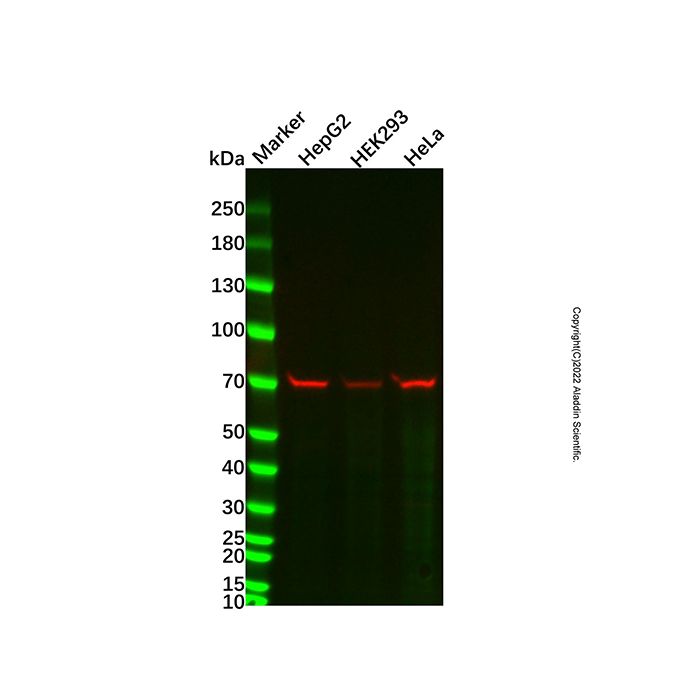
Antigen: Ku70 (XRCC6) inferred from product name. Specific tested applications are not provided for this item; the following are general use-cases for Ku70 antibodies (literature/general):
Western blotting (WB): Detection of Ku70 in nuclear extracts; observe appropriate nuclear protein loading controls.
Immunoprecipitation (IP)/Co-IP: Enrichment of Ku70 and Ku70/Ku80 complexes; use nuclease-treated lysates to reduce DNA-mediated bridging.
ChIP-related workflows: If epitope accommodates, may be used to enrich Ku70-bound chromatin; stringency and crosslinking conditions must be optimized.
Practical tips (general):
Ku70 is abundant in many cell types; nuclear extraction buffers (with mild detergent and salt) can improve signal-to-noise.
DNase treatment of lysates can disrupt nonspecific DNA bridging of protein complexes, improving specificity in IP/Co-IP.
Validate secondary antibodies against the correct mouse isotype (isotype not specified for this item; verify on CoA).
Note: The manufacturer-validated applications, dilutions, and species reactivity for SKU Ab302043 are not specified; consult the CoA/Spec Sheet.
Reaction Conditions
Classical reaction conditions (solvent, temperature, catalysts) are not applicable. For immunoassay workflows, general condition ranges are provided for context only (not item-specific performance claims):
Sample preparation (general):
Lysis buffers: RIPA or nuclear extraction buffers at 4°C with protease/phosphatase inhibitors for preserving protein complexes.
DNA/RNA considerations: DNase treatment can reduce nucleic acid-mediated nonspecific interactions in Ku70 IP experiments.
Incubation conditions (general):
WB/IF/IHC primary incubations typically 1–16 h at 4–25°C depending on assay format and antibody affinity.
IP incubations often 1–4 h at 4°C with gentle rotation.
Wash buffers (general):
TBS-T or PBS-T for WB/IF; increasing ionic strength and mild detergents can reduce background.
Expected outcomes and yields: Assay- and protocol-dependent; no item-specific performance data are provided. Optimize empirically.
Note: Validated applications, recommended dilutions, and optimal conditions for SKU Ab302043 are not specified; consult the CoA/Spec Sheet.
Safety and Handling
GHS classification, pictograms, signal word, H-statements: Not specified for this item; refer to the product SDS for authoritative safety information.
Research Use: For research use only (per Product Data). Not for diagnostic or therapeutic use.
Biosafety considerations (general):
Mouse monoclonal antibody in PBS; “Azide Free” minimizes acute toxicity risks associated with sodium azide but can increase risk of microbial growth—use aseptic technique.
“Animal Free” manufacturing reduces adventitious agent concerns from animal-derived supplements (general), but standard BSL-1 practices still apply unless your protocols dictate otherwise.
Handling and PPE (general best practice):
Wear lab coat, nitrile gloves, and safety glasses. Avoid ingestion and aerosolization. Handle in a clean area to prevent contamination.
Incompatibilities (general):
Avoid strong oxidizers and extremes of pH or temperature that can denature proteins. Avoid repeated freeze–thaw cycles (explicit in Product Data).
First aid (general):
Skin/eye contact: Rinse with water. Ingestion/inhalation: Seek medical attention per institutional policy. Provide SDS to healthcare personnel.
Spill/cleanup (general):
Absorb with inert material, wash area with suitable disinfectant, dispose per institutional bio/chemical waste procedures.
Solvent Selection
Not a conventional small-molecule reagent; as a protein, this monoclonal antibody is formulated for aqueous buffers.
Applicability: Organic solvent selection is not typically relevant. Use compatible physiological buffers.
From Product Data: PBS Only (formulation). Avoid diluting into incompatible buffers without pilot testing.
General buffer compatibility (literature/general):
Preferred: PBS, TBS, or assay-specific buffers at neutral pH; maintain isotonicity to preserve structure.
Avoid: High concentrations of organic solvents, strong acids/bases, or detergents unless validated for your assay.
Additives (general notes):
Carrier-free format favors downstream conjugations. If needed, low concentrations of inert protein (e.g., 0.1–1 mg/mL BSA) can reduce adsorption losses, but this conflicts with “carrier free” requirements—only add if your workflow demands it.
Preservatives: Azide-free formulation means sterility must be maintained by technique or single-use aliquots rather than chemical preservatives.
Storage and Reconstitution
Storage conditions (from Product Data): Store at -20°C. Avoid repeated freezing and thawing.
Shipping (from Product Data): Shipped in an ice chest with ice pads to maintain cold chain.
Format-specific notes: Appearance and concentration are not specified for this item; confirm whether the product is supplied as a liquid or lyophilized.
General best practices (supplementary guidance; verify against your lab’s SOPs and the CoA):
Upon receipt: Inspect integrity of secondary containment and temperature indicators. Briefly centrifuge the vial to collect contents before opening.
Aliquoting: Because the product is Azide Free and Carrier Free, prepare single-use aliquots in sterile, low-bind tubes to prevent contamination and adsorption losses. Keep on ice during handling.
Freeze–thaw: Minimize cycles. If repeated access is required, aliquot accordingly. Avoid frost-free freezers.
Short-term storage: For frequent use over several days, many labs hold working aliquots at 2–8°C; however, the item’s specified long-term storage is -20°C. Follow the CoA if it provides different short-term guidance.
Reconstitution: If supplied lyophilized (not specified), reconstitute with sterile PBS or assay buffer to the desired concentration, gently invert to mix; avoid vigorous vortexing and foaming. Allow to equilibrate at 2–8°C before use.
Stabilization (optional, general): If adsorption is problematic, low concentrations of inert protein or sugars can improve stability, but this alters the Carrier Free status—only add if necessary for your workflow.
Documentation: Record lot number and create an aliquot map to support traceability.
Structure and Identity
Professional-grade mouse monoclonal antibody directed against Ku70 (also known as XRCC6). Item-specific structural identifiers (small-molecule style) are not applicable to proteins/antibodies.
Item-specific identifiers from Product Data:
CAS: Not specified for this item; refer to CoA/Spec Sheet.
CID: Not specified for this item; refer to CoA/Spec Sheet.
InChIKey: Not applicable to macromolecular antibodies.
SMILES: Not applicable to macromolecular antibodies.
Molecular formula: Not specified for this item; refer to CoA/Spec Sheet.
Molecular weight: Not specified for this item; refer to CoA/Spec Sheet.
Typical IgG monoclonal antibodies are Y‑shaped, ~150 kDa (literature, varies by isotype), composed of two heavy and two light chains with disulfide bonds.
Contains variable domains (VH/VL) forming the paratope that recognizes the Ku70 epitope; constant domains define isotype and Fc effector functions (isotype not specified for this item).
Post-translational modifications (e.g., glycosylation) are common in the Fc region of mammalian IgG (literature).
Antigen/Target from Product Name: Ku70 (XRCC6). Epitope, clone ID, and species reactivity: Not specified for this item; refer to CoA/Spec Sheet.
Synthetic Utility
Not applicable in the classical organic synthesis sense. As a monoclonal antibody, this reagent functions as a selective binding protein for biochemical detection and enrichment.
Relevant laboratory utilities (general):
Affinity capture of Ku70 and associated complexes (IP/Co-IP) from cell or tissue lysates.
As a capture or detection antibody in immunoassays (ELISA-like formats) after appropriate conjugation.
Probe in imaging assays to localize Ku70 within cells or tissues.
For chemical building-block or catalyst roles, this product is not typically used. Refer instead to Reaction & Applications for immunoassay-focused uses.
Target Specificity
Only information from Product Data is provided here.
Antigen/Target: Ku70 (XRCC6), inferred from the product name “Ku70 Mouse mAb”.
Host/Isotype: Mouse monoclonal; specific isotype not specified for this item; refer to CoA/Spec Sheet.
Clone ID: Not specified for this item; refer to CoA/Spec Sheet.
Epitope: Not specified for this item; refer to CoA/Spec Sheet.
Species reactivity: Not specified for this item; refer to CoA/Spec Sheet.
Cross-reactivity: Not specified for this item; refer to CoA/Spec Sheet.
Conjugate: None specified; appears unconjugated. Confirm on CoA/Spec Sheet.
Frequently Asked Questions
What is the purity of this product, and how is it determined?
This product is supplied at ≥95% purity, determined by SDS-PAGE. Lot-specific values are stated on the Certificate of Analysis.
How should this product be stored?
Store at ?20 °C. Avoid repeated freeze–thaw cycles. Aliquot into single-use volumes before freezing.
What does Animal Free mean?
Animal Free indicates that the material has been processed and tested for specialty industrial processing. Specifications focus on the impurities that affect performance in that application — for example, metal content for electronics, particle size for batteries, refractive index for optics, or moisture content for moisture-sensitive processes.
What does Carrier Free mean?
Carrier Free indicates that the material has been processed and tested for specialty industrial processing. Specifications focus on the impurities that affect performance in that application — for example, metal content for electronics, particle size for batteries, refractive index for optics, or moisture content for moisture-sensitive processes.
How is this product shipped?
This product ships in an insulated container with ice pads. Unpack on arrival and transfer it to the storage condition stated above.
What documentation is provided?
Available product documentation, including Certificates of Analysis (COA), Safety Data Sheets (SDS), and specification sheets, is shown in the product document area. Document availability and access follow the current site policy.
Which species reactivity has this antibody been validated against?
Validated reactivity is listed on the PDP and on each lot's datasheet. We validate against the most commonly tested species for the target (Ku70 Mouse mAb); cross-reactivity in untested species may exist but is not guaranteed. Contact technical support for specific species inquiries.
Need help choosing the grade?
Our grade selection guide covers purity, stabilizer status, and application suitability for all variants in our catalog.
We use cookies to ensure the website functions properly and, where permitted, to improve your experience. You can manage your preferences at any time in Settings. Learn more in our Cookie Policy.
Shall we send you a message when we have discounts available?
Remind me later
Thank you! Please check your email inbox to confirm.
Products are supplied to verified businesses, institutions, and qualified professionals for research and development use only. Not for use in humans, animals, diagnosis, or therapy.