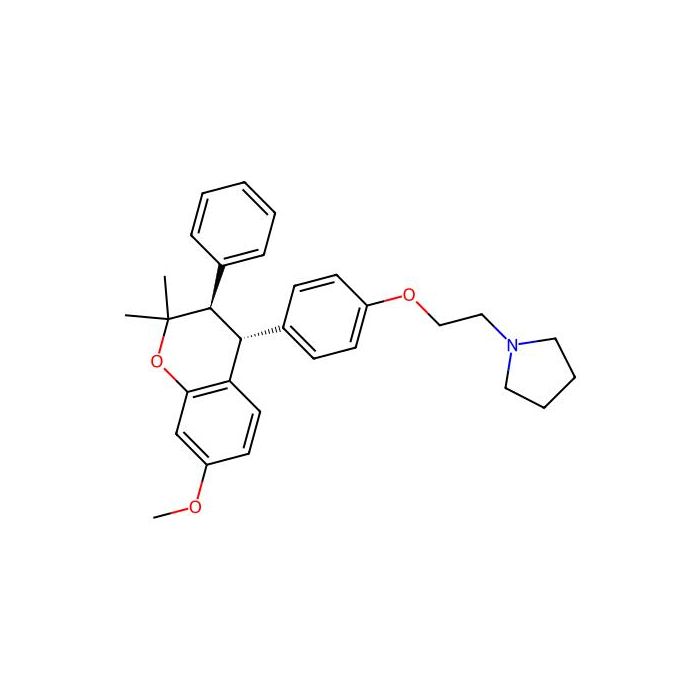
This compound belongs to the class of organic compounds known as 7-o-methylated isoflavonoids. These are isoflavonoids with methoxy groups attached to the C7 atom of the isoflavonoid backbone. Isoflavonoids are natural products derived from 3-phenylchromen-4-one.
External Descriptors
Not available
1. Djoumbou Feunang Y, Eisner R, Knox C, Chepelev L, Hastings J, Owen G, Fahy E, Steinbeck C, Subramanian S, Bolton E, Greiner R, and Wishart DS. ClassyFire: Automated Chemical Classification With A Comprehensive, Computable Taxonomy. Journal of Cheminformatics, 2016, 8:61.
Determine the necessary mass, volume, or concentration for preparing a solution.
Dilution Calculator
Determine the dilution needed to prepare a stock solution.
Reconstitution Calculator
Reviews
Customer Reviews
Application Protocols
Item-specific tested applications: Not provided in Product Data.
General research protocols (literature/practice; adjust to your system)
Cell-based reporter assay (ERE-luc)
Prepare 10 mM DMSO stock; store aliquots at −20 °C, protected from light.
Plate ER-responsive cells transfected with ERE-luciferase. Treat with serial dilutions (e.g., 0.01–10 μM final; DMSO ≤0.1%). Include vehicle and positive-control ligand controls.
Incubate 16–24 h; quantify luciferase activity; normalize to protein/DNA or cotransfection control.
Competitive binding assay (ER LBD)
Incubate purified ER LBD with fluorescent/radiolabeled tracer and varying concentrations of test ligand in binding buffer (e.g., HEPES, 150 mM NaCl, 1 mM DTT, 0.01% Tween-20).
Determine Ki via displacement curves (fit to appropriate binding model). Validate with a known reference SERM.
LC–MS reference standard use
Prepare calibration standards in MeOH or MeCN/H2O with 0.1% formic acid. Use matrix-matched calibration for biological samples. Monitor multiple reaction monitoring (MRM) transitions optimized empirically.
Note: Conditions are illustrative and should be optimized for each laboratory system. Follow institutional safety and waste protocols.
Biological Roles
Literature/General (research context; no clinical claims)
Target class: Selective estrogen receptor modulator (SERM) engaging ERα and ERβ. Acts as a ligand that differentially modulates receptor conformation, promoting tissue- and promoter-selective transcriptional outcomes in model systems.
Mechanism outline: Ligand binding alters ER LBD conformation (helix 12 positioning), impacting coactivator/corepressor recruitment. In cell-based assays, centchroman-class ligands can show antagonist behavior in some contexts and partial agonism in others, characteristic of SERMs.
Downstream readouts: Changes in estrogen response element (ERE)-driven reporter activity, modulation of ER target gene mRNA/protein levels, and shifts in chromatin recruitment patterns (e.g., ChIP-qPCR/ChIP-seq) provide quantitative measures of activity.
ADME considerations for in vitro work: High lipophilicity, strong protein binding, and lysosomal sequestration potential can influence apparent potency and kinetics. Use time-course and washout experiments to interpret pharmacodynamics in cells.
Metabolism (in vitro): O-demethylation and N-dealkylation are common oxidative pathways observed with tertiary-amine SERMs in microsomes; generate standards of putative metabolites to deconvolute signals in LC–MS experiments.
Note: Values such as Ki, EC50, or logP vary across systems and are not specified for this item; consult primary literature for your exact assay conditions.
Buffer Applications
Not typically applicable.
L-Centchroman is a hydrophobic small-molecule ligand, not a buffering reagent. It does not form classical buffer systems.
For biological assays, prepare stocks in DMSO and dilute into pre-selected buffers or cell culture media. If enhanced aqueous solubility is required, consider forming a defined acid salt or using solubilizing excipients (e.g., cyclodextrins), validating that these do not confound the assay.
Green Alternatives
Context: Selection of solvents and processes for handling a hydrophobic tertiary amine (centchroman-class) in synthesis and analytical sample prep.
Greener solvent choices (literature/principles)
Replace chlorinated solvents (CH2Cl2/CHCl3) with 2-MeTHF or ethyl acetate for extractions and nonpolar chromatographic steps; both offer lower toxicity and better environmental profiles.
Use ethanol or isopropanol as co-solvents instead of acetonitrile or methanol where feasible in prep-scale crystallizations or recrystallizations.
For biological stock solutions, minimize DMSO by preparing a buffered aqueous solution of a defined salt (e.g., citrate), provided the experimental design tolerates protonated form.
Comparison (general)
CH2Cl2 vs 2-MeTHF: 2-MeTHF has higher boiling point, renewable feedstock, and comparable solvency for lipophilic amines; may require longer evaporation times.
MeCN vs EtOH/H2O: EtOH/H2O can be viable for RP-HPLC preparative work; MeCN typically affords sharper peaks analytically but has higher life-cycle impact.
Solid handling: Favor salt formation (e.g., HCl, p-toluenesulfonate) to improve crystallinity and reduce reliance on large solvent volumes for trituration.
Operational tips
Implement microscale DoE to identify the lowest-impact solvent delivering required solubility/selectivity.
Capture and recycle high-purity solvents (DMSO, MeCN) when used in significant volumes.
Pharmaceutical Uses
Item-specific
No pharmacopeial grade or excipient role is specified for this item; refer to CoA/Spec Sheet.
Role in R&D: Employed as a reference standard for analytical method development and as a tool compound for estrogen receptor pathway research. Also used in impurity profiling and stability-indicating studies for SERM-class substances.
Form considerations: The free base is hydrophobic; salt forms (e.g., hydrochloride, citrate) are often used to improve crystallinity, solubility, and handling in formulation research. Selection of counterion affects hygroscopicity and dissolution.
Quality expectations: For use as a reference standard, identity/purity should be confirmed by orthogonal methods (NMR, HRMS, HPLC). Document storage, lot traceability, and stability per good laboratory practice.
No therapeutic or clinical claims are made; this product is supplied strictly for research use only.
Physical Properties
Item-specific (from Product Data)
Appearance: Not specified for this item; refer to CoA/Spec Sheet.
Molecular formula: Not specified for this item; refer to CoA/Spec Sheet.
Molecular weight: Not specified for this item; refer to CoA/Spec Sheet.
Literature/General (typical values for centchroman/ormeloxifene; for reference only)
Physical state: Organic solid; hydrophobic; typically crystalline when purified.
Solubility profile: Practically insoluble in water; soluble in polar aprotic organics (DMSO, DMF) and moderately soluble in alcohols (MeOH, EtOH) and chlorinated solvents (CH2Cl2, CHCl3). Diluents such as PEG400 or cyclodextrins are often used to enhance aqueous handling (analytical/biological assays).
Acid–base behavior: Contains a tertiary amine (basic) that readily forms salts with mineral or organic acids; phenoxy/methoxy groups are neutral; chroman oxygen is non-basic.
Partitioning: Highly lipophilic (high logP reported in literature for analogs); expect strong adsorption to hydrophobic plastics—use glass where possible.
UV/Vis: Strong aromatic absorbance in UV region; useful for HPLC-UV detection (literature).
Note: Do not treat the above as specifications for SKU L693956; consult the item’s CoA/SDS for definitive properties.
Quality and Grades
Item-specific (from Product Data)
Grade/Purity: Not specified for this item; refer to CoA/Spec Sheet.
Guidance on grades (general)
Research grade small molecules are typically supplied at high chemical purity (e.g., ≥95% by HPLC/GC/NMR) appropriate for discovery chemistry, analytical method development, and mechanistic biology. Exact assay method and acceptance criteria should be verified on the CoA.
Stabilizers: None specified for this item. Centchroman-class materials are generally stable under ambient dry conditions without stabilizers; salt forms may be used to improve handling if needed (not specified here).
Identity confirmation: Professional practice is to confirm identity by 1H/13C NMR and HRMS; HPLC purity and retention time should be consistent with literature or an internal reference standard.
Impurities: Potential process-related impurities include O-dealkylated phenols, N-oxide, or quaternized amine species (literature). Review CoA for known impurity limits if critical to your application.
Suitability: If using for quantitative cell biology or as an analytical reference, verify purity and water content (Karl Fischer) on receipt when requirements are stringent. For structure–activity studies, ensure batch-to-batch consistency via spectral overlay.
Reaction and Applications
Item-specific applications from catalog
Manufacturer applications: Not provided in Product Data.
Literature/General research uses (non-clinical)
Molecular probe: Widely used as a selective estrogen receptor modulator (SERM) in mechanistic studies of ERα/ERβ signaling, coactivator/corepressor recruitment, and gene expression modulation in cell-based assays.
Receptor binding/assays: Serves as a reference ligand for competitive binding assays, reporter gene assays (ERE-luc), and ChIP-based transcriptional profiling under SERM conditions.
Analytical reference: Employed as a reference standard in HPLC/LC–MS method development for SERM quantitation, metabolism (in vitro microsomes/S9), and stability-indicating assays.
Synthetic/derivatization context (general)
Salt formation: The tertiary amine forms stable hydrochloride/tosylate salts—useful for purification, crystallization, and improving handling.
Metabolite synthesis: O-demethylation (e.g., BBr3, AlCl3/thiols) affords phenolic metabolites; N-oxidation (peracids) or N-dealkylation routes model oxidative biotransformations.
Conjugation handles: Quaternization (MeI, MeOTf) generates permanently charged analogs for MS response tuning or affinity probes; attachment through phenolic positions (after deprotection) enables immobilization.
Practical tips: Exclude strong oxidants during handling; if performing electrophilic aromatic substitutions on the scaffold, protect the amine to control regioselectivity and avoid overalkylation.
O-Demethylation: BBr3 (1–3 equiv) in dry CH2Cl2, −78 to 0 °C, 1–6 h; quench with MeOH/H2O to afford phenols. Alternatives include AlCl3/thiophenol in refluxing toluene.
N-oxidation: mCPBA (1.1–1.5 equiv) in CH2Cl2 at 0–25 °C, 0.5–2 h, monitoring by TLC/HPLC; avoid over-oxidation.
Quaternization: MeI or MeOTf in acetonitrile/acetone at 20–50 °C, several hours to overnight; isolate quaternary ammonium salts by precipitation with ether.
Salt formation: Dissolve free base in minimal EtOAc/IPA, add HCl in IPA or p-TsOH in EtOAc; crystallize at 0–5 °C, then filter and dry under vacuum.
Analytical method development: RP-HPLC using C18, 40–80% MeCN/H2O with 0.1% formic acid or ammonium formate for MS compatibility; UV detection in near-UV region is effective for aromatic scaffolds.
Biological stock preparation: Dissolve to 10–50 mM in dry DMSO; store aliquots to avoid repeated freeze–thaw. Dilute into prewarmed media to target 0.1–10 μM working concentrations, keeping DMSO ≤0.1–0.5% v/v.
Conditions above are representative literature practices for centchroman-like tertiary amines; optimize per substrate and scale.
Safety and Handling
Item-specific (from Product Data)
GHS signal word / hazards / pictograms: Not specified for this item; refer to SDS.
General laboratory safety (literature/practice; defer to SDS for authority)
Likely hazards: Organic tertiary amines and polyaromatics may cause irritation to skin/eyes/respiratory tract; avoid inhalation of dust and contact. Handle in a fume hood.
PPE: Lab coat, safety glasses, and appropriate chemical-resistant gloves (e.g., nitrile). Avoid generating dust; use anti-static measures during weighing.
Incompatibilities: Strong oxidizing agents (risk of exotherm/oxidation). Tertiary amines can react with strong electrophiles and acylating agents. Avoid prolonged exposure to strong acids/bases unless forming a defined salt.
First aid (overview): If on skin/eyes, rinse with water for ≥15 min; remove contaminated clothing. If inhaled, move to fresh air. If ingested, rinse mouth and seek medical attention. Provide SDS to responders.
Fire safety: Combustible organic solid; use CO2, dry chemical, or foam. Combustion may produce CO/CO2/nitrogen oxides.
Environmental: Avoid release to the environment; collect spills with inert absorbent and dispose per institutional and local regulations.
Always consult the product-specific SDS for definitive classification, exposure limits, and emergency procedures.
Solvent Selection
General guidance for centchroman-type hydrophobic amines (literature/practice)
Polarity class: Nonpolar–moderately polar aromatic with a basic tertiary amine; overall lipophilic.
Recommended solvents for stock solutions: DMSO or DMF (10–50 mM typical lab stocks). Ethanol or methanol can be used for lower concentrations. For aqueous assays, dilute DMSO stocks into buffered media; limit final DMSO to ≤0.1–0.5% v/v where biological systems are used.
Solubility/miscibility: Practically insoluble in water as free base. Solubility increases upon protonation; preparing an acid salt in situ (e.g., with HCl or citrate) can enhance aqueous solubility for analytical work.
Adsorption: High hydrophobicity can cause loss to polypropylene; prefer glass vials and syringes, or precondition plastics with solvent.
Chromatography considerations: Reverse-phase HPLC with high-organic mobile phases (MeCN/H2O + 0.1% formic acid or ammonium formate) affords good retention and peak shape for tertiary amines. Additives suppress tailing by transient protonation.
Comparison (general)
DMSO: Highest solvating power; biologically tolerated at low %.
Ethanol: Volatile and convenient; limited solubility for very lipophilic bases.
MeCN: Useful for analytical dilutions; less suitable for high-concentration stocks.
2-MeTHF/EtOAc: Good for synthetic workup and extraction; not ideal for biological stocks.
Storage and Reconstitution
Item-specific (from Product Data)
Storage conditions: Room temperature.
Shipped in: Not specified for this item; refer to CoA/Spec Sheet.
General guidance (literature/practice)
Protection: Store in a tightly closed, light-resistant container in a dry place. Although ambient storage is acceptable per item data, many labs keep aliquots desiccated to minimize moisture uptake and oxidative degradation.
Reconstitution for assays: Prepare concentrated stocks (e.g., 10–50 mM) in anhydrous DMSO. Filter (PTFE, 0.22 μm) if particulate is observed. For aqueous applications, consider forming a defined acid salt or using co-solvents/excipients; verify stability and assay compatibility.
Stability: Avoid repeated freeze–thaw of solutions; aliquot upon initial dissolution. Monitor by HPLC/LC–MS for degradation (look for O-dealkylation or N-oxide byproducts in stressed samples).
Solid handling: Allow the container to equilibrate to room temperature before opening to prevent condensation. Reseal promptly and return to storage after use.
Expiry: Follow on-label shelf-life; if absent, implement periodic quality checks (e.g., annual HPLC purity verification) for long-term projects.
Structure and Identity
Item-specific (from Product Data)
SKU: L693956
Product name: L-Centchroman
CAS: 78994-23-7
InChIKey: 431214 (as provided)
Storage: Room temperature
Category: 化学和生化试剂
Research use note: For research use only
Literature/General (for reference only; not item-specific)
Synonyms: Centchroman; Ormeloxifene; 7-methoxy-2,2-dimethyl-3-phenyl-4-[4-(pyrrolidin-1-yl)ethoxy]chroman (stereochemistry: trans at 3,4 of chroman, “L-” designation per supplier naming)
Molecular class: Non-steroidal selective estrogen receptor modulator (SERM); polycyclic chroman ether with a tertiary amine side chain
Core features: Chroman (benzopyran) ring, methoxy substituent on aromatic ring, 2,2-dimethyl substitution, diaryl substitution at C-3/C-4 positions, para-pyrrolidinoethoxy side chain (tertiary amine)
2D description: A bicyclic benzopyran (chroman) fused aromatic system bearing a methoxy group on the A-ring; at C-3 a phenyl substituent and at C-4 a para-(pyrrolidinoethoxy)phenyl substituent in trans relationship; the side chain terminates in a cyclic tertiary amine (pyrrolidine).
Synthetic Utility
Literature/General
Functional groups: Chroman ether, methoxy aryl ether(s), tertiary amine (pyrrolidino), multiple aryl rings. These enable selective transformations for analog generation and probe synthesis.
Typical transformations:
O-Demethylation to phenols (BBr3, BCl3, AlCl3/thiol systems) for diversification via O-alkylation or O-acylation.
N-derivatization: Quaternization (MeI/MeOTf) for permanent cationic analogs; acylation/carbamoylation under Schotten–Baumann conditions to tune basicity and lipophilicity.
Oxidations: Formation of amine N-oxides (mCPBA) as metabolites or as synthetic handles for Polonovski-type rearrangements.
Electrophilic aromatic substitution on less deactivated rings, guided by existing substituent directing effects; protect the tertiary amine to control reactivity.
Retrosynthetic notes: Assembly commonly proceeds via chroman (benzopyran) construction and sequential aryl/side-chain installation; late-stage diversification on phenolic or amine sites is efficient for SAR exploration.
Purification: Salt formation (HCl, p-TsOH) improves crystallinity; reverse-phase chromatography helpful when mixtures contain polar byproducts from N-oxidation or quaternization.
These strategies support preparation of centchroman analogs, isotopologues, and affinity probes for mechanistic studies.
Target Specificity
Not applicable to this product type.
L-Centchroman is a small-molecule ligand, not an antibody or affinity reagent with defined species reactivity/clone/isotype.
For receptor studies, consult literature for ERα/ERβ binding characteristics and assay-specific parameters; none are specified for this item.
We use cookies to ensure the website functions properly and, where permitted, to improve your experience. You can manage your preferences at any time in Settings. Learn more in our Cookie Policy.
Shall we send you a message when we have discounts available?
Remind me later
Thank you! Please check your email inbox to confirm.
Products are supplied to verified businesses, institutions, and qualified professionals for research and development use only. Not for use in humans, animals, diagnosis, or therapy.